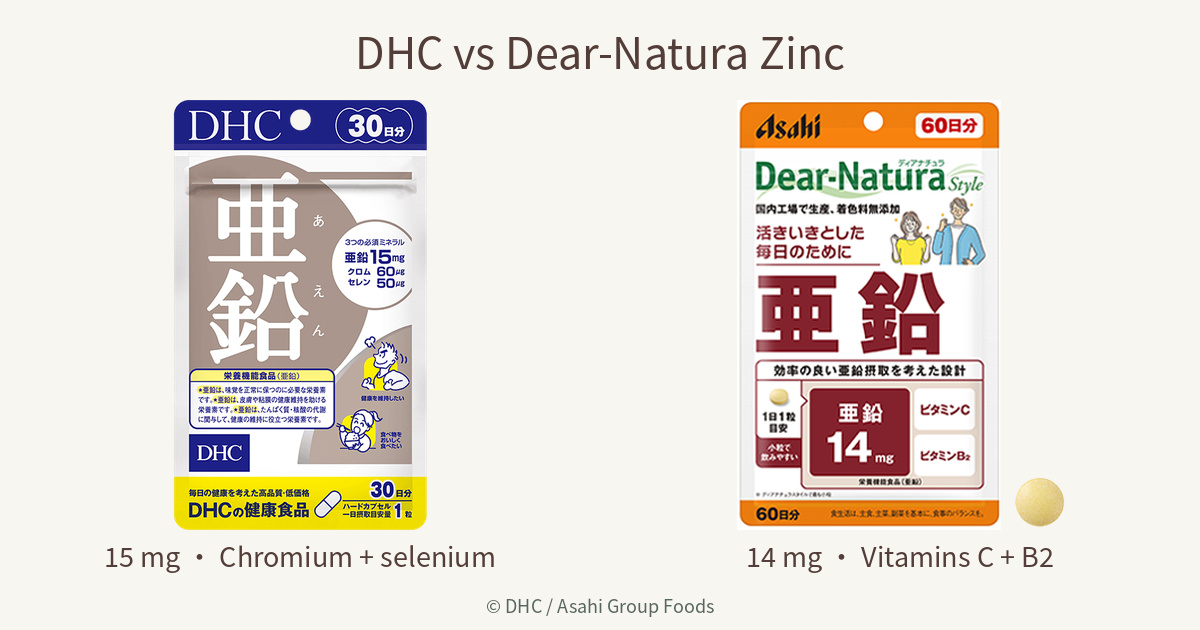
Choose between DHC Zinc and Asahi Dear-Natura Style Zinc by whether you need extra zinc, the accompanying nutrients and the dosage form. Current Japanese DHC supplies 15 mg zinc with chromium and selenium; Dear-Natura’s pouch supplies 14 mg with vitamins C and B2. A 1 mg difference does not establish which works better.

I’m Irene, a Taiwan-born, Japan-licensed pharmacist working in a Japanese drugstore. Before choosing another supplement, let’s check the multivitamin or mineral product already at home. If it contains zinc, that extra pouch may deserve a pause.
Sources checked on 19 October 2026, Japan time. This guide covers DHC Zinc 30 days and the Dear-Natura Style Zinc pouch reformulated from May 2026, not every zinc product from either brand.
- Three questions before choosing a brand
- Identify the current pouch, not just the word “zinc”
- One daily unit, two different combinations
- Already using a multivitamin? Do this calculation first
- Capsule, yellow tablet and the daily routine
- Medicines, pregnancy and allergies need their own check
- Complete nutrition and ingredient lists
- Official sources and image credits
Three questions before choosing a brand
- Already taking a mineral blend or a multivitamin with zinc? Check the combined daily amount before adding a separate zinc supplement.
- Have an identified reason to supplement zinc? Compare the extras: chromium and selenium in DHC, or C and B2 in this Dear-Natura pouch. Neither formula contains zinc alone.
- Hoping to treat ongoing fatigue, altered taste or hair loss? Seek an assessment of the cause. A nutrient’s normal role does not establish that either product will treat your symptoms.
These are not children’s zinc products. DHC excludes infants and children; Dear-Natura expressly excludes under-18s. If you are receiving treatment or taking medicines, have a doctor check the complete label before starting.
Identify the current pouch, not just the word “zinc”
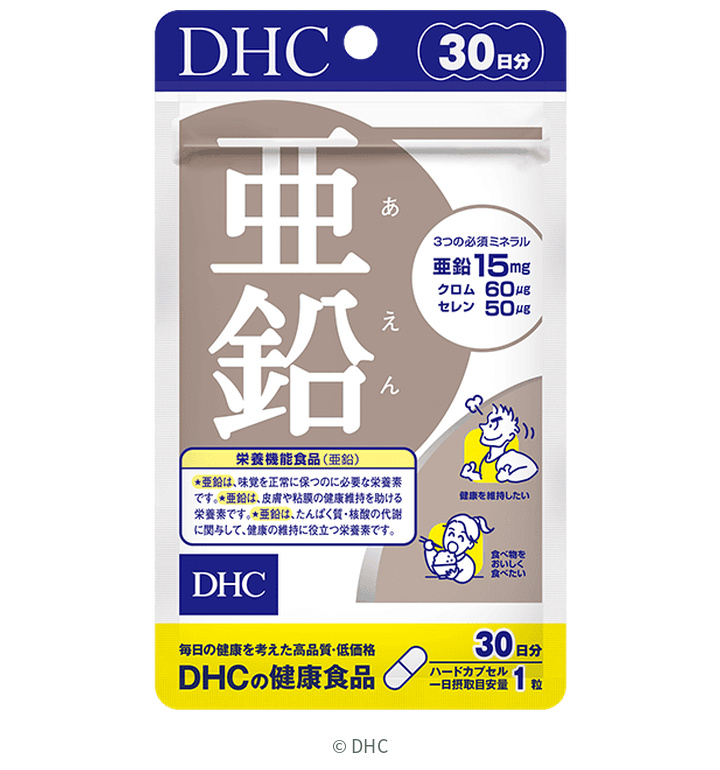
DHC: look for 亜鉛 on the grey-brown pouch. The photograph shows 30 capsules for 30 days, at one capsule daily. Directions for a similarly named DHC product sold overseas should not replace the Japanese label.
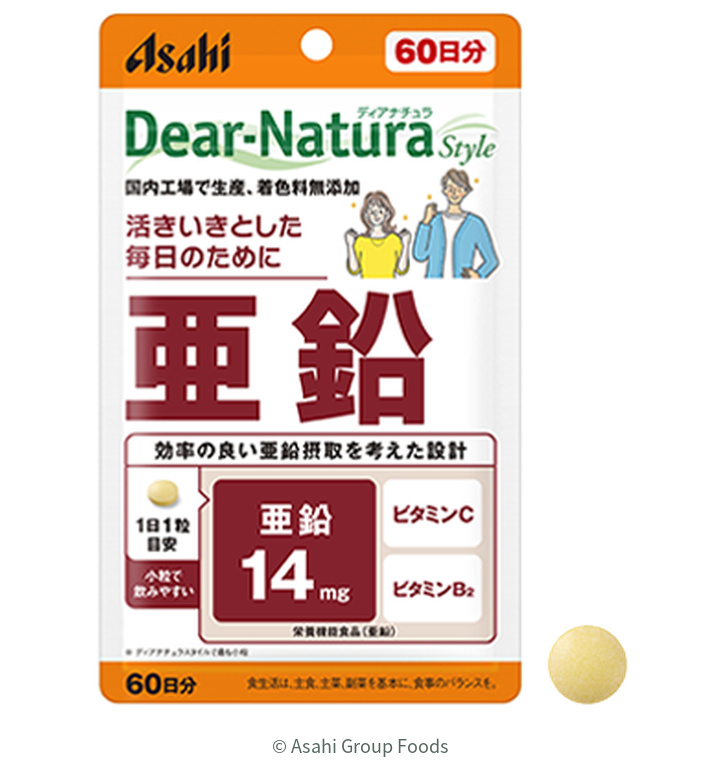
Asahi Dear-Natura Style: look for the orange top, “Style,” zinc 14 mg and the vitamin C/B₂ labels on the front. The pictured pouch contains 60 tablets for 60 days, and the yellow tablet is part of the official product image. The website also lists 20 days and a 90-day pack sold by selected online retailers; local availability varies.
From May 2026, Dear-Natura replaced maca extract with vitamins C and B2. B2 also makes the tablet yellow. The manufacturer says changeover timing varies between products. If your own pouch still lists maca (マカ), use that pouch’s complete label rather than this new-formula guide. This comparison concerns the Style pouch, not the brand’s other bottled or combination zinc products.
One daily unit, two different combinations
| Per labeled daily serving | DHC Zinc | Dear-Natura Style Zinc |
|---|---|---|
| Daily serving | 1 hard capsule | 1 tablet |
| Zinc | 15.0 mg | 14.0 mg |
| Additional nutrients | Chromium 60 μg; selenium 50 μg | Vitamin C 34 mg; B2 0.5 mg |
| Zinc ingredient | Zinc gluconate | Zinc gluconate |
| Allergen declaration | Gelatin | No applicable items in the website’s allergen declaration |
Both ingredient lists use zinc gluconate. Brand names and the numbers 15 and 14 do not demonstrate superior absorption. Ask whether you need the accompanying nutrients, too. If you already take vitamin C or a B-complex, count Dear-Natura’s added vitamins alongside them.
Both are Japanese foods with nutrient function claims for zinc. Their permitted nutrition statements concern normal taste and skin/mucosal health, among other roles. These are foods, not medicines. Unlike Japan’s Foods for Specified Health Uses (FOSHU), they have not undergone individual review by the Consumer Affairs Agency. Taking more will not make them cure disease or necessarily improve health.
Already using a multivitamin? Do this calculation first
Write down the full daily serving from every pouch, not just the amount per tablet. For example, if your existing supplement supplies 6 mg zinc daily, adding DHC’s 15 mg makes 21 mg from supplements. Adding Dear-Natura’s 14 mg instead makes 20 mg, before counting food.
That calculation highlights overlap; it is neither a suggested combination nor your personal safe limit. Both manufacturers warn that excess zinc can interfere with copper absorption. Following each pouch separately does not establish that the combination suits you. If your existing product is DHC, check the Multi Vitamin, Multi Mineral and Perfect comparison, then show a pharmacist the products you actually take.
Capsule, yellow tablet and the daily routine
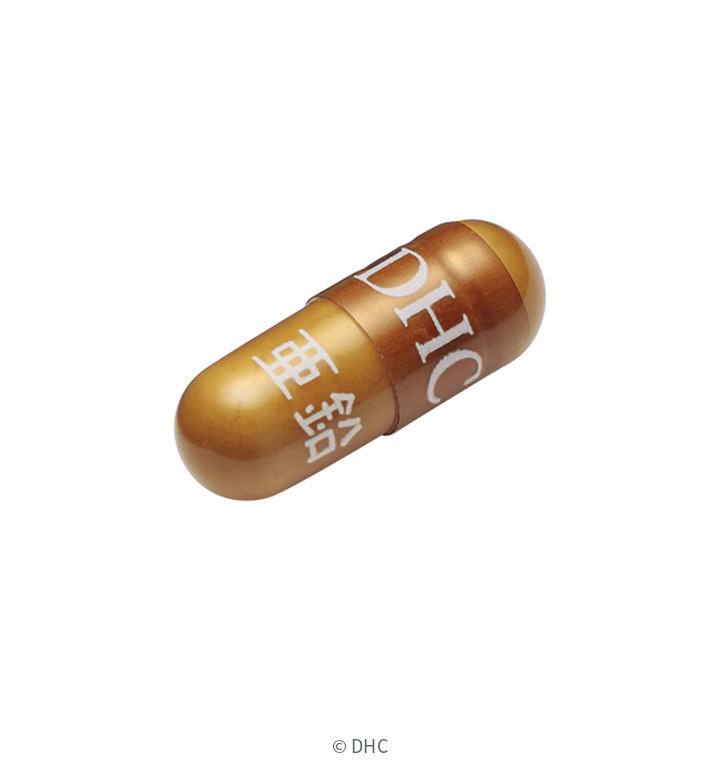
DHC is a hard capsule, listed at approximately 15.8 mm long and 5.7 mm across/thick. The photograph is enlarged, not actual size. Dear-Natura’s yellow tablet appears in the complete product image above. The photographs are not a shared-scale size comparison and cannot tell you which will feel easier to swallow.
- Both have a daily serving of one unit, taken with water. DHC also specifies lukewarm water; Dear-Natura’s general FAQ says to follow the package and ordinarily use water or warm water. Do not double the amount to make up for a missed day.
- This comparison does not establish a “best before-bed” schedule. Dear-Natura’s FAQ allows ordinary supplements to fit your routine; prioritize the daily amount and the directions on your own pouch.
- Dear-Natura notes that B2 may turn urine yellow, and ingredients may cause speckles, uneven color or changes in color or smell. Those explanations are not a reason to continue if you feel unwell.
- For either product, stop taking it if you feel unwell after use. Both DHC and Dear-Natura explicitly give this instruction.
- DHC specifies avoiding direct sunlight, heat and humidity. For both, reseal after opening, use promptly and keep out of children’s reach. Check the actual Dear-Natura pouch for other storage conditions, and avoid leaving supplements in hot, damp places.
Medicines, pregnancy and allergies need their own check
- Receiving medical treatment: Dear-Natura flags this group under its avoid-use guidance, while its detailed precautions require a doctor’s advice for treatment or medicine use. Do not start it on your own; let the treating doctor decide whether it is appropriate. DHC also requires medical advice when taking medicines or receiving care.
- Pregnancy or breastfeeding: DHC explicitly asks pregnant users to consult a doctor. Zinc being essential is not a reason to add either product to a prenatal or breastfeeding supplement regimen without an individual review of the whole plan.
- Allergies: DHC contains gelatin and tells people with food allergies to check ingredients and avoid use. Dear-Natura’s “no applicable items” concerns the scope of its allergen declaration; it is not a guarantee against every allergy or a vegan certification.
- Do not invent a medicine-spacing rule: show a doctor or pharmacist the medicine names and every supplement label. Do not stop prescribed treatment or assume that separating products by a few hours solves every possible issue.
Complete nutrition and ingredient lists
DHC Zinc: per 249 mg capsule
Energy 0.9 kcal; protein 0.08 g; fat 0.01 g; carbohydrate 0.12 g; salt equivalent 0.001 g; zinc 15.0 mg; chromium 60 μg; selenium 50 μg. The 30-capsule pouch lists a net weight of 7.4 g. Each capsule contains 200 mg of filling, distinct from the 249 mg whole-capsule weight.
Ingredients: chromium-containing yeast (made in Mexico), selenium-containing yeast; zinc gluconate, gelatin, cellulose, glycerin fatty acid esters, colors (caramel, titanium dioxide), fine silicon dioxide.
Dear-Natura Style Zinc: per daily tablet
Energy 0.76 kcal; protein 0 g; fat 0.0043 g; carbohydrate 0.18 g; salt equivalent 0.0002–0.0006 g; zinc 14.0 mg; vitamin B2 0.5 mg; vitamin C 34 mg.
Ingredients: zinc gluconate, cellulose, vitamin C, calcium stearate, sodium starch glycolate, thickener (pullulan), shellac, vitamin B2, glycerin. These lists follow the Japanese official websites; check the back of the actual pouch you buy.
My buying order: establish the need for zinc, check overlap, then choose between the chromium/selenium capsule and the C/B2 tablet. Deciding not to add another supplement can be a well-informed choice.