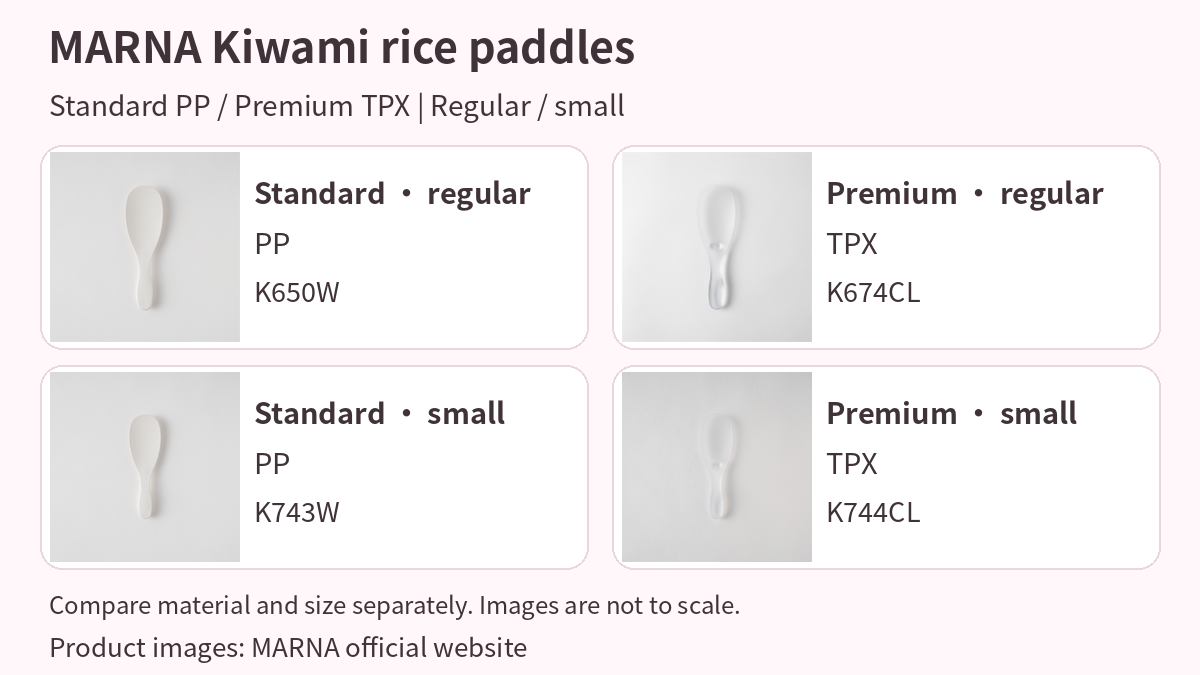
When buying a MARNA Kiwami rice paddle in Japan, separate size from material: normal or small, then standard PP or Premium TPX. The 120°C and 140°C heat-resistance labels do not give permission to use these paddles for frying or cooking in a heated pan.[1][2][3][4]

I’m Irene, a Taiwan-born pharmacist qualified in Japan.
Sources checked on 24 October 2026, Japan time. This guide uses official specifications and precautions to help visitors and residents shop; it is not a hands-on test, measurement or non-stick performance ranking.
Match the model, then separate size from range
This table covers only the white standard K650W and K743W, and clear Premium K674CL and K744CL. On Japanese labels, ノーマル means normal size and 小 means small. プレミアム identifies a different material range, not a larger size. Do not automatically apply this table to other colours or ranges.[1][2][3][4]
On a phone, scroll sideways inside the table to see every column.
| Model, colour and JAN | Size | Material | Heat-resistance label |
|---|---|---|---|
| Kiwami K650W White JAN 4976404265078 | Normal 67 × 23 × 219 mm | Polypropylene (PP) | 120°C |
| Kiwami K743W White JAN 4976404274315 | Small 58 × 17 × 189 mm | Polypropylene (PP) | 120°C |
| Kiwami Premium K674CL Clear JAN 4976404267416 | Normal 67 × 23 × 219 mm | Polymethylpentene (TPX) | 140°C |
| Kiwami Premium K744CL Clear JAN 4976404274414 | Small 58 × 17 × 189 mm | Polymethylpentene (TPX) | 140°C |
MARNA lists Japan as the country of origin for all four. The dimension strings retain the order on the official pages; they have not been relabelled as length, width and height or independently measured to scale. For a given size, the standard and Premium versions have the same listed overall dimensions.[1][2][3][4]
Think about handling and material separately
MARNA describes the small version as compact and easy to manoeuvre for serving portions, and normal as a basic everyday size for turning rice from the bottom and serving it. Compare the dimensions with how you normally serve rice before buying for yourself or as a gift. Small is not necessarily right for everyone, and normal does not automatically mean less effort.[1][2][3][4]
Next, match the complete name and resin: the standard models here use PP; Premium uses TPX. Colour alone is not enough: MARNA also lists a white Premium K674W, which is outside this table. Matching the model and JAN barcode is clearer than looking only for white or clear plastic. This guide does not treat the Premium name or higher heat rating as a universal benefit or a promise that rice will never stick.[1][3]
120°C or 140°C does not make this a frying utensil
Both ranges explicitly prohibit use in heated pots, frying pans and earthenware pots. Keep them away from flames and hot places, and use them only for their intended purpose. The Premium rating of 140°C does not cancel those restrictions. If you are shopping for a utensil for cooking in a hot pan, do not substitute this rice-serving paddle.[1][2][3][4]
MARNA also says not to leave a paddle inside a rice cooker for a long time. Wet it once in water before use to help reduce rice sticking. That is the maker’s use advice, not a guarantee of completely non-stick performance.[1][2][3][4]
Avoid scratching; Premium has an extra material caution
- Wash with dishwashing detergent before use.
- Rinse thoroughly after use, drain and dry.
- Scouring brushes or abrasive cleaning powder may cause scratches.
- Premium: terpenes in citrus peel, such as lemon peel, or oils and fats can alter the material. The higher heat rating is not a reason to overlook this caution.[1][2][3][4]
The heat rating alone does not establish whether a dishwasher, microwave or another cleaning method is suitable. Follow the complete label and precautions supplied with your own product; this table does not replace them.
A short shelf-side checklist
- Confirm that you want a rice-serving paddle, not a utensil for heated cookware.
- Compare ノーマル or 小 and the dimensions, then check the Premium name and material.
- Match the model number and JAN. If buying a gift, keep the product instructions so the recipient can check its use and cleaning limits.
Takeaway: size and material are separate choices. All four share the restrictions on heated cookware and prolonged storage inside a rice cooker. Start with the intended use and exact model, then choose a size.[1][2][3][4]