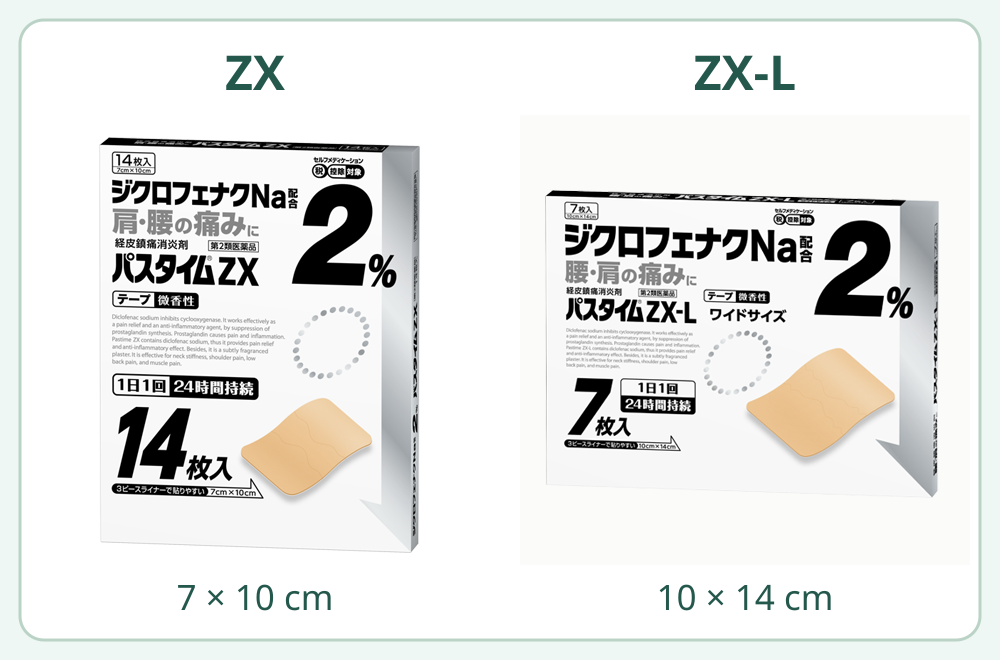

I’m Irene, a Taiwanese pharmacist working in a Japanese drugstore. Two silver PASTIME boxes can look almost identical on the shelf. Before choosing by “2%” or the number of patches in the box, look at ZX versus ZX-L: the larger patch has a different maximum number you may use.
Match the box: ZX is not ZX-L
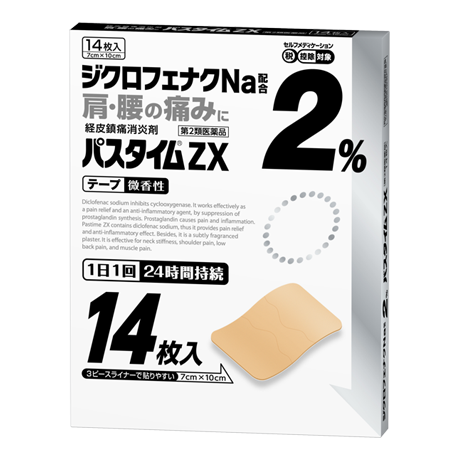
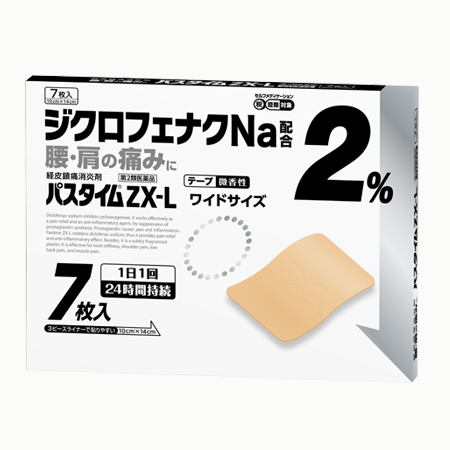
Both are Japanese Class 2 OTC external pain-relief medicines containing diclofenac sodium 2%. They are labelled for joint pain, muscle pain, lower-back pain, tendon-sheath inflammation (hand/wrist pain), elbow pain such as tennis elbow, bruises, sprains and shoulder pain associated with shoulder stiffness. They relieve symptoms, not the underlying cause of a disease. They are not a preventive patch to put on before a long sightseeing day.
| Check | ZX | ZX-L |
|---|---|---|
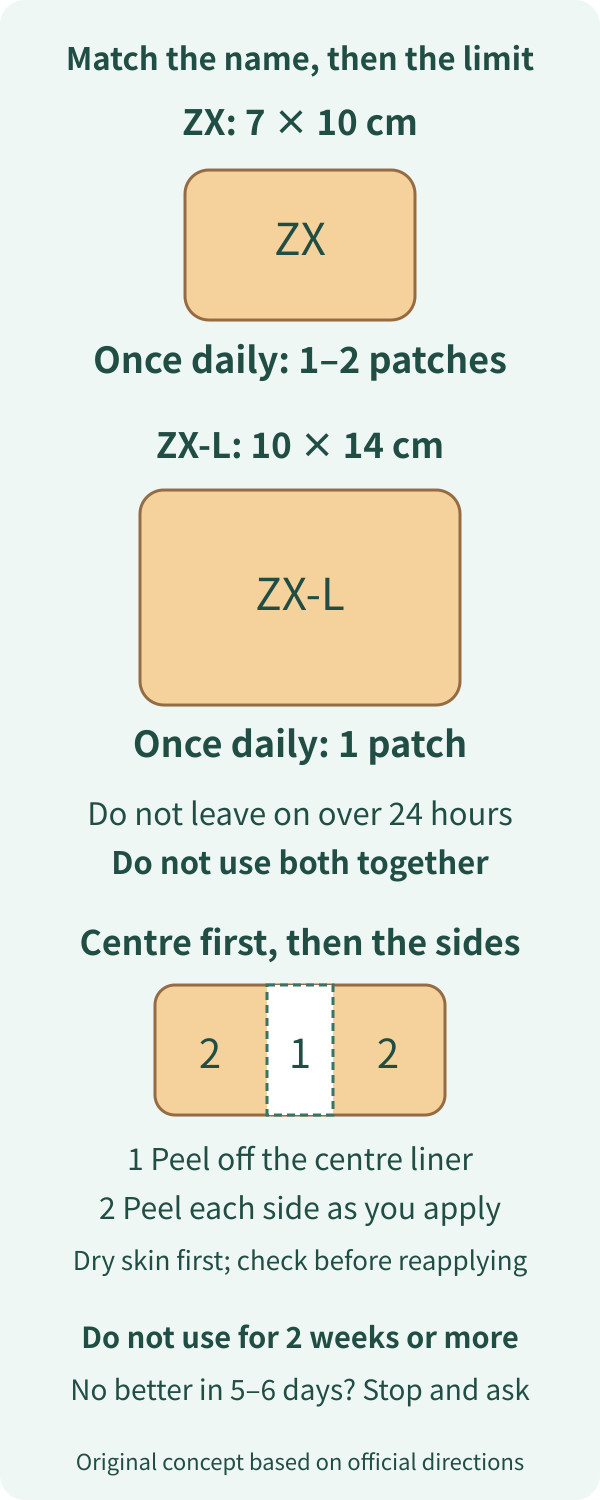
| Patch size | 7 × 10 cm | 10 × 14 cm |
| Amount each time | 1–2 patches, never more than 2 | 1 patch, never more than 1 |
| Frequency | Once daily | Once daily |
The same “2%” is the concentration, not permission to use the same number of patches. The listed adhesive mass is 0.75 g per ZX patch and 1.5 g per ZX-L patch. Do not combine the two products, or use them with another diclofenac external medicine. During use, do not use other external pain-relief/anti-inflammatory medicines either.
Who must not use either patch?
- Anyone who has had an allergic reaction to the product or one of its ingredients.
- Anyone who has ever had asthma. This is not limited to asthma caused by painkillers.
- Anyone pregnant or possibly pregnant.
- Children under 15.
Do not apply around the eyes, to mucous membranes, eczema, irritated skin, wounds, athlete’s foot/ringworm or areas with pus.
How to apply: centre liner first
- Check that the skin is suitable and wipe away sweat or moisture.
- Peel off the centre section of the three-piece plastic liner first.
- Peel the two side sections one at a time as you apply the patch to the affected area.
- Do not leave one application on for more than 24 hours. Before applying again to the same area, check there is no rash, redness, itching or irritation.
If your skin is sensitive, the leaflet says to try a piece approximately 1–2 cm square on a sensitive area such as the inner arm for at least half a day before use, checking for rash, redness, itching or irritation. A negative skin test does not make this suitable for anyone in the do-not-use groups above. This is the specific skin-test instruction, not advice to cut up patches to change the dose. Do not apply other external preparations to the same application site.
Do not use continuously for two weeks or more. Separately, if symptoms have not improved after 5–6 days, stop and consult a doctor, pharmacist or registered seller with the leaflet. The two-week limit is not permission to ignore the earlier consultation point.
Show your other medicines before choosing
Consult a doctor, pharmacist or registered seller before use if you are receiving medical treatment, use other medicines, have a history of medicine-related allergy or tape-related skin irritation, or are elderly.
Also consult first if you have been diagnosed with a peptic ulcer, a blood disorder, liver disease, kidney disease, high blood pressure, heart disease or influenza.
The leaflet specifically lists medicines that need this check: new quinolone antibiotics, triamterene, lithium, methotrexate, non-steroidal anti-inflammatory painkillers (including aspirin), steroid medicines, diuretics, ciclosporin and selective serotonin reuptake inhibitors (SSRIs). Do not decide from the brand name alone; show the actual medicines or your medication list.
When to stop, and when care is urgent
Stop immediately and consult with the leaflet if you develop a rash, redness, itching, contact irritation, swelling, pain, stinging/irritation, heat sensation, rough skin, peeling/flaking, blisters or pigmentation changes.
Seek medical care immediately for possible shock/anaphylaxis: itching, hives, hoarse voice, sneezing, throat itching, breathing difficulty, palpitations or clouded consciousness soon after use.
Also seek immediate medical care for severe contact dermatitis/photosensitivity: intense itching with rash/redness, swelling, irritation, blisters or raw/eroded skin, pigmentation changes or white patches. Symptoms can spread beyond the application site, and sun-exposed areas may develop symptoms or worsen.
Keep the leaflet with the patches
Store in a cool place away from direct sunlight and out of children’s reach. Do not transfer to another container. After opening the bag, fold its opening over and use the contents promptly even if still within the expiry date. Do not use expired patches.
Show this at the drugstore counter
パスタイムZXとZX-Lの違いを確認したいです。使う人は[ ]歳で、今使っている薬はこちらです。ぜんそくや薬のアレルギーなども含めて、使えるか確認してください。
“Please explain the difference between PASTIME ZX and ZX-L. The person using it is [ ] years old, and these are their medicines. Please check suitability, including asthma and medicine allergies.”
My shortcut: check whether you can use it → match ZX or ZX-L → check the patch limit → follow the centre-first liner and skin checks. A wider patch is a size choice, not a reason to skip the safety questions.