Your shopping list says “Pabron Gold A”, but the shelf has a bottle version and a box of sachets. Tablets and fine granules contain the same seven active ingredients in the same amounts per adult dose. Start with the form you prefer, then check age and dosing.

Let’s match the name first
This guide covers パブロンゴールドA, not S Gold W, Ace or every product in the Pabron family. It relieves a range of cold symptoms. Popularity alone does not make it the right choice for everyone, and you should not take the tablet and granule versions together.
Your 3-minute choice: symptoms first, then the form
A combination medicine is one option to discuss when a cold brings several symptoms such as cough, phlegm, a runny nose, sore throat or fever. If only one symptom bothers you, a seven-ingredient formula may add ingredients you do not need; a pharmacist or registered OTC medicine seller can help narrow the choice.
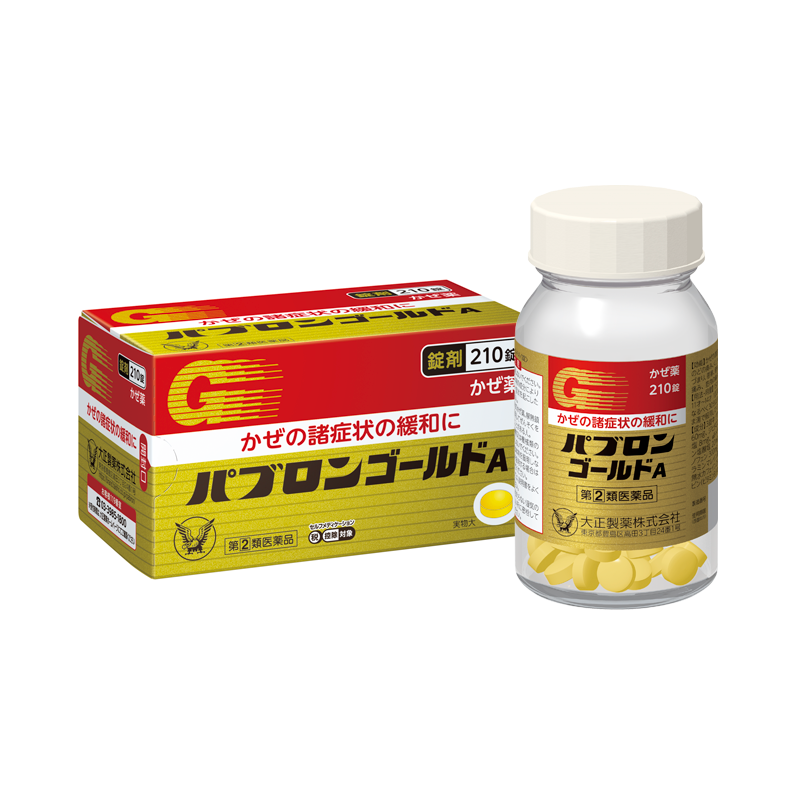
Tablets | 3 per adult dose
Small tablets in a bottle. Count the dose for the person’s age and swallow with water or warm water. The bottle is not suitable for all ages.
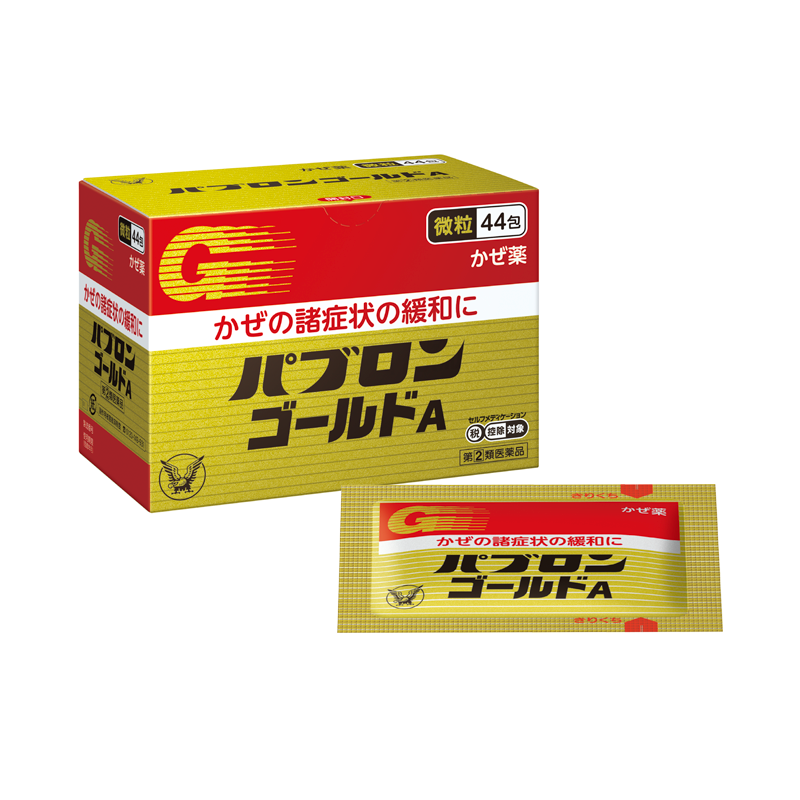
Fine granules | 1 sachet per adult dose
Each sachet contains 0.96 g. Take with water or warm water: these are not water-free Ryukakusan Direct granules. Ages 12–14 use less than one whole sachet.
Both forms can cause drowsiness. Do not drive, cycle or operate machinery after taking either—especially relevant on a self-drive holiday.
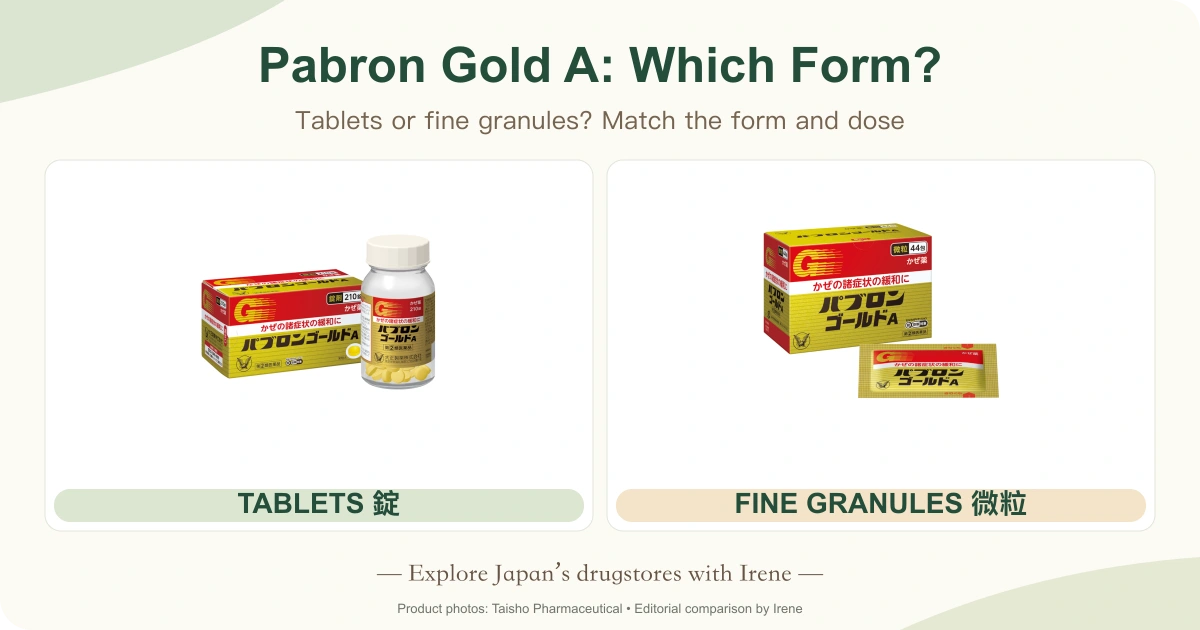
Match the box: gold packaging is not enough
パブロンゴールドA〈錠〉
Look for ゴールドA・錠
パブロンゴールドA〈微粒〉
Look for ゴールドA・微粒
Product photos: Taisho Pharmaceutical. Photos are not shown to scale. Sources are listed at the end.
Look for ゴールドA, then 錠 (tablets) or 微粒 (fine granules). 錠 and 包 also appear beside the total tablet or sachet count. That is the pack quantity, not a single dose. If buying a requested item, save the full box photo rather than remembering only “gold Pabron”.
What do the seven ingredients do?
Amounts are per adult dose: three tablets or one 0.96 g sachet, not per day. The active ingredients match; inactive ingredients differ. The powder form alone does not establish faster or stronger relief.
| Active ingredient | Per adult dose | What it contributes |
|---|---|---|
| Guaifenesin | 60 mg | Helps loosen phlegm so it can be cleared |
| Dihydrocodeine phosphate | 8 mg | Suppresses cough |
| dl-Methylephedrine hydrochloride | 20 mg | Opens the airways and helps reduce cough |
| Acetaminophen / paracetamol | 300 mg | Relieves fever and pain, including headache and sore throat |
| Chlorpheniramine maleate | 2.5 mg | Relieves sneezing, runny nose and nasal congestion |
| Anhydrous caffeine | 25 mg | Supports headache relief; it does not cancel drowsiness |
| Riboflavin / vitamin B2 | 4 mg | Supplies vitamin B2 |
This is symptom relief, not an antibiotic or a medicine to take in advance to prevent a cold. Feeling less feverish or sore is not a reason to pack more activities into a day when you need rest.
Doses: the two age boundaries are 12 and 15
| Age | Tablets per dose | Granules per dose |
|---|---|---|
| 15 and older | 3 tablets | 1 sachet (0.96 g) |
| 12–14 | 2 tablets | Two-thirds of a sachet |
| Under 12 | Do not use | Do not use |
For both forms: three times daily, preferably within 30 minutes after meals, with water or warm water. Children must use the medicine under a parent or guardian’s supervision. Do not give a full adult sachet to a 12–14-year-old simply because tablets are difficult to swallow.
Before use: easy-to-miss travel precautions
- Do not combine medicines: avoid other cold medicines, pain/fever medicines, sedatives, cough/expectorant medicines and oral antihistamines, including allergy, rhinitis and motion-sickness medicines.
- No driving or alcohol: do not drive or operate machinery after taking it; avoid alcohol before and after use.
- Do not use: under age 12, with an allergy to an ingredient, or after a previous asthma reaction to cold or pain/fever medicines.
- Pregnancy and breastfeeding: consult a doctor, pharmacist or registered OTC medicine seller before use if pregnant or possibly pregnant. Do not use while breastfeeding; if taking it, avoid breastfeeding.
- Check first: ongoing treatment, older age, a medicine-allergy history, high fever, difficulty urinating, or diagnosed thyroid disease, diabetes, heart disease, high blood pressure, liver/kidney disease, ulcers, glaucoma, breathing impairment, sleep apnoea or obesity require consultation as directed by the leaflet.
If there is no improvement after five or six doses, stop and seek advice—not after five or six days. Do not exceed the dose or use long term. Stop and seek advice for reactions such as a rash; breathing difficulty, altered consciousness or severe skin symptoms need urgent medical care.
At the shelf: three final checks
Find Gold A
Match ゴールドA. Other Pabron names can mean different formulas.
Choose the form
Use the person’s age and preference. Tablets and granules are alternatives, not a set to take together.
Leave with clear directions
Check the dose and after-meal timing. Tell the seller before buying if you will drive or are already taking cold medicine.
Questions before you buy or use it
Are the tablets or granules more effective?
The manufacturer lists the same active ingredients and amounts per adult dose. The form and inactive ingredients differ. This alone does not show that either works better or faster; follow the dose for the exact form.
Why might staff ask my age or limit the quantity?
Gold A contains dihydrocodeine and other ingredients subject to Japan’s anti-misuse sales controls. Rules effective from May 2026 require seller checks and information, with small-pack and quantity limits for buyers under 18. There is not a universal one-box legal limit for every adult. Cooperate with staff rather than shopping around to evade checks.
Can I take it every day to prevent a cold?
No. It relieves cold symptoms; it is not a preventive medicine. Do not exceed the dose or use it continuously long term.
How long can I keep an opened tablet bottle?
For the tablets, use within six months of opening and within the printed expiry date. Keep the bottle tightly closed and away from moisture as directed. Do not apply this tablet-bottle rule automatically to other forms.
Sources and photo credits
Based on Japanese manufacturer information. English names help you read this guide; match the full Japanese name when shopping. Official photos retain the original packaging artwork. Read the current leaflet supplied with your pack before use.