Japanese official product page, currently linked Japanese leaflet and PMDA information checked on 1 November 2026. This is a buying-decision guide to Japanese new KONJISUI 4mL, not a diagnosis or a do-it-yourself dental repair guide.
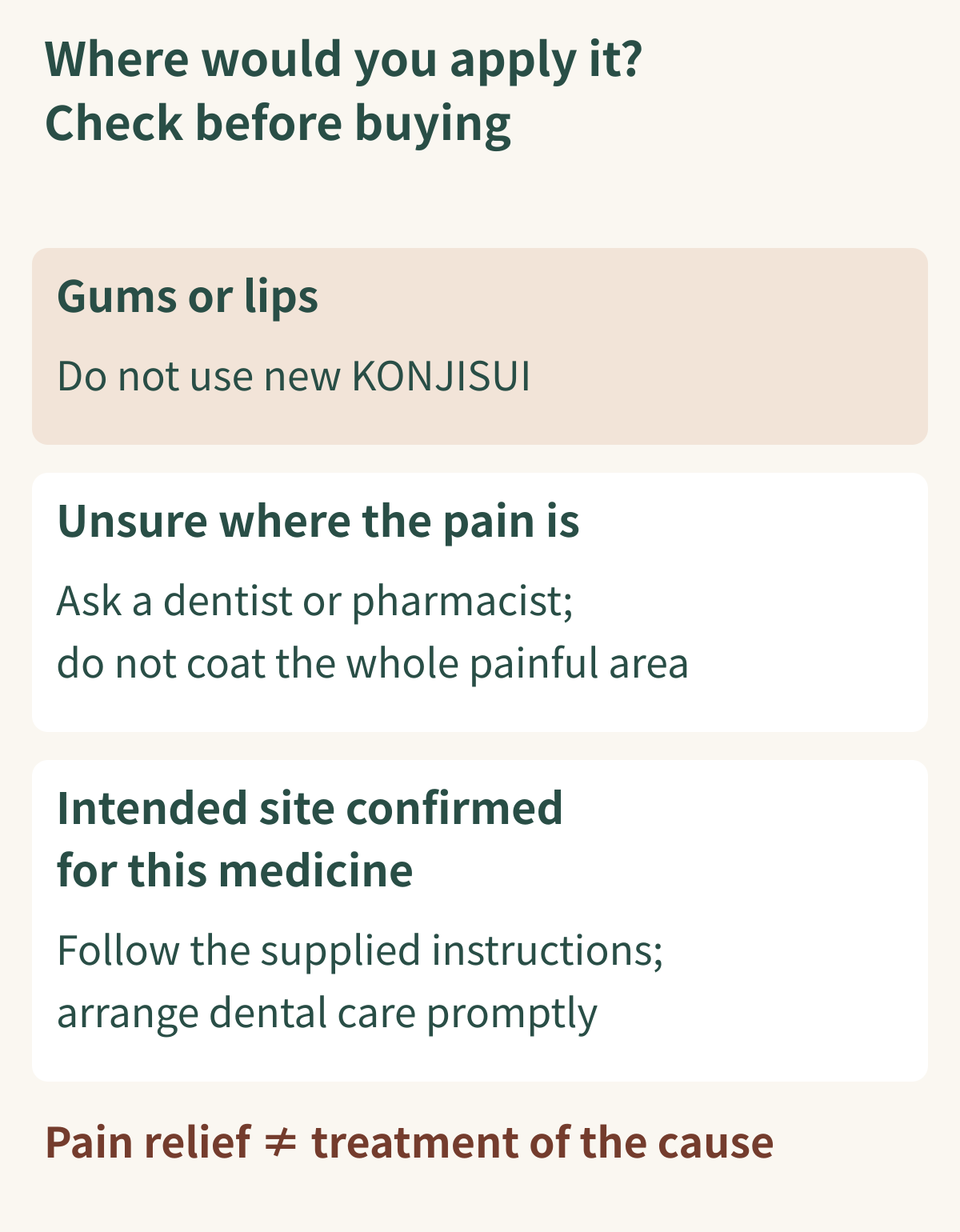
Looking for something to numb a toothache during a trip? New KONJISUI is not a gum-numbing gel: its Japanese leaflet explicitly says not to use it on gums or lips. Pain somewhere inside your mouth does not make an overseas numbing gel, mouth-ulcer treatment and this dental liquid interchangeable.
I’m Irene, a Taiwanese pharmacist working in a Japanese drugstore. With this bottle, the useful first questions are where you intend to apply it and whether dental care is arranged—not whether a Japanese medicine is stronger than one from home.
Identify this bottle, not a general “mouth medicine”
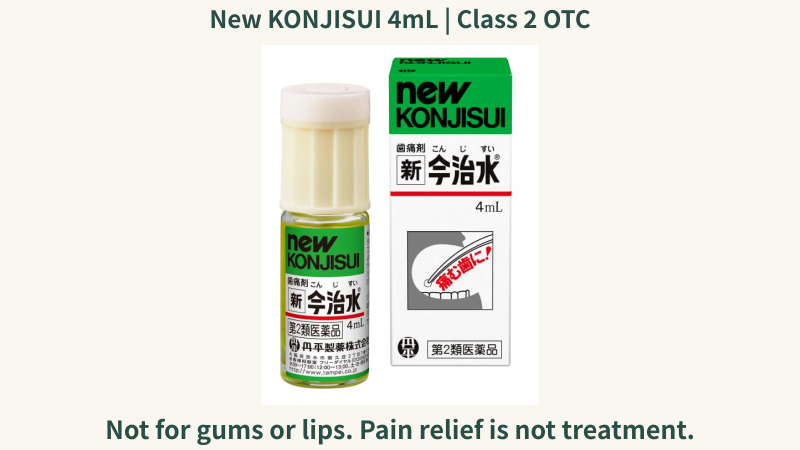
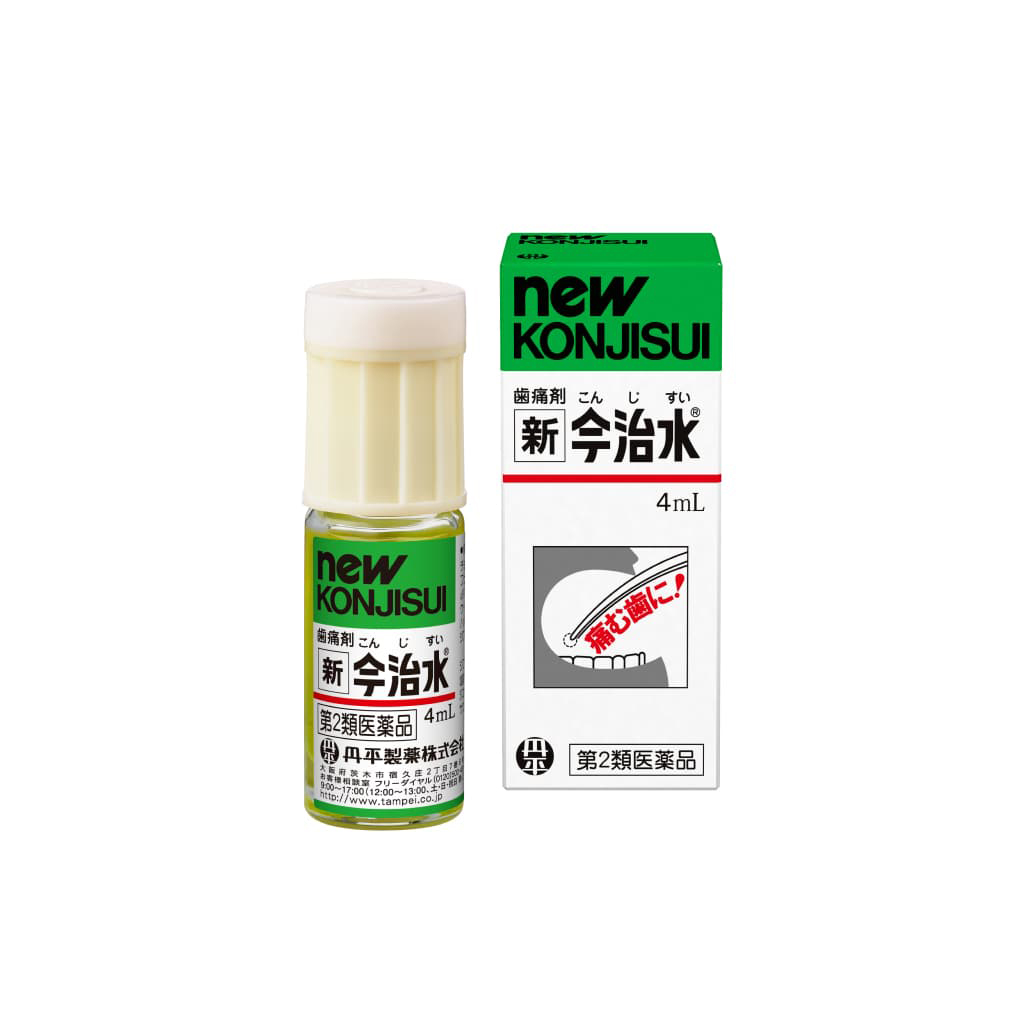
The pictured Japanese product is Tampei Pharmaceutical’s 新今治水 (new KONJISUI), 4mL, a Class 2 OTC medicine. It is a local dental-pain liquid, not a mouthwash or a painkiller to swallow. It contains several active ingredients, including phenol and dl-camphor. A small bottle sold in a drugstore still has strict application-site limits.
The Japanese leaflet lists relief of pain associated with “むし歯、浮歯、歯の根”—tooth decay, the sensation described as “floating teeth,” and tooth roots. That does not permit applying it to gums, and it does not mean it treats tooth decay. For gum pain, an ulcer, or uncertainty about whether a tooth or gum is hurting, ask a dentist or pharmacist rather than coating the whole painful area. This guide also does not transfer the ingredients or directions of the separate gel product コンジスイQ to this liquid.
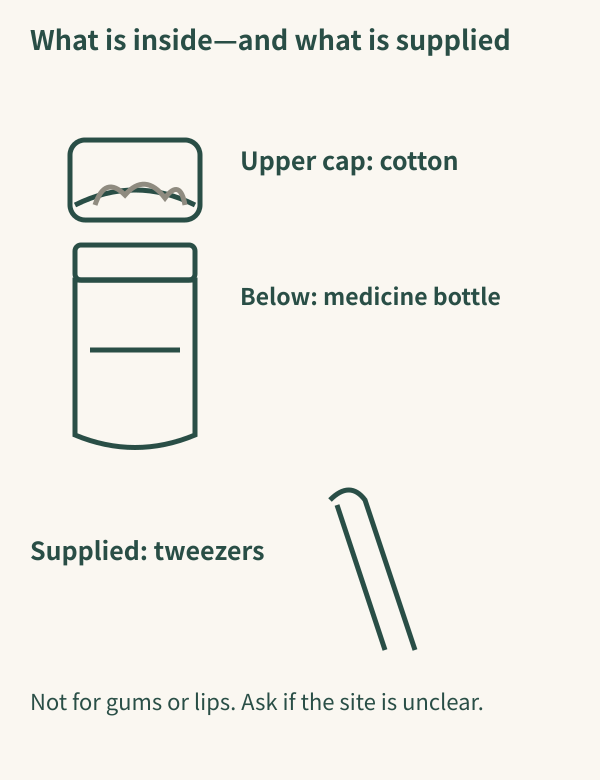
The cap, liquid and supplied tool
“Pain relief” is not enough: check the intended site
The Japanese directions use a medicine-soaked cotton ball in a decayed tooth’s cavity, and explicitly say not to apply it anywhere other than the cavity of the painful tooth. It is for dental use only, not for the eyes or other purposes.
This article does not teach you to find or make a hole, fill a tooth or operate tweezers. If you cannot identify the painful site or are unsure you can follow the instructions, take the product to a pharmacist and arrange dental care. Numbness after contact is not proof that a site is suitable. Children require a guardian’s guidance and supervision; this article is not individual clearance for a child or for use during pregnancy or breastfeeding.
Five or six uses is a stop rule—not a reason to postpone a dentist
- Ask before use: If you are receiving medical or dental treatment, or have had an allergic reaction to a medicine or similar substance, consult a doctor, dentist, pharmacist or registered medicine seller first. Show your current medicines; do not independently add other painkillers.
- Stop when symptoms occur: For a rash, redness or itching after use, stop immediately and take the leaflet to one of those professionals. Worsening pain or swelling is also a reason to seek help without waiting to reach a particular number of applications.
- No improvement after five or six uses: Stop and seek advice with the leaflet. These are applications, not five or six days, and not a course you must finish.
New KONJISUI cannot treat the underlying cause of pain, such as a cavity. Arrange dental treatment promptly even if pain temporarily eases. Do not use a response to the medicine as a diagnosis or keep adding applications to get through the rest of your trip.
More is not better; keep the carton and leaflet
Excess medicine on areas other than teeth can temporarily alter taste; the leaflet says to wipe it away with gauze or similar material. If it accidentally gets on the skin around the mouth or face, wash thoroughly with water immediately and wipe it off. Do not swallow it or use it in the eyes. For misuse, accidental swallowing or continuing discomfort, seek professional help with the product rather than inventing a remedy.
Keep it tightly closed in a cool, dry place away from direct sunlight, flames and children. Do not transfer it to another container. Do not use it after the expiry date on the carton; even within that date, use it promptly after opening. Keep the carton’s expiry information and the leaflet while travelling.
Give the pharmacist more than a product name
Explain where it hurts, when it started, whether there is swelling or fever, and the names and last doses of medicines already used. To ask for dental care, you can show: 「歯が痛いです。歯科を受診したいです。」 (“My tooth hurts. I would like to see a dentist.”) Do not just ask for something stronger, or cancel dental care because a medicine is available.