Information checked: 19 October 2026. This guide compares Japan’s Bo-koren (ボーコレン) and Bo-koren Age Plus (ボーコレンエージ+). Both are Class 2 OTC medicines, but their formulas, labelled profiles and tablet counts differ. Age Plus is not simply a stronger version or an automatic choice after 40.
Check whether you need medical care first
Painful or frequent urination and a feeling of incomplete emptying deserve assessment. Get prompt medical help for fever, chills, back or side pain, nausea or vomiting: a bladder infection can spread to the kidneys. Visible blood in the urine, or suspected UTI during pregnancy or possible pregnancy, needs urgent medical assessment rather than trying a Kampo product first.
Seek urgent medical assessment for suspected UTI in children, men, adults aged 65+, or people with diabetes or weakened immunity. Rapid worsening or no improvement within 48 hours of starting treatment or self-care needs urgent review; repeated episodes need investigation. Confusion, drowsiness or difficulty speaking requires emergency help.
These are general urinary-symptom safety pointers, separate from Japanese product directions. Neither product proves an infection has cleared or replaces a clinician’s decision about antibiotics.

Let’s check the symptoms before the box
I’m Irene, a Taiwan-born, Japan-licensed pharmacist working in a Japanese drugstore. Constantly looking for a toilet can disrupt a trip. Start by explaining when symptoms began, whether you have a fever and whether there is blood in your urine. That helps more than choosing a pink or orange box.
Match the formula and labelled profile, then the box
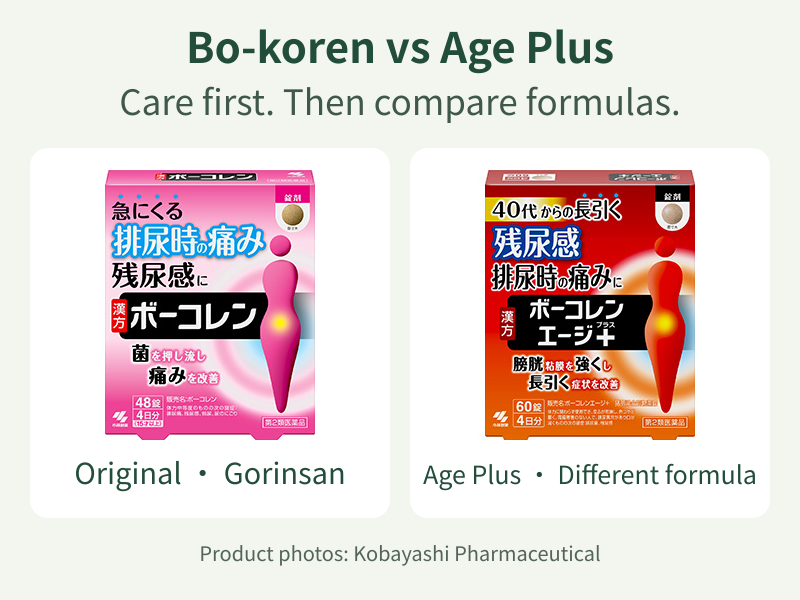
Original Bo-koren: Gorinsan
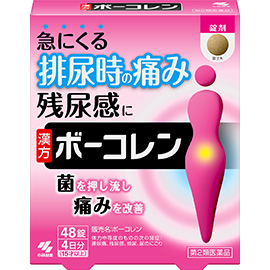
Look for ボーコレン
The adult daily dose of 12 tablets contains 2.55 g of Gorinsan extract. Its labelled uses are painful urination, incomplete-emptying sensation, frequent urination and cloudy urine in people of moderate physical strength.
Available in 48- and 96-tablet packs; the photo shows 48. Urine colour or smell alone does not establish that this product is appropriate or that you have an infection.
Age Plus: Choreito-goshimotsuto
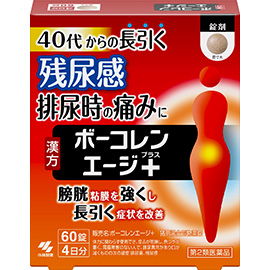
Look for エージ+ and 猪苓湯合四物湯錠
The adult daily dose of 15 tablets contains 3,300 mg of extract. Its profile is people of any physical strength with dry, dull-looking skin, no gastrointestinal disorder, urinary abnormalities and thirst. Within that profile, indications are difficulty urinating, painful urination, incomplete-emptying sensation and frequency.
A 60-tablet pack. Age alone, or symptoms that have lasted a long time, does not establish a match. Persistent symptoms need a cause identified.
Product and tablet photos: Kobayashi Pharmaceutical. Original Japanese packaging is retained; photos are not to scale.
These are different Kampo formulas. Original Bo-koren uses 11 crude drugs, including licorice and gardenia. Age Plus has nine extract materials: alisma, poria, Japanese angelica, peony, cnidium, rehmannia, polyporus, talc and gelatin. 3,300 mg versus 2.55 g is not a strength ranking across different formulas. Do not combine the products on your own.
Both are taken three times daily, but the tablet count differs
Original: tablets per dose
- Ages 15+: 4 tablets
- Ages 7–14: 3 tablets
- Ages 5–6: 2 tablets
- Under 5: do not use
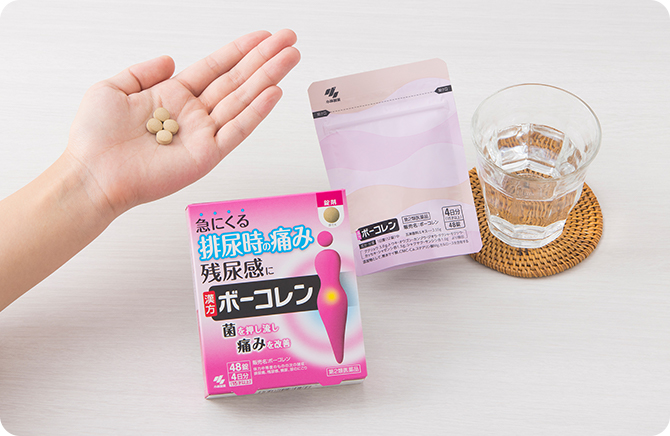
Children require parental supervision. A labelled child dose does not make suspected childhood UTI suitable for self-treatment.
Age Plus: tablets per dose
- Ages 15+: 5 tablets
- Under 15: do not use
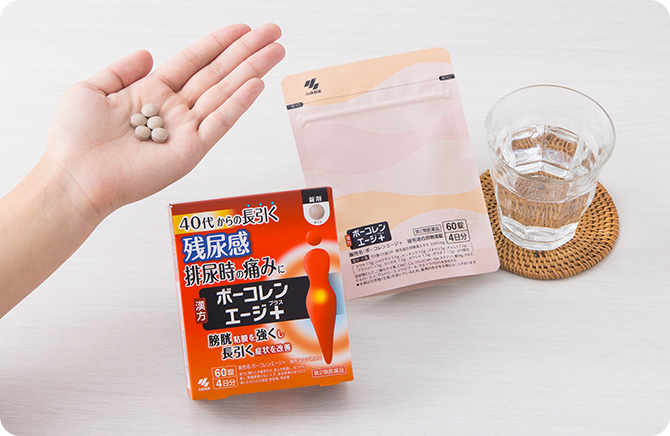
Do not transfer the original product’s child doses to Age Plus or take all 15 daily tablets at once.
Take either product before or between meals, with water or warm water, three times daily. “Between meals” means about 2–3 hours after eating, not during food. At the adult dose, original Bo-koren 48 tablets and Age Plus 60 tablets each contain four days’ supply. That is pack arithmetic, not a four-day cure promise or a reason to wait until the pack is finished before seeking care.
Who needs advice before use?
Both leaflets require prior advice from a doctor, pharmacist or registered medicine seller if you are receiving medical treatment, are pregnant or may be pregnant, or have a weak stomach and tend to get diarrhoea. Suspected UTI during pregnancy needs medical assessment, not only a purchase check.
- Original Bo-koren additionally lists: older adults, people with swelling, and those diagnosed with hypertension, heart disease or kidney disease.
- Age Plus additionally lists: people who have developed a rash, redness or itching from medicines or similar substances.
Show the pharmacist your prescription medicines, OTC products and other Kampo formulas. Original Bo-koren contains licorice; different brand names can still mean overlapping ingredients. A shorter caution list for Age Plus does not make it an automatic alternative for someone with a chronic condition. If breastfeeding, ask about your individual situation and an appropriate treatment plan.
Stop rules: the leaflet’s “one month” is not a UTI waiting period
Both leaflets say to stop and seek advice, bringing the package, if symptoms have not improved after about one month. Do not use this as permission to wait a month with a possible infection. Fever, side pain, blood in urine, pregnancy-related symptoms or lack of improvement within 48 hours need earlier assessment as explained above.
- With either product, stop immediately and seek advice for loss of appetite or stomach discomfort after use.
- Age Plus also lists rash, redness and itching as reasons to stop immediately and consult.
- Diarrhoea can occur with either; stop and seek advice if it persists or worsens.
The original product also lists rare serious reactions: interstitial pneumonia (sudden or persistent dry cough, fever or breathlessness); pseudoaldosteronism/myopathy (progressively worsening limb weakness, numbness, stiffness or muscle pain); and mesenteric phlebosclerosis (repeated abdominal pain, diarrhoea, constipation or bloating with long-term use). Stop and obtain immediate medical care for these symptoms. Its leaflet also requires advice before prolonged use.
Keep tablets in their original packaging, close the zip firmly after each dose, and store away from sun, heat and moisture, out of children’s reach. Do not transfer tablets to another container or handle them with wet hands; Age Plus tablets may discolour when wet. Do not use expired medicine.
Irene’s practical tip: explain these three things
At a pharmacy or clinic, start with: “When did it begin? Is pain, frequency or incomplete emptying the main problem? Is there fever, back pain or blood in the urine?” Then mention possible pregnancy, medical conditions and medicines. For a family purchase, get the full product name or a box photo. Someone being older is not enough reason to choose Age Plus.
Three questions before buying
Do I need Age Plus once I turn 40?
No. “From your 40s” is manufacturer positioning. The Japanese dose instructions allow ages 15+, subject to the full labelled profile. Persistent or recurrent urinary symptoms should not simply be attributed to age.
Can I use it instead of antibiotics?
Do not substitute it for antibiotics a clinician considers necessary. Symptom relief does not prove an infection is gone. A healthcare professional should decide whether testing or antibiotics are needed.
Is this the same choice as Inochinohaha?
No. If you meant a period- or menopause-related product, see the Inochinohaha A, White, Active and Meguribi comparison. Being displayed in a women’s-health section does not turn painful urination into ordinary menstrual or menopausal discomfort.
Sources
Product directions follow Japanese manufacturer labelling. General assessment guidance comes from the NHS and NIDDK. This guide cannot diagnose your symptoms; read the complete leaflet supplied with your pack before use.