
Hi, I’m Irene, a Taiwanese pharmacist working in a Japanese drugstore.
If you’re shopping for a child’s itchy insect bite in Japan, the cream, liquid and Anpanman patches can look like three versions of the same thing. Let’s check age and body area first, then choose a form you can apply carefully.
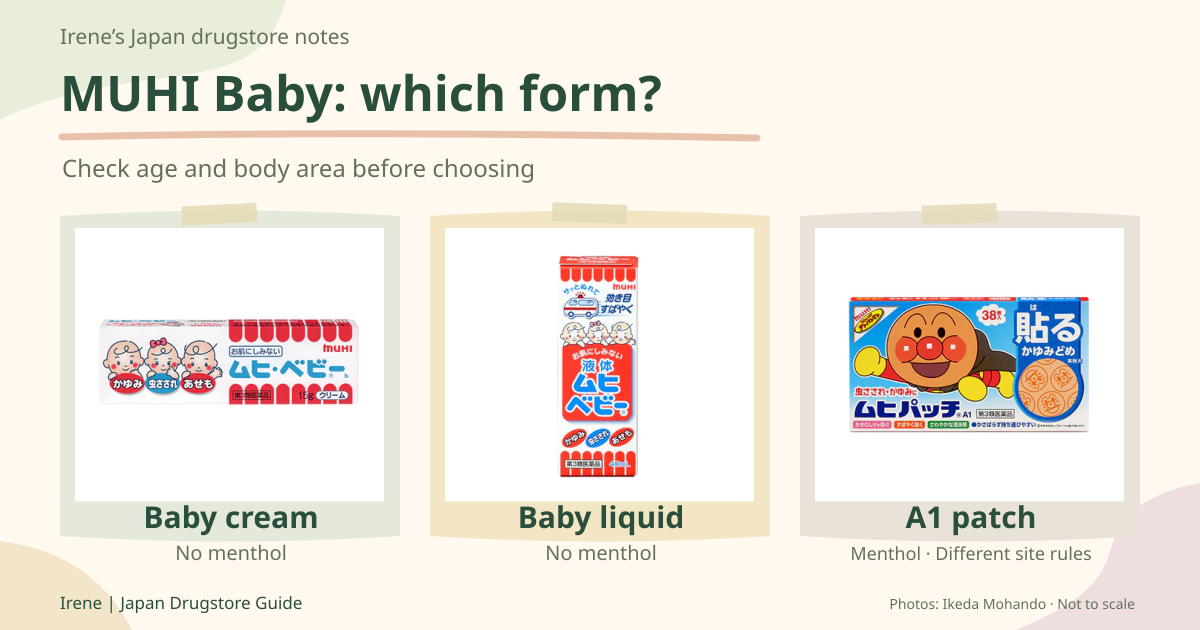
Start here: MUHI Baby cream and liquid contain no menthol. The Anpanman product, MUHI Patch A1, contains menthol and has different application restrictions. All three are Japanese Class 3 OTC medicines. The word “Baby” or a familiar character does not tell you everything about how to use them.
Which MUHI Baby should you choose?
- Want to control a small amount on your fingertip, especially on the face or diaper-area skin? Consider the cream first. The manufacturer highlights its easy handling for these areas; the skin’s condition still matters.
- Applying to a moving child’s body without getting medicine on your hands? Compare the sponge-head liquid. Face application still requires putting a little on a finger first.
- A child keeps scratching one spot? Check whether the A1 patch’s age guidance and body-site rules fit, and whether the skin is intact. Never put it on the face, head, neck or broken skin.
The cream and liquid have the same labeled indications. There is no exclusive “liquid for bites, cream for heat rash” rule. The useful differences are starting-age guidance, skin condition, body area and ease of application.
Cream: ムヒ・ベビーb
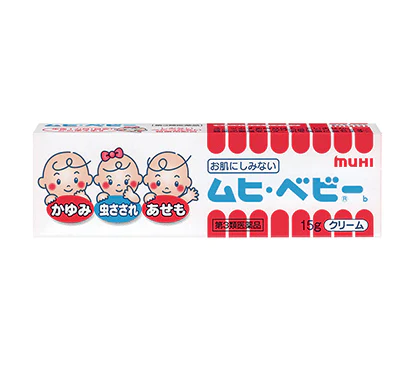
Starting-age guide: 1 month old
Look for “クリーム” and “15g.” This is a cream, rather than an ointment formulation. The manufacturer describes a moisturizing feel and easy spreading. The small tube is convenient to carry; dispense onto your hand to control where it goes.
Liquid: 液体ムヒベビー
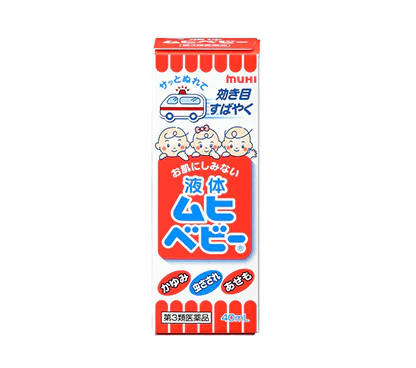
Starting-age guide: 3 months old
Look for “液体” and “40mL.” This is a sponge-tip applicator bottle, not a spray. The official FAQ describes a light, fresh feel and quick application to the body. Follow the separate face instructions below.
Patch: ムヒパッチA1
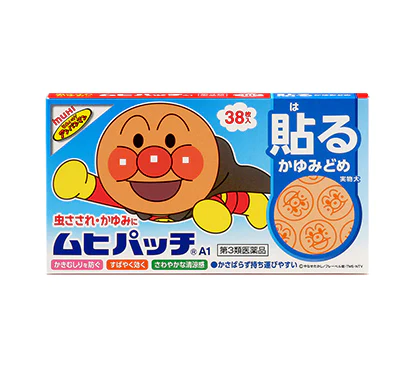
Starting-age guide: 1 year old
Match “パッチA1” and Anpanman. Covering the spot can help prevent scratching, but it is not a dressing for skin already scratched open. It contains cooling menthol and has stricter body-site rules than Baby cream or liquid.
What is actually in each medicine?
Baby cream and liquid are both labeled for itching, insect bites, heat rash, contact dermatitis, eczema, hives, dermatitis, chilblains and raw/eroded skin; the manufacturer also describes use for diaper rash. Those indications do not mean every rash is suitable for self-treatment. Severe weeping or rawness needs advice first. A1 patches have a narrower list: insect bites, itching and chilblains.
- Cream: diphenhydramine relieves itching; glycyrrhetinic acid reduces inflammation; isopropyl methylphenol has an antiseptic action; and tocopherol acetate, a vitamin E derivative, supports blood flow and symptom recovery.
- Liquid: diphenhydramine hydrochloride relieves itching, while panthenol (provitamin B5) supports normal skin function. It is a different formula, rather than diluted cream.
- A1 patch: diphenhydramine for itching, isopropyl methylphenol for antiseptic action, and l-menthol for cooling and itch relief.
Both Baby products are steroid-free, menthol-free, fragrance-free and uncolored. The liquid leaflet also states that it has no alcohol-type cooling ingredient. Water evaporation can still produce a mild cooling sensation, so “menthol-free” does not mean you will feel no coolness at all. A1 patches are also steroid-free, but their menthol makes them different.
Irene’s ingredient check: You don’t need to memorize every chemical name. Knowing which product contains menthol and which stays stuck to the skin already helps you choose more carefully. “Steroid-free” does not make every body area suitable or establish that it is safer than a steroid medicine. The condition and directions matter too.
Ingredient amounts, if you need to check the label
Figures for cream and liquid are per 100g of the preparation. Patch figures are per 100g of medicated adhesive, not per patch.
- Cream: diphenhydramine 1.0g; glycyrrhetinic acid 0.5g; isopropyl methylphenol 1.5g; tocopherol acetate 0.5g.
- Liquid: diphenhydramine hydrochloride 2.0g; panthenol 1.0g.
- A1 patch: diphenhydramine 1.0g; isopropyl methylphenol 1.0g; l-menthol 3.0g.
The diphenhydramine form, formulation and delivery differ, so “2% versus 1%” does not establish twice the effect or a strength ranking. If your child has an ingredient allergy, check the full excipient list too. For example, the cream’s stearyl alcohol is a fatty alcohol, different from everyday disinfectant alcohol; “no alcohol-type cooling ingredient” does not mean no chemically named alcohol of any kind.
How to use the cream, liquid and patch
All three are for external use only, with adult guidance and supervision. Check the full name before borrowing directions from another MUHI product.
1. Baby cream: dispense, then apply
- If the skin is dirty, clean it gently with water or lukewarm water. Avoid rubbing heat rash or diaper rash.
- Gently squeeze from the tube’s end and apply an appropriate amount to the affected skin. The label says several times a day.
- It may be used on the face. Near the eyes, take a small amount onto your hand and spread thinly, keeping it out of the eyes. Ask a pharmacist if you cannot apply it accurately while your child moves.
Diaper-area care also includes keeping skin clean and changing diapers regularly. Use on diaper-contact skin does not mean applying inside the body or onto mucous membranes. Seek advice first for severe weeping or rawness.
2. Baby liquid: wet the sponge before applying
- Press the sponge slowly against the skin a few times to let the liquid soak through. If it is difficult to dispense, the leaflet suggests a firmer area such as the back of the hand.
- Once the sponge is wet, apply to the affected body skin. The label says an appropriate amount several times daily. The official FAQ gives 5–6 applications a day as a guide, adjusted to symptoms, rather than a target every child must meet.
- For the face, put a small amount on a finger first and spread thinly. Do not press the bottle tip directly near the eyes.
- Close the cap firmly. Do not run the sponge over another ointment or cream on the same spot; the leaflet warns that this can damage the sponge.
For lightly scratched skin, the manufacturer advises trying a small amount and watching for stinging. Severe weeping or rawness needs professional advice first. A low-stinging formula is not a guarantee that any broken skin will feel comfortable.
Irene’s application tip: It’s understandable to want to deal with a bite on your child’s face quickly. Settle them into a steady position, take a little onto your finger and spread it carefully. The sponge saves time on suitable body areas; near the eyes, that extra step matters.
3. A1 patch: only on suitable, intact skin
- Wipe away sweat or water first. Peel the patch from its backing and apply to the affected area; the label says several times a day.
- Use about 4–5 hours per application as a guide. Do not leave it on the same spot for a long time. The official FAQ also says to avoid continuous reapplication after removal, especially on delicate skin.
- Stop and seek advice if rash, redness, itching or swelling develops. Contact irritation and pigmentation changes can occur; longer wear is not better.
When should you ask for help or stop?
- Before use: ask a doctor, pharmacist or registered OTC seller if the child is under medical treatment or has previously had an allergic reaction to medicines or similar substances. The Baby cream and liquid also list severe weeping or rawness as reasons to ask first.
- Rash, redness, itching or swelling after application: stop immediately and take the leaflet or carton when seeking advice about a possible side effect.
- No improvement after 5–6 days: stop and consult for all three products. Do not wait out those days if symptoms worsen or a reaction develops first.
- Baby cream or liquid gets in an eye: rinse immediately with water or lukewarm water. Persistent redness, pain or watering needs an eye doctor.
Tell the pharmacist your child’s age, affected body area, how long the problem has lasted, any broken/weeping skin and medicines already being used. That makes the conversation much more useful than simply asking for the gentlest product.
Storage after opening and accidental ingestion
Keep out of direct sunlight in a cool place, out of children’s reach and in the original container. Do not use expired medicine. The Baby brand FAQ gives about 6 months after opening, within the printed expiry date, while the leaflets advise using promptly after opening. Close the liquid cap firmly and keep the cream’s small cap away from children. For A1, fold the opened foil pouch twice along its fold line and use promptly; do not apply Baby’s six-month guide to patches.
These medicines must not be swallowed. The liquid leaflet advises prompt medical care after approximately 5mL or more is swallowed, or if dizziness, nausea, unusual tiredness or abnormal breathing occurs. This amount is not a safety threshold for other products. If a patch, cap or unknown amount is swallowed, take the product and seek immediate medical advice.
Questions parents ask
Is liquid for insect bites and cream for heat rash?
Both Baby products have the same labeled indications, including insect bites and heat rash. Check starting-age guidance, body area and skin condition, then consider which form you can apply more conveniently. These symptoms do not create an exclusive either-or choice.
Why can menthol-free Baby liquid still feel cool?
The liquid has no menthol-type cooling ingredient, but its leaflet explains that evaporation of water can give a natural cooling sensation. A1 patches do contain l-menthol and should not be treated as the same formula.
Can I apply the liquid bottle directly to a bite on the face?
Baby liquid may be used on the face, but the manufacturer says to put a small amount on a finger first and keep it out of the eyes. Do not press the sponge directly near the eyes. A1 patches must not be used on the face; the official FAQ also excludes the head and neck.
Can an A1 patch cover scratched-open skin or stay on all night?
Do not use A1 as a wound dressing. Wounds, scratched-open skin, weeping and raw areas are excluded. About 4–5 hours per application is the guide, with no prolonged or continuous use on the same spot. Do not assume it is an overnight anti-scratch patch.
Does turning one month old automatically make the cream suitable?
One month is the manufacturer’s starting-age guide, not a guarantee for every infant or rash. Ongoing medical treatment, allergy history and severe weeping or rawness still require advice first. Ask a doctor or pharmacist for children below the guide or when the cause is uncertain.
How long should I keep using it if there is no improvement?
For all three products, stop and seek advice from a doctor, pharmacist or registered OTC seller if symptoms have not improved after 5–6 days. Stop immediately for rash, redness, itching or swelling after use rather than waiting for that period to end.
Official sources and product images
Checked 8 October 2026 against the current products sold in Japan, Japanese leaflets/carton label and official FAQs. Check the label again for versions sold in other countries.
- MUHI Baby b: product, ingredients and original image
- Cream Japanese leaflet: application and safety
- Liquid MUHI Baby: product, ingredients and original image
- Liquid Japanese leaflet: applicator, cooling sensation and ingestion
- MUHI Patch A1: product, ingredients and original image
- A1 38-patch carton label
- A1 official full precautions
- Baby brand page: texture, face use and storage after opening
- Official FAQ: choosing cream or liquid
- Official FAQ: liquid on the face
- Official FAQ: liquid on lightly scratched skin
- Official FAQ: liquid application frequency
- Official FAQ: no patches on face, head or neck
- Official FAQ: patch duration and avoiding continuous use
Product images: Ikeda Mohando, used for product identification and comparison with original packaging and notices retained; not to scale. Character and trademark rights in the patch image remain with their respective owners. This guide does not replace individual medical advice or the full label supplied with your product.