Choosing BIO-THREE at a Japanese drugstore? Start with the person’s age and preferred form.
- Hi tablets are an option from age 5. They must not be given to younger children.
- H powder is an option for people who prefer powder and is labelled for ages 3 months and over. A baby with digestive symptoms may still need medical assessment before you choose a product.
- Neither product is suitable under 3 months.

I’m Irene, a Taiwan-born, Japan-licensed pharmacist working in a Japanese drugstore. If those similar blue-and-white packs have you hesitating, let’s choose by who will take it and which form will be easier to use as directed.
Product information checked: 11 October 2026 · Japanese-market versions.
Both are designated quasi-drugs in Japan, labelled for bowel regulation, constipation, loose stools and abdominal bloating. Both are taken three times a day after meals, with different amounts depending on age and form.
Identify the right pack at the shelf
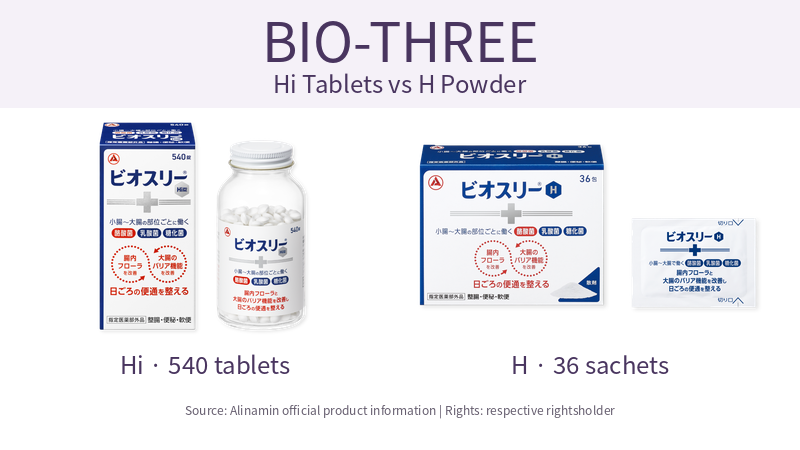
Save these Japanese names to show the pharmacist:
Name used here
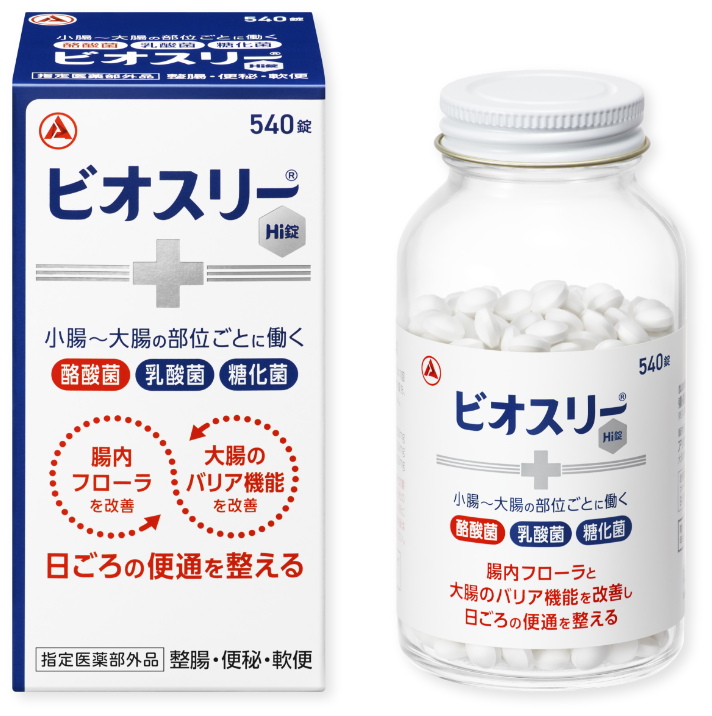
Hi tablets
- Full Japanese product name
- ビオスリーHi錠
- What to look for
- “Hi錠”; bottles or a 42-tablet blister pack
H powder
- Full Japanese product name
- ビオスリーH
- What to look for
- “H” and “散剤”; 36 sachets, 1 g each
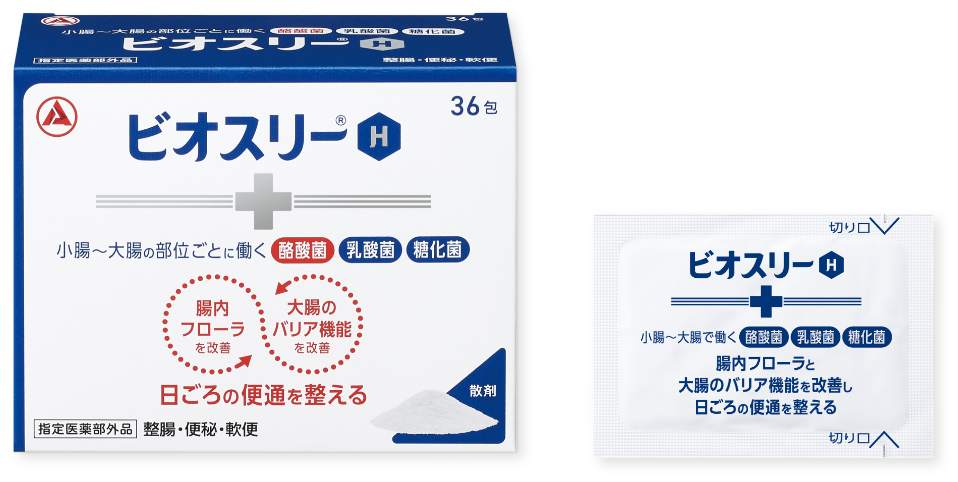
Both use blue-and-white packaging, so check the letters and dosage form rather than colour alone. The current official range lists Hi packs of 42, 90, 180, 270 and 540 tablets. Online channels may have other pack sizes. A larger pack does not indicate a stronger product.
This guide covers these Japanese retail products. Do not transfer the doses to prescription BIO-THREE or similarly named products sold in other countries.
Are the ingredients different?
At the labelled adult daily dose, both contain the same listed amounts of three active bacterial ingredients: butyrate-producing bacteria 150 mg, lactomin (lactic acid bacteria) 30 mg and saccharifying bacteria 150 mg. That means six Hi tablets compared with three H sachets. These are ingredient weights, not a count of live organisms.
The official explanation assigns different roles to the three: butyrate production supports the mucus barrier in the large intestine; lactic acid bacteria produce lactic acid and help butyrate-producing bacteria multiply; saccharifying bacteria help beneficial gut bacteria grow.
The manufacturer’s FAQ says the two forms do not differ in effect. There is no reason to interpret “Hi” as a stronger version. Their inactive ingredients do differ: both contain lactose hydrate and potato starch, while the tablets also contain cellulose, hydroxypropylcellulose, anhydrous silica, talc and magnesium stearate. Milk allergy concerns milk proteins. The manufacturer notes that lactose may contain tiny traces of milk protein, which can matter for highly sensitive people. If you have a milk allergy, particularly a severe one, check with a clinician before use.
My shelf-selection tip: focus on age, ease of taking the product and following its directions. The name and pack size are less useful guides.
How much should you take?
Age
15 years and over
- Hi tablets: amount per dose
- 2 tablets
- H powder: amount per dose
- 1 sachet
5 to under 15 years
- Hi tablets: amount per dose
- 1 tablet
- H powder: amount per dose
- Half a sachet
3 months to under 5 years
- Hi tablets: amount per dose
- Do not use
- H powder: amount per dose
- Half a sachet
Under 3 months
- Hi tablets: amount per dose
- Do not use
- H powder: amount per dose
- Do not use
Every permitted dose above is taken three times daily after meals. Children need adult supervision. Do not crush Hi tablets to make a substitute for H powder for a child under 5, or take a full dose of both forms together.
The official FAQ allows Hi tablets to be chewed; the age limit still applies. With the 42-tablet pack, push each tablet out of its blister before taking it. Never swallow the packaging.

For babies, the manufacturer’s FAQ allows H powder to be licked directly or mixed with a little water. Ask a pharmacist to demonstrate if unsure. Do not mix the powder into milk, juice or yogurt: the manufacturer says it has not confirmed the effects of mixing with foods and drinks and recommends water.
After using half a sachet, fold its opening over and use the remainder within two days, as directed on the box. Keep the original box for its instructions.

Pack size and storage matter too
Keep both products cool, dry, out of direct sunlight and away from children. Do not transfer them to another container.
For Hi bottles, remove the protective packing from the top after opening and write down the opening date. Close the cap tightly after every use and aim to use the contents promptly within six months of opening. For the 42-tablet pack, the corresponding period is three months after opening the inner aluminium bag. Neither period extends the printed expiry date.
Before choosing the largest bottle, consider how much you will actually use and how you will store it.
When should you get advice?
If you are receiving medical treatment, ask a doctor or pharmacist before use. If symptoms have not improved after about a month, stop and seek advice, taking the Hi leaflet or H box with you.
Seek emergency care immediately for sudden, severe abdominal pain. Get urgent medical advice for bloody stools, repeated vomiting that prevents you keeping fluids down, or signs of dehydration such as reduced urination. Babies who stop feeding or have fewer wet nappies need prompt assessment; do not wait a month. Suspected food poisoning or infectious gastroenteritis also needs medical assessment.
Quick questions
Is H powder just for children?
No. It has an adult dose, so adults who prefer powder can consider it too.
Does Hi work faster?
The manufacturer does not rank these forms by speed or strength. Do not increase the dose or expect a guaranteed time to benefit.
Will it prevent travellers’ diarrhoea?
That is not a labelled indication. Keep food hygiene and hydration in mind while travelling, and ask for advice if symptoms develop.
Official references
This is a guide to Japanese retail labels; follow your own pack and advice from your healthcare professional.