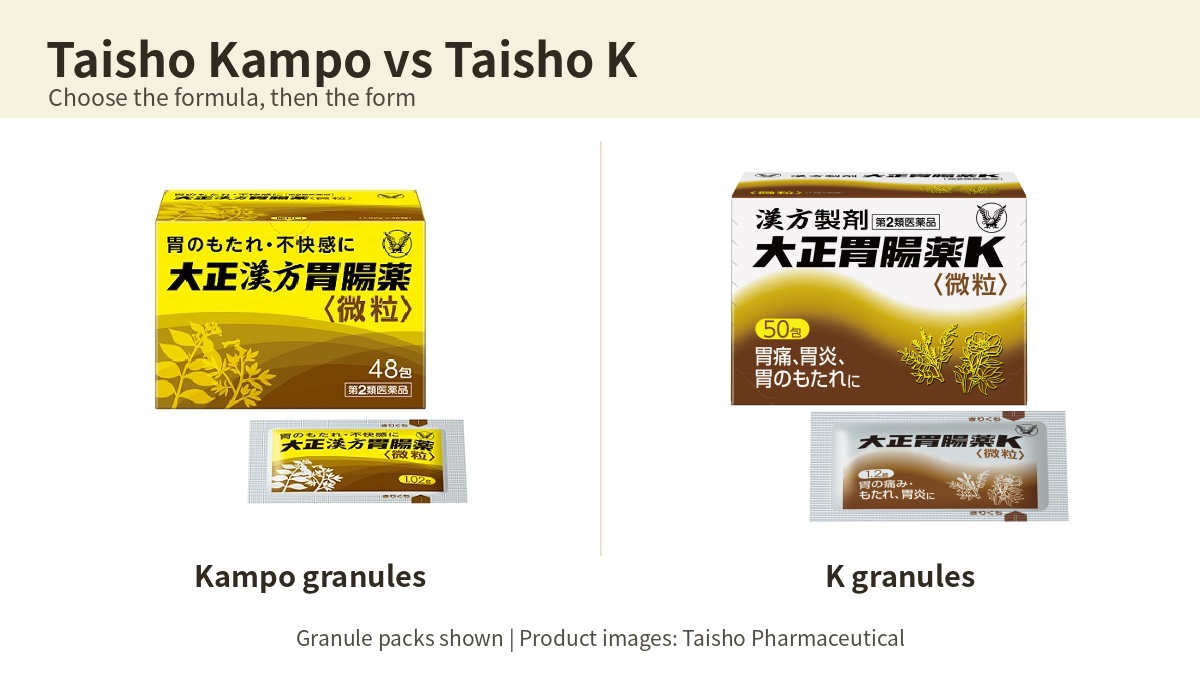
The yellow Taisho Kampo box and the white-and-gold Taisho K box can look like a simple choice between standard and stronger stomach medicine. Add granules and tablets, and the shelf becomes harder to read.
Make two decisions in order: check which formula and precautions fit your situation, then choose its granules or tablets. Within each family, the labelled active amounts match at the equivalent adult dose. K contains more Shakuyakukanzoto extract, but that number alone cannot tell you which medicine is appropriate.

I’m Irene, a Taiwan-born, Japan-licensed pharmacist working in a Japanese drugstore. Let’s separate the letters and dosage forms so the packaging becomes easier to navigate.
Sources checked: 12 October 2026. This guide covers Japan-market products. All four are Japanese Class 2 OTC medicines.
Check these safety conditions before choosing
- Seek emergency care for sudden or severe abdominal pain, vomiting blood or coffee-ground-like material, black tarry stools, chest pain or collapse. Do not assume these are stress-related stomach symptoms.
- Pain that persists, keeps returning or worsens, difficulty swallowing, or unexplained weight loss needs medical assessment.
- None of these four products is for children under 5. All four require consultation with a doctor, pharmacist or registered OTC salesperson before use if you are receiving medical treatment.
- K specifically also requires pre-use consultation for older people, people with swelling, and those diagnosed with high blood pressure, kidney disease or heart disease. Check this before switching to K.
- If you are pregnant, breastfeeding or taking other stomach medicines or Kampo products, ask a healthcare professional to check your complete medicine list. A missing warning does not establish suitability for your circumstances.
A short route through the shelf
Comparing medicines for a usually weak stomach, heaviness or poor appetite? The usual Taisho Kampo family is presented by the manufacturer for that context. Its labelled uses also include stomach pain, so pain relief is not exclusive to K.
Considering K? Check its additional consultation conditions first. K is labelled for stomach pain, gastritis, heaviness and other stomach symptoms, but stress around a meal does not diagnose the cause of pain. More severe pain is a reason to reassess, not automatically a reason to choose K.
Once the formula is suitable: choose granules if you prefer sachets and can tolerate the powder’s flavour; choose the matching tablets if you prefer swallowing tablets and can do so safely. Both forms are taken with water or lukewarm water.
Four products, arranged as two formula families
| Formula family | Granules: Japanese pack name | Tablets: Japanese pack name |
|---|---|---|
| Usual Taisho Kampo | 大正漢方胃腸薬〈微粒〉 | 大正漢方胃腸薬〈錠剤〉 |
| Taisho K | 大正胃腸薬K〈微粒〉 | 大正胃腸薬K〈錠剤〉 |
Taisho Kampo granules: the yellow sachet pack
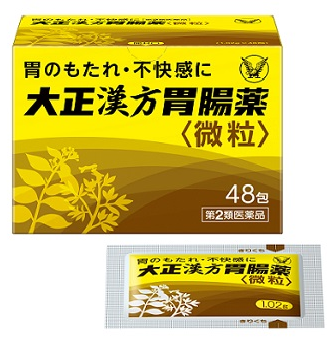
Look for 大正漢方胃腸薬 and 微粒. Each sachet weighs 1.02 g; one sachet is the dose for ages 15 and over. The manufacturer lists 12-, 20-, 32- and 48-sachet packs. Individual sachets make the dose easy to identify, but keep the outer packaging and directions.
Taisho Kampo tablets: the matching tablet formula
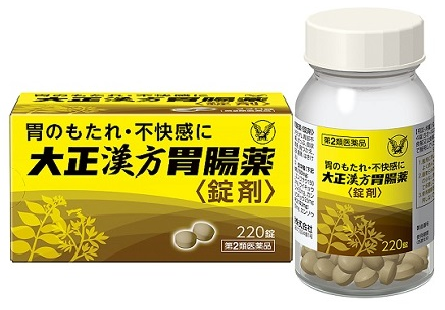
Look for 錠剤. Four tablets, rather than one, contain the same labelled active amounts as one usual-formula sachet. Listed pack sizes are 60, 100, 160 and 220 tablets. Excipients differ between the forms, so check the complete ingredients if you have an allergy or a relevant dietary restriction.
Taisho K granules: find the K and check its precautions
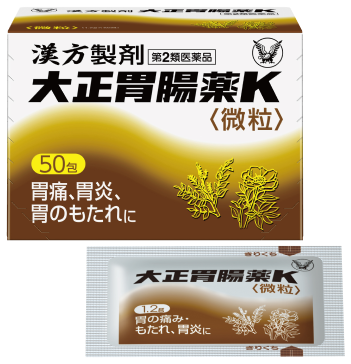
The white-and-gold box has a prominent K. Each sachet weighs 1.2 g; one sachet is the dose for ages 15 and over. Listed sizes are 16, 24, 38 and 50 sachets. Before choosing this family, review the additional warnings related to age, medical conditions and licorice-associated adverse effects below.
Taisho K tablets: K in a bottle
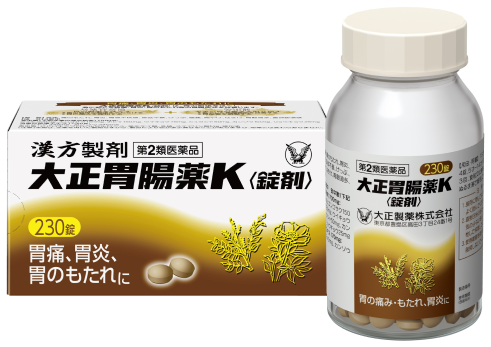
Four tablets provide the same labelled active amounts as one K sachet. Look for 110- or 230-tablet packs when comparing current sizes. The manufacturer says production of the 70- and 190-tablet packs has ended, with sales ending when remaining stocks run out. That does not mean the entire K tablet product is discontinued, and it does not confirm stock at any store.
What actually changes in the formula?
These amounts are per adult dose: one sachet or four matching tablets, not per day.
| Active preparation per dose | Usual Taisho Kampo | Taisho K |
|---|---|---|
| Anchusan mixed crude-drug powder | 700 mg | 700 mg |
| Shakuyakukanzoto extract | 140 mg | 170 mg |
The Anchusan portion is the same in both families: cinnamon bark 200 mg, corydalis tuber 150 mg, oyster shell 150 mg, fennel 75 mg, shukusha (Amomum) 50 mg, licorice 50 mg and lesser galangal rhizome 25 mg.
For the Shakuyakukanzoto extract, the source amounts are 280 mg each of peony and licorice in the usual formula, versus 340 mg each in K. These describe the starting crude drugs used for the extract; do not add them to the extract weight as extra ingredients. At three adult doses daily, the extract totals 420 mg in the usual family and 510 mg in K.
The practical distinction: changing form within a family changes how you take the medicine. Changing from the usual family to K changes the ingredient balance and the listed precautions. The amounts do not establish that K works better for everyone or that granules act faster than tablets.
The two families share many labelled uses, including stomach heaviness or discomfort, gastritis, stomach pain, poor appetite, belching, abdominal bloating, heartburn, excess stomach acid, abdominal pain and nausea. The usual family additionally lists 胸つかえ, a blocked or full feeling in the chest. Actual chest pain belongs to the emergency guidance above and should not be self-labelled as indigestion.
Dose and timing: the same age bands for all four
| Age | Granules per dose, either family | Tablets per dose, either family |
|---|---|---|
| 15 and over | 1 sachet | 4 tablets |
| 5–14 | Half a sachet | 2 tablets |
| Under 5 | Do not take | Do not take |
Take the appropriate dose three times daily, before or between meals, with water or lukewarm water. The Japanese term 食間 means between meals, with roughly 2–3 hours after a meal given as a guide. It does not mean during a meal. K packaging also specifies roughly 30–60 minutes before a meal. Children need parental supervision; ask a pharmacist if a child cannot safely swallow tablets.
Do not stack the usual and K products, or treat matching granules and tablets as separate medicines to take together. Other Kampo medicines may also contain licorice, so have a pharmacist check combinations.
When to stop, and how to keep the medicine
All four labels say to stop and consult if symptoms have not improved after about a month. This is not a reason to wait a month with ongoing stomach pain. Worsening, recurring or concerning symptoms need earlier assessment. K additionally says to consult about prolonged continuous use.
Stop and seek advice for a rash, redness or itching after taking a dose. All four labels warn about rare liver dysfunction. Possible signs include fever, rash, jaundice, brown urine, marked tiredness and loss of appetite; stop taking the medicine and obtain medical assessment immediately if these occur.
K also lists pseudoaldosteronism and myopathy as rare serious reactions. Symptoms include limb heaviness, numbness, tightness or stiffness, together with progressively worsening weakness or muscle pain. Stop and seek medical care immediately. The usual family’s leaflet does not list those warnings in the same way; that does not make combinations with other licorice-containing products risk-free.
For either granule product, fold the opening of a partly used sachet and use the remainder within two days. Keep either tablet bottle tightly closed and use it within six months after opening, without exceeding the printed expiry date. On first opening, discard the bottle seal and packing material as directed. Do not return tablets touched with wet hands to the bottle. Store away from sunlight, heat and moisture, out of children’s reach, in the original container.
Questions worth asking before checkout
Can I take a Kampo stomach medicine every day for maintenance?
These are medicines with defined uses, doses and adverse effects. A large pack is not a reason for long-term use. Repeatedly needing stomach medicine deserves a check of the underlying cause.
Do these instructions cover Active, Sowa or other Taisho stomach medicines?
No. The manufacturer marks Active tablets, Active granules and Sowa (爽和) as production-ended products. Taisho G, P, Balancer and the oral liquid are also different formulas. Do not transfer the doses in this guide to them.
What should I tell the pharmacist?
Explain where the discomfort is, how long it has lasted, whether it returns and which medicines you take. Once a formula is appropriate, choose the form you can take accurately. For another brand comparison, see Ohta’s Isan S versus A. The Gaster10 dosage-form guide covers a different type of stomach medicine and its restrictions; do not combine products on your own.
Sources
- Taisho Pharmaceutical: usual granules, usual tablets, K granules and K tablets. Each page links the Japanese leaflet or container/package information. Japanese directions govern this guide.
- Taisho Pharmaceutical: Kampo stomach medicine catalogue. Product images come from the official product pages above.
- NHS: Stomach ache, for abdominal-pain referral signs.
This guide helps identify Japanese products and their directions; it cannot replace an individual assessment. Always read the full label supplied with your pack.