Checked October 11, 2026 | Products sold in Japan
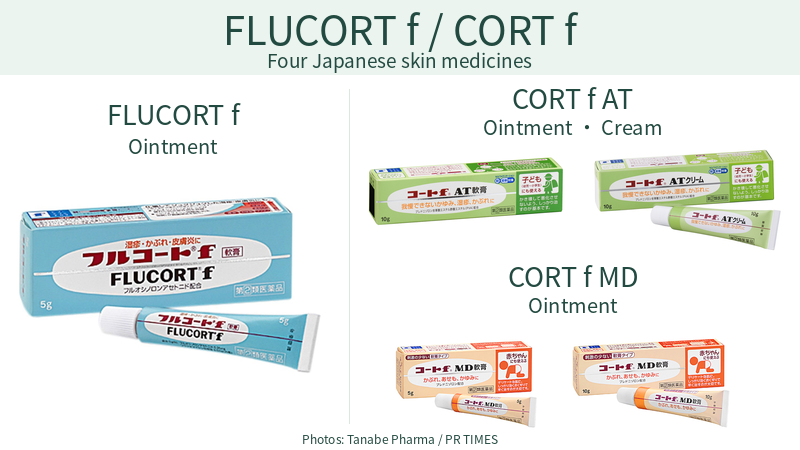
The blue FLUCORT f, green CORT f AT and orange CORT f MD packs differ in steroid strength, additional ingredients and suitable uses. AT also comes as an ointment and a cream, making four products to recognise on the drugstore shelf.
FLUCORT f combines a stronger steroid with an antibiotic. AT adds ingredients for itching, pain and antiseptic action. MD contains a weaker steroid. Start with the skin problem and body area, then consider the person using it, rather than choosing solely by the age pictured on the box.

I’m Irene, a Taiwan-born, Japan-licensed pharmacist working in a Japanese drugstore. Let’s start with the affected area and formulation, then match the right box. If AT is suitable for your skin problem, the cream is worth considering for a dry area when you prefer a less greasy feel; the ointment offers a more protective, oily base. For FLUCORT f’s antibiotic-containing formula, or MD for a baby or delicate body area, talk through the symptoms with a pharmacist before choosing.
Ask a doctor or pharmacist first if the area is extensive, severely weeping or eroded, or you are unsure whether the problem is eczema, a fungal infection or something else. Chronic conditions such as atopic dermatitis and psoriasis need an appropriate treatment plan, rather than repeated courses of different OTC creams.
The four products at a glance
These are Japanese topical-steroid ranks. “Strong,” “Mild” and “Weak” describe potency, not which medicine is best for everyone.
| Product | Japanese steroid rank | Main formulation differences | Form and sizes |
|---|---|---|---|
| FLUCORT f | Strong | Steroid plus antibiotic | Ointment; 5 g, 10 g |
| CORT f AT ointment | Mild | Steroid, lidocaine, antiseptic and vitamin E derivative | Ointment; 10 g |
| CORT f AT cream | Mild | Same active ingredients and concentrations as AT ointment | Cream; 10 g |
| CORT f MD ointment | Weak | Steroid plus glycyrrhetinic acid | Ointment; 5 g, 10 g |
All four contain a steroid and are designated Class 2 OTC medicines in Japan.
Match the Japanese name on the box
Blue: FLUCORT f ointment
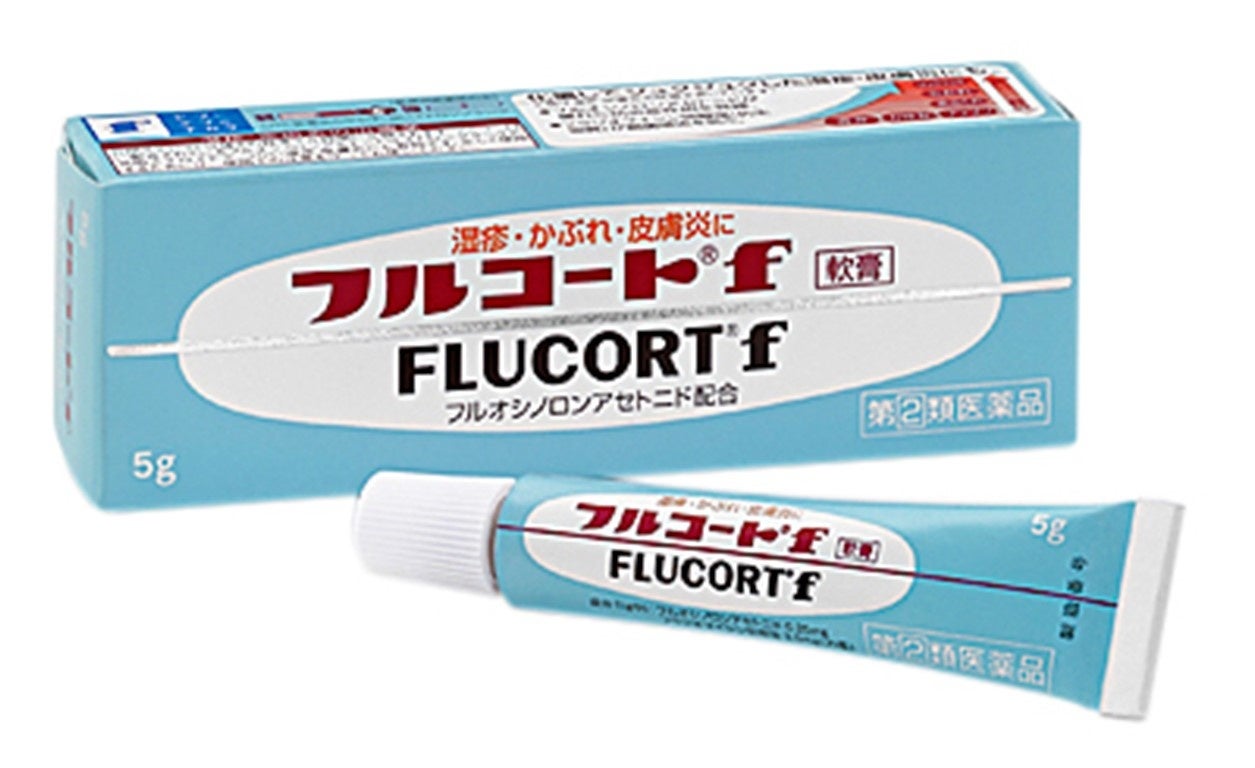
Look for フルコートf, FLUCORT f and 軟膏, meaning ointment. This guide covers the Japanese OTC product. Similarly named medical-use preparations have their own instructions.
Green: CORT f AT ointment or cream
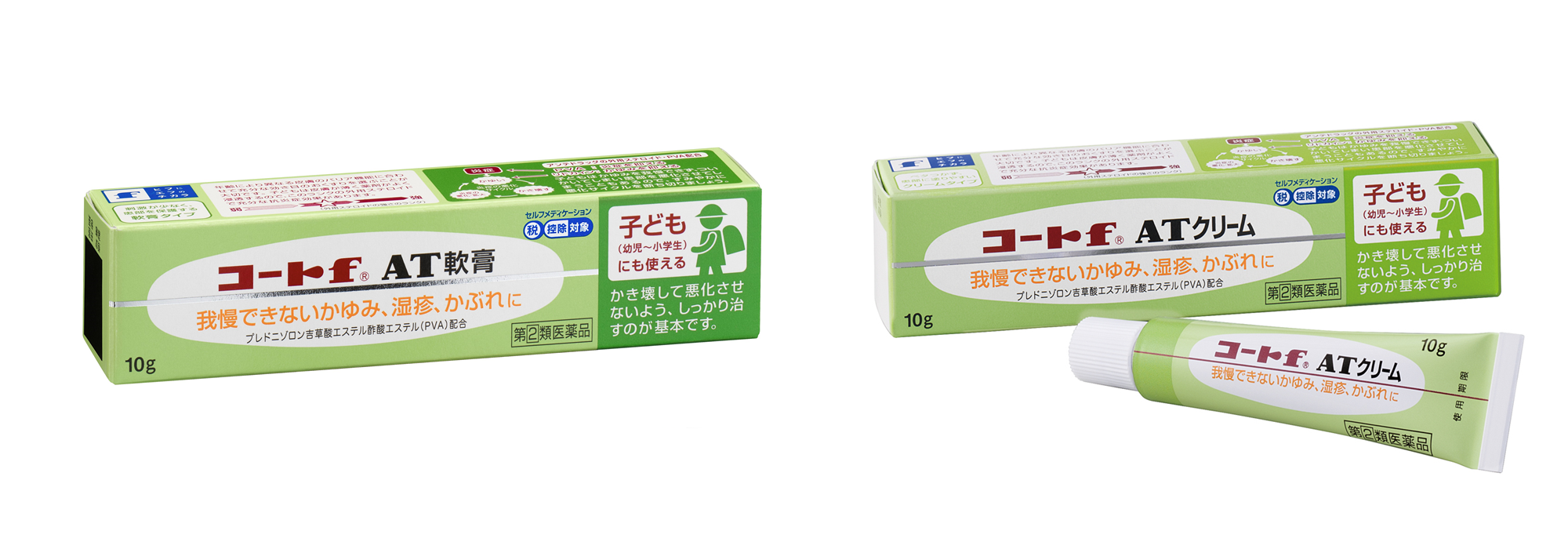
コートf AT軟膏 is the ointment; コートf ATクリーム is the cream. Check the ending rather than relying on the green colour.
Orange: CORT f MD ointment
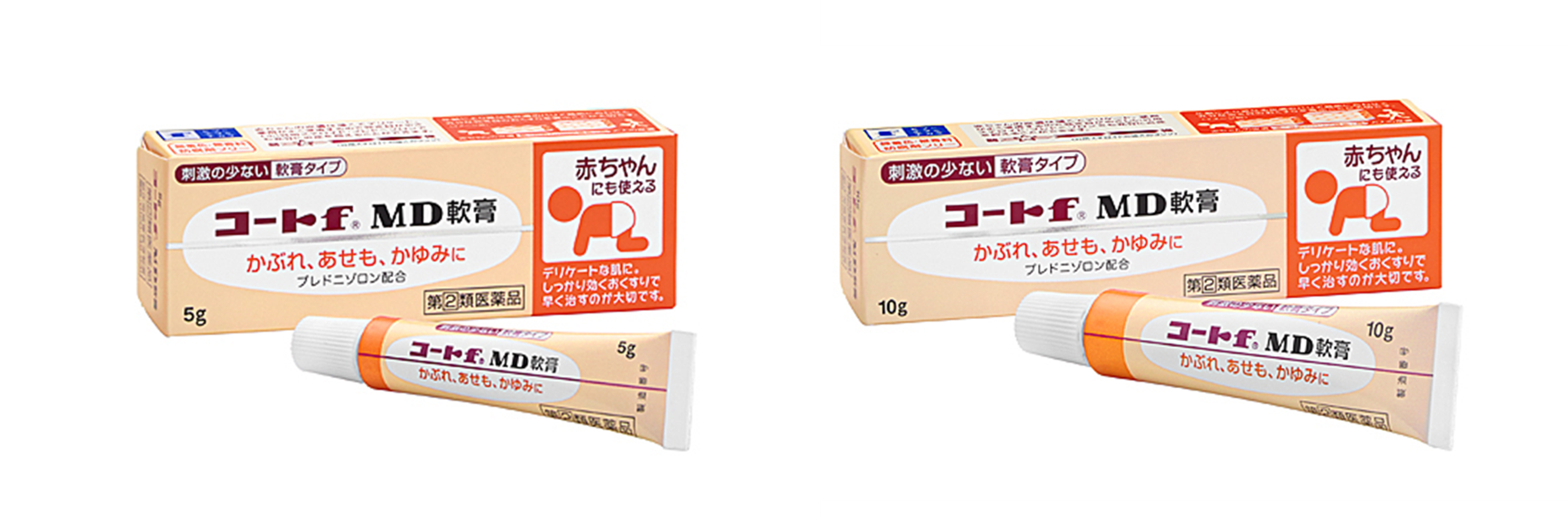
Look for コートf MD軟膏. Its baby illustration does not mean it is exclusively for babies. Packaging may change, so check the complete product name and formulation.
Ingredients: antibiotic and antiseptic are different
Amounts below are per 1 g of medicine, not per application.
- FLUCORT f: fluocinolone acetonide 0.25 mg, an anti-inflammatory steroid; fradiomycin sulfate 3.5 mg (potency), an antibiotic.
- Both AT forms: prednisolone valerate acetate (PVA) 1.5 mg; lidocaine 10 mg for itching and pain; isopropyl methylphenol (IPMP) 1 mg for antiseptic action; tocopherol acetate 5 mg, a vitamin E derivative.
- MD: prednisolone 2.5 mg and glycyrrhetinic acid 5 mg, both used to reduce inflammation.
You cannot compare different steroids by their milligram numbers alone. MD has a larger prednisolone number but remains in a weaker potency category than FLUCORT f.
What is FLUCORT f labelled for?
Its Japanese indications include eczema, dermatitis, heat rash, contact rash, chilblains, insect bites and hives accompanied by suppuration, plus suppurative skin diseases such as impetigo, facial boils and folliculitis. A blister or red patch alone does not establish one of these diagnoses.
Severely weeping or eroded skin is an exclusion even for FLUCORT f. Do not use it for chickenpox or fungal infections such as athlete’s foot. The antibiotic does not make it suitable for every infection.
What about AT and MD?
AT is labelled for eczema, dermatitis, contact rash, itching, insect bites, heat rash and hives. MD also lists chilblains. Both prohibit use on suppurating lesions. AT’s antiseptic ingredient does not override that warning or make it interchangeable with an antibiotic-containing product. None of the four should be used on chickenpox, athlete’s foot or other ringworm lesions.
AT ointment or cream?
Ointment is more protective and greasy, and can suit dry or mildly wet skin. Cream feels less greasy and mainly suits dry areas; it is not suitable for wet or weeping skin and may cause irritation. Severe weeping or erosion needs professional advice rather than simply switching to ointment.
The active concentrations are identical in the two AT forms. A lighter feel is not a reason to apply more. PVA is an “antedrug” steroid that becomes less active after absorption into the body, but it still has precautions and limits on self-treatment.
Children, babies and facial skin
The manufacturer presents AT as an option for children and MD for babies and some delicate adult skin areas. These are selection pointers, not exclusive age bands. The four leaflets do not specify numerical minimum ages; children must use them under a guardian’s supervision. The manufacturer also recommends gentler alternatives to FLUCORT f for babies and younger children, whose skin barrier is less mature; ask a pharmacist to check the choice against the affected area and symptoms.
A baby’s diaper rash can be a yeast infection rather than simple irritation. MD must not be used for candidiasis. Rash extending into skin folds, extensive involvement, pain or persistent symptoms warrants assessment.
Facial use needs particular care:
- FLUCORT f: consult before applying to the face, lips or mucous membranes. Do not use in or around the eyes.
- AT: do not use around the eyes or on mucous membranes.
- All four: no broad facial application or prolonged continuous use.
Do not choose MD for an unexplained eyelid or genital rash just because it is weaker. Ask a professional to identify what needs treating.
How often, how much and for how long?
| Product | Labelled application frequency |
|---|---|
| FLUCORT f | An appropriate amount once to several times daily |
| AT ointment and cream | An appropriate amount several times daily |
| MD ointment | An appropriate amount 1–4 times daily |
Apply to the affected area without vigorous rubbing. Do not use as routine prevention or an all-over moisturiser.
The manufacturer’s fingertip-unit guide uses a 5 mm tube opening: a line from the tip of an adult’s index finger to its first crease is about 0.5 g and covers roughly two adult palm-sized areas. A narrow tube opening produces a different amount for the same length. Ask a pharmacist to demonstrate if unsure.
Separately, an area exceeding two to three of the patient’s own palms calls for consultation. Use the child’s or baby’s palms when estimating their affected area. This area threshold is different from the adult fingertip-unit guide.
Stop and consult if there is no improvement after 5–6 days. If symptoms worsen, do not wait that long. Do not self-treat for more than one week. New rash, itching, irritation, swelling or suppuration also needs a stop-and-consult response. A weaker steroid is not intended for indefinite use, and buying all three strengths is not a substitute for a treatment plan.
Before you buy
For all four, consult first if you are receiving medical treatment, are pregnant or may be pregnant, have a medicine-allergy history, or have extensive affected areas. For severely weeping or eroded skin, FLUCORT f must not be used; AT and MD require consultation before use. FLUCORT f additionally requires consultation for older adults, deep wounds and severe burns. Do not use FLUCORT f if you have previously reacted to that medicine, antibiotics or corticosteroids.
When FLUCORT f is used in the diaper area, its leaflet warns against tight diapers or occlusive pants. It also says to avoid contact with latex rubber products. All four are for external use only. Rinse accidental eye contact immediately with water or lukewarm water; seek eye care if symptoms are severe.
CORT f Hepamedi and Hepamedi HD are separate moisturising medicines, rather than another strength in this steroid comparison. Before paying, check the full Japanese name, formulation and expiry date. Tell the pharmacist the user’s age, affected area and symptoms so the advice fits the situation.
This guide explains Japanese-market products and cannot diagnose an individual skin condition. Follow the leaflet supplied with your pack and your healthcare professional’s instructions.
Sources
- Tanabe Pharma: FLUCORT f product details and leaflet
- Tanabe Pharma: CORT f AT product details, ointment leaflet, cream leaflet and formulation guidance
- Tanabe Pharma: CORT f MD product details, leaflet and use guidance
- Tanabe Pharma: FLUCORT f age and use FAQ