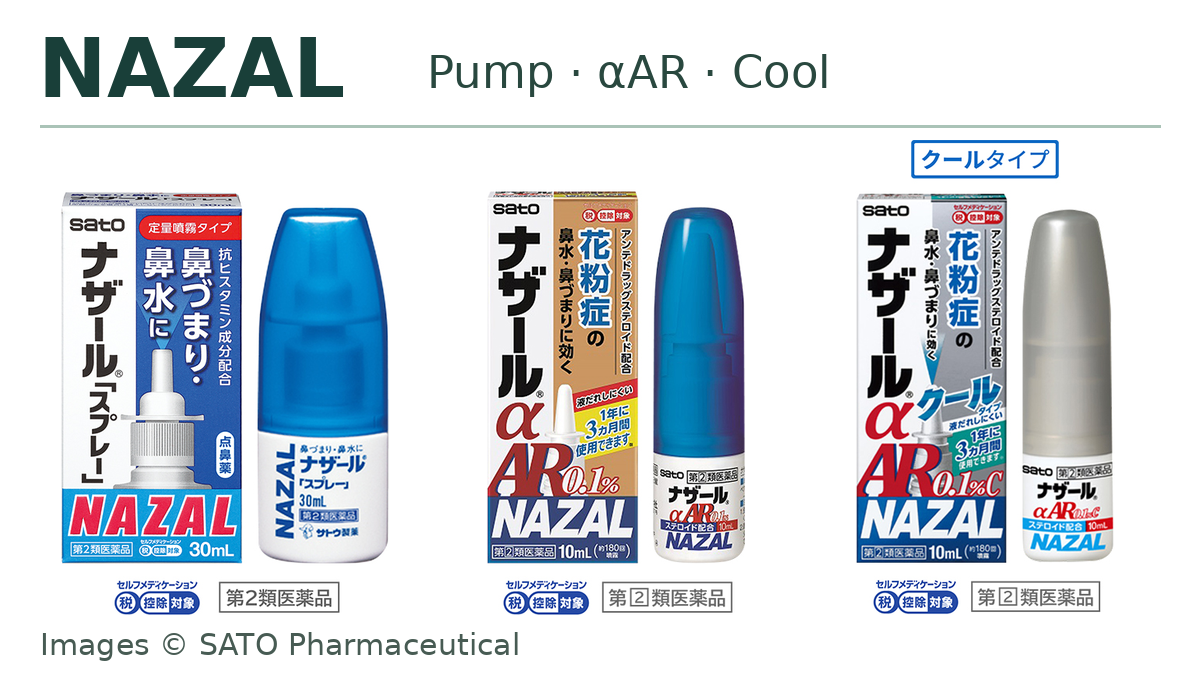
Several boxes say NAZAL, but they do not all treat the same kind of blocked nose. Start with the cause of your symptoms and your age, then decide whether you want a cooling sensation.
Information checked: 12 October 2026. This guide covers the Japanese-market products.
 I’m Irene, a Taiwan-born, Japan-licensed pharmacist working in a Japanese drugstore. Let’s look at the words on each box and separate the number of sprays from the number of times you use them.
Which type should you consider?
- Short-term relief of a blocked or runny nose: the regular NAZAL pump spray contains a nasal decongestant. Its label covers symptoms caused by allergic rhinitis, acute rhinitis or sinusitis, from age 7. It must not be used continuously for a long period. Relieving sinus symptoms does not mean treating their underlying cause. Pregnancy or possible pregnancy, medical treatment and chronic conditions call for checking the consultation precautions below before choosing it.
- Confirmed seasonal pollen allergy: NAZAL αAR0.1% and αAR0.1%C are steroid nasal sprays for adults aged 18 and over who meet their safety conditions. They are usually used morning and evening. These Japanese products are not labelled for colds or every form of year-round nasal allergy.
- Regular αAR or Cool? Choose by your preference for cooling, after checking suitability. They have the same active ingredient and labelled dose. Cool is not a higher-strength version.
Do not self-select αAR if you are under 18, pregnant or possibly pregnant. The Japanese leaflets also prohibit use with diagnosed hypertension, diabetes, asthma, glaucoma, recurrent nosebleeds, infections, tuberculosis-related disease or systemic fungal infection; a pus-forming infection at the nostril; a previous allergic reaction to this product or another beclometasone dipropionate product; or three months or more of steroid nasal-spray use in the past year. These are the rules for these OTC products. Do not stop or switch prescribed treatment yourself.
The three options at a glance
- Product
- Regular Pump
- Labelled use
- Nasal symptoms from allergic rhinitis, acute rhinitis or sinusitis
- Age
- 7+
- Routine and feel
- Short-term symptom relief; designed to sting less
- Product
- αAR0.1%
- Labelled use
- Seasonal pollen allergy
- Age
- 18+
- Routine and feel
- Usually morning and evening; regular version
- Product
- αAR0.1%C
- Labelled use
- Seasonal pollen allergy
- Age
- 18+
- Routine and feel
- Usually morning and evening; cooling version
Use this table to distinguish their purposes. Spray counts, intervals and duration limits are below. Meeting the age limit does not override the precautions above.
Recognize the three boxes
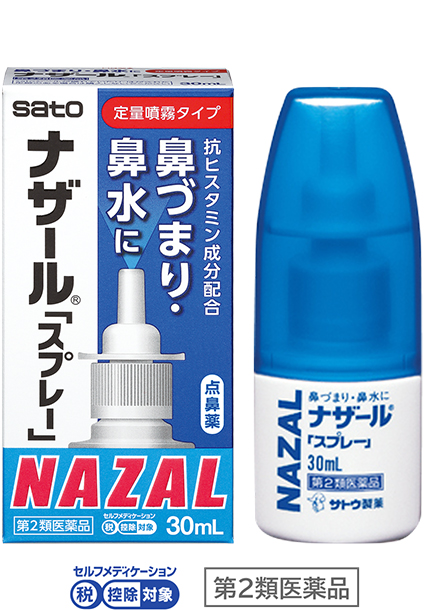
Regular NAZAL Spray Pump
Look for: ナザール「スプレー」(ポンプ)
The official image shows a blue-and-white 30 mL box with red NAZAL lettering. Its active ingredients are naphazoline hydrochloride, chlorpheniramine maleate and benzalkonium chloride. Naphazoline constricts blood vessels in the nasal lining; chlorpheniramine is an antihistamine.
Think of this as a short-term symptom-relief option, rather than a bottle to use routinely until empty. The word “pump” alone is not enough to identify it: the αAR bottles also have a pump mechanism.
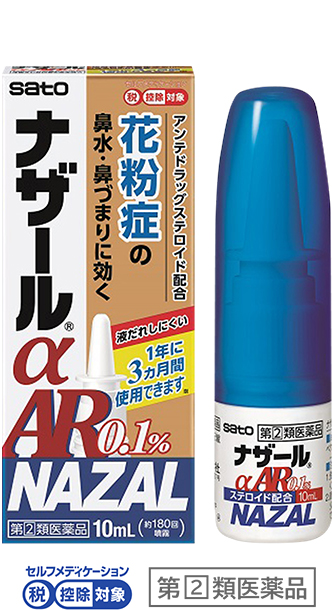
NAZAL αAR0.1%: the regular seasonal-allergy version
Look for: ナザールαAR0.1%<季節性アレルギー専用>
The official image shows a gold-toned 10 mL box. The active ingredient is beclometasone dipropionate, a corticosteroid used here for pollen-related blockage, runny nose and sneezing. The usual schedule is twice daily.
The manufacturer describes this version as less likely to sting in the nose. That does not guarantee irritation-free use. Its leaflet also lists menthol among the additives, so do not choose it on the assumption that it is menthol-free.
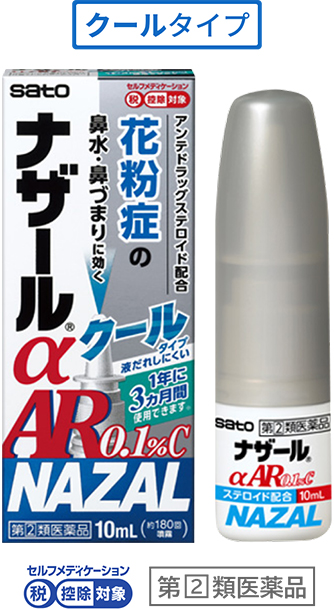
NAZAL αAR0.1%C: the cooling seasonal-allergy version
Look for: ナザールαAR0.1%C<季節性アレルギー専用> and クールタイプ
The official image shows a silver-and-blue 10 mL box. This has the same active ingredient, concentration, age restriction and directions as regular αAR. The cooling sensation is a preference, not a measure of effectiveness. Do not keep spraying through irritation or nosebleeds because you think a stronger sensation means better treatment.
Product images: official Sato Pharmaceutical product pages, © SATO Pharmaceutical. Match the full name, size and enclosed leaflet when buying. Individual store stock has not been checked.
Sprays per dose and doses per day are different
Regular pump spray
- Age 7 and over: spray 1–2 times into the nasal cavity per application, no more than 6 applications a day, with at least 3 hours between applications.
- Under 7: do not use. Children need a parent or guardian’s supervision.
- Six applications per day does not mean six sprays at once, and the maximum is not a target.
- Do not use continuously for a long period. Overuse can actually cause nasal blockage. If symptoms have not improved after about 3 days, stop and consult a doctor, pharmacist or registered medicine seller.
Both αAR versions
- Age 18 and over: usually one spray into each nostril, twice a day, morning and evening.
- The label permits adjustment up to four applications a day, eight sprays in total, at least 3 hours apart. Four daily applications are a ceiling, not the normal starting schedule.
- Reduce frequency when symptoms improve. If they worsen again, frequency may be increased within those limits.
- If there is no improvement after about one week, stop and seek professional advice.
- Do not exceed three months of use in a year, counting other steroid nasal sprays too. If treatment is needed for longer, see an ear, nose and throat specialist.
The regular spray is for short-term symptom relief; αAR is usually used on a regular schedule during the relevant allergy period. Do not replace that schedule with continuous decongestant use all season.
How to use the bottles
Regular pump spray
- Blow your nose to clear the passages and remove the cover.
- Before first use, hold the nozzle upward and press several times until a mist appears.
- Keep the bottle upright, insert the nozzle straight into the nostril and spray while breathing in gently. Stay within the labelled dose.
- Wipe the nozzle with a tissue and replace the cover.
Both αAR versions
- Check for a pus-forming infection at the nostril. If present, do not use.
- Blow your nose gently.
- Shake the bottle gently before removing the cap. Hold it as illustrated below. On first use, prime it until a mist appears.
- Keep it upright and place the nozzle gently in the nostril. Do not point it toward the nasal septum, the wall between the nostrils. Spray once into each nostril.
- Wipe the part that touches your nose and replace the cap. Rinse your mouth if you taste the medicine.
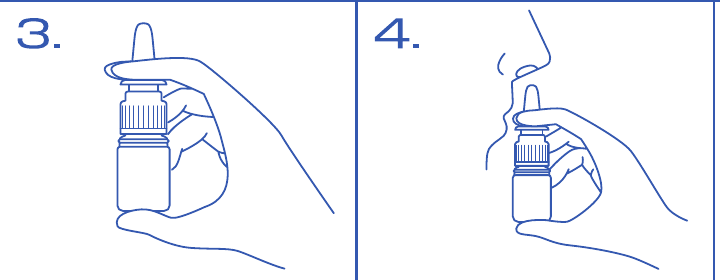
The left illustration shows the grip; the right shows the upright bottle during spraying. Shake gently beforehand and keep the nozzle away from the nasal septum. Illustration: Sato αAR leaflet, © SATO Pharmaceutical.
For the manufacturer’s illustrations, see page 2 of the regular pump leaflet or αAR leaflet. Do not use either bottle sideways, poke the nozzle with a pin, or share it with someone else.
When to ask before buying
Regular pump spray: consult first if you are receiving medical treatment, pregnant or possibly pregnant, have had an allergic reaction to a medicine or similar substance, or have hypertension, heart disease, diabetes, a thyroid disorder or glaucoma. Notice the difference: hypertension, diabetes and glaucoma require consultation for the regular spray, but are listed as reasons not to use these OTC αAR products.
Both αAR versions: consult first if breastfeeding, older, receiving medical or allergy treatment, prone to medicine allergies, affected by hypertrophic rhinitis or nasal polyps, or receiving long-term or high-dose systemic steroid treatment. Head, forehead or cheek pain with yellow or green mucus also needs assessment, as does uncertainty about whether the symptoms are seasonal allergy at all.
If you take an oral allergy medicine, cold medicine, another nasal spray or prescription medicine, show the pharmacist the packages or medicine list. The αAR leaflet also says not to follow this product with steroid nasal sprays unless a doctor has prescribed them and you follow that doctor’s directions. Changing brands does not reset the annual use limit.
When to stop or get medical help
For the regular spray, stop and consult if you develop a rash, redness, itching, nasal swelling or irritation.
For αAR, stop and seek advice for nosebleeds, nasal crusting, irritation, altered smell, pus-forming nasal or throat symptoms, rash, headache or dizziness, nausea or vomiting, diarrhoea, loss of appetite, asthma symptoms, eye pain or blurred vision, palpitations or raised blood pressure. New or unusual head or facial pain, or yellow or green mucus after use, also calls for stopping and assessment.
Sudden breathing difficulty, hoarseness, hives or confusion after αAR can indicate a serious allergic reaction. Get urgent medical help; do not wait for the one-week review point.
Questions you might have in the shop
Does one bottle of αAR last three months?
The wording about three months on the box refers to a use limit. The manufacturer describes the 10 mL bottle as approximately 180 sprays, or around 45 days at the usual twice-daily schedule of one spray per nostril. It is not a three-month supply. Priming and actual use can affect how long a bottle lasts.
Is Cool stronger?
No higher active-ingredient concentration is listed. Both αAR versions have the same active ingredient and dose; cooling does not establish better relief.
Can I buy αAR for a cold?
These Japanese αAR products are labelled for seasonal pollen allergy. A blocked nose alone does not make them suitable. Ask the pharmacist about an appropriate short-term option for your symptoms.
Can a child use a smaller adult dose?
Do not improvise a reduced dose. Regular NAZAL pump spray is not for under-7s, and both αAR versions are not for under-18s. If you are also comparing liquids, see the guide to children’s medicine syrups in Japan, without combining runny-nose medicines on your own.
Before buying, check the full name, the user’s age, whether pollen is the cause, medical conditions and current medicines. Those details matter more than the box colour.
Official sources
- Sato: regular NAZAL pump spray and leaflet
- Sato: NAZAL αAR0.1% and leaflet
- Sato: NAZAL αAR0.1%C and leaflet
This guide helps identify Japanese products; it cannot replace individual diagnosis or medication advice. Read the leaflet enclosed with your own product before use.