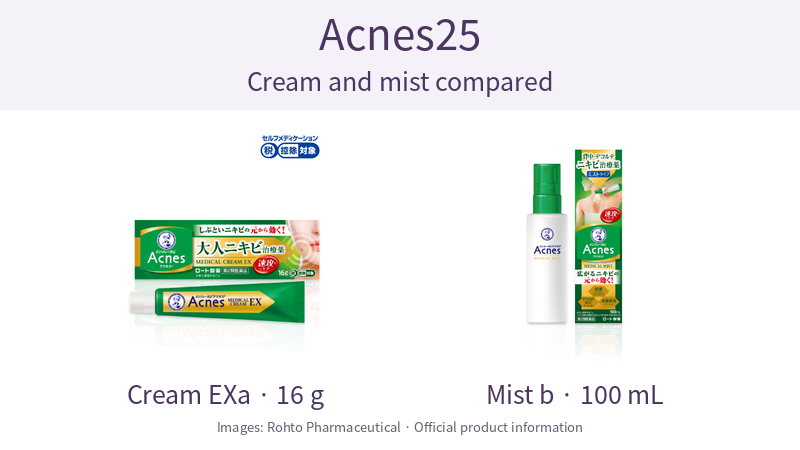
For a few noticeable red pimples that you want to treat precisely, start by looking at Acnes25 Cream EXa. For acne on your back or upper chest, Mist b offers an upside-down spray bottle that may be easier to handle.

I’m Irene, a Taiwan-born, Japan-licensed pharmacist working in a Japanese drugstore. Let’s match the two packages, then look at the ingredients and how you would actually apply them.
Product information checked: 11 October 2026 · Japanese-market versions.
Ask before buying if you are receiving medical treatment, have had an allergic reaction to medicine, or have a large affected area, severe weeping or raw skin, deep wounds or severe burns. The mist also requires advice first for severe acne with hard lumps. Speak to a doctor or pharmacist.
Compare the application, formula and schedule
Feature
Cream EXa
- Starting point
- Precise fingertip application to localised red pimples
- Main formula difference
- Contains anti-inflammatory ibuprofen piconol
- Directions
- Apply after cleansing, several times daily
- Facial use
- Apply to the pimples
- Seek advice if not improving
- After 5–6 days
- Fragrance
- Fragrance-free
Mist b
- Starting point
- Acne on the back or upper chest that is harder to reach
- Main formula difference
- Contains keratin-softening salicylic acid
- Directions
- Spray morning and evening
- Facial use
- Put on your hand first; never spray the face directly
- Seek advice if not improving
- After about 2 weeks
- Fragrance
- Fragranced
Both can be used for facial acne, with different application methods. The mist is neither prohibited on the face nor simply the cream’s formula in a liquid bottle. This comparison covers products sold in Japan.
Find the complete Japanese name
Cream EXa 16 g
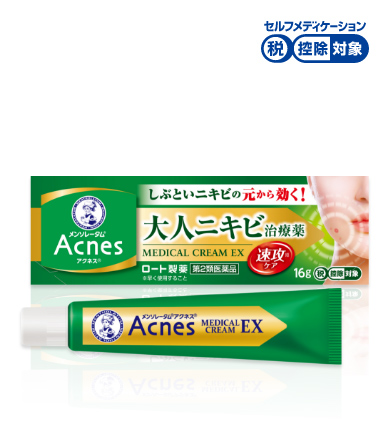
Official Japanese name: メンソレータムアクネス25メディカルクリームEXa
Look for a green carton and a white-and-green tube. The front shows “MEDICAL CREAM EX” and 16 g; match EXa in the full Japanese sales name. This fragrance-free, colourant-free cream becomes transparent when spread.
Mist b 100 mL
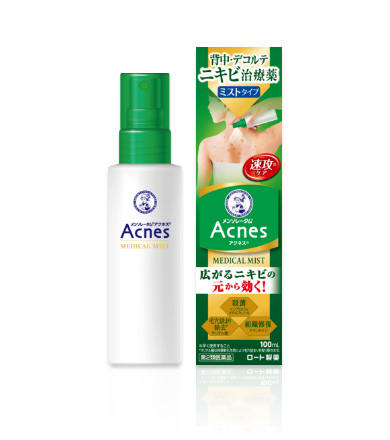
Official Japanese name: メンソレータムアクネス25メディカルミストb
Look for a white-and-green spray bottle with a green carton, marked 100 mL. Check the final b in the full Japanese name. The bottle works upside down. The formula is colourant-free and fragranced.
Both are Japanese Class 2 OTC medicines. These names identify the Japan-market products; an Acnes product sold elsewhere may have different ingredients or directions.
What the ingredients do
The following amounts are per 100 g of product, including the mist. Its 100 mL pack size does not change that ingredient denominator.
- Cream EXa: ibuprofen piconol 3 g for inflammation; isopropyl methylphenol, also called IPMP, 1 g for its antiseptic action; and allantoin 0.2 g to support repair of damaged skin tissue.
- Mist b: IPMP 0.3 g and allantoin 0.2 g, plus salicylic acid 0.5 g to soften keratin and help clear blocked pores. It does not contain ibuprofen piconol as an active ingredient.
That makes the cream a red-pimple-focused option and the mist an option with keratin-softening action and convenient body application. A higher amount of one ingredient does not establish which product will work better for you. Tissue repair is not a promise to remove established acne scars or pits. Both list ethanol among their other ingredients.
How to apply them
Before first use of either product, test a small amount on your inner arm overnight. Do not use it if a rash, redness, itching or other sensitivity appears the next morning.
Cream EXa: After washing your face with soap or another cleanser, apply an appropriate amount to the pimples several times daily. Use only on acne lesions, not broadly over the surrounding skin or as an all-over face cream.
Mist b: Spray an appropriate amount onto affected areas twice daily, morning and evening. You can hold the bottle upside down for your back. For facial acne, dispense it onto your hand first, then apply to the pimples. Never spray directly onto your face.
Both are for external use only. Keep away from the eyes and eye area. Rinse accidental eye exposure immediately with water or lukewarm water; seek eye care if symptoms are severe.
When to stop
- Cream EXa: stop and seek advice if there is no improvement after 5–6 days. Stop immediately and seek advice for rash, redness, itching, stinging, swelling, or dryness or a tight feeling.
- Mist b: stop and seek advice if there is no improvement after about 2 weeks. Stop immediately and seek advice for rash, redness or itching. Pause use if it causes dryness; stop if stinging on a wound is bothersome. If restarting after a pause for mild dryness, leave longer intervals between applications. Redness, a rash or itching calls for stopping and seeking advice.
Bring the carton and explain when you started, how often you used it and what changed. Suspected side effects should not wait for the no-improvement deadline.
“25” is not an age cutoff. Neither leaflet gives a numerical minimum age; children need parental supervision. Ask a pharmacist when choosing for a child, during pregnancy or breastfeeding, or alongside another acne treatment.
Keep the original packaging, close tightly and store in a cool place away from sunlight and children; keep the cream away from humidity too. Do not transfer to another container. Use promptly after opening and never after expiry. Do not store the mist at or below 0°C, because crystals may form. Keep it away from flames and avoid spraying clothes, bedding, furniture or flooring.
Which one goes on your shopping list
Consider Cream EXa for precise application to localised red pimples, or Mist b for convenient application to acne on the back or upper chest. A large affected area or severe symptoms calls for advice before self-treatment.
Save the full Japanese name for the drugstore, and note your first day of use. Knowing when to ask for help matters just as much as choosing the bottle or tube.