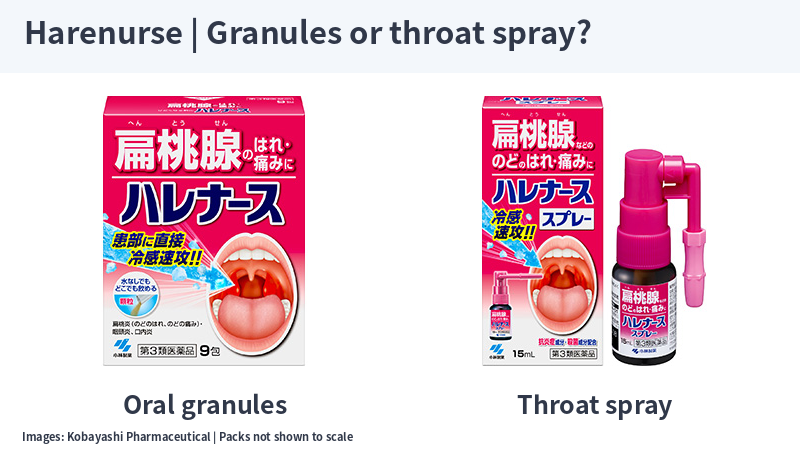
The first choice is the route: Harenurse granules are swallowed; Harenurse Spray is applied to the throat. Their active ingredients differ completely. Before choosing the familiar box, check your other medicines, your age and whether you can use a spray without breathing it in.

I’m Irene, a Taiwan-born, Japan-licensed pharmacist working in a Japanese drugstore. For this comparison, I want to make the small-print differences easier to use at the shelf, especially the oral-medicine ingredients that can overlap.
Checked against Kobayashi’s current Japanese product pages and complete Japanese leaflets on 14 October 2026 (Japan time). Read the leaflet supplied with your own pack.
Start with the exact product
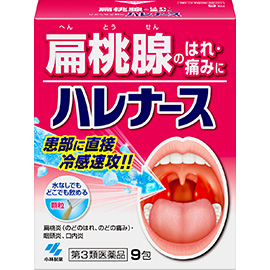
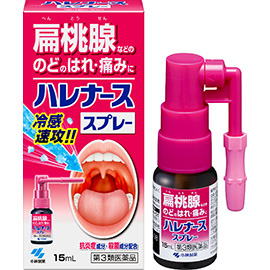
The table compares the two routes and their labeled indications, not equivalent strengths. Both are Japanese Class 3 OTC medicines.
| Product / shelf name | Route and labeled use | Important distinction |
|---|---|---|
| Harenurse granules / ハレナース | Oral; tonsillitis with throat swelling/pain, pharyngitis and stomatitis | Contains tranexamic acid and licorice extract; check all other oral medicines |
| Harenurse Spray / ハレナーススプレー | Local spray; pain, swelling, irritation, discomfort and hoarseness caused by throat inflammation; stomatitis | Azulene anti-inflammatory ingredient plus CPC antiseptic; requires correct spray technique |
Ingredient amounts below use different label bases: granules are per adult daily amount of 3 sachets (3.9 g), while spray is per 100 mL of liquid. The spray bottle contains 15 mL. Neither 100 mL nor a whole bottle is a dose.
| Product | Active ingredients on that basis |
|---|---|
| Granules: adult daily 3 sachets | Tranexamic acid 750 mg; licorice extract 198 mg (equivalent to 990 mg crude licorice); pyridoxine hydrochloride (B6) 50 mg; riboflavin (B2) 12 mg; sodium L-ascorbate 500 mg |
| Spray: per 100 mL | Sodium azulene sulfonate hydrate 0.02 g; cetylpyridinium chloride hydrate (CPC) 0.3 g |
How to use each form
Granule quantities below are per dose, taken three times daily, morning, noon and evening. The spray uses an amount applied locally several times daily; the Japanese spray instructions do not state a minimum age.
| Product / age | Per use |
|---|---|
| Granules, age 15+ | 1 sachet |
| Granules, age 7–14 | Half a sachet, with adult supervision |
| Granules, under 7 | Do not take |
| Spray | Suitable amount sprayed locally several times daily; product-page guidance is about 2–3 sprays each time |
- For granules, swallow without water if comfortable; water or warm water may be used if needed. This is an oral medicine, not a product to rub onto the throat.
- If a sachet is split, fold the opening at least twice. Use the remainder that same day or discard it.
- For the spray, rotate the nozzle at its base to the horizontal position and remove the cap. On first use, press until liquid comes out.
- Aim at the affected area while gently breathing out. Do not inhale during spraying. Ask a pharmacist before using it for a child who cannot reliably cooperate; children require adult supervision.
- Replace the cap, return the nozzle and store upright, away from heat/flames and children. Avoid the eyes; rinse immediately if splashed. Get medical help for severe eye symptoms or accidentally swallowing a large amount.
Check other medicines before the granules
Do not take the granules with any other oral medicine containing tranexamic acid, licorice or glycyrrhizin. This includes some cold, pain, cough and allergy medicines and some Kampo formulas. Show the pharmacist the actual boxes or ingredient lists. Different brand names do not prevent duplication. The spray has different actives, but that alone is not a recommendation to combine the two.
Before taking the granules, consult a doctor, pharmacist or registered seller if you are receiving medical/dental treatment, pregnant or possibly pregnant, older, have a history of medicine allergy, swelling, hypertension, heart or kidney disease, an existing blood clot or a risk of thrombosis. Before the spray, seek advice if receiving treatment, with a medicine-allergy history or severe sores inside the mouth. Neither form is for prolonged continuous use.
When to stop and seek help
Stop either product and consult if symptoms have not improved after 5–6 days. Do not wait that long if symptoms are worsening. Stop and seek advice for a rash, redness, itching, nausea or stomach symptoms. With granules, also watch for dizziness, frequent urination and persistent/worsening diarrhea; worsening muscle weakness, pain, numbness or stiffness requires prompt medical attention because of the rare licorice-related pseudoaldosteronism/myopathy warning. With spray, stop for persistent or worsening mouth irritation.
Granule B2 can turn urine yellow; tell a clinician before urine/stool testing that the product contains vitamin C. The spray contains ethanol: do not use while driving, and note the manufacturer’s warning that breath alcohol readings can be affected for a period after use.
Breathing difficulty, inability to swallow, or severe symptoms that are getting worse quickly need immediate medical care. A very high fever or signs of dehydration need prompt medical assessment rather than repeated shopping for another throat medicine. Keep the package to show the clinician.
Irene’s shelf checklist
- Read the complete product name and choose oral versus spray deliberately.
- For granules, check age and duplicate tranexamic acid/licorice first.
- For spray, check that the user can gently exhale during application.
- Treat the cooling sensation as a sensation, not proof that the illness has resolved.