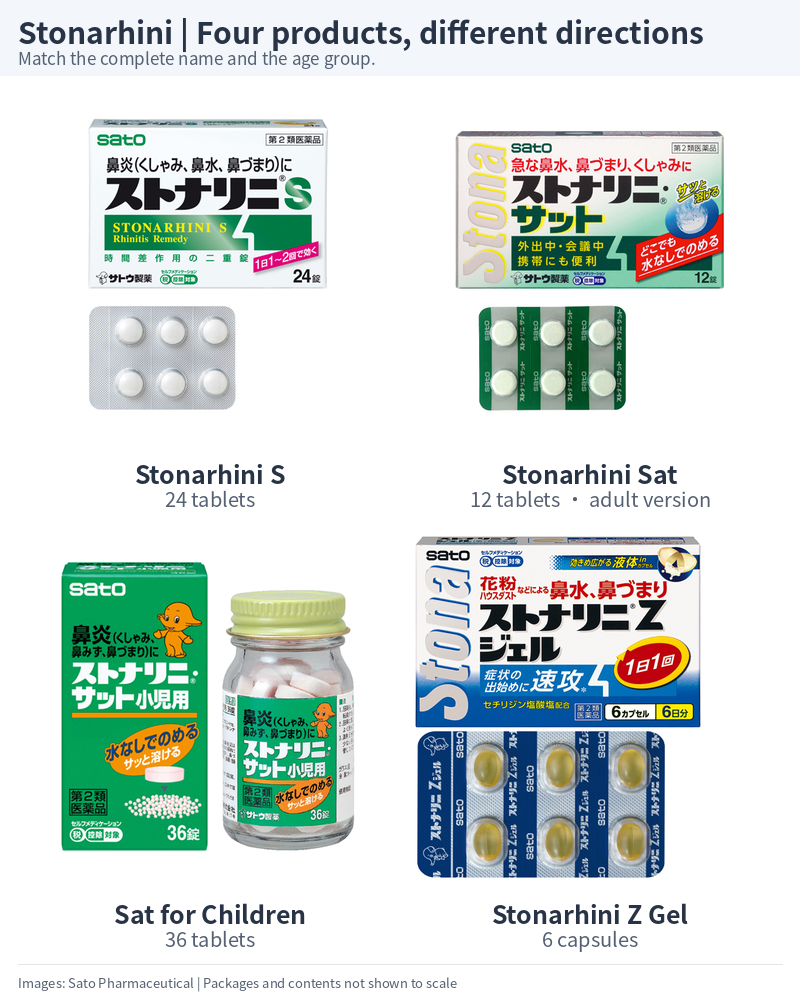

I'm Irene, a Japanese-licensed pharmacist with Taiwanese roots, working in a Japanese drugstore. Stonarhini boxes can look like variations on one medicine. The useful first check is whether you need an allergy-specific capsule, a combination rhinitis medicine, or the separate children's product.
Start with age, symptoms and your plans for the day
- Age 15 or older, with nasal allergy symptoms from pollen or house dust: Z Gel is the single-ingredient cetirizine option, taken once before bed. Its kidney-disease, medicine-combination and breastfeeding restrictions need checking first.
- Age 15 or older, considering a combination medicine for rhinitis symptoms: S is a layered tablet taken once or twice daily. Sat is a different combination, chewed or dissolved in the mouth, three times daily.
- Age 5–14: only Sat for Children has directions for this age range among these four. The adult boxes are not suitable substitutes.
- Need to drive or operate machinery: all four Japanese leaflets prohibit this after taking the medicine. Bedtime dosing, caffeine, or wording about less drowsiness does not remove that restriction.
All four are Japanese Class 2 OTC medicines. Choose one appropriate product after checking other medicines; do not combine them.
Recognise the boxes and the differences that matter
Stonarhini S: a layered combination tablet
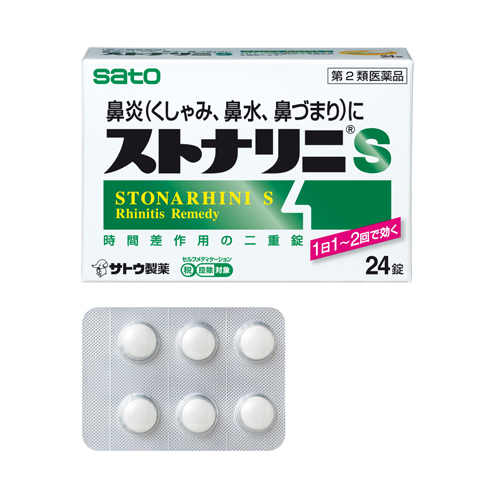
Look for ストナリニS. The pictured pack has 24 tablets; the current manufacturer page lists 12, 18 and 24 tablets. S contains chlorpheniramine maleate, phenylephrine hydrochloride and datura extract. Its outer layer dissolves in the stomach and inner core in the intestine.
The labeled uses are relief of sneezing, runny or blocked nose, watery eyes and a heavy-headed feeling due to acute or allergic rhinitis. It is a sugar-coated tablet, not the waterless Sat formulation. Its directions are one tablet per dose, once or twice daily, for ages 15 and older.
Stonarhini Sat: the adult waterless option
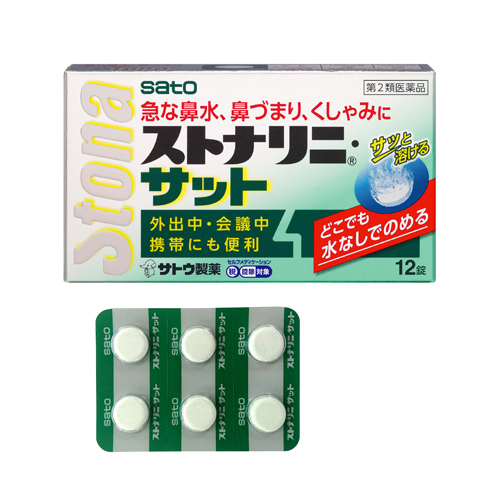
Look for ストナリニ・サット. The pictured pack has 12 tablets; 24-tablet packs are also listed. It is menthol-flavoured and can be chewed or dissolved in the mouth without water; taking it with water is also permitted.
Sat combines d-chlorpheniramine maleate, phenylephrine hydrochloride, belladonna alkaloids and caffeine. Its label lists relief of sneezing, runny or blocked nose, watery eyes, sore throat and a heavy head associated with acute rhinitis, allergic rhinitis or sinusitis. That is a symptom-relief indication, not a reason to ignore high fever or persistently worsening symptoms.
Stonarhini Z Gel: once-daily cetirizine for nasal allergies
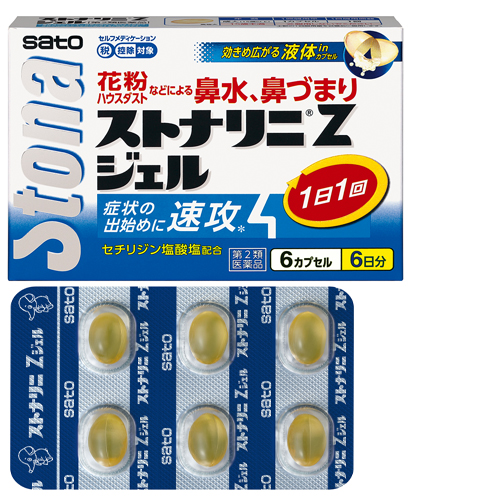
Look for ストナリニZジェル, including the word ジェル. The pictured pack contains six soft capsules; the manufacturer also lists 12 and 24. Each capsule contains cetirizine hydrochloride 10 mg in a liquid-filled soft capsule.
Its indication is relief of sneezing, runny nose and blocked nose caused by pollen, house dust or similar nasal allergies. The adult dose is one capsule once daily before bed. If you are unsure whether symptoms are allergic, consult before choosing it. It is not a general cold-medicine substitute.
Stonarhini Sat for Children: check 小児用
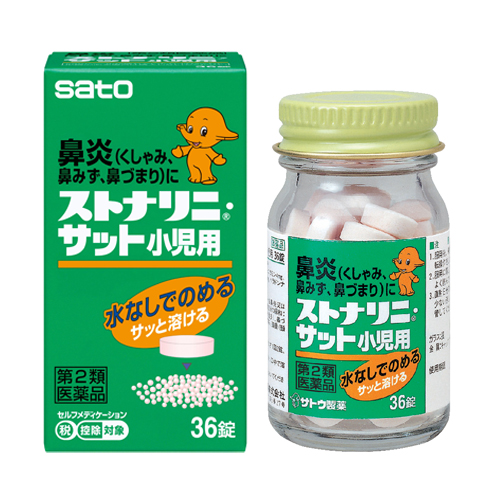
Look for ストナリニ・サット小児用, not just the green colour. The current pack contains 36 strawberry-flavoured tablets, which are chewed or dissolved in the mouth. Water may also be used.
This product contains d-chlorpheniramine, phenylephrine and belladonna alkaloids, with no caffeine listed as an active ingredient. Its symptom indications match adult Sat, but its formula amounts and age-based tablet counts differ. A parent or guardian must supervise each dose.
Ingredients: compare the stated basis
The amounts below are not a “strength ranking.” Chlorpheniramine and d-chlorpheniramine are not identical label ingredients, and the medicines have different combinations and dose schedules.
| Product and amount being compared | Active ingredients in that amount |
|---|---|
| S: 2 tablets, the maximum labeled adult daily amount | Chlorpheniramine maleate 12 mg; phenylephrine hydrochloride 12 mg; datura extract 24 mg. Totals combine inner-core and outer-layer amounts. |
| Adult Sat: 6 tablets, the labeled adult daily amount | d-Chlorpheniramine maleate 6 mg; phenylephrine hydrochloride 30 mg; belladonna alkaloids 0.6 mg; anhydrous caffeine 80 mg |
| Z Gel: 1 capsule, the labeled adult daily amount | Cetirizine hydrochloride 10 mg |
| Sat for Children: 9 tablets, the daily amount for ages 11–14 only | d-Chlorpheniramine maleate 4 mg; phenylephrine hydrochloride 15 mg; belladonna alkaloids 0.4 mg. Younger children take fewer tablets. |
Irene's practical check: adult Sat is convenient when water is unavailable, but that changes how you take it, not the driving rule. Its caffeine also does not make it a non-drowsy medicine.
Exact doses: keep adult and children's directions separate
| Product and age | Amount per dose | Frequency and interval |
|---|---|---|
| S, age 15+ | 1 tablet | Once or twice daily |
| Adult Sat, age 15+ | 2 tablets | 3 times daily, at least 4 hours apart |
| Z Gel, age 15+ | 1 capsule | Once daily before bed |
| Sat for Children, age 11–14 | 3 tablets | 3 times daily, at least 4 hours apart |
| Sat for Children, age 7–10 | 2 tablets | 3 times daily, at least 4 hours apart |
| Sat for Children, age 5–6 | 1 tablet | 3 times daily, at least 4 hours apart |
Under 15: do not use S, adult Sat or Z Gel. Under 5: do not use Sat for Children. Do not halve an adult medicine to create a child's dose.
- Check the full name, age and other medicines before taking a dose. Keep the product's leaflet with you.
- Remove tablets or capsules completely from blister packaging. Adult Sat breaks easily: press with the pad of a finger, watch for detached foil and take all parts of the prescribed tablets promptly. Never swallow packaging.
- Chew or dissolve Sat and Sat for Children as directed. Follow S's own directions and Z Gel's bedtime schedule; do not transfer Sat's four-hour interval to the other products.
- Keep all four in their original packaging, away from direct sun, heat, moisture and children's reach. Close the children's bottle tightly; do not treat its strawberry flavour as making it a sweet. Do not use any product after its expiry date.
Check these restrictions before buying
S, adult Sat and Sat for Children
While taking any of these three, do not use another oral rhinitis medicine, another oral medicine containing an antihistamine, or a medicine for gastrointestinal pain/spasm. Antihistamines may also be in cold, cough/phlegm, motion-sickness and other allergy medicines. Do not use these products continuously for a long period.
Consult first if you are receiving medical treatment, are pregnant or may be pregnant, are older, or have a history of medicine allergy. Also consult for high fever, difficulty urinating, glaucoma, diabetes, thyroid disease, heart disease or high blood pressure. The children's leaflet includes the general adult precautions required for this medicine category; this does not create an adult dose for the children's product.
Z Gel has its own additional rules
- Do not take it if you have diagnosed kidney disease, are under 15, or have had an allergic reaction to this product, its ingredients or piperazine derivatives including levocetirizine or hydroxyzine.
- Do not combine it with other allergy medicines, including those for skin conditions or rhinitis; oral antihistamine-containing medicines, including certain cold, cough, motion-sickness and sedative/sleep medicines; or oral medicines containing theophylline, ritonavir or pilsicainide hydrochloride hydrate. Have prescription names checked by a pharmacist.
- Do not drink alcohol before or after taking it. If breastfeeding, do not take it or avoid breastfeeding while taking it. Ask your healthcare professional which option is appropriate rather than changing feeding on your own.
- Consult before use if receiving treatment; pregnant or possibly pregnant; older; previously allergic to medicines; diagnosed with liver disease or epilepsy; with a history of seizures; unsure that symptoms are allergic; or previously diagnosed with another allergic condition such as asthma or atopic dermatitis.
When to stop and seek advice
S, adult Sat and Sat for Children: stop and consult if symptoms do not improve after 5–6 days. Stop promptly for a rash, redness, itching, nausea/vomiting, appetite loss, headache, trouble urinating, facial flushing or unusual light sensitivity. If dry mouth, drowsiness, constipation or blurred vision persists or worsens, stop and consult. Unusual bruising or bleeding, marked pallor/breathlessness, or sudden high fever with chills and sore throat requires immediate medical assessment because the leaflets describe rare serious blood disorders.
Z Gel: consult if there is no improvement after one week, or before continuing beyond two weeks even if it helps. Its leaflet lists additional reactions, including skin, digestive, heart, urinary, vision and mood/behaviour changes: stop and seek advice for new suspected adverse effects. Persistent or worsening dry mouth, constipation, diarrhea or drowsiness also needs reassessment. Seek immediate care for warning signs such as difficulty breathing, impaired consciousness, a seizure, yellow skin or eyes, dark urine, or unexplained bleeding or bruising. Do not wait for several signs to occur together.
For a useful shelf decision, remember age → allergic or other rhinitis symptoms → other medicines and medical conditions → dose format. If driving is part of your plan or the cause is unclear, ask a pharmacist to help choose an appropriate alternative before taking anything.
Official sources and image credits
Current manufacturer listings and their linked Japanese leaflets checked on 14 October 2026. Follow the package you purchase; this guide does not replace its complete leaflet.
- Sato: Stonarhini S
- Sato: Stonarhini S Japanese leaflet
- Sato: Stonarhini Sat
- Sato: Stonarhini Sat Japanese leaflet
- Sato: Stonarhini Z Gel
- Sato: Stonarhini Z Gel Japanese leaflet
- Sato: Stonarhini Sat for Children
- Sato: Stonarhini Sat for Children Japanese leaflet
Product photographs: Sato Pharmaceutical official product pages.