Product information checked: 12 October 2026. This guide covers products sold in Japan.
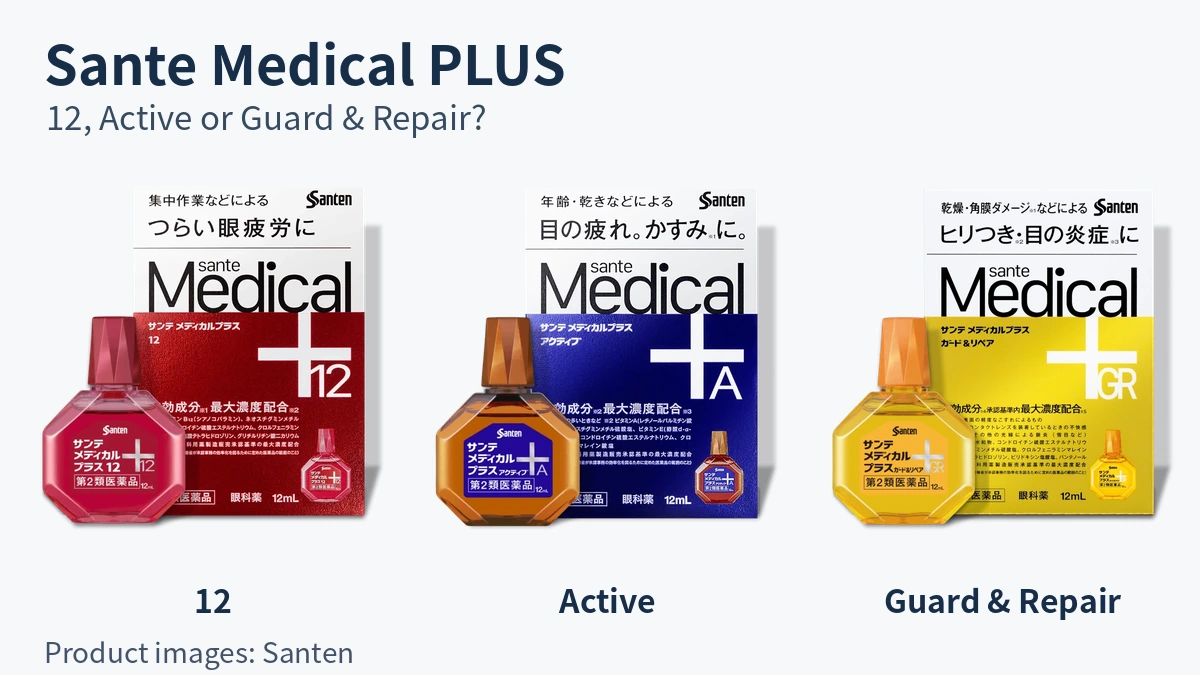
Red, blue or yellow: which Sante Medical box should you choose? Start with the full name and your main symptom. PLUS 12 focuses on tired eyes; PLUS Active on tiredness associated with ageing and dryness, and blurred vision such as when there is excess eye discharge; PLUS Guard & Repair on eye inflammation caused by ultraviolet or other light. Their labelled uses overlap, so box colour cannot tell you what is causing your symptoms.

I’m Irene, a Taiwan-born, Japan-licensed pharmacist working in a Japanese drugstore. Let’s match the PLUS, 12, A and GR markings to the real boxes, then narrow down what to discuss with the pharmacist.
Before choosing: get urgent medical help for severe eye pain or sudden changes in vision. Loss of vision, or a red eye accompanied by changes in sight, pain when looking at light, or a severe headache and nausea, needs emergency care. Consult a doctor, pharmacist or registered OTC medicine seller before use if you have glaucoma, are receiving medical treatment, or have had an allergic reaction to a medicine. None of these three drops may be used while wearing soft contact lenses, including coloured soft lenses.
A quick way to narrow the choice
- Your main concern is tired eyes after concentrated screen work: ask about the red PLUS 12. Vitamin B12 and neostigmine are among the ingredients used in its eye-fatigue formula.
- Your eyes feel tired and dry more readily as you get older: ask about the blue PLUS Active. It contains vitamin A, sodium chondroitin sulfate and vitamin E. The blurred-vision indication is qualified as “such as when there is excess eye discharge”; it does not cover every reason for unclear sight.
- You are comparing products labelled for light-related inflammation or discomfort with hard contact lenses: look for the yellow PLUS Guard & Repair. Pain, light sensitivity or worsening vision should be assessed first. Do not assume a scratched or infected cornea is a self-treatment problem.
If simple dryness is your main problem, or you need drops to use with soft lenses still in, ask whether a different type of product is more suitable. All three contain a redness-relieving ingredient and have a set dosing schedule.
The three current PLUS boxes
All three are Japanese Class 2 OTC medicines in 12mL bottles. Santen gives each a cooling level of 3. That describes the sensation of applying the drops, not how effective or suitable they are.
| Product | Package to match | Main formula distinction |
|---|---|---|
| PLUS 12 | Red, +12; サンテメディカルプラス12 | 12 active ingredients, including vitamin B12, neostigmine and vitamin E |
| PLUS Active | Blue, +A; サンテメディカルプラスアクティブ | 9 active ingredients, including vitamin A, sodium chondroitin sulfate and vitamin E |
| PLUS Guard & Repair | Yellow, +GR; サンテメディカルプラスガード&リペア | 11 active ingredients, including zinc sulfate, panthenol and vitamin B6 |
PLUS 12: start with the eye-fatigue question
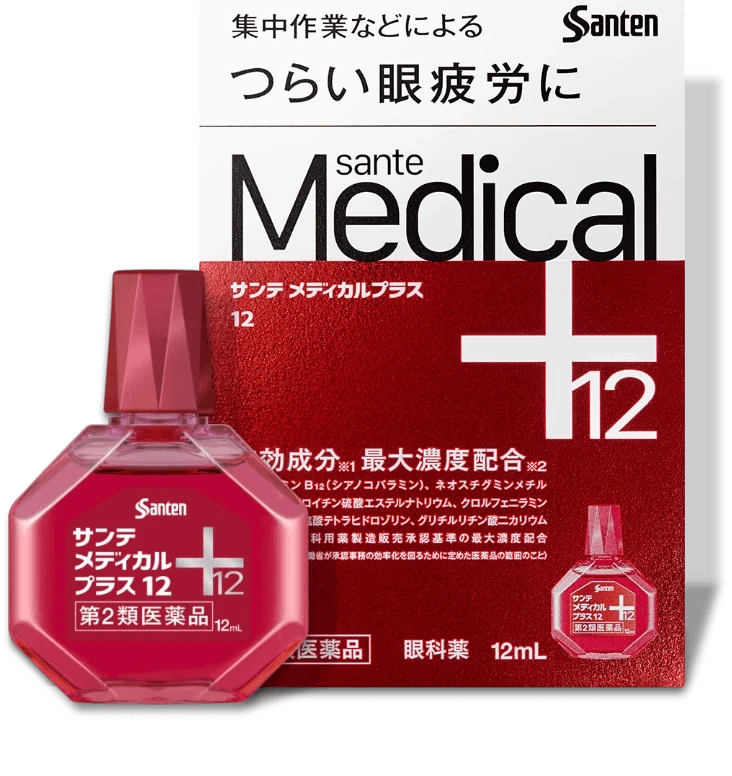
PLUS 12 combines vitamin B12 and neostigmine with vitamin E, sodium chondroitin sulfate and ingredients for itching, inflammation and redness. It is a useful starting point for a pharmacist conversation about tired eyes after close work. Having 12 active ingredients does not make it proportionally more effective than a product with fewer.
Vitamin B12 gives the liquid its red colour. If it spills onto clothing, rinse promptly with water. Drops do not replace rest, appropriate glasses or an eye examination when one is needed.
PLUS Active: check why vision is unclear
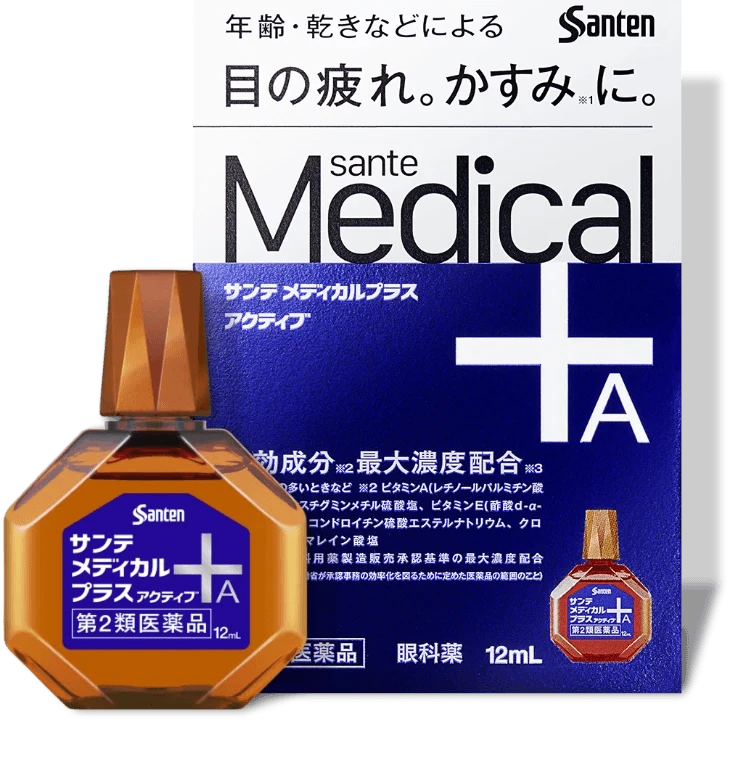
Vitamin A supports secretion of mucin, a tear component, and helps stabilise tears. Sodium chondroitin sulfate protects the cornea and helps retain moisture. The formula also contains neostigmine, an antihistamine and a redness-relieving ingredient.
The name does not set an age at which everyone should start using it. Reading difficulty, cataracts and other eye conditions need proper assessment; a box that mentions ageing is not enough to identify the cause. Persistent blurred vision is a reason to get advice rather than keep switching drops.
PLUS Guard & Repair: recognise GR, not the old Guard EX formula
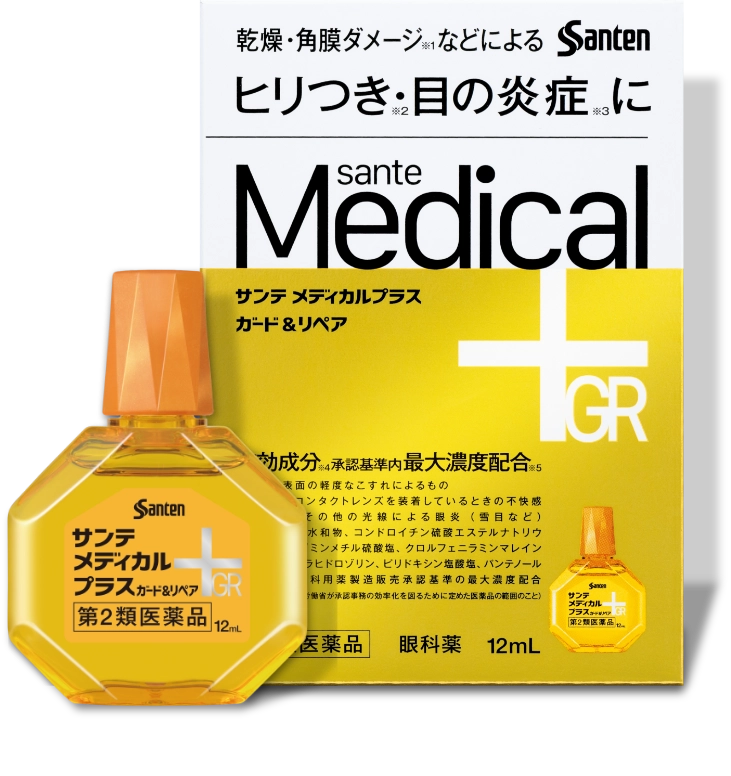
Zinc sulfate and panthenol are among this formula’s ingredients. Labelled uses include eye inflammation caused by ultraviolet or other light, tired eyes and discomfort while wearing hard contact lenses. The manufacturer qualifies its discussion of corneal damage as minor rubbing of the corneal surface. This is not a basis for treating an eye injury, infection or unexplained pain yourself.
The current Guard & Repair active-ingredient list does not contain the active vitamin B2 featured in the old Guard EX. Do not apply an old Guard EX ingredient guide to a GR box, or infer the contents from the yellow bottle.
What about the versions without PLUS?
Santen still lists Medical 12, Medical Active and Medical Guard & Repair alongside their PLUS counterparts as of the check date. The differences are product-specific:
- 12: both have 12 active ingredients. The standard version contains panthenol; PLUS contains vitamin E instead. Their dipotassium glycyrrhizate and redness-relieving ingredient concentrations also differ.
- Active: both have 9 active ingredients. Epsilon-aminocaproic acid is 1.0% in the standard version and 2.0% in PLUS; the other active ingredients and stated amounts match.
- Guard & Repair: the standard version has 10 active ingredients and PLUS has 11. PLUS adds dipotassium glycyrrhizate and contains 0.1% panthenol, compared with 0.05% in the standard version.
These are formulation differences, not a promise that PLUS is better for everyone. Ingredient counts or percentages do not establish a “strongest” product among the three PLUS formulas either.
Santen marks Medical Guard EX and Medical PLUS Guard EX as no longer manufactured. That does not establish whether an individual shop has old stock. If you encounter an EX box, check its exact name, expiry date and own leaflet. This guide’s main comparison is the current PLUS trio; EX and GR are not the same product.
How to use the three PLUS drops
Each Japanese leaflet gives the same dose: 1–3 drops per application, 5–6 times a day. Do not exceed the directions or keep applying drops just because the cooling sensation has faded. Overuse can cause abnormal sensitivity to light or make redness worse.
- Wash your hands and remove lenses as required.
- Keep the tip away from your eye, eyelid and eyelashes. Apply the labelled dose, close your eyes gently and wipe away overflow.
- Close the cap firmly. Store away from sunlight and heat, never in a hot car, and do not share the bottle.
- Do not use cloudy drops, drops with floating particles, an expired bottle, or one left in excessive heat. Use promptly after opening.
Contact-lens check: all three list discomfort while wearing hard lenses among their indications. Soft lenses, including coloured soft lenses, must be removed. Do not assume the hard-lens wording authorises use with coloured lenses. Ask your eye-care professional or pharmacist about reinsertion and whether you should continue wearing lenses when your eyes are uncomfortable. Stop wearing lenses if your eye is red or painful. A red eye in a contact-lens wearer needs urgent assessment; eye pain with loss of vision needs emergency care.
Stop and seek advice if you develop a skin rash, redness or itching, or eye redness, itching, swelling or stinging pain. Also stop and consult if blurred vision does not improve, or symptoms are not better after 5–6 days. That is a reassessment point, not permission to wait six days while symptoms worsen.
Common questions
Can children use them?
The three Japanese leaflets require adult supervision for children but do not give a product-specific numerical minimum age. That does not mean they suit every age. Check with an eye-care professional or pharmacist before choosing for a child, especially one who cannot describe symptoms clearly.
Can I alternate all three, or combine them with other drops?
Do not layer them to cover more symptoms. Several ingredients overlap. Show a doctor or pharmacist the full names of any drops you already use. If a combination is appropriate, general guidance is to leave at least five minutes between different drops, while following individual instructions.
What about pregnancy or breastfeeding?
These leaflets do not list a separate pregnancy or breastfeeding prohibition. That is not an individual safety assessment. People receiving medical treatment are already advised to consult before use; tell your maternity clinician or pharmacist the exact product name and check your plan.
How long does an opened bottle last?
The product leaflets say to use promptly after opening. Santen’s general OTC FAQ gives roughly three months as a guide, while noting that storage and handling vary. It is not a guarantee for every bottle, or permission to self-treat for three months. Follow the symptom-related stopping rules above.
At the counter, describe the symptom, how long it has lasted, your lens type and other medicines before pointing to the full name. That gives the pharmacist much more useful information than asking for “the red one”.
Looking at a different Santen range? See Sante FX: NEO, V Plus, AL or Contact.
Sources
- Santen: PLUS 12 and Japanese leaflet
- Santen: PLUS Active and Japanese leaflet
- Santen: PLUS Guard & Repair and Japanese leaflet
- Standard versions: Medical 12, Medical Active, Medical Guard & Repair
- Santen: Product list and manufacturing-ended notices, OTC FAQ, Applying eye drops, Other precautions
- NHS: Eye pain and urgent symptoms, Red-eye warning signs
This guide helps identify Japanese products and explain their labels. It cannot diagnose an eye condition. Follow the leaflet supplied with your medicine and advice from your healthcare professional.