
I'm Irene, a Taiwanese-born, Japanese-licensed pharmacist working in a Japanese drugstore. With Hyalein S, the useful question is not which package looks stronger. It is whether you want a small bottle you reopen or a fresh single-use vial each time.
Choose the format first
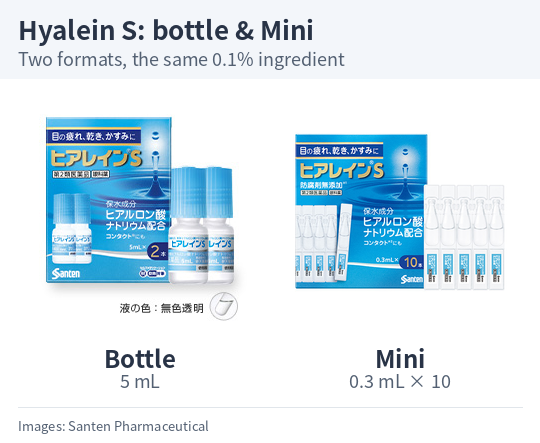
Both contain 0.1% purified sodium hyaluronate and have the same labelled dose: one drop per application, five to six times a day. Mini is not a stronger version.
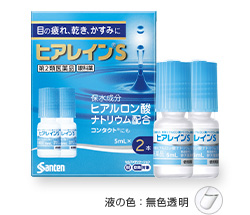
- Choose Hyalein S (ヒアレインS) if you prefer a 5 mL multi-dose bottle and can keep its tip clean between uses.
- Choose Hyalein S Mini (ヒアレインSミニ点眼) if you prefer preservative-free, single-use vials and are comfortable discarding each vial immediately after that application, even when liquid remains.
- Neither may be used while wearing coloured contact lenses. Ordinary soft, oxygen-permeable, hard and disposable lenses are covered by the manufacturer's compatibility guidance.
Important before buying: the Japanese OTC instructions say do not use if you have been diagnosed with dry-eye disease, Sjögren's syndrome, Stevens–Johnson syndrome or a corneal infection. Occasional dryness as a symptom and a diagnosed eye disease are not interchangeable. A familiar ingredient does not make this an automatic substitute for your prescribed drops.
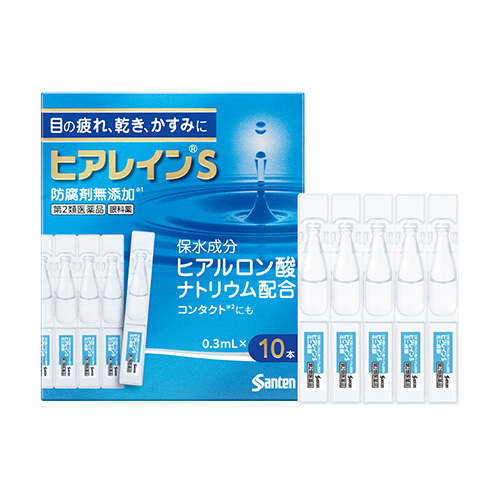
What actually differs?
| Point | Hyalein S bottle | Hyalein S Mini |
|---|---|---|
| Japanese medicine category | Class 2 OTC medicine | Class 2 OTC medicine |
| Pack format | 5 mL bottle; one- and two-bottle packs | 0.3 mL × 10 single-use vials |
| Active ingredient | Purified sodium hyaluronate 0.1% | Purified sodium hyaluronate 0.1% |
| Dose each time / daily frequency | One drop / five to six times daily | One drop / five to six times daily |
| Additive distinction | Includes chlorhexidine gluconate solution | Preservative-free; does not include that additive |
| After opening | Recap; use as soon as possible | Discard after one application, including any remainder |
| Coloured contacts | Do not use while wearing them | Do not use while wearing them |
Sodium hyaluronate holds water. These medicines are labelled to relieve dryness, a gritty or prickly foreign-body sensation, tired eyes, blurred vision and discomfort while wearing soft or hard contacts. They do not cover every possible cause of those symptoms.
Santen describes the series as having a slightly thick feel. The bottle's manufacturer cooling scale is zero; that is a sensation rating, not a promise that irritation is impossible. Neither “Mini” nor “preservative-free” means suitable for every eye.
The bottle also contains aminocaproic acid, sodium edetate hydrate, an isotonicity agent and a pH adjuster; Mini lists these same additives but omits chlorhexidine gluconate solution. If you have an ingredient allergy, check the complete leaflet rather than choosing by pack format alone.
Opening and using each format
Multi-dose bottle
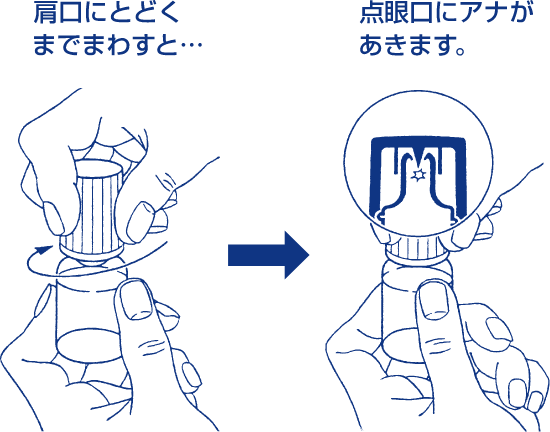
- Keep the bottle unopened until needed. At first use, turn the cap clockwise down to the bottle's shoulder to pierce the sealed dropper opening.
- Apply one drop, without touching the eye, eyelid or eyelashes with the tip. Follow the labelled frequency of five to six times daily.
- Close the cap after use. Do not share the bottle or use solution that has become cloudy.
Single-use Mini
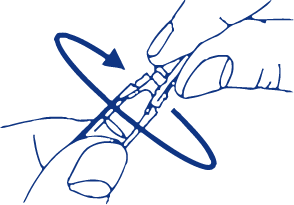
- Open a vial only when ready to use it. Slowly twist the cap; do not pull it off by force.
- Apply one drop, keeping the tip away from the eye, eyelid and eyelashes. The daily frequency is again five to six times.
- Throw the opened vial away after that application. Leftover solution is not a second dose to keep for later.
Both are for eye use only. The leaflets give no numerical minimum age; children must use them under a parent or guardian's supervision. That wording is not a recommendation to self-treat an infant's eye problem.
When to ask before using, and when to stop
Do not use either product if you have previously had an allergic reaction to it or one of its ingredients. A sudden decrease in vision or severe eye pain means medical assessment, not an OTC trial. The diagnosed conditions listed above are also explicit do-not-use conditions.
Ask a doctor, pharmacist or registered OTC medicine seller before use if you are receiving medical treatment, have had medicine-related allergies, or have glaucoma. Also ask if eye symptoms occur with dry mouth or nasal dryness, or with persistent or rapidly worsening high fever, sore or eroded lips, sore throat, or widespread rash/redness. Do not dismiss these accompanying symptoms as ordinary tired eyes.
After use, stop immediately and consult if you develop a skin rash, redness or itching, or eye redness, itching, swelling, pain, irritation, a foreign-body sensation or discharge.
Keep the two time points separate:
- Stop and consult if blurred vision does not improve, anything feels abnormal, or symptoms do not improve after about one week of correct use. For the bottle, the leaflet describes this as roughly finishing the first bottle; consult before starting a second.
- Consult before continuing beyond two weeks, even if symptoms have improved. Improvement does not rule out another eye condition.
The leaflets do not specify a separate pregnancy or breastfeeding restriction. This is not an individual safety clearance: ask your healthcare professional if pregnant, breastfeeding, using other eye medicines or unsure whether this product fits your treatment.
Carrying it on a trip
Keep the medicine away from direct sunlight and heat, out of children's reach, and in its original container. Do not leave it in a hot car or beside a heater. Do not use an expired product or one exposed to heat that may have damaged its container or contents.
Keep the bottle tightly closed and use it promptly after opening. For Mini, use the vials promptly after opening the bag, and avoid putting them in a back pocket where a cap could open accidentally. Single-use packaging does not remove the need for clean handling.
My quick takeaway
For this family, choose the opening-and-disposal routine you can follow, rather than expecting a different strength. Before checking out, read the full Japanese name, confirm that coloured contacts are not being worn, and check the do-not-use conditions. If you already have an eye diagnosis, discuss the choice with your eye-care professional first.
Sources
Product information checked 15 October 2026. This guide explains Japanese labelling and does not diagnose an eye condition or replace the leaflet supplied with your medicine.