
I'm Irene, a Taiwanese-born, Japanese-licensed pharmacist working in a Japanese drugstore. With Ribimex, the small letter W matters: choosing a texture also means checking which formula you are buying.
Start with the rash, then choose the texture
For an appropriate, limited area of eczema or dermatitis, W ointment is the more versatile vehicle for dry or mildly moist skin; W cream suits dry skin when you prefer a less greasy finish; the non-W lotion spreads through hair more easily. These are Kowa's vehicle descriptions, not a reason to treat an unidentified rash yourself.
All three contain the same concentration of the steroid PVA. The W products add three other active ingredients; the lotion does not. More ingredients do not establish that one is the best choice for every rash.
If the area is infected, very wet or eroded, extensive, or of uncertain cause, ask a pharmacist or clinician before choosing. These products are not antifungal medicines and are not for acne.
Recognize the current Japanese packages
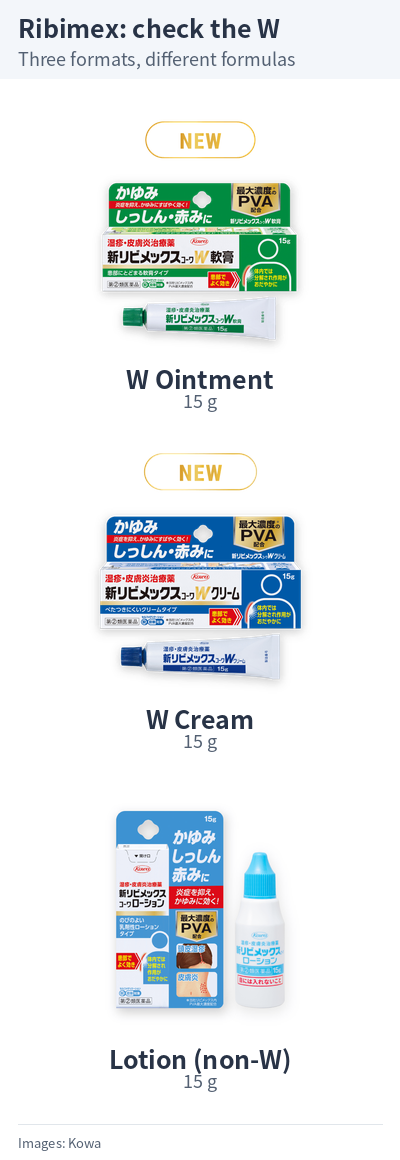
Kowa launched the W ointment and cream on March 5, 2026. The current family also lists the lotion without W. Look for the full Japanese name rather than relying only on green or blue packaging. All three are designated Class 2 OTC medicines in Japan.
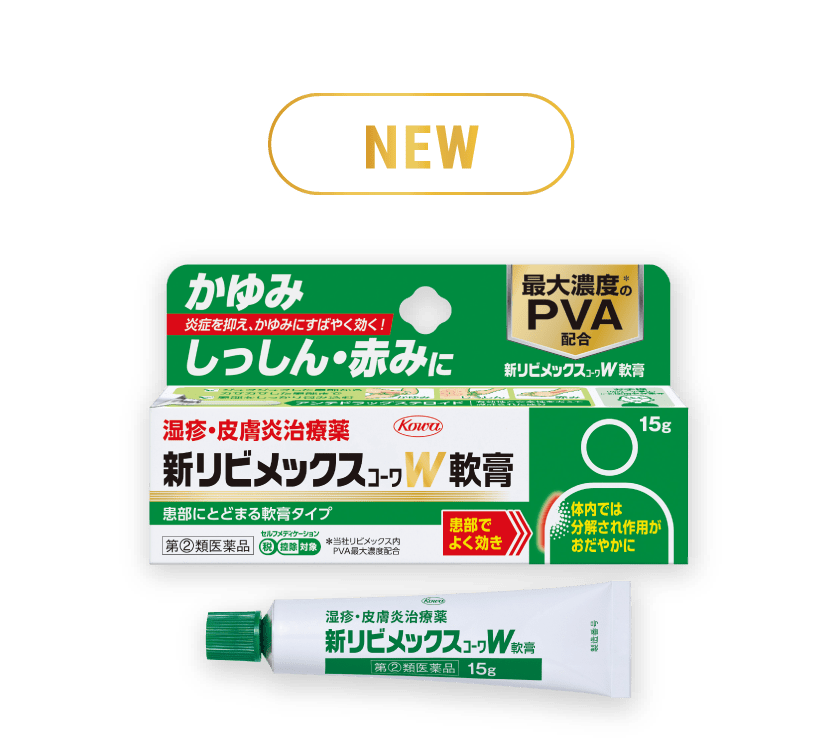
W ointment: green package, 8 g or 15 g
The package says 新リビメックスコーワW軟膏. Kowa describes its ointment base as suitable for dry and moist affected skin. However, severe weeping or erosion still requires consultation before use. An ointment is not a dressing for an infected wound.
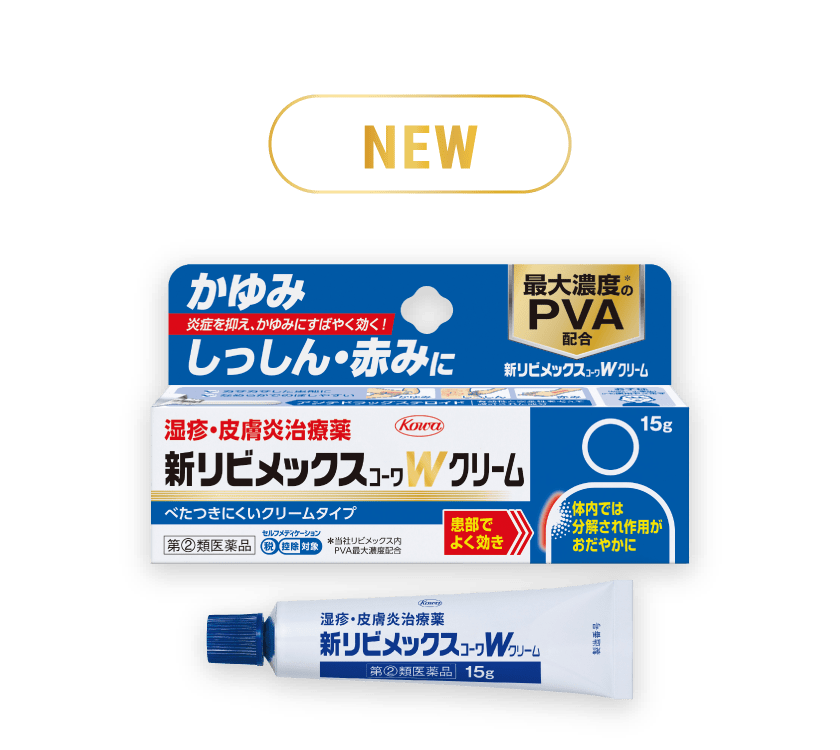
W cream: blue package, 8 g or 15 g
Look for 新リビメックスコーワWクリーム. It has the same four active ingredients and concentrations as W ointment, with a different base. Kowa describes it as easy to spread and less sticky, suited to dry, rough affected skin. The cream includes fragrance among its additives; check the full leaflet if you have ingredient allergies.
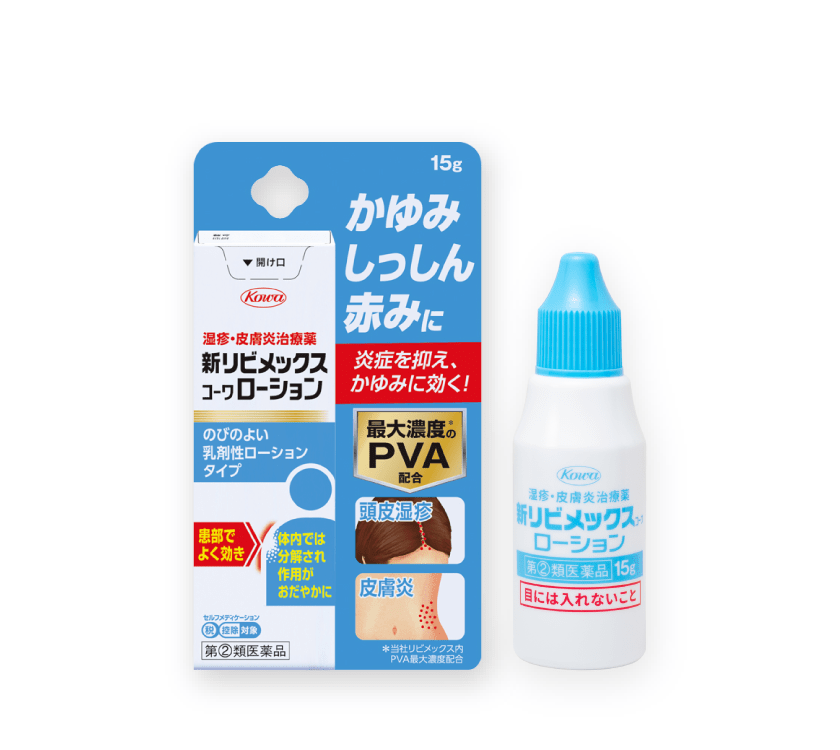
Lotion: light-blue package, 15 g
The name is 新リビメックスコーワローション, without W. This is an emulsion-type lotion, not a cosmetic toner. It is easier to distribute on hairy areas such as the scalp, when the underlying condition is suitable for this medicine. Shake the bottle well before use. Do not apply the nozzle directly to the skin.
What is actually different in the formula?
| Ingredient, per 1 g | W ointment and W cream | Non-W lotion |
|---|---|---|
| Prednisolone valerate acetate, PVA | 3 mg (0.3%) | 3 mg (0.3%) |
| Diphenhydramine hydrochloride | 20 mg | Not an active ingredient |
| Allantoin | 2 mg | Not an active ingredient |
| Tocopherol acetate | 5 mg | Not an active ingredient |
PVA reduces inflammation. The W formula also includes an antihistamine for itch and ingredients described in the Japanese label as supporting tissue repair and blood circulation. This does not make W a treatment for scars or justify putting it on healthy skin.
Kowa calls PVA an “antedrug” steroid: it acts in the skin and is broken down after absorption. It is still a steroid with important site, duration and amount restrictions. Long use can thin the skin and cause persistent redness; the face requires particular care.
The labelled indications are eczema, dermatitis, contact irritation, itching, heat rash, insect bites and hives. This is a list of approved uses, not a way to diagnose every itchy spot.
How to apply it
The exact leaflet direction for each product is to apply an appropriate amount to the affected area several times a day. Kowa's practical guide suggests morning and evening as a guide, reducing applications as symptoms improve. Stop once the symptoms have improved.
- Clean your hands and the affected skin. For the lotion, shake well first.
- Put a small amount on a clean finger and spread gently over the affected area only. Do not rub hard. For the scalp, part the hair so the lotion reaches the skin.
- Keep the tube or bottle opening off the affected skin. Close it firmly afterwards. Do not repeatedly fold or bend the ointment or cream tube.
- Do not cover treated skin with cling film or another poorly ventilated covering. Avoid tight nappies/diapers or impermeable plastic pants over a treated area.
For scale, Kowa describes about 0.5 g as covering two adult palm areas: roughly a fingertip unit of ointment/cream, or a one-yen-coin-sized amount of lotion. This is an amount guide, not permission to treat a large area. Its advice is to keep self-treatment to approximately two to three adult palm areas; seek advice for anything larger.
Where and when not to use it
- Do not use on chickenpox, fungal infections such as athlete's foot or ringworm, or skin with pus. Do not use for acne, boils, cosmetic prevention or after shaving.
- Keep away from the eyes, eye area and genital mucous membranes. If medicine gets into an eye, rinse immediately with water or lukewarm water; seek ophthalmic care if symptoms are severe.
- Do not apply broadly to the face. Kowa advises avoiding facial self-treatment unless the cause is known, such as an insect bite. Where appropriate, keep it to a small area and about one week at most; get individual advice rather than treating persistent facial redness.
- Do not use continuously for a long period. Kowa defines this as around two weeks, but do not wait that long if it is not helping: stop and consult after 5–6 days without improvement, or earlier if it worsens.
Children, pregnancy and reasons to ask first
The leaflets require adult supervision for children and do not specify a numeric minimum age. Kowa's FAQ gives age one as a general guide, while warning that young children's skin absorbs medicine readily. This is not a blanket recommendation for babies or prolonged childhood use. Ask before treating a very young child or a sensitive body area.
Consult before use if you are pregnant or may be pregnant, already receiving medical treatment, have a history of medicine-related allergies, have a large affected area, or have severe weeping/erosion. Kowa's FAQ permits breastfeeding use; still obtain advice if treatment would involve the breast or an area an infant could touch or lick.
Stop and consult if you develop rash, redness, itching or swelling, or new acne, fungal-looking changes, pus or persistent irritation at the treated area. The lotion also lists a tight feeling in the skin. Bring the product and leaflet so the formulation can be checked.
A simple shelf-side recap
First confirm that a steroid is suitable for the problem. Then choose the base: ointment for versatility, cream for a less greasy feel on dry skin, or lotion for access through hair. Finally, check W versus non-W, because the formulas differ even though PVA remains 0.3% in all three.
Store tightly closed in a cool, dry place away from direct sunlight, heat and children. Keep it in its original container and do not use after the printed expiry date. Read the leaflet in the package you actually buy.
Sources
Product information checked October 15, 2026. This guide explains Japanese OTC labels and does not replace a diagnosis or the package leaflet.