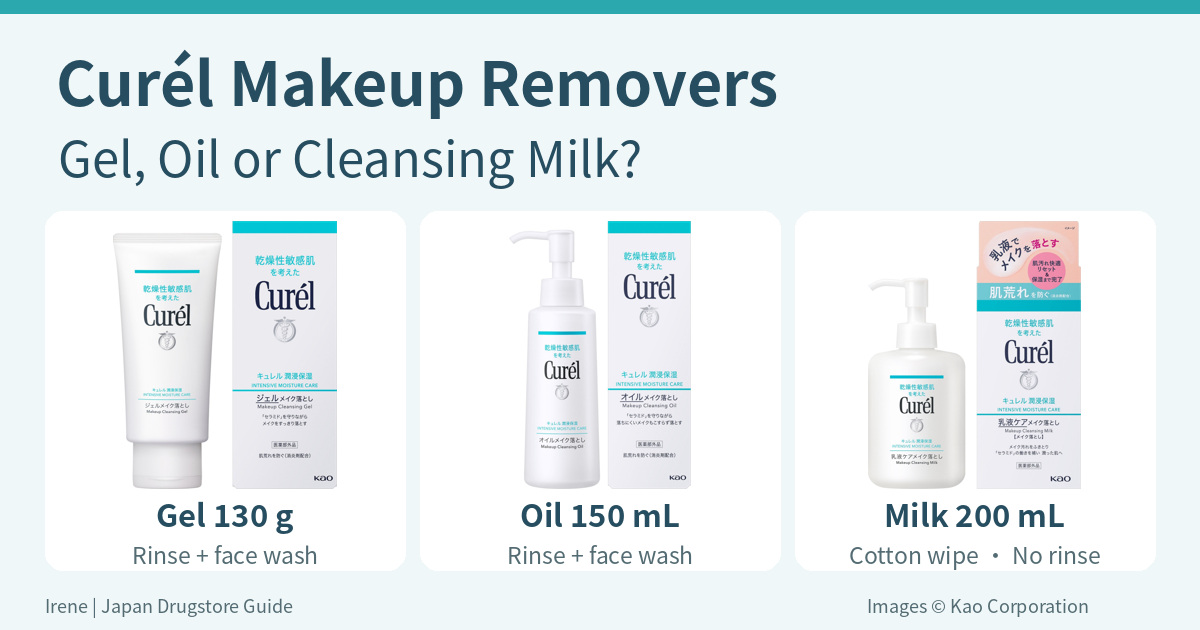
Choose the 130 g gel if you like a soft gel and a sink-based routine; look at the 150 mL oil if waterproof mascara is a priority; consider the 200 mL milk if you prefer removing makeup with cotton pads before your shower. Gel and oil both need rinsing followed by face wash. The milk is wiped off, with no rinse or separate face wash required.

I’m Irene, a Taiwanese-born, Japanese-licensed pharmacist working in a Japanese drugstore. Faced with these similar white packs, I would start with your evening: do you want to remove makeup at the sink, or sit down and take it off before your shower? That makes the choice much clearer.
Checked 18 October 2026. This guide covers the Japanese versions. All three are classified as quasi-drugs in Japan.
- Start with the routine you want
- Gel: a soft texture for a familiar rinse-off routine
- Oil: the option with an explicit waterproof-mascara claim
- Cleansing milk: take your makeup off before your shower
- Ingredients: protecting ceramides and adding moisturizing care
- Read the shelf words before choosing a white bottle
- Is the 180 mL refill a different milk?
- A few questions before you buy
- Sources
Start with the routine you want
| Product | Why compare it first? | Amount and method | What comes next? |
|---|---|---|---|
| Gel 130 g | You prefer a soft gel at the sink | Dry hands; about a 2 cm diameter amount | Rinse well, then use face wash |
| Oil 150 mL | Waterproof mascara is part of your makeup | Dry hands; about 4 pumps | Rinse well, then use face wash |
| Cleansing milk 200 mL | You want a cotton-pad routine away from the sink | About 3–4 pumps per cotton pad; replace pads as needed | No rinse or separate face wash required |
The useful distinction is what your hands do and what happens afterwards. The milk lets you skip water and an extra cleanser, but you still need enough product and fresh pads to remove the makeup. Simply smoothing it over a made-up face is not the intended method.
Gel: a soft texture for a familiar rinse-off routine
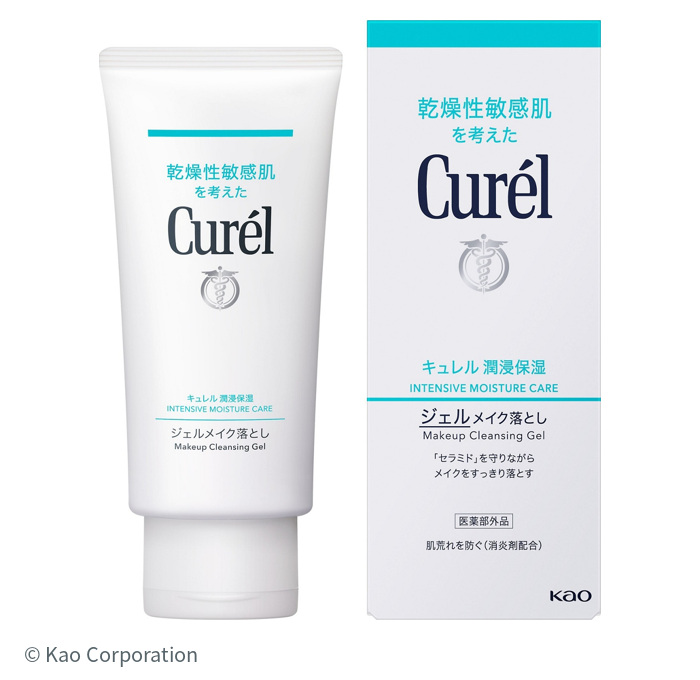
Look for キュレル ジェルメイク落とし, 130 g, labelled Makeup Cleansing Gel. Kao describes a soft gel that blends easily with makeup and rinses without a sticky or slippery residue. Its stated cleansing targets include lipstick and foundation.
This is a practical starting point if you enjoy spreading a gel with your fingertips before rinsing. The format alone does not tell you which product is strongest, and it does not establish that every waterproof eye product will come off.
- 1Start with dry handsUse an amount about 2 cm across. Dot it over both cheeks, forehead, nose and chin. For resistant eye makeup or lipstick, keep both hands and face dry.
- 2Blend gently, then rinseWork it into the makeup with gentle circular movements and rinse well with water or lukewarm water. Avoid prolonged rubbing.
- 3Follow with face washThe gel is the makeup-removal step. Kao instructs you to use a separate facial cleanser afterwards.
Oil: the option with an explicit waterproof-mascara claim
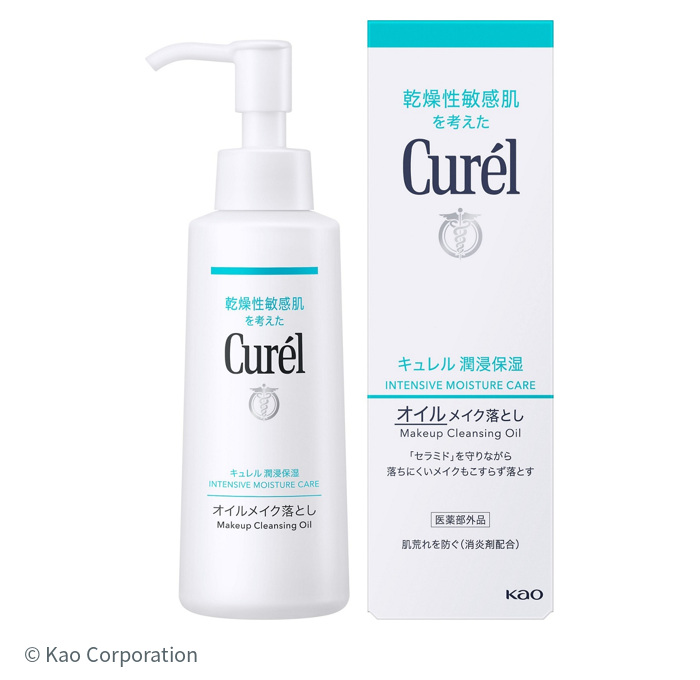
The Japanese name is キュレル オイルメイク落とし, 150 mL, labelled Makeup Cleansing Oil. Kao specifically says it removes waterproof mascara and describes an oil that mixes readily with water, rinses easily and leaves a moisturized finish.
If waterproof mascara is part of your usual makeup, that claim is more helpful than choosing whichever pack sounds most intensive. Film-forming mascara labelled for warm-water removal should still be removed according to its own directions.
- 1Prepare dry hands and faceLightly towel away water if your hands or face are wet. This oil’s official directions also say to remove contact lenses before use.
- 2Use about 4 pumpsDispense into dry hands and gently blend with makeup, without pulling at the eye area.
- 3Rinse thoroughlyUse water or lukewarm water. Follow the bottle’s method rather than adding a long rubbing stage.
- 4Use face wash afterwardsLike the gel, this oil requires a separate face-wash step.
Cleansing milk: take your makeup off before your shower
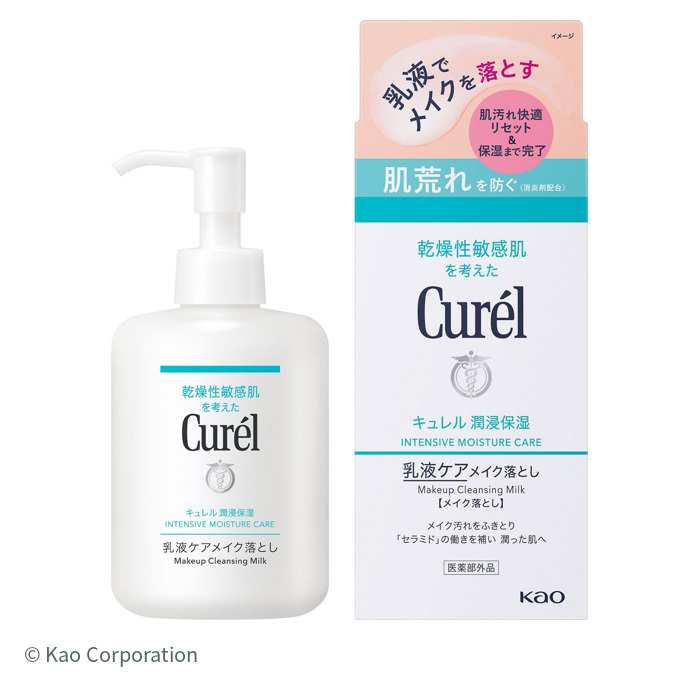
Look for キュレル 潤浸保湿 乳液ケアメイク落とし, 200 mL. The Japanese pack calls it Makeup Cleansing Milk. Kao describes a 100% emulsion formula that removes makeup while moisturizing, designed to stay between the cotton pad and skin as you glide it across.
That can be appealing when you get back to your hotel and want to remove makeup before settling down. Remember to pack cotton pads too. If wiping is a sensation you dislike, the convenience alone is not a reason to force this routine.
1. Use about 3–4 pumps per pad
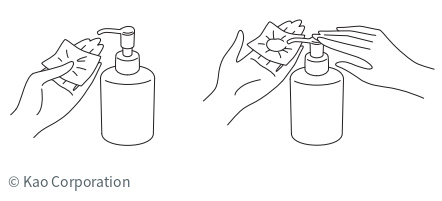
Stand the bottle on a stable surface. Hold the cotton pad in your palm with its centre slightly cupped and press the pump slowly. Kao recommends larger pads with unsealed edges so they can absorb plenty of milk. The amount is per pad, not a maximum allowance for the entire face.
2. Press lightly, then glide outwards
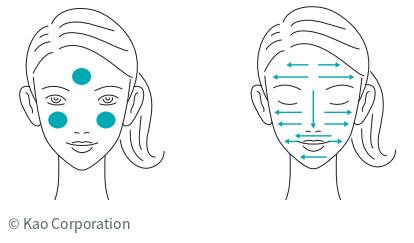
Hold the pad horizontally. Lightly press it onto the cheeks and forehead first, then glide from the centre of the face outwards, following the direction of the cotton fibres. Avoid scrubbing back and forth with a dry pad.
3. Be gentle around eyes and lips; replace dirty pads
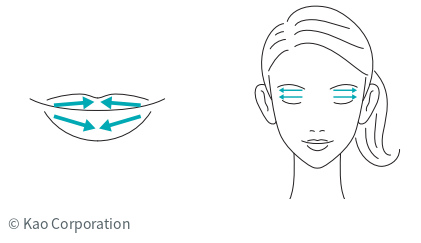
Wipe the lips from the corners towards the centre. For eye makeup, close your eyes, hold the pad against the makeup briefly, then wipe gently. Fold the dirty side inwards to use the rounded edge on small areas. Replace dirty pads and repeat until no makeup transfers. Afterwards, no rinse or separate face wash is needed.
Waterproof and film-forming eye makeup need their own plan. Kao recommends Curél Oil, a dedicated eye/lip remover, or warm water as appropriate to the makeup’s removal instructions. Do not keep increasing pressure when something will not come off.
Ingredients: protecting ceramides and adding moisturizing care
All three Japanese products list dipotassium glycyrrhizate as their active ingredient and carry a skin-roughness prevention claim. “Quasi-drug” is their Japanese regulatory category; these are not treatments for eczema or dermatitis.
- Gel: includes sorbitol solution and glycerin. Kao emphasizes cleansing while protecting the skin’s existing ceramides.
- Oil: includes mineral oil and other oily ingredients. It also emphasizes protecting existing ceramides during cleansing; it is not an oil-free formula.
- Milk: includes Kao’s ceramide-function moisturizing ingredient and eucalyptus extract, with moisturizing care alongside makeup removal. Its penetration claim refers to the outermost skin layer, the stratum corneum.
All three are labelled fragrance-free, colorant-free and without added ethanol. That last claim does not exclude every alcohol-type ingredient: the gel lists isopropanol, for example. Check the full ingredients if you already know a substance disagrees with your skin.
Design for dry, sensitive skin and allergy/patch testing do not guarantee that nobody will react. They also do not give us a universal gentleness ranking for the three formulas.
Read the shelf words before choosing a white bottle
- メイク落とし: makeup remover. ジェル identifies the gel, オイル the oil, and 乳液ケア the emulsion-care format.
- 泡洗顔料 or 泡ジェル洗顔料: facial cleansers. A white bottle or the word ジェル does not make these interchangeable with the makeup-removing gel.
- 乳液 or フェイスクリーム: moisturizing emulsion or face cream. For this wipe-off makeup remover, look for the full wording 乳液ケアメイク落とし.
If you actually want a moisturizer for after cleansing, see the Curél face-cream comparison. If you want to rinse with water but skip an extra face wash, the Softymo guide explains that different routine. Product names overseas may differ; the directions here are for the Japanese packs.
Is the 180 mL refill a different milk?
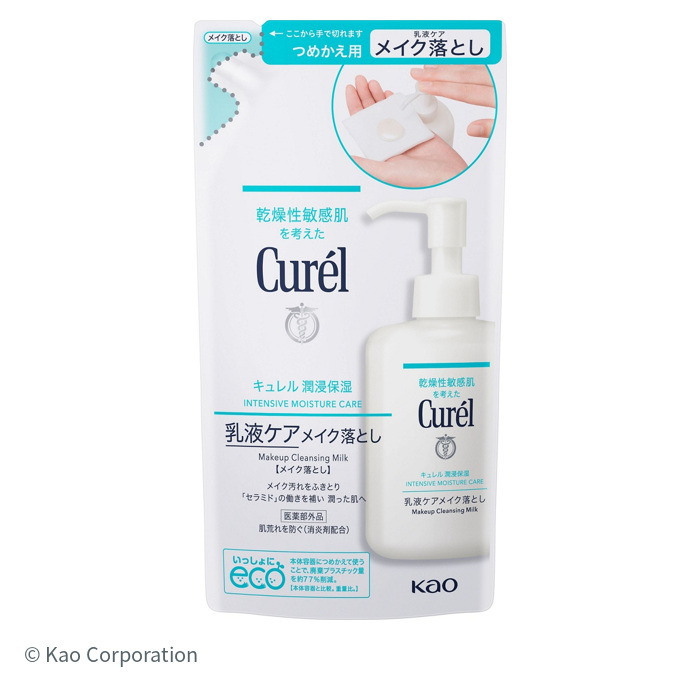
No. The 180 mL refill has the same Japanese regulatory product name and disclosed ingredients as the 200 mL bottle. It is a refill size of the same formula, not a more concentrated fourth remover.
Finish the original bottle before adding the whole refill to the matching container. Kao says not to wash the empty bottle or pump first and not to mix in other products. Keep a note of the refill’s batch number and replace the bottle from time to time. For a first purchase without the matching bottle, the pump pack is the straightforward choice.
A few questions before you buy
Can the milk remove sunscreen?
Kao says it can. Still check your sunscreen’s own removal instructions, particularly for resistant formulas or products with specific requirements. This is not evidence that one wipe removes every waterproof sunscreen.
Can I use the milk in the morning or add moisturizer?
Kao also allows it in place of morning face washing, without rinsing afterwards. If you want more moisture, additional skincare is an option. The convenient format does not require everyone to give up their usual moisturizer.
What if my skin becomes red or itchy?
Stop using it rather than immediately trying another remover on irritated skin. Do not apply to wounded, swollen, eczematous or otherwise abnormal areas. Consult a dermatologist for redness, swelling, itching, irritation or unusual lightening/darkening, including reactions after sun exposure. Rinse thoroughly at once if product enters the eyes; with the oil, do not rub if blurring or other discomfort occurs. Seek eye care if symptoms remain. Store out of reach of children or anyone who may accidentally ingest it.
My shopping shortcut: choose the evening routine first. Gel and oil mean dry hands, a thorough rinse and face wash. Milk means well-soaked pads, gentle wiping and fresh pads as needed, with waterproof eye makeup handled separately. You do not need all three to put together a workable routine.
Sources
Follow the Japanese label on your purchased product if it changes. Texture and finish descriptions are Kao’s; product photographs and use illustrations are from Kao.
- Kao Japan: Gel 130 g, ingredients, directions and packaging
- Kao Japan: Oil 150 mL, ingredients, directions and packaging
- Kao Japan: Makeup Cleansing Milk 200 mL
- Kao Japan: Milk 180 mL refill and refill directions
- Curél Japan: makeup removers, face washes and low-irritation design qualifications
- Curél Japan: moisturizing design of the cleansing milk
- Kao: whether a face wash is needed after the milk
- Kao: cotton-pad technique and official illustrations
- Kao: choosing cotton pads
- Kao: cleansing milk and sunscreen removal
- Kao: morning use and additional moisturizing care
- Kao Taiwan: localized product names
- Kao Hong Kong: localized product names