
Product information checked: 17 September 2026
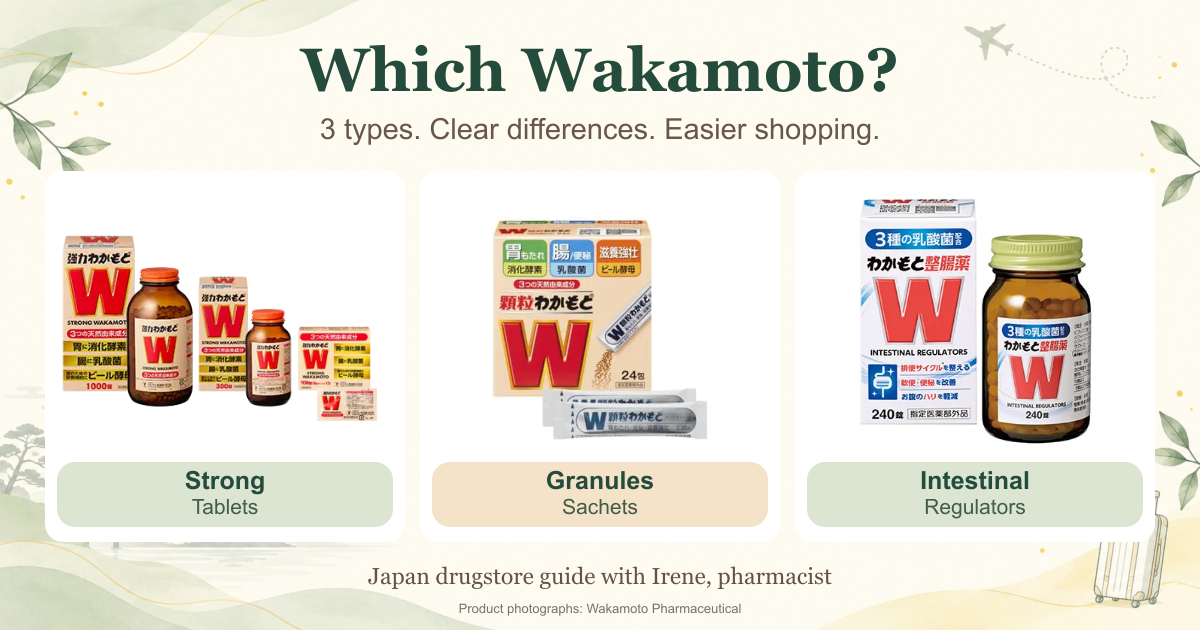
“Please bring me some Wakamoto from Japan.” It sounds easy—until you see a brown bottle, granules and a white box with the same large W. This 3-minute guide helps you compare the formulas, recognize the packages and keep the right dose with the right product.

Let’s find the Wakamoto you came for
Hi, I’m Irene, a pharmacist from Taiwan working in Japan. Before reaching for the largest bottle, let’s check the purpose and form. If family sent you a photo, match the full Japanese name. A big W on the front is only the beginning!
Choose in 3 minutes: digestion support or bowel regulation?
Start with the problem, then choose tablets or granules. All three are for ages 5+. A brown bottle, white box or red W alone is not enough to identify the product.
Strong Wakamoto / Wakamoto Granules
Both combine digestion support, bowel regulation and nutritional supplementation. Their labelled uses also include constipation and loose stools. Next, choose the form you can take comfortably.
Wakamoto Granules
The adult dose is 1 sachet instead of 9 Strong Wakamoto tablets, three times daily after meals. Their adult daily active-ingredient amounts are the same; granules are not stronger.
Wakamoto Intestinal Regulator
Two bifidobacteria types plus L. gasseri, for bowel regulation, constipation, loose stools and bloating. It does not have the Strong formula’s digestion and nutrition combination.
Irene’s tip: The brown version also lists bowel-related uses; constipation does not automatically mean the white box. Match a family member’s exact Japanese product name. Ask a doctor or pharmacist before use if receiving medical treatment.
Match these three Japanese names to the packages
Save this box comparison before your drugstore visit. At the shelf, match the full Japanese name, then check the form and pack size. Photos are not to scale; image size does not show pack size.
The photos show the outside box as well as the bottle or sachets. Save the one you need. These English descriptions help you navigate; the Japanese name is the label to match in the store.
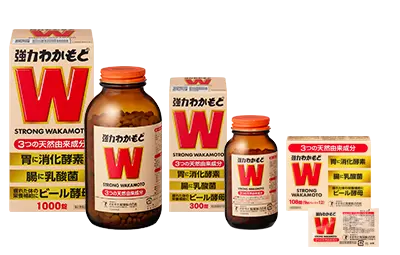
強力わかもと
Look for 強力
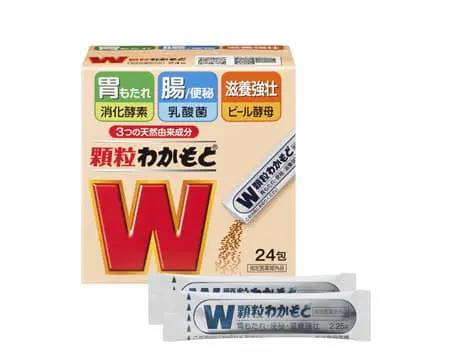
顆粒わかもと
Look for 顆粒
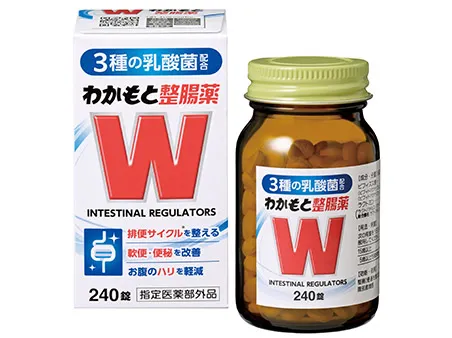
わかもと整腸薬
Look for 整腸薬
Product photos: Wakamoto Pharmaceutical. Strong: 1,000, 300 and 108 tablets; granules: 24 sachets; intestinal regulators: 240 tablets. Photos are not shown to scale. Sources are listed at the end.
What do the ingredient differences mean?
You do not have to learn every ingredient name. These are the differences that help explain what you are comparing.
| What the formula offers | Strong / granules | Intestinal regulators |
|---|---|---|
| Digestive support | Aspergillus oryzae NK culture powder provides digestive enzymes. The labeled uses include indigestion and a heavy stomach after eating. | Digestive support is not one of this product’s labeled uses. |
| Bowel regulation | Lactic acid bacteria culture powder is part of a formula also labeled for constipation, soft stools and abdominal fullness. | B. longum, B. bifidum and L. gasseri form a different combination focused on bowel regulation. |
| Nutritional supplementation | Yeast, culture powders and B vitamins contribute to the nutritional formula, for situations on the label such as physical fatigue or recovery from illness. | It does not have the Strong product’s nutritional combination. |
| How to use the comparison | Choose whether you want to compare this combination, then decide between tablets and granules. | Compare this when you are looking at bowel-regulating formulas. It is not Strong Wakamoto compressed into fewer tablets. |
The manufacturer describes the two bifidobacteria in the white product as acting mainly in the large intestine, and L. gasseri mainly in the small intestine. That describes the formula; it does not prove it is better for every person.
Strong Wakamoto: the brown product, 9 tablets per adult dose
Look for 強力わかもと. Its labeled uses include indigestion, overeating, a heavy stomach and poor appetite, as well as bowel regulation and nutritional supplementation in specified situations.
For ages 15 and older, the labeled dose is 9 tablets, three times a day, after meals. Nine tablets is the dose for this particular formula, not evidence that each tablet is “weak.”
Prefer a smaller pack for travel? Besides the 300- and 1,000-tablet bottles, the manufacturer lists a 108-tablet pack with twelve portions of nine tablets. You do not have to switch to granules just to find a portable package.
Wakamoto granules: another form of the same active combination
Look for 顆粒わかもと. The adult daily amount—three sachets—has the same labeled amounts of six active ingredients as 27 Strong Wakamoto tablets. It is a different form, not an extra-strength version.
If you prefer not to take many tablets at once, compare the granules. For ages 15 and older, take 1 sachet per dose, three times a day, after meals, with water or lukewarm water. One sachet is one adult dose, not the whole day’s amount. The box contains 24 sachets. New difficulty swallowing should be assessed rather than managed only by changing the form.
Wakamoto intestinal regulators: a different three-bacteria formula
Look for わかもと整腸薬 and the blue 3種の乳酸菌 label. This product is for bowel regulation, constipation, soft stools and abdominal fullness. Compare it if you want an intestinal-regulating formula without Strong Wakamoto’s digestive and nutritional combination.
For ages 15 and older, take 2 tablets per dose, three times a day, after meals. The manufacturer lists 90- and 240-tablet bottles. Two tablets here and nine tablets of Strong belong to different formulas; the counts are not interchangeable.
How to take the three products
These are amounts per dose. All three are taken three times daily, after meals, with water or lukewarm water. The manufacturer explains “after meals” as within about 30 minutes of eating. An adult should supervise children. Swipe the table sideways on a phone.
| Age | Strong Wakamoto | Wakamoto granules | Intestinal regulators |
|---|---|---|---|
| 15 years and older | 9 tablets | 1 sachet | 2 tablets |
| 11–14 years | 6 tablets | 2/3 sachet | 1 tablet |
| 8–10 years | 5 tablets | 1/2 sachet | 1 tablet |
| 5–7 years | 3 tablets | 1/3 sachet | 1 tablet |
| Under 5 years | Do not take | Do not take | Do not take |
One last look before paying
Save the exact name, pack photo and dose table together. At home, do not rely on a remembered tablet count. Strong: nine tablets. Granules: one sachet. Intestinal regulators: two tablets. These are adult amounts per dose; children need their own age row.
Three checks for an easier shopping trip
- Before you go: save the requested product photo. If choosing for yourself, start with the formula you want to compare.
- At the shelf: check 強力, 顆粒 or 整腸薬, then the bottle or sachet size. Do not use the W or bottle color alone.
- Before paying: check the person is at least 5 and save the right dose. If a before-use consultation applies, resolve it before taking the product.
Back to the package photos ↑ Once you have found what you need, spend the time you saved on the food, shops and places you came to Japan to enjoy.
What needs attention before and during use?
- Before use: people receiving medical treatment should consult a doctor or pharmacist for all three products. Strong and granules also require consultation if you or your family are prone to allergies, or you have had allergic symptoms from medicine.
- Check ingredients: Strong and granules contain wheat in their culture powders. The intestinal regulator contains lactose hydrate as an added ingredient. Check the full list if you have a relevant allergy or dietary restriction.
- Stop if symptoms occur: for Strong or granules, a rash, redness or itching after use means stop and consult. For the intestinal regulator, the leaflet also says to stop and consult if soft stools or diarrhea occur.
- Not improving after about one month? Stop and consult a doctor or pharmacist, taking the leaflet. Do not wait a month if symptoms are worsening.
- General warning signs: severe abdominal pain, black or bloody stools, or repeated vomiting need prompt medical assessment.
- Storage: follow the pack’s instructions, check its expiry date and keep it out of children’s reach.
Questions before you buy or use it
Which is stronger: the brown or white Wakamoto?
Color, bacteria count and tablets per dose do not rank their effects. Strong and granules combine digestive support, bowel regulation and nutritional supplementation. The white intestinal regulator has a different three-bacteria formula. Compare their purposes and ingredients.
Why is the Strong Wakamoto adult dose nine tablets?
Nine tablets is its labeled amount per dose for ages 15 and older. Do not substitute another product’s tablet count. Granules offer the same adult daily amounts of active ingredients in another form, while the white product has a different formula.
Can I take Wakamoto on an empty stomach?
All three are labeled for use three times daily after meals, with water or lukewarm water. The manufacturer describes after meals as within about 30 minutes of eating.
What if I already take B vitamins or a multivitamin?
Strong Wakamoto and granules contain B1, B2 and nicotinamide. Check the labels of other products you use too. Overlapping B vitamins alone do not prove an excessive dose or mean you should automatically switch to the white product. Ask a doctor or pharmacist if unsure.
How long should I wait if it is not helping?
The leaflets say to stop and consult if symptoms have not improved after about one month. Seek advice sooner for side effects or worsening symptoms, and get medical help for warning signs such as severe pain or black or bloody stools.
Are granules the only convenient option for travel?
No. Strong Wakamoto also has a 108-tablet pack divided into twelve portions of nine tablets. Granules come in a box of 24 sachets. Choose the formula and form first, then compare pack sizes.
Sources and photo credits
Product information is based on Japanese manufacturer materials. The English names help you read this guide; match the full Japanese name on the box when shopping. Official product photographs are shown without changing the packaging artwork.