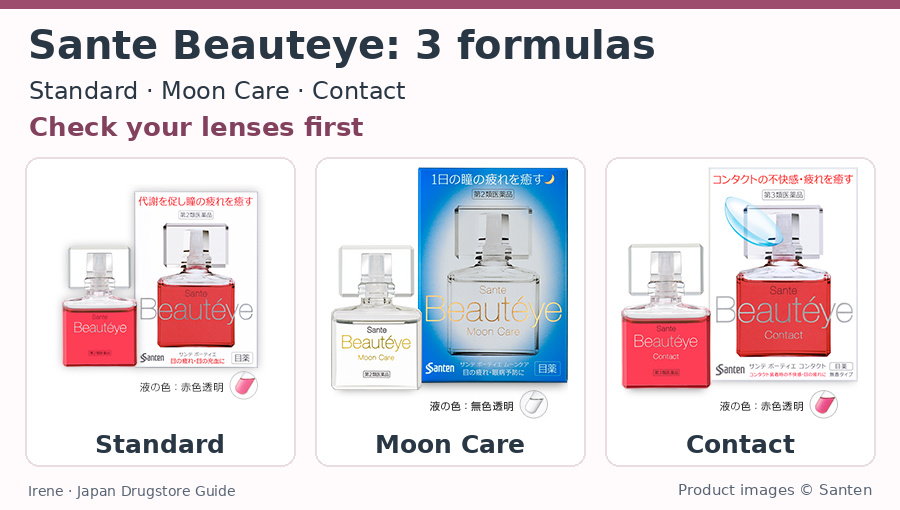
Of these three, only Beauteye Contact can be used while wearing ordinary soft contact lenses. None can be used while wearing colored soft lenses.
Standard Beauteye includes itching among its labeled uses. Moon Care changes the formula and needs care with bedtime timing. Contact has a different active formula again. Start with lenses and symptoms, then consider cooling sensation.

I’m Irene, a Taiwan-born, Japan-licensed pharmacist working in a Japanese drugstore. Beauteye’s perfume-like bottles catch the eye. Before choosing one, let’s check your lenses and the symptoms you want help with.
Information checked: 19 October 2026, Japan time | Japanese 12 mL products
Check whether self-care is appropriate first. Seek advice before use if you have severe eye pain, are receiving medical treatment, have a history of allergic reactions to medicines or other substances, or have glaucoma. A very painful red eye, or a red eye in a contact-lens wearer, needs urgent assessment; stop wearing lenses. A red eye with vision changes, pain when looking at light, or a severe headache with nausea needs emergency care. Do not use redness-relieving drops to hide these symptoms.
The differences that matter first
| Check | Standard Beauteye | Moon Care | Contact |
|---|---|---|---|
| Exact Japanese name | サンテ ボーティエ | サンテ ボーティエ ムーンケア | サンテ ボーティエ コンタクト |
| Japanese OTC category / size | Class 2 / 12 mL | Class 2 / 12 mL | Class 3 / 12 mL |
| Ordinary, uncolored soft lenses in place | No | No | Yes, including disposable lenses |
| Ordinary, uncolored hard lenses in place | Yes | Yes | Yes, including oxygen-permeable lenses |
| Colored lenses | No with colored soft lenses; do not assume other materials are compatible | No with colored soft lenses; do not assume other materials are compatible | Colored contact lenses explicitly excluded |
| Redness-relieving active | Tetrahydrozoline hydrochloride 0.05% | Tetrahydrozoline hydrochloride 0.01% | Not included; conjunctival redness is not a labeled indication |
| Manufacturer’s cooling level | 3 | 2 | 0 |
| Stop and seek advice if not improving | After 5–6 days of use | After 5–6 days of use | After about 2 weeks of use |
All three list tired eyes as an indication. Contact can also be used without lenses. Cooling levels describe sensation, not effectiveness, and level 0 does not guarantee that irritation or allergy is impossible.
Match the pack, then read the formula
Here, “standard” means Beauteye without a Moon Care or Contact suffix. These similar bottles contain different medicines. The names below identify the Japanese products, not an equivalent approved formulation in your home country.
Standard Beauteye: tired, red or itchy eyes
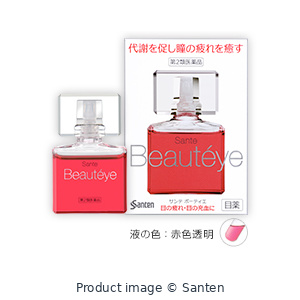
The five actives are taurine 1.0%, vitamin B12 (cyanocobalamin) 0.02%, chondroitin sulfate sodium 0.5%, tetrahydrozoline hydrochloride 0.05% and chlorpheniramine maleate 0.03%. Chlorpheniramine is the antihistamine ingredient. B12 also gives the solution its red color.
Labeled uses include tired eyes, conjunctival redness, blurred vision associated with excess discharge, itching, eyelid inflammation, inflammation caused by ultraviolet or other light, and discomfort with hard contact lenses. The label also lists prevention of eye disease after swimming or when dust or sweat enters the eyes. These indications are not a way to diagnose an infection or eye injury yourself.
Moon Care: a different formula with a bedtime detail
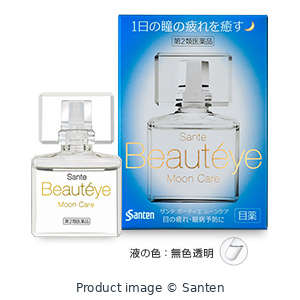
Moon Care contains potassium L-aspartate 1.0%, panthenol 0.1%, chondroitin sulfate sodium 0.5%, natural vitamin E (d-α-tocopherol acetate) 0.05% and tetrahydrozoline hydrochloride 0.01%. It does not contain standard Beauteye’s B12 or chlorpheniramine.
Its labeled uses are tired eyes, conjunctival redness, blurred vision associated with excess discharge, hard-lens discomfort, and prevention of eye disease in the situations described above. It does not list itching. It still contains a redness-relieving active, so its evening branding is no reason to keep adding extra drops.
Contact: more changes than cooling level
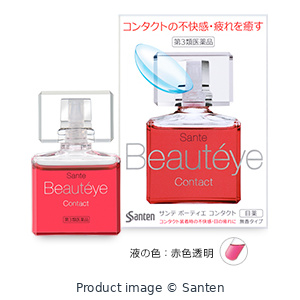
Contact contains vitamin B6 (pyridoxine hydrochloride) 0.1%, vitamin B12 (cyanocobalamin) 0.02% and neostigmine methylsulfate 0.005%. Santen describes these through their roles in eye-tissue metabolism and focusing function. Tetrahydrozoline is absent; this is a separate formula.
It is labeled for discomfort with soft or hard contact lenses, tired eyes, blurred vision associated with excess discharge, and prevention of eye disease in the situations above. It can also be used without lenses. It does not separately list redness, itching or tear supplementation for dry eyes.
Santen states that Contact has no added preservatives such as benzalkonium chloride. It still has excipients, including edetate sodium, boric acid, povidone, an isotonizing agent and a pH adjuster. Standard Beauteye and Moon Care list benzalkonium chloride. “No added preservatives” does not mean “no other ingredients,” or permission to use it with colored lenses. Ask a pharmacist to check the full formula if you have ingredient allergies.
Using Moon Care before bed: leave 5–10 minutes
Moon Care’s evening positioning does not make it a sleep aid; insomnia is not a labeled use. Santen’s general OTC eye-drop FAQ recommends finishing drops at least 5–10 minutes before sleep, rather than falling asleep immediately after applying them. Moon Care’s dose remains 5–6 applications daily, with no night-only restriction. Do not add an extra bedtime dose beyond the directions.
None of the three is labeled to reverse short-sightedness, restore eyesight or block blue light. Ingredient counts, cooling levels and different concentrations do not establish an effectiveness ranking.
The same labeled dose for all three
- Check your lenses first. Remove soft lenses for standard Beauteye or Moon Care. Contact excludes colored lenses. The compatibility rule matters more than the bottle’s color.
- Use 1–3 drops per application, 5–6 times daily. Keep the tip away from your eyes, eyelids and lashes. Do not use cloudy solution. These are eye drops, with no labeled use for cleaning, disinfecting or storing lenses.
- Close the cap, and keep the bottle to yourself. Do not share or transfer the liquid to another container. Standard Beauteye and Moon Care warn that overuse can cause unusual light sensitivity and actually worsen redness.
The three leaflets do not give one universal waiting time before reinserting lenses. Ask an eye-care professional or pharmacist with your lens and drop details. If you already use other eye drops, check the combination rather than alternating these bottles to cover more symptoms.
When to stop and seek advice
- Standard Beauteye and Moon Care: stop and seek advice if symptoms have not improved after 5–6 days of use.
- Contact: stop and seek advice if symptoms have not improved after about 2 weeks.
- All three: stop if blurred vision does not improve. Stop immediately for a possible reaction such as a skin rash, redness or itching, or eye redness, itching, swelling or stinging pain. Take the leaflet to a doctor, pharmacist or registered OTC medicine seller in Japan.
These are review points, not courses you must finish or instructions to wait through worsening symptoms.
Children, pregnancy and breastfeeding
Each leaflet requires adult supervision for children but gives no numerical minimum age. For young children, especially those who cannot describe their symptoms clearly, seek an ophthalmologist’s guidance before choosing these drops. An unspecified minimum age does not mean they suit every age.
During pregnancy, follow the label and tell your obstetric clinician about the drops. These leaflets do not have a specific pregnancy or breastfeeding prohibition, but breastfeeding, other medicines and ongoing treatment still merit an individual check.
Opened bottles and travel storage
Keep bottles tightly capped, cool, out of direct sunlight and beyond children’s reach. Avoid hot cars and heaters; do not use drops left in excessive heat, past their expiry or with an abnormal appearance. Rinse clothing promptly with water if the red B12 solution in standard Beauteye or Contact spills on it.
The Japanese standard and Moon Care leaflets say to use promptly after opening. Contact’s Japanese leaflet gives about three months after opening as a guide, within the expiry date. Santen’s general FAQ also uses about three months, conditional on handling and storage. It is not a guarantee: stop for cloudiness or floating material. Crystals around the nozzle or inside the cap can be gently wiped off with clean gauze as directed.
One useful question at the shelf
Tell the pharmacist your lens type and main symptoms, then show the full product name. Standard Beauteye includes itching and redness among its uses; Moon Care needs the evening timing check; Contact is the option here for ordinary soft lenses left in place. If dryness, colored-lens discomfort or persistent redness is the main issue, ask whether a different product or an eye examination would be more appropriate.
Sources and scope
- Sante Beauteye: product information and Japanese package leaflet
- Sante Beauteye Moon Care: product information and Japanese package leaflet
- Sante Beauteye Contact: product information and Japanese package leaflet
- Santen: translated product information, including English
- Santen FAQ: bedtime use, children, pregnancy and storage
- Santen Beauteye: range and bottle design
- NHS: red-eye warning signs
This guide covers products sold in Japan and helps you read their labels. It does not replace individual medical advice. Follow the current leaflet for your exact pack and your clinician’s instructions; Japanese labeling does not establish approval in another country.