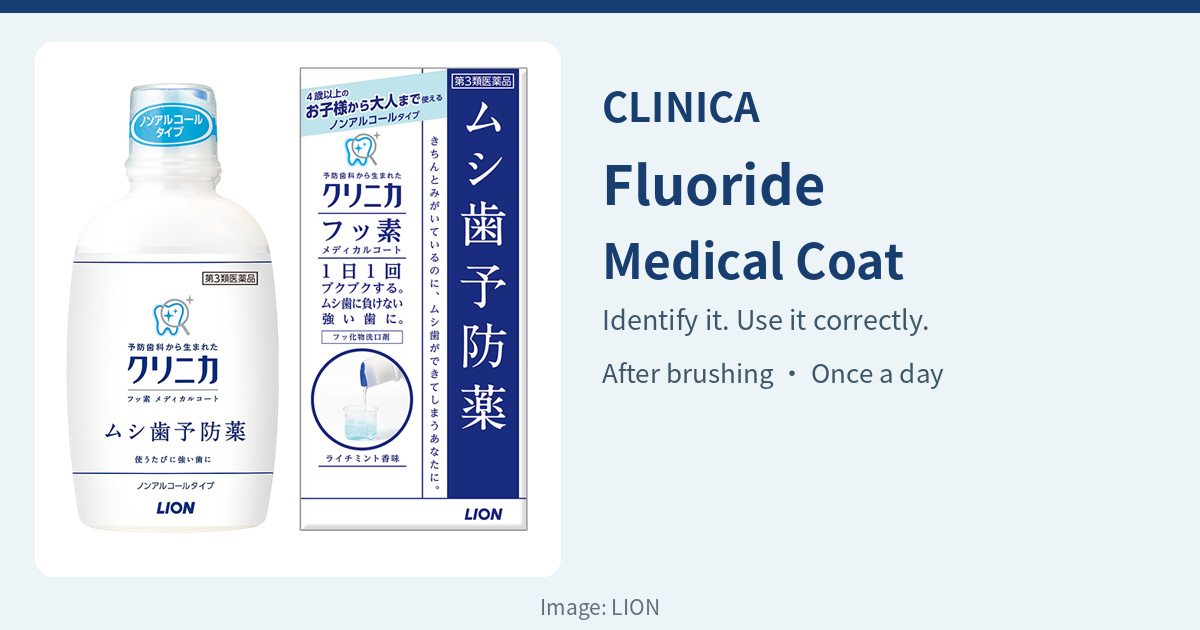
Looking for a fluoride rinse to add after brushing? Clinica Fluoride Medical Coat is the bottle to identify. In Japan it is a Class 3 OTC medicine used no more than once daily, for people aged 4 or older who can swish and reliably spit it out. If you want toothpaste, liquid toothpaste or a breath-freshening mouthwash, check the product category first: the steps are different.

I’m Irene, a Taiwan-born, Japan-licensed pharmacist working in a Japanese drugstore. Similar-looking oral-care bottles can make a simple purchase surprisingly confusing. Let’s identify this one, then make its measuring cap and final 30 minutes easy to understand.
Information checked: 19 October 2026. This guide follows the current Japanese product label. Products sold in other markets may differ. A dentist can help decide whether an extra fluoride rinse fits your cavity risk and existing routine.
Choose the right type of oral-care product
For a fluoride step after brushing: this medicinal rinse
The exact Japanese name is クリニカ フッ素メディカルコート, Clinica Fluoride Medical Coat. Its approved use is preventing tooth decay. Swish it around your teeth and spit it out. It is not taken by mouth as a drink, and it does not replace brushing. A visible cavity, persistent toothache or painful swollen gums needs dental assessment.
For brushing: toothpaste or liquid toothpaste
Regular toothpaste is used with a toothbrush. Japanese bottles labelled 液体歯磨 or 液体ハミガキ are liquid toothpaste. For example, Clinica’s liquid toothpastes require brushing after rinsing and spitting. The English words “Dental Rinse” on a bottle do not tell you that brushing can be skipped.
For a regular mouthwash: check its stated purpose
A rinse labelled 洗口液 has its own ingredients, uses and directions. “Fresh breath” or “antibacterial” does not automatically mean fluoride-based cavity prevention. Its dose and frequency should not be transferred to this medicine.
At the shelf, ask three things: does this require brushing, what is its active ingredient, and what is it intended to do? Those clues are more useful than bottle colour or how minty it sounds.
Recognise the medicine on the shelf
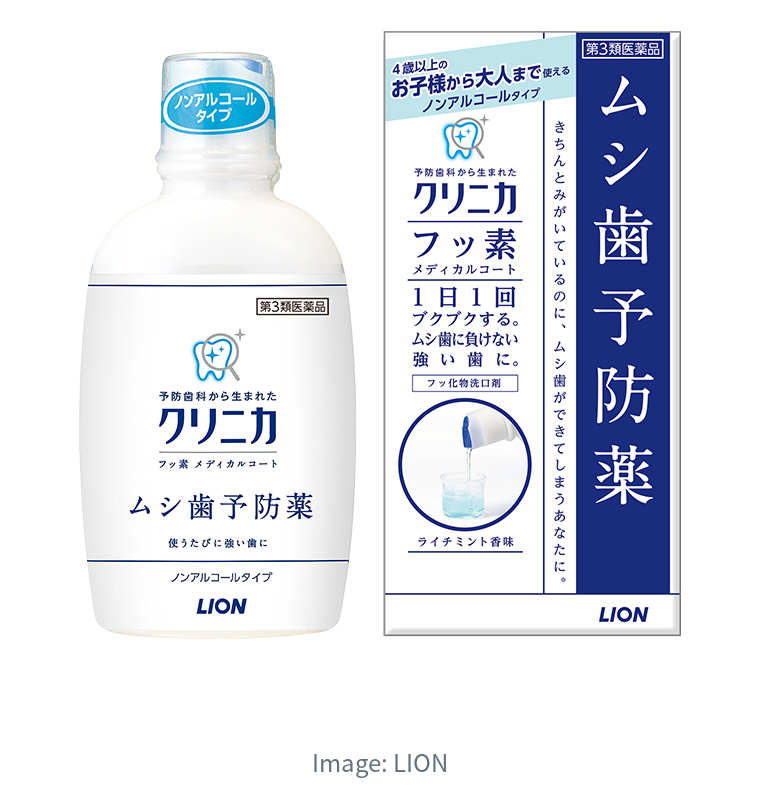
- Full name: クリニカ フッ素メディカルコート.
- Useful label clues: 第3類医薬品 means Class 3 medicine; ムシ歯予防薬 means a medicine for preventing tooth decay; フッ化物洗口剤 identifies a fluoride rinse. The package also carries 1日1回, once daily.
- Bottle and flavour: 250 mL, lychee-mint flavour and alcohol-free. Alcohol-free does not mean irritation or allergy is impossible, and it does not remove the age restrictions.
If buying for someone else, compare the full name and carton rather than asking for “the blue-and-white Clinica mouthwash”. A current manufacturer listing does not guarantee stock at every shop. Check the actual expiry date and enclosed instructions when buying.
What does 0.5 mg/mL mean?
Each 1 mL contains 0.5 mg of sodium fluoride, equivalent to a 0.05% sodium fluoride solution. That is the mass of the sodium fluoride compound, not the mass of fluoride ions alone.
The product table in Japan’s Fluoride Mouthrinsing Manual, 2022 edition lists this rinse as 0.05% sodium fluoride, approximately 225 ppm fluoride ions. Do not transfer the 1,450 ppm figure seen on some toothpastes to this bottle. Toothpaste and rinse also have different formulations, amounts and directions, so a ppm number alone is not a useful “stronger versus weaker” ranking.
Fluoride supports remineralisation and resistance to acid as part of cavity prevention. It does not fill a cavity that has already formed. Careful daily brushing, cleaning between teeth and regular dental check-ups still matter.
How much to use and what to do
The sequence: eat → brush → measure the rinse → swish for 30 seconds to 1 minute → spit out. For the next 30 minutes, do not rinse with water, eat or drink. Use no more than once a day.
The Japanese directions are 5–10 mL once daily after a meal or before bed, for ages 4 and over. The usual amounts depend on mouth size:
- Ages 4–5: usually 5 mL.
- Ages 6 and over, including adults: usually 7–10 mL.
- Under 4: do not use. Anyone unable to swish and reliably spit must not use it, whatever their age.
- Brush first. The manufacturer recommends using the rinse after brushing; bedtime is one practical option. This is an additional fluoride step, not a replacement for brushing.
- Measure with the supplied cap; do not dilute. Press PUSH on the pouring spout to open it, then pour one dose into the cap. The amount must fit comfortably in the mouth all at once without being swallowed. Do not drink directly from the bottle.
- Swish around the teeth with your head slightly down. Continue for 30 seconds to 1 minute, then spit out. Do not tilt your head back to gargle at the throat, and do not swallow. Discard any measured liquid left in the cap rather than taking it as extra rounds.
- Leave the fluoride in place. Do not rinse with water, eat or drink for 30 minutes after spitting. If the taste or sensation is too uncomfortable, the instructions allow rinsing with water, although this may reduce the effect. Stop immediately and seek advice for irritation or other unusual symptoms.
- Wash the measuring cap and close the bottle. Rinse the cap with water after each use. Press the pouring-spout side down to close it and replace the cap. If you miss a day, do not use a double dose next time.
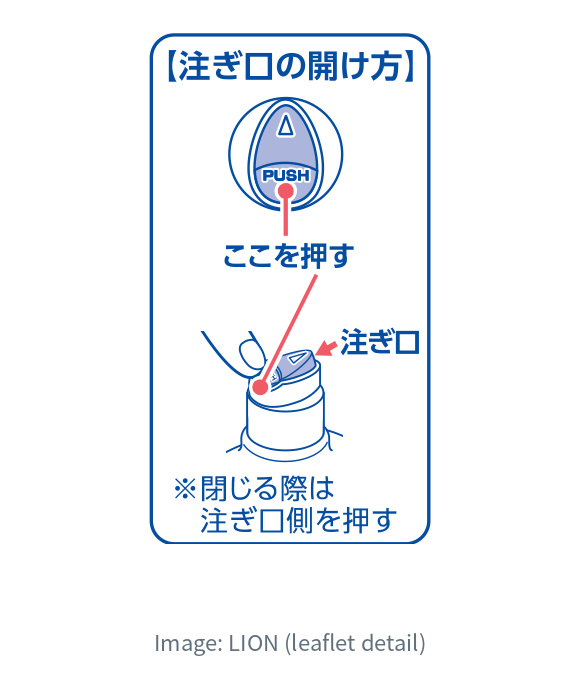
The top of this manufacturer diagram shows the PUSH opening point. The lower note says to press down on the spout side when closing. Follow the full steps above and the instructions supplied with your bottle.
Children, artificial teeth and other fluoride care
Turning four is only the first condition
Practise with plain water first and confirm that the child can swish and spit the liquid out reliably. A parent or guardian must supervise. The same ability check matters for people who need assistance or have little experience rinsing. A suitable age does not override swallowing difficulties, and lychee-mint flavour does not make this a drink.
Can it be used with fluoride toothpaste?
The manufacturer allows use alongside correctly used fluoride toothpaste, school fluoride-rinsing programmes or fluoride application at a dental clinic. Permission to combine them is not a recommendation that everyone needs another fluoride product. If you already have an individual cavity-prevention plan, tell your dentist which products and frequencies you use before adding to it.
What about dentures, crowns or braces?
Fluoride acts on natural tooth tissue; artificial teeth themselves do not receive this cavity-prevention benefit. The manufacturer identifies natural teeth around partial dentures or orthodontic appliances as areas that may be difficult to clean and worth assessing for extra prevention. Cleaning remains essential. Its FAQ says not to use this product when all teeth are artificial, such as dentures, crowns or implants, because it has no effect on those artificial teeth. Ask your dentist for a suitable cleaning plan.
Side effects, swallowing and storage
- Do not use: under age 4; inability to swish and spit; or a previous allergic reaction to this product or any of its ingredients.
- Ask before use: if you have had allergic reactions to medicines or similar products, consult a doctor, dentist, pharmacist or registered OTC medicine seller in Japan. Check the full ingredients; alcohol-free products can still contain flavourings or other ingredients that disagree with you.
- Stop immediately and seek advice: for a rash, redness or irritation of the skin or mouth, nausea or diarrhoea. Take the product and leaflet with you.
If some is accidentally swallowed: the leaflet says that vomiting, abdominal pain or diarrhoea should be followed by about 1–2 glasses of milk, or water if milk is unavailable, and consultation with a doctor, dentist, pharmacist or registered OTC medicine seller. A small accidental swallow without these symptoms does not require that milk-or-water step.
Do not force someone to drink to reach a stated number of glasses. General poisoning first aid requires the person to be alert and able to swallow safely. If they are unconscious, having a seizure or breathing abnormally, call emergency services immediately and do not give anything to drink.
This is not permission to drink it. The leaflet also says to consult a doctor, dentist, pharmacist or registered OTC medicine seller if excessive use causes any abnormal symptoms. If a child drinks from the bottle, the amount is unknown or substantially more than one dose was swallowed, seek individual medical advice promptly with the bottle to hand rather than assuming that no symptoms means no risk.
Store out of children’s reach in a cool, dry place away from direct sunlight. Do not leave it in a hot car, transfer it to a travel bottle or use it after expiry. The cap is for measuring; do not leave liquid in it for the next dose. Do not pass unneeded leftover medicine to someone else; discard it.
Irene’s shelf check: find the Class 3 cavity-prevention medicine, then check that the person using it can spit reliably. Choose it as part of an appropriate prevention plan. The practical essentials are brushing first, measuring correctly, once-daily use and the 30-minute period after spitting.
Still choosing an everyday toothpaste? See the Clean Dental toothpaste guide or the APAGARD comparison. For a product intended for gum symptoms, read Dent Health R versus Bb; those medicines have different purposes and directions from this fluoride rinse.
Official information and image sources
- LION: current product, ingredients and precautions
- LION: Japanese package insert and use instructions, two pages
- Clinica: product and use guide
- Clinica: fluoride medicine FAQ; liquid toothpaste and mouthwash FAQ
- Fluoride Mouthrinsing Manual, 2022 edition: only the concentration table on printed pages 23–24 is cited here. Current product directions come from LION’s leaflet.
- Japan Poison Information Center: general poisoning first aid, for the no-forced-fluids and emergency-help safeguards.
Package and pouring-spout images belong to LION and are used here to identify the product and explain its operation. Read the full instructions supplied with your bottle. This guide does not replace individual advice from your dentist or another healthcare professional.