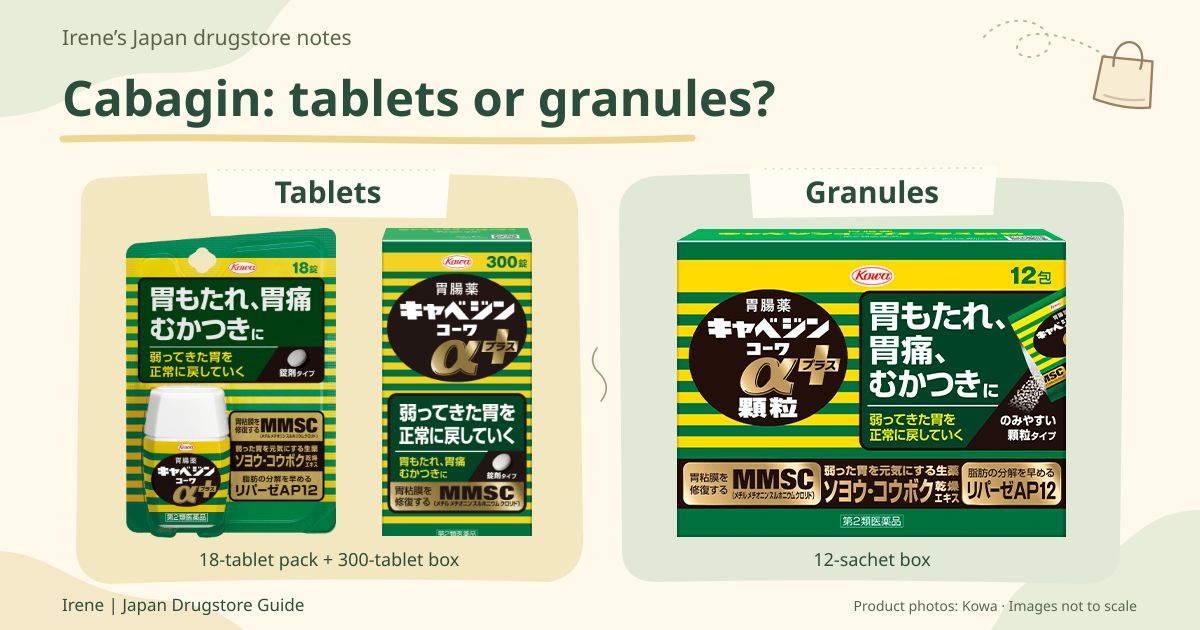
Cabagin is on your shopping list, but the shelf has bottles, small packs and granules. Let’s recognise the two forms, then find the one you prefer taking.

Irene · A pharmacist in Japan, originally from Taiwan · About Irene
Both forms list uses including bloating, indigestion and heartburn. Their active ingredients and amounts in an adult’s daily dose match. Start with the form you prefer, then check the age-based dose and precautions.
Tablets or granules: which form do you prefer?
Prefer tablets?
Count out tablets; small packs are available too
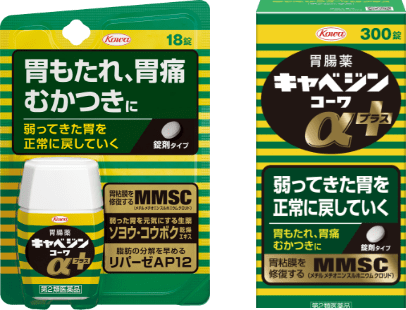
キャベジンコーワαプラス
Look for αプラス and a number with 錠. The 18-tablet pack in the photo is also tablets.
Prefer granules?
Individual sachets with a shiso flavour
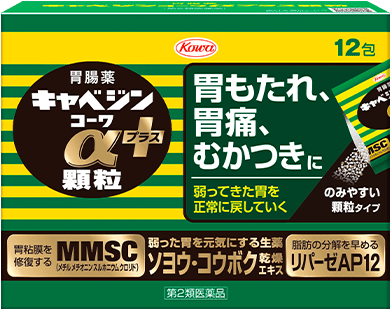
キャベジンコーワαプラス顆粒
Look for αプラス and 顆粒. Take the granules with water or lukewarm water.
A small discovery for your travel bag: granules are not the only portable option. Tablets also come in an 18-tablet pack, so you can look for a small pack without switching to a form you do not prefer.
This guide compares Alpha Plus tablets and Alpha Plus granules sold in Japan. Both are Class 2 OTC medicines under Japan’s classification. Their forms, structure and inactive ingredients differ. Matching adult daily active-ingredient amounts does not establish that granules work faster, tablets are stronger, or both start working at exactly the same speed.
Neither form is for children under 8. For other ages, check the amount per dose. If you are receiving treatment, pregnant or breastfeeding, read the precautions before use.
At the shelf, these Japanese words help
- αプラス means Alpha Plus, the current product name. If a family member’s photo only says α, check the formula changes first.
- 顆粒 means granules. For tablets, match the full name キャベジンコーワαプラス.
- 錠 / 包 shows the tablet or sachet count. Tablets come in packs of 18, 100, 200 and 300; granules in 12, 28 and 56 sachets. Pack size is not a strength rating.
Save the full Japanese name and a package photo on your phone. At the shelf, check name → form → tablet or sachet count. If you cannot find it, show the photo to a staff member and ask 「この商品はありますか?」 (“Do you have this product?”). Packaging can change, so check the full name and instructions on the product in your hand.
Buying for family? Match the name and check the user’s age before choosing a pack size. One sachet is not the right amount for every age.
Older Alpha vs Alpha Plus: more than a name change
Kowa lists the older キャベジンコーワα as discontinued. Alpha Plus tablets launched on 2 October 2024, followed by Alpha Plus granules on 3 April 2026. Discontinued production does not mean every shop has sold all remaining stock; an older box alone does not establish that a product is counterfeit.
Compared with the older Alpha tablets, Alpha Plus adds magnolia bark extract and changes the antacid ingredients: magnesium hydroxide replaces magnesium carbonate. The amounts of sodium bicarbonate, precipitated calcium carbonate and perilla extract also change. MMSC, the ingredient used to help repair the stomach lining, remains in the formula.
An old ingredient table therefore cannot become an Alpha Plus table by changing its heading. If someone requested the older product, explain the new name and formula first. Follow the packaging for the version actually purchased. These changes do not prove that Plus works better for everyone.
How to take it: age first, then the amount per dose
All amounts below are for one dose. Both products are taken three times a day, after meals, with water or lukewarm water. Children must take them under a parent’s or guardian’s supervision.
| Age | Tablets | Granules |
|---|---|---|
| 15 and over | 2 tablets | 1 sachet |
| 11–14 years | 1 tablet | 2/3 sachet |
| 8–10 years | 1 tablet | 1/2 sachet |
| Under 8 | Do not take | Do not take |
Check the row again when a child turns 8, 11 or 15. For granules, half a sachet is not the dose for every child, and turning 8 does not mean the adult dose starts.
Six tablets or three sachets is the adult’s total daily amount, not a single dose. Tablets and granules are alternatives, not a combination to take together. Do not increase the dose or frequency because your stomach still feels uncomfortable after a meal.
For the full directions in English, choose English on Kowa’s official pages: tablet instructions / granule instructions.
What needs attention before and during use?
Medicines not to combine, and breastfeeding
- Do not combine either product with gastrointestinal analgesic/antispasmodic medicines (胃腸鎮痛鎮痙薬), a category used for stomach or intestinal pain and cramps. If you are unsure whether another stomach medicine falls into this category, ask a doctor, pharmacist or Japan’s registered OTC medicine salesperson (登録販売者), a qualified seller of certain non-prescription medicines, to check it.
- Do not use while breastfeeding, or avoid breastfeeding while using the medicine. An ingredient can pass into breast milk and cause a rapid heartbeat in the baby; the medicine may also reduce milk production. Simply spacing a dose around feeds does not establish that the two can safely be combined.
Ask before taking it if any of these apply
Consult a doctor, pharmacist or registered OTC medicine salesperson before use if you are receiving medical treatment; are pregnant or might be pregnant; are elderly; have had an allergic reaction to medicines or other substances; or have difficulty urinating. The same applies if you have been diagnosed with kidney disease, heart disease, glaucoma or a thyroid disorder.
Stop for these symptoms, or if it has not helped after about two weeks
If you develop a rash, skin redness or itching, stop taking the medicine immediately and seek advice, taking the outer box with you. Stop and seek advice if dry mouth persists or gets worse, too.
If symptoms have not improved after about two weeks of use, stop and seek advice with the outer box. This is not a requirement to take it for two weeks, or to wait that long if you feel worse. Seek medical help sooner if symptoms worsen.
Choosing a pack size? Think about storage too
Before buying the largest bottle, consider what you need and how you will store it once opened. More tablets do not automatically make a pack a better choice.
- Bottled tablets: note the opening date and close the cap tightly after each use. Aim to use the tablets within six months of opening, and never beyond the printed expiry date. Handle them with dry hands; discard any tablets that accidentally get wet. Remove and discard the protective packing material inside the bottle when you first open it.
- Granule sachets: if the age-based dose leaves some in a sachet, fold the opening closed and use the remainder within two days.
- Both forms: keep them away from heat, direct sunlight and moisture, out of children’s reach. Keep them in their original container and do not use them after expiry.
One last check before taking it home: match the name and directions first; choose the pack size last. Bringing home the right product is more useful than bringing home a huge bottle and guessing how to take it. Keep the box and dose table together for one less thing to work out at home.
What do the ingredients do? Four useful roles
Both products list uses including stomach discomfort, a bloated or full feeling, stomachache, indigestion, excess stomach acid and heartburn. Heartburn is a symptom; this guide cannot diagnose gastro-oesophageal reflux disease, and not every stomachache is suitable for self-treatment.
You do not need to memorise the full ingredient list to understand the main roles:
- Stomach-lining repair
- Helps repair the damaged stomach lining.Ingredients: Methylmethionine sulfonium chloride, or MMSC
- Acid neutralisation and reduced acid secretion
- Antacids neutralise excess acid; scopolia extract helps reduce excess acid secretion.Ingredients: Sodium bicarbonate, magnesium hydroxide, precipitated calcium carbonate and scopolia extract
- Support for stomach function
- Helps restore the stomach’s movement.Ingredients: Perilla, magnolia bark and swertia herb
- Digestive support
- Enzymes help digest carbohydrates, proteins and fats.Ingredients: Biodiastase 2000 and lipase AP12
The tablets have an outer and inner layer. Granules are a different formulation, with different inactive ingredients. When comparing active-ingredient amounts, the matching reference is 6 tablets or 3 sachets in an adult’s whole day, not one tablet and one sachet.
A small name story: MMSC was discovered in cabbage juice and was historically called “vitamin U”; the name Cabagin also comes from cabbage. It is an interesting connection, but this is still a medicine with doses and restrictions. It is not a routine supplement to take before a feast, or permission to eat or drink more.
A few questions you may still have
Do granules work faster, or are tablets stronger?
The official materials checked for this guide do not establish a difference in onset or effectiveness between the two. Their adult daily active-ingredient amounts match, but the dosage forms, structure and inactive ingredients differ. Compare the form you prefer, pack size and age-based dose rather than ranking them by strength.
Are granules the only portable option?
No. Granules come in individual sachets, but tablets also come in an 18-tablet pack. Choose a form you are comfortable taking, then a suitable pack size. Do not transfer bottled tablets into another container for travel.
Can I take the granules without water?
The directions are to take them after meals with water or lukewarm water, not to swallow them dry. Tablets also need water or lukewarm water.
Can I take it every day to maintain my stomach health?
Kowa’s FAQ says use may continue when the medicine is helping, but to stop and seek advice if symptoms have not improved after about two weeks. That does not mean everyone needs a daily stomach medicine, or that it prevents problems from overeating or drinking. Follow the indications, directions and precautions; do not increase the dose or assume indefinite use is suitable.
My pack has no paper leaflet. Is that normal?
The Japanese information PDFs currently provided by Kowa state that a package insert is not enclosed and that the information appears on the outer box. Keep the box, not just the bottle or sachets. The absence of a paper leaflet alone does not establish whether a product is genuine; also check its full name, expiry date and where you bought it.
Can I use this ingredient comparison for the older Alpha?
Not directly. This guide covers Alpha Plus tablets and Alpha Plus granules; the older Alpha has a different formula. If that is the version you have, check its own packaging and directions, as well as the expiry date.
Also comparing Biofermin, Wakamoto or EBIOS?
These names often appear on the same Japan shopping list, but they are different formulas. Their tablet counts cannot be swapped between products. Continue with the question you are actually comparing:
- Biofermin S and S Plus: tablets, fine granules and formula differences — compare bowel-regulating formulas, tablets and fine granules.
- Wakamoto: three products and their different roles — separate the digestion and nutritional-support combination from the intestinal-regulating formula.
- EBIOS: yeast tablets and intestinal regulators (Traditional Chinese) — check the full names, uses and directions for these different products.
These are links to other product guides, not a recommendation to take the products together.
Sources and packaging references
This guide is based on Kowa’s Japanese product information and package directions, cross-checked against its English translations. English descriptions help you read the guide; match the full Japanese name when shopping. Uses refer to the Japanese labelling and are not expanded into disease diagnoses.
- Kowa: Alpha Plus tablets — uses, doses, ingredients and pack sizes
- Kowa: Alpha Plus granules — uses, doses, ingredients and pack sizes
- Kowa: tablet instructions in several languages / granule instructions
- Kowa: older Alpha and discontinued-production notice
- Kowa: tablet launch announcement, 2 October 2024
- Kowa: granule launch announcement, 3 April 2026
- Kowa: frequently asked questions
- Cover and product-comparison photos (Kowa): tablets / granules.