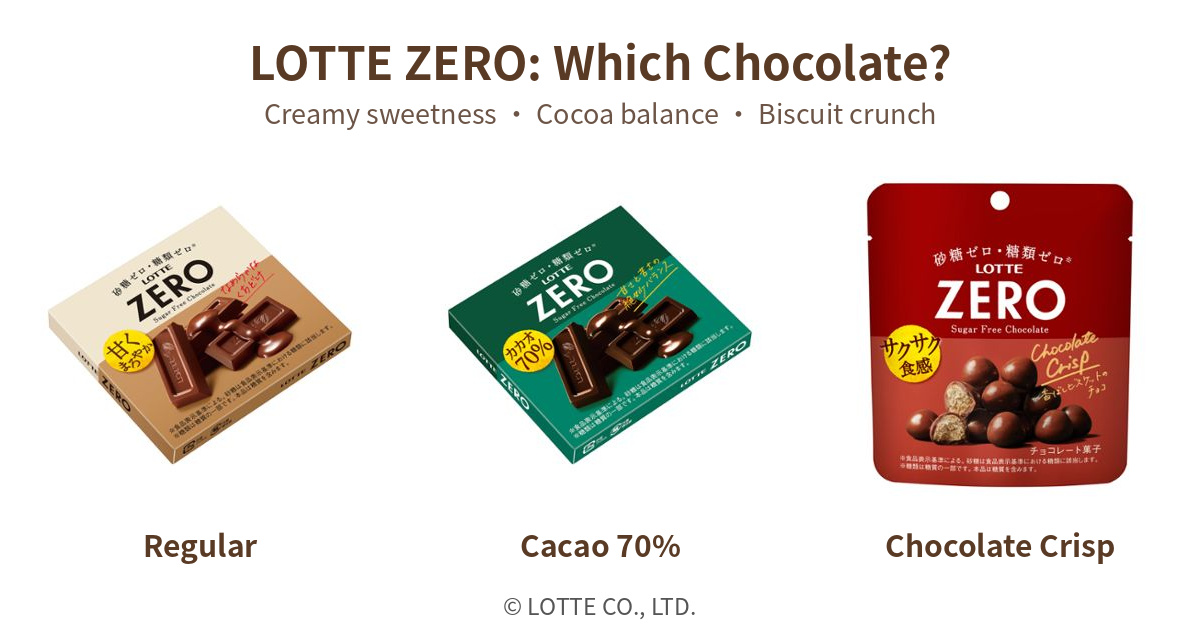
Choose regular ZERO for creamy sweetness, Cacao 70% for a balance of cocoa bitterness and sweetness, or the red Chocolate Crisp pouch for a biscuit crunch. The “zero” on these three products refers to sugars; it does not mean zero carbohydrate or zero calories.

I’m Irene, a Taiwan-born, Japan-licensed pharmacist working in a Japanese drugstore. When choosing a snack, I separate the flavor I want from the nutrition terms on the pack. Here is how to recognize these three ZERO products and read their labels.
Sources checked on 19 October 2026, Japan time. This guide covers the current Japanese 50 g regular box, 50 g Cacao 70% box and 28 g Chocolate Crisp pouch. The flavor descriptions below come from LOTTE, not an Irene taste test.
Choose the texture first
| Choice | LOTTE’s description and buying cue | Package to find |
|---|---|---|
| Regular | Smooth-melting, sweet and rich. Start here if you want straightforward chocolate sweetness. | Cream-and-gold ZERO box; 50 g, five sticks |
| Cacao 70% | Mellow cocoa bitterness and richness, balanced with sweetness. Compare this if you want a cocoa-focused flavor. | Dark-green ZERO Cacao 70% box; 50 g, five sticks |
| Chocolate Crisp | Toasted biscuit coated in rich chocolate, with a crisp bite. Choose it for a biscuit center rather than solid chocolate. | Red Chocolate Crisp pouch; 28 g |
70% is a cocoa percentage, not a health ranking or a promise of no sweetness. There is no need to choose a flavor you dislike simply because its number is higher.
Match the actual pack, not just the ZERO logo
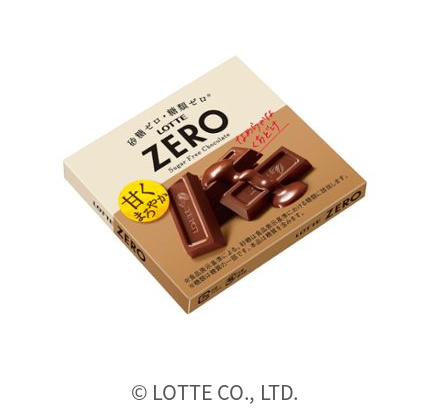
Regular: this guide uses the 50 g, five-stick box labeled ゼロ. Nutrition is given per 10 g stick. The separate bite-size Sugar Free Chocolate pouch is not the same package or serving unit.
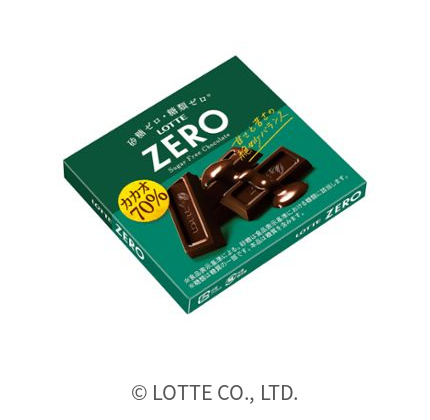
Cacao 70%: look for 70% on the dark-green box, labeled ゼロ<カカオ70%>. Use this current product identity rather than assuming an older “Bitter” listing has the same formula.
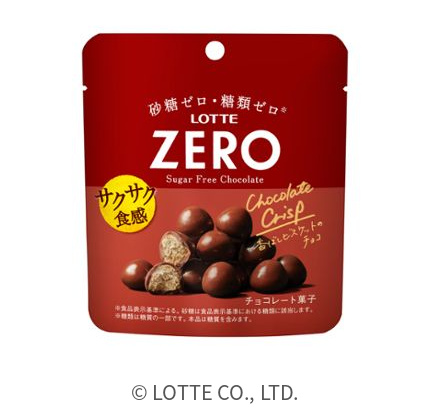
Chocolate Crisp: the current full Japanese name is ゼロ シュガーフリーチョコレートクリスプ. The front says Chocolate Crisp and shows a biscuit center. This 28 g chocolate-and-biscuit snack is distinct from plain chocolate bites, ZERO biscuits, protein bars and frozen desserts. Package pictures are not shown to a shared physical scale.
What is actually zero?
LOTTE explains that the Japanese “Sugar Free” or “糖類ゼロ” claim means less than 0.5 g of sugars per 100 g under Japan’s labeling standard. It is a labeling threshold, not a promise that every serving contains chemically absolute zero sugars. Table sugar is one type of sugar; the Japanese label category 糖質 means carbohydrate excluding dietary fiber and covers more than sugars alone.
These products obtain sweetness from sugar alcohols and sweeteners. Their ingredients include maltitol and lactitol, as well as sweeteners such as aspartame and sucralose. Sugar alcohols count within carbohydrate excluding fiber on the Japanese nutrition label. That is why a product can declare 0 g sugars while still listing a nonzero amount of carbohydrate excluding fiber. Crisp also contains wheat flour, whole-wheat flour and egg as part of its biscuit recipe.
Zero sugars does not mean zero carbohydrate or zero calories. This comparison is about snack labels, not a promise of blood-glucose control, weight loss or unlimited portions. If you have a medical dietary requirement, discuss the actual portion and full label with your care team rather than deciding from the ZERO name.
One 10 g stick is not one 28 g pouch
| Nutrition | Regular | Cacao 70% | Chocolate Crisp |
|---|---|---|---|
| Label unit | One 10 g stick | One 10 g stick | One 28 g pouch |
| Energy | 48 kcal | 52 kcal | 131 kcal |
| Protein | 0.8 g | 1.0 g | 2.1 g |
| Fat | 4.0 g | 4.4 g | 9.1 g |
| Carbohydrate | 5.0 g | 4.3 g | 16.2 g |
| Carbohydrate excluding fiber* | 4.0 g | 3.1 g | 13.5 g |
| Of which: sugars | 0 g | 0 g | 0 g |
| Dietary fiber | 1.0 g | 1.3 g | 2.7 g |
| Salt equivalent | 0.011 g | 0.004 g | 0.07–0.16 g |
*Carbohydrate excluding fiber includes sugar alcohols; it is not the same as “sugars.”
The two boxes can be compared at the same 10 g weight: Cacao 70% has less carbohydrate excluding fiber but slightly more energy, 52 rather than 48 kcal. Less of one carbohydrate category does not automatically mean fewer calories. Crisp’s 131 kcal applies to its entire pouch, so do not rank that number against a single stick without noticing the portion difference.
Eating the complete 50 g box would provide a calculated 240 kcal for regular or 260 kcal for Cacao 70%, obtained by multiplying the per-stick figures by five. Those are calculations, not recommended portions. Fiber is already included in total carbohydrate, so do not add it again. Figures are reproduced as labeled; rounding can produce a 0.1 g difference when adding subcategories.
Dark chocolate can still contain milk
| Product | Declared ingredient allergens | Shared-equipment information |
|---|---|---|
| Regular | Milk, soy | No shared-equipment statement on the checked product page; this does not establish absence of cross-contact. |
| Cacao 70% | Milk, soy | No shared-equipment statement on the checked product page; this does not establish absence of cross-contact. |
| Chocolate Crisp | Wheat, egg, milk, soy | Made on shared equipment with products containing almonds and macadamia nuts. |
All three contain milk ingredients. The green Cacao 70% box is neither a dairy-free nor a vegan choice. Crisp’s biscuit introduces wheat and egg, which matters when buying for someone else. LOTTE warns that formulas may change: check the complete ingredients, allergen information and precautions on the pack you buy and eat.
Three checks before you buy
- Pick the experience: smooth sweetness, cocoa bitterness balanced with sweetness, or a biscuit crunch.
- Match the name and weight: the two boxes here contain 50 g and five sticks; the red pouch contains 28 g. Other ZERO products need their own label checks.
- Read nutrition for the amount you will eat: take out your chosen portion and keep the original pack available for anyone sharing it. Follow its storage directions and consider heat exposure while traveling with chocolate.
If you want stronger high-cocoa flavors or a whole-almond center, see my Meiji Chocolate Effect flavor and texture comparison. Those products have different sugar and portion labels; ZERO’s sugar-free claim does not transfer to them.
My takeaway: choose a flavor you actually want, then check the serving unit and allergens. The useful detail is what “zero” refers to and how much you plan to eat.