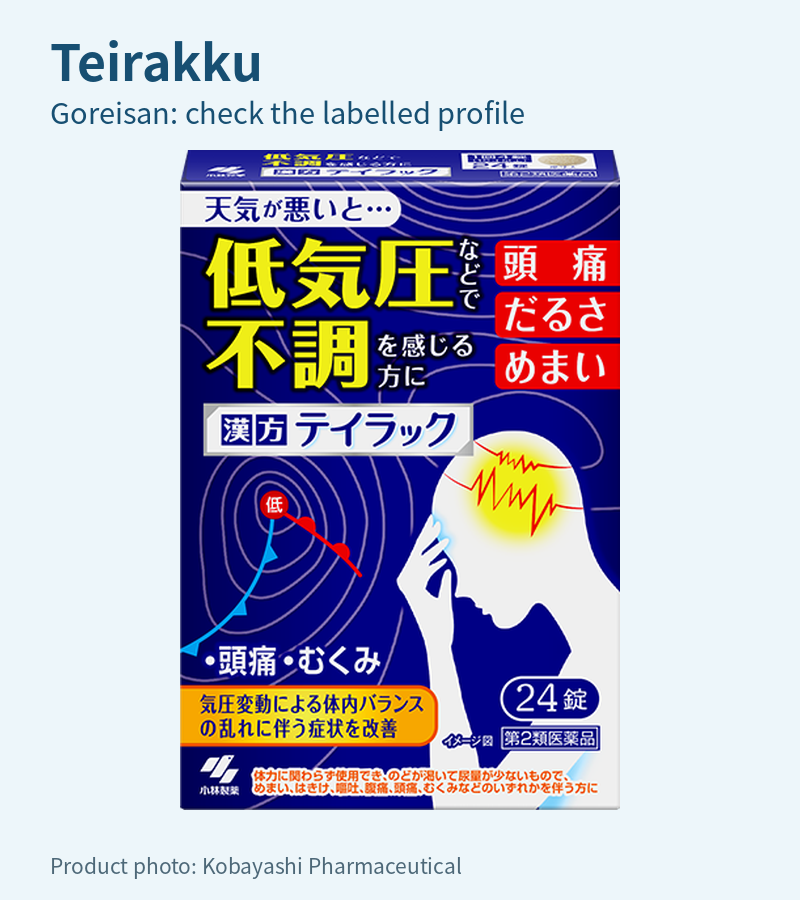
Weather turns, your head starts hurting, and a blue box catches your eye in a Japanese drugstore. Kobayashi Teirakku (テイラック) is a Class 2 OTC Kampo medicine containing Goreisan. Before choosing it, check the symptom pattern on the label, rather than the weather forecast alone.
Start here: its labelled profile includes thirst and reduced urine output, with symptoms such as headache, dizziness or swelling. Weather-related discomfort alone does not establish that Teirakku suits you. It is not a general-purpose painkiller or a medicine for anxiety.
If headaches are new, recurrent or worsening, or swelling has no clear cause, arrange medical assessment. Do not assume the weather explains them.

I’m Irene, a Taiwan-born, Japan-licensed pharmacist working in a Japanese drugstore. When a trip is interrupted by a headache, a familiar-looking remedy can feel reassuring. Let’s check what this particular box is for, how many tablets to take, and when getting help matters more than choosing a medicine.
Symptoms to assess before buying
Get emergency help for a sudden, extremely painful headache, or headache with weakness, trouble speaking, confusion, loss of vision, or a very high fever, a stiff neck or sensitivity to bright light. Headache with vomiting or eye/vision problems needs urgent assessment. Recurrent or worsening headaches need a clinician’s review.
Swelling with breathlessness or chest pain needs emergency help. Unexplained swelling in one leg, sudden severe or painful swelling, redness or heat needs urgent assessment. Persistent or worsening swelling should be evaluated. These are general safety boundaries, separate from the medicine’s label.
What does the Japanese label actually say?
Teirakku’s labelled profile is people of any physical strength who have thirst and reduced urine output, accompanied by one or more symptoms such as dizziness, nausea, vomiting, abdominal pain, headache or swelling. Within that profile, indications are watery diarrhoea, acute gastroenteritis, heat-related illness, headache, swelling and hangover.
Do not use it for acute gastroenteritis with tenesmus: repeated painful urges to pass stool with a feeling of incomplete emptying. The broad phrase “any physical strength” does not cancel the other conditions or age restrictions. Heat-related illness or inability to keep fluids down can need medical care; this indication is not a plan for managing severe illness yourself.
Dizziness appears as an accompanying symptom in this indication framework, rather than proof that every cause of dizziness can be treated with Teirakku. Likewise, a headache on a rainy day does not diagnose a Goreisan-responsive problem.
Recognise the box: one formula, two pack sizes
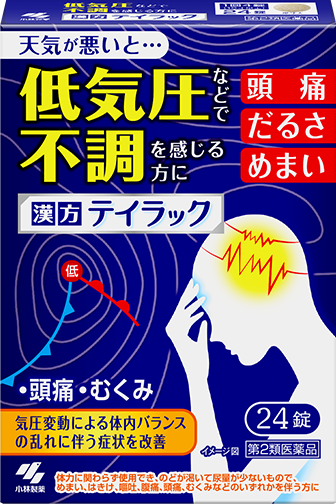
Look for テイラック and the Japanese Class 2 medicine mark. The current manufacturer catalogue lists 24 and 48 tablets. They are pack sizes of the same formula, not a standard and stronger version. The photo shows the 24-tablet box; store stock may vary.
The adult daily amount of 12 tablets contains 2.3 g of Goreisan extract, made from alisma 5.0 g, polyporus 3.0 g, poria 3.0 g, atractylodes rhizome (the white-atractylodes type) 3.0 g and cinnamon bark 2.0 g. These are starting crude-drug amounts used for extraction, not extra ingredients to add to the extract weight. This five-ingredient formula does not contain licorice.
Full additive list
Croscarmellose sodium, silicon dioxide, carmellose calcium, talc, magnesium stearate, cellulose, hypromellose, macrogol and carnauba wax. Natural crude drugs can cause slight variation in tablet colour.
How many tablets, and when?
- Ages 15 and over: 4 tablets per dose, three times daily.
- Ages 5–14: 2 tablets per dose, three times daily. Give under parental guidance and supervision.
- Under 5: do not use.
Take with water or warm water before or between meals. “Between meals” means around 2–3 hours after eating, not during a meal. Follow the stated dose; 12 tablets is the adult daily total, not a single dose.
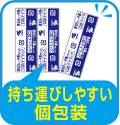
Product and contents photos: Kobayashi Pharmaceutical.
The manufacturer describes starting when symptoms appear, including when the weather changes. That does not authorise taking extra doses or using it routinely before every rainy day. At the adult labelled dose, 24 tablets cover two days and 48 tablets four days; these are supply calculations, not recommended treatment lengths.
Who should ask before taking it?
The leaflet requires advice from a doctor, pharmacist or registered medicine seller before use if you:
- Are receiving medical treatment
- Are pregnant or may be pregnant
- Have previously developed a rash, redness, itching or similar symptoms from medicines or other substances
Show the professional all prescription medicines, OTC products and Kampo remedies you use. Do not assume two different brand names mean different ingredients. If breastfeeding or buying for a child, ask about the individual situation; a listed child dose is not a diagnosis or a reason to self-treat unexplained symptoms.
The stop points differ: doses, days and one month
Stop immediately and seek advice if a rash, redness or itching appears after taking it; bring the package. These may be side effects.
The leaflet also says to stop and consult, bringing the package, if there is no improvement after:
- About one month for the indications without a shorter specified period, including headache and swelling
- 5–6 doses for acute gastroenteritis or hangover
- 5–6 days for watery diarrhoea or heat-related illness
These are label stop points, not permission to wait with unexplained, worsening or urgent symptoms. Follow the earlier care advice whenever it applies. There is no reason to finish a box before seeking help.
Keeping an opened sachet during a trip
Store away from direct sunlight in a cool, dry place, out of children’s reach. Keep the original packaging; do not transfer the medicine to another container. If a sachet is divided, fold the opening over at least twice. Use the remainder that same day or discard it. Do not keep an opened half-sachet for a later trip, or use medicine past its expiry date.
Is this interchangeable with other Japanese remedies?
With EVE for a headache?
No. Teirakku contains Goreisan, rather than EVE’s conventional analgesic ingredients. If you meant EVE, use the EVE formula and dose comparison to identify that specific product. Do not add or substitute medicines solely because both boxes mention headache.
With Taisho Kampo gastrointestinal oral liquid?
No. That liquid combines Goreisan with Orengedokuto and has its own gastrointestinal indications, extract amounts and age limit of 15+. Teirakku is standalone Goreisan; sharing a formula name does not make the products or doses interchangeable.
Irene’s shopping tip: save the exact box photo, then tell the pharmacist when symptoms started, whether you are thirsty or passing less urine, and which medicines you already take. Those details are more useful than asking for “the strongest weather-headache medicine.”
Sources
Checked 19 October 2026. Japanese manufacturer directions control this guide; read the leaflet supplied with your own pack. This article supports product identification, not individual diagnosis.