Found パリエットS in a Japanese pharmacy? Before adding it to your current stomach medicine or replacing a prescription, ask the pharmacist to check your symptoms, medicines and treatment dates. Pariet S is a Japanese pharmacist-guidance medicine, not an automatic substitute for an overseas or prescribed PPI.
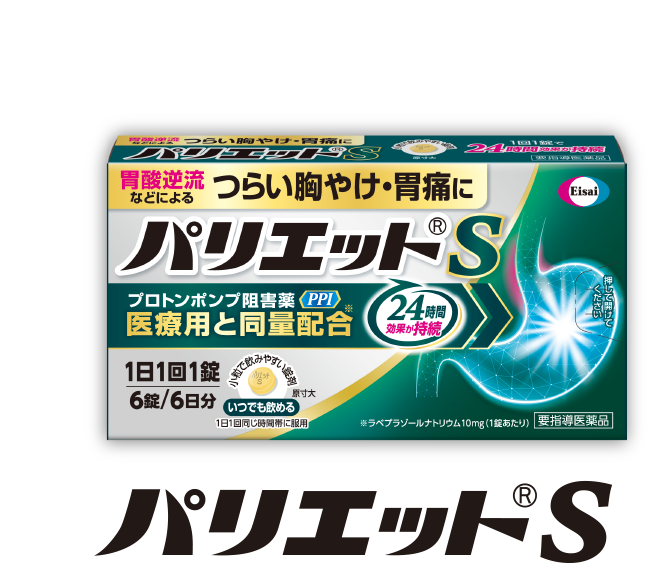
Checked: November 1, 2026, against current Japanese product information, the July 2026 leaflet and purchase materials. The official photograph shows the six-tablet pack.
Sudden or persistent severe abdominal pain, vomiting blood or black stools are also urgent warning signs: do not try stomach medicine first. Seek immediate medical help; in Japan call 119 when emergency assistance is needed, or use the local emergency number elsewhere. The three-day and two-week rules below are not waiting periods for these symptoms.
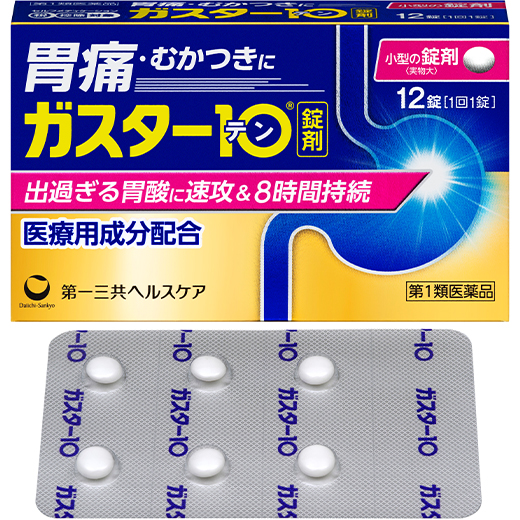
- Identify Japanese Pariet S—not a rule for every PPI
- Acid already in the stomach—or acid yet to be secreted?
- Similar purposes do not mean identical purchase conditions
- Bring three groups of information to the pharmacist
- Keep prohibitions separate from questions requiring assessment
- If suitable, separate the dose from the stopping rules
- A better question than “Which is stronger?”
- Official sources
Identify Japanese Pariet S—not a rule for every PPI
Each tablet contains 10mg rabeprazole sodium, a proton pump inhibitor that reduces stomach-acid secretion. Its Japanese approved symptoms are stomach pain, heartburn and stomach heaviness. This does not make it a self-treatment for every abdominal pain, ulcer or reflux diagnosis.
For example, you may have taken another acid-suppressing medicine for several days before noticing a six-tablet pack here. The useful question is what you already took and for how long, not whether buying another box starts a new clock. Pack size is not an instruction to finish a course.
If the product is famotidine, see our separate Gaster10 tablet, powder and S-tablet guide. It is not a chart for adding or switching to Pariet S.
Acid already in the stomach—or acid yet to be secreted?
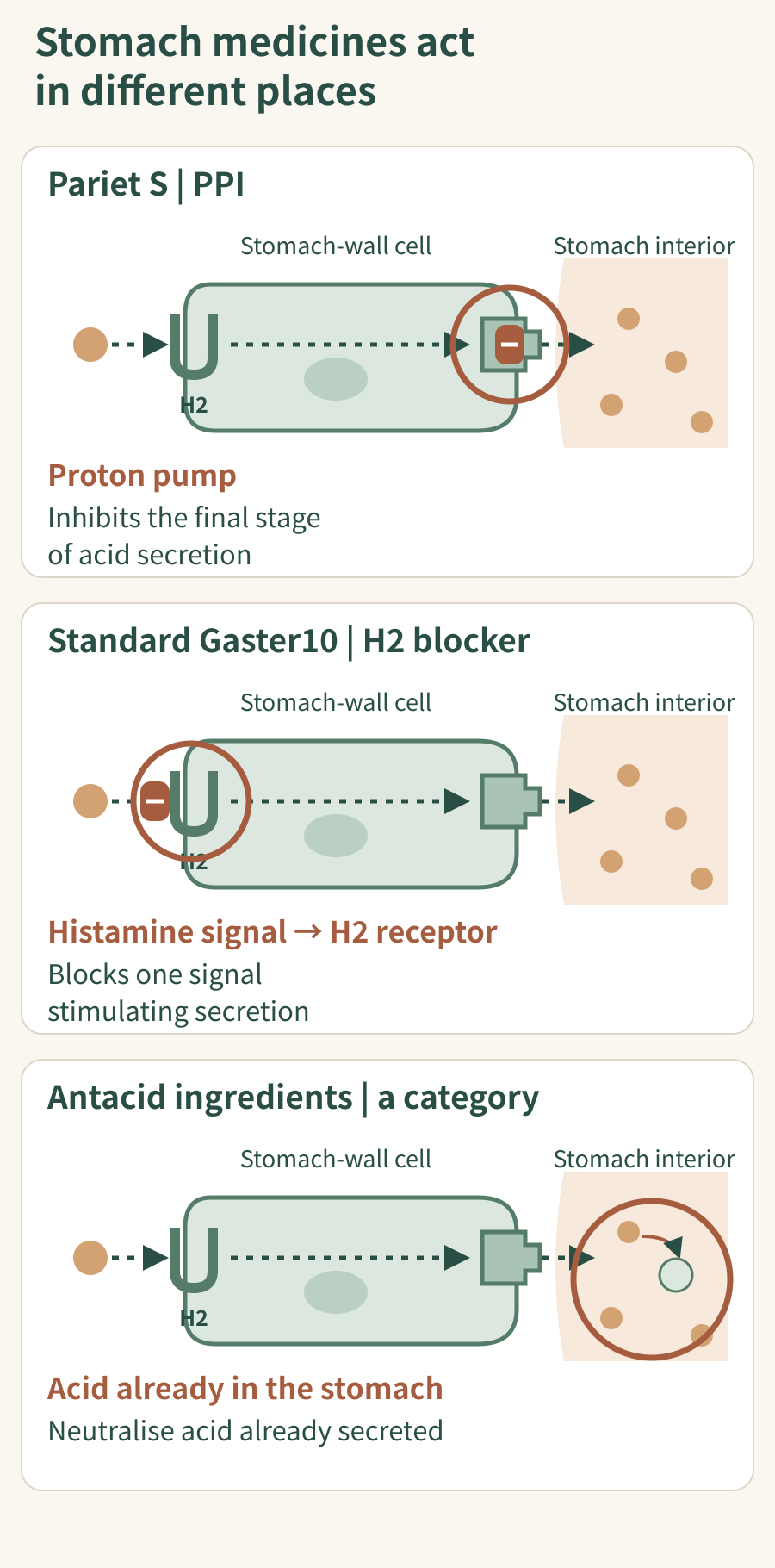
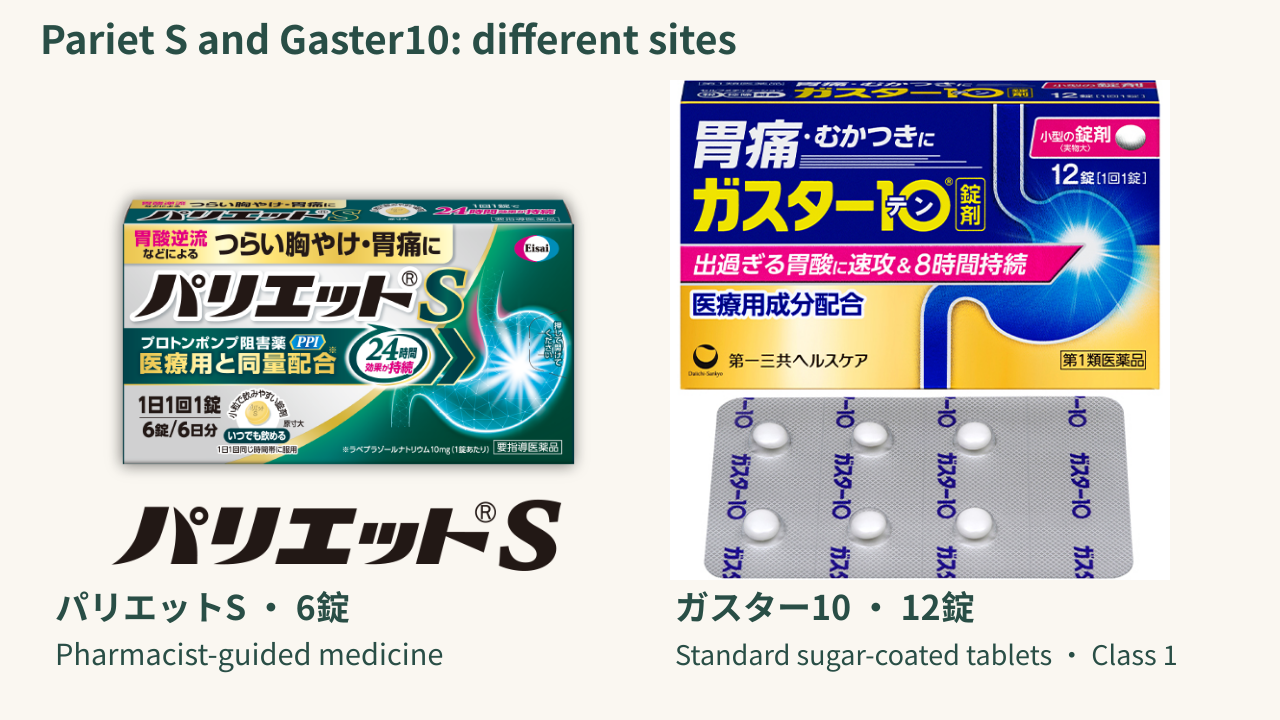
It helps to separate acid already in the stomach from acid the stomach is about to release. Pariet S’s PPI acts on the proton pump, the final stage of acid secretion in stomach-wall cells. Gaster10’s H2-blocking action targets the histamine signal that stimulates secretion. Both reduce secretion, but they are not the same ingredient or dosing regimen. Neither description means eliminating all stomach acid or physically stopping reflux.
Antacid ingredients work elsewhere: they neutralise acid already secreted into the stomach. Here, “antacid” describes an ingredient’s role, not every multi-ingredient stomach remedy. A combination product may also contain herbal ingredients or digestive enzymes with other roles. The word “stomach medicine” does not make their instructions interchangeable.
Different places of action do not mean the medicines can be added together
Reducing future secretion and neutralising existing acid may sound complementary, but the Japanese leaflets for both Pariet S and Gaster10 prohibit taking other gastrointestinal medicines during use. Do not combine or switch them yourself or invent a washout interval. Show a pharmacist the products and dates already used, and do not stop prescribed treatment yourself.
Similar purposes do not mean identical purchase conditions
These examples compare Japanese Pariet S with standard sugar-coated Gaster10 tablets, not Gaster10 S tablets, powder or overseas products. They highlight potential mix-ups; they are not a complete contraindication checklist or self-selection chart.
- Labelled symptoms: Pariet S lists stomach pain, heartburn and stomach heaviness; standard Gaster10 also lists nausea. These terms are not diagnoses and do not cover every abdominal pain.
- Age: Pariet S is for ages 15 and over, with prior consultation for older people. Standard Gaster10 is for ages 15 to under 80, with prior consultation from age 65. Seeing “15 and over” does not justify overlooking an upper limit or other restrictions.
- Pregnancy or possible pregnancy: standard Gaster10 must not be taken; Pariet S requires prior consultation. The latter is not an assurance that use in pregnancy is suitable or a way around assessment.
- Stopping: both require stopping when symptoms settle, stopping and consulting if three days bring no improvement, and not continuing beyond two weeks on your own. Pariet S also counts continuous use of other PPIs. These are not schedules for alternating medicines.
Have a pharmacist check any current treatment or other medicines first. Gaster10 has do-not-take conditions involving treatment for blood, kidney, liver, heart, stomach/duodenal and immune-system diseases, as well as specified medicines. Do not dilute those into “just ask, then it is fine”. Pariet S’s prohibitions and consultation requirements follow below. Mechanism and medicine category are not rankings of strength, safety or suitability.
Bring three groups of information to the pharmacist
- Symptoms: where the discomfort is, when it started, whether it keeps returning, persists or worsens, and any unexplained weight loss.
- All products and dates: prescribed medicines, OTC products, medicines brought from abroad and supplements—especially gastrointestinal medicines and previous PPIs. Bring medication records, boxes or clear photographs, and the dates you started and last used them. Say if you do not know the ingredient.
- Your circumstances: age, current treatment, liver disease or a stomach/duodenal-ulcer diagnosis, allergies, possible pregnancy and breastfeeding.
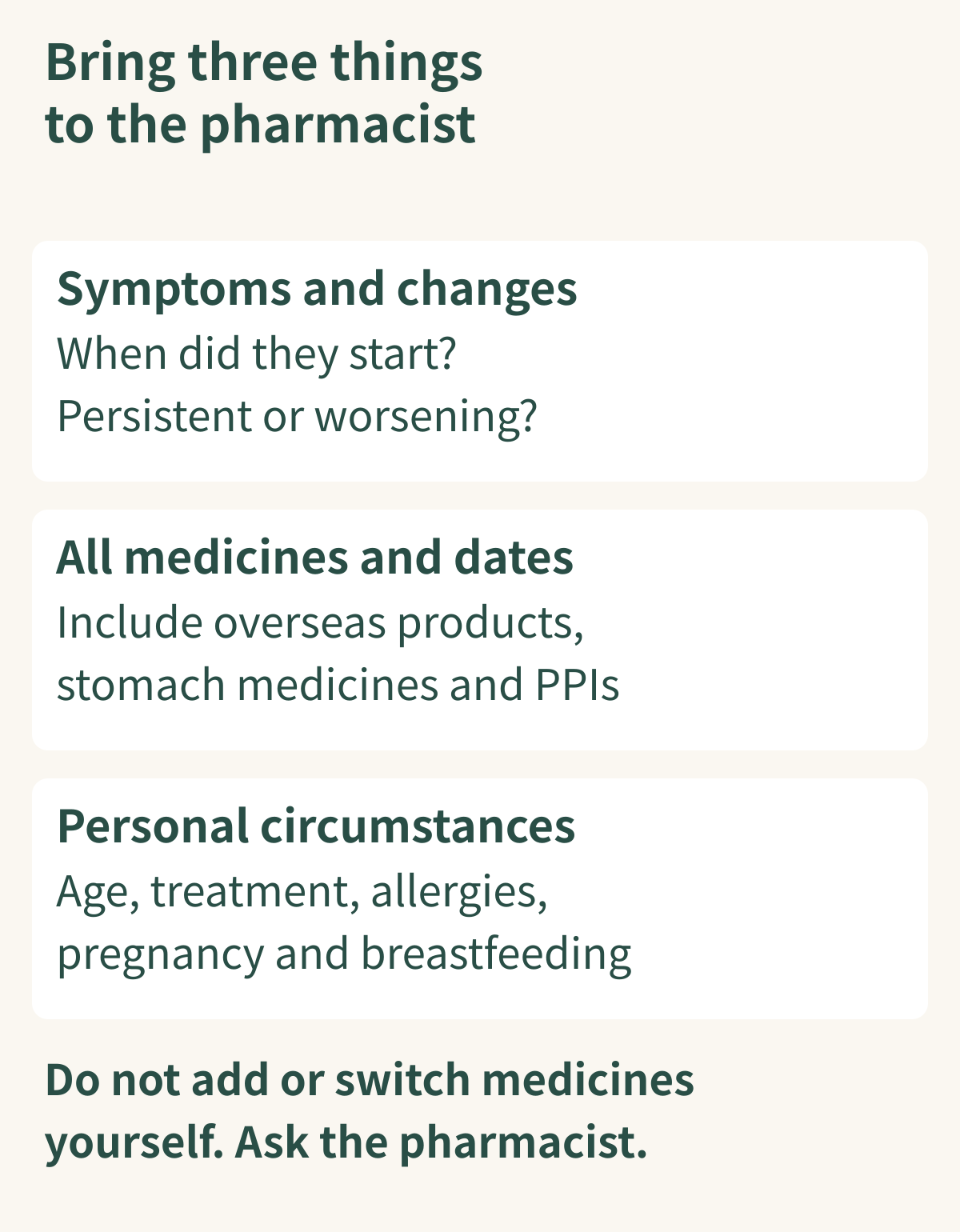
The official purchase checklist is for checking suitability with a pharmacist, not a self-completed clearance certificate. It can be filled in at the pharmacy; printing it at home is optional. You cannot buy it when the pharmacist is absent. If making a special trip, check pharmacist availability and stock first; a store-locator listing is not a live supply guarantee.
Keep prohibitions separate from questions requiring assessment
Do not take it if you are under 15, have had an allergic reaction to this product or its ingredients, or take rilpivirine hydrochloride. Do not take other gastrointestinal medicines while taking Pariet S. Do not stop an existing treatment yourself to make this purchase possible.
Consult before use if receiving medical treatment, pregnant or possibly pregnant, older, or if you have a history of medicine or other allergies, persistent stomach/abdominal pain, unexplained weight loss, liver disease or a stomach/duodenal-ulcer diagnosis. The purchase checklist specifically asks about medicines including digoxin, methyldigoxin, itraconazole, gefitinib and methotrexate. A medicine missing from these examples is not automatically compatible.
The breastfeeding instruction is not to take this medicine, or to avoid breastfeeding if taking it. Discuss this with a healthcare professional rather than inventing an interruption interval. These are important purchase checks, not a replacement for the leaflet’s complete precautions.
If suitable, separate the dose from the stopping rules
The Japanese directions are one tablet once daily for ages 15 and over, at the same time each day, swallowed with water or lukewarm water without chewing or crushing. These are enteric-coated tablets. Do not increase the frequency or tablet count because discomfort remains, and remove the tablet from its packaging before swallowing. This product can be taken regardless of meals; do not transfer that rule to other PPIs.
- Symptoms settle: stop taking it. You do not need to finish the six-tablet pack.
- No improvement after three days: stop and consult a doctor or pharmacist with the leaflet. Do not wait for the two-week limit.
- Continuous-use limit: do not exceed two weeks, including time taking other PPIs. A brand change does not reset this period. If you have already used them continuously for two weeks, do not buy more to extend self-treatment; see a doctor. This is not an instruction to stop a prescribed course yourself or a rule for restarting after a self-selected break.
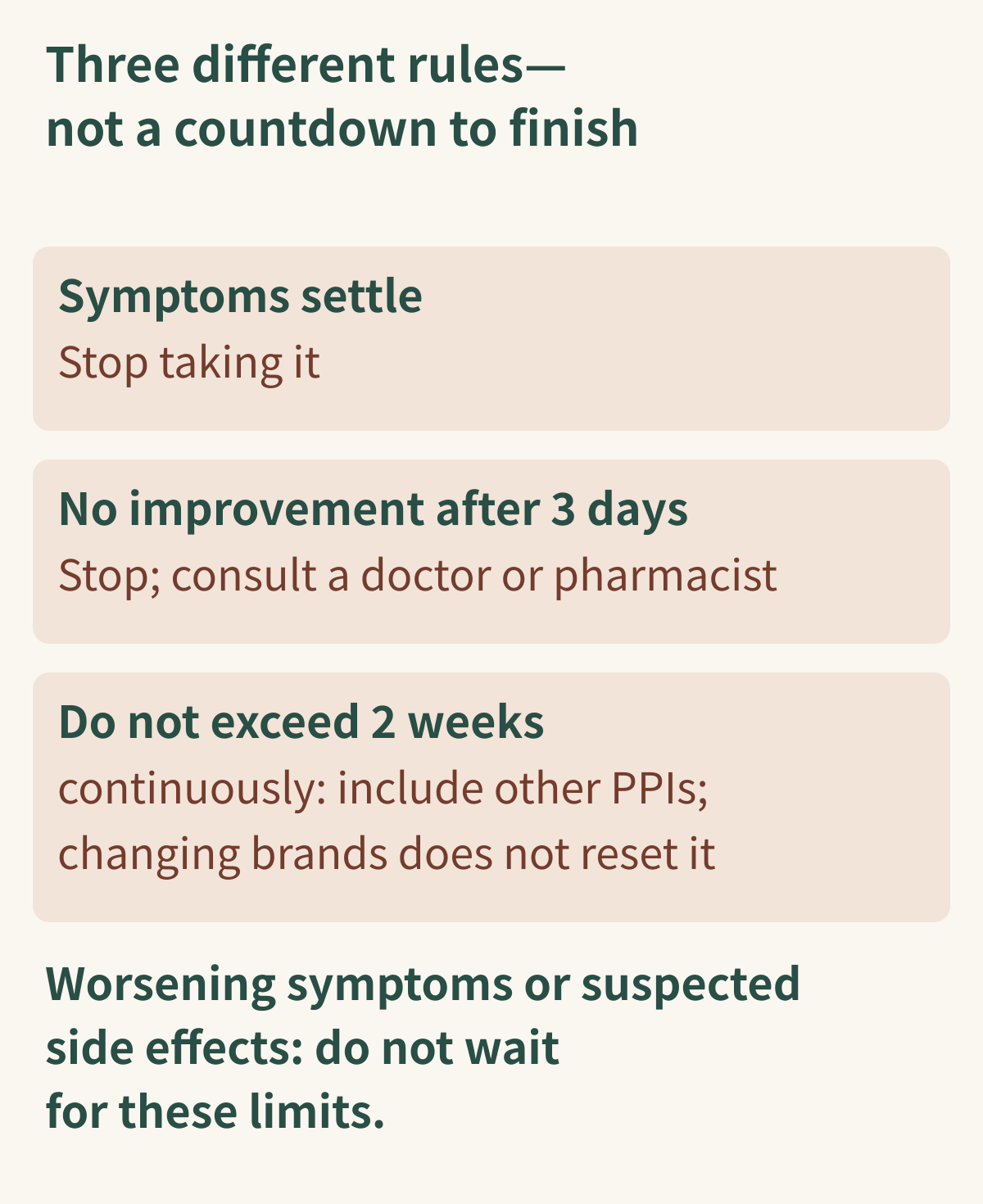
None of these time limits means waiting through worsening symptoms or suspected side effects. Stop promptly and consult if you develop leaflet-listed problems such as a rash, diarrhoea/constipation, abdominal pain or dizziness after use. Serious symptoms—such as breathing difficulty, altered consciousness, high fever with widespread rash or mucosal problems, jaundice, markedly reduced urine, seizures or vision changes—require immediate medical attention. These examples are not the complete list. Do not automatically treat new symptoms as your original stomach complaint.
Keep the original packaging and leaflet, away from children and direct sunlight in a cool, dry place; do not transfer the tablets to another container. Use within six months of opening the inner bag and before the expiry date. Never swallow the desiccant. This storage limit is not permission for prolonged or repeated self-treatment.
A better question than “Which is stronger?”
Show the pharmacist your products and dates and ask whether this purchase is appropriate. This guide neither diagnoses the cause nor guarantees a sale. If it is unsuitable, ask about medical assessment or another appropriate next step rather than choosing a different box to bypass the check.
Official sources
- Japanese product information / 日本官方產品資訊
- Japanese leaflet, July 2026 / 日本添付文書
- Purchase checklist / 購買前檢查表
- User information / 使用者資訊
- NHS: chest-pain emergency signs / 胸痛警訊
- Manufacturer: Pariet S mechanism
- Manufacturer: acid suppression and antacid mechanisms
- Current Japanese standard Gaster10 tablet leaflet
- Japan Ministry of Health, Labour and Welfare: emergency warning signs
- Manufacturer: Gaster10 H2-receptor mechanism