Current Japanese product, leaflet and launch information checked: 1 November 2026. This guide explains ALINAMIN Shoyaku PREMIUM; it is not an individual treatment assessment or a recommendation to replace the whole range with the newest product.
There is another gold Alinamin box on Japan’s drugstore shelf: ALINAMIN Shoyaku PREMIUM launched on 26 October 2026. The interesting change is not simply the colour. It combines six herbal ingredients and six vitamin ingredients in one sugar-coated tablet. But more ingredients and a “Premium” name do not automatically tell you whether it fits your purpose.
Start with three facts: it is a Japanese Class 3 medicine; its indications concern nutritional support, physical weakness and supplementation in specified circumstances; it is not simply the EX range’s eye, shoulder and lower-back product under a more luxurious name.
- Recognise the product: “生薬” matters more than gold
- What is new? A formulation and tablet design—not the invention of B1
- How does it relate to energy? Support is not stimulation
- Translate “fatigue” advertising back into the actual indications
- The easy-to-miss number: the ingredients are listed “per three tablets”
- Continued use does not mean continuing through adverse effects
- Pack size and opening date matter—not just price per tablet
- Official information and photograph sources
Recognise the product: “生薬” matters more than gold
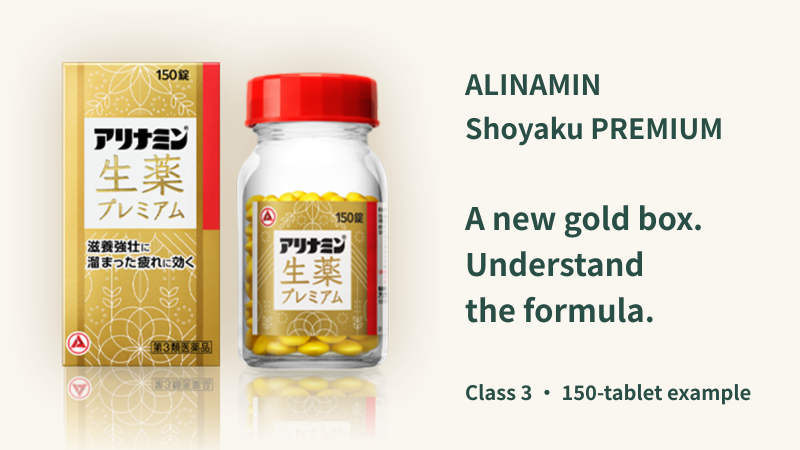
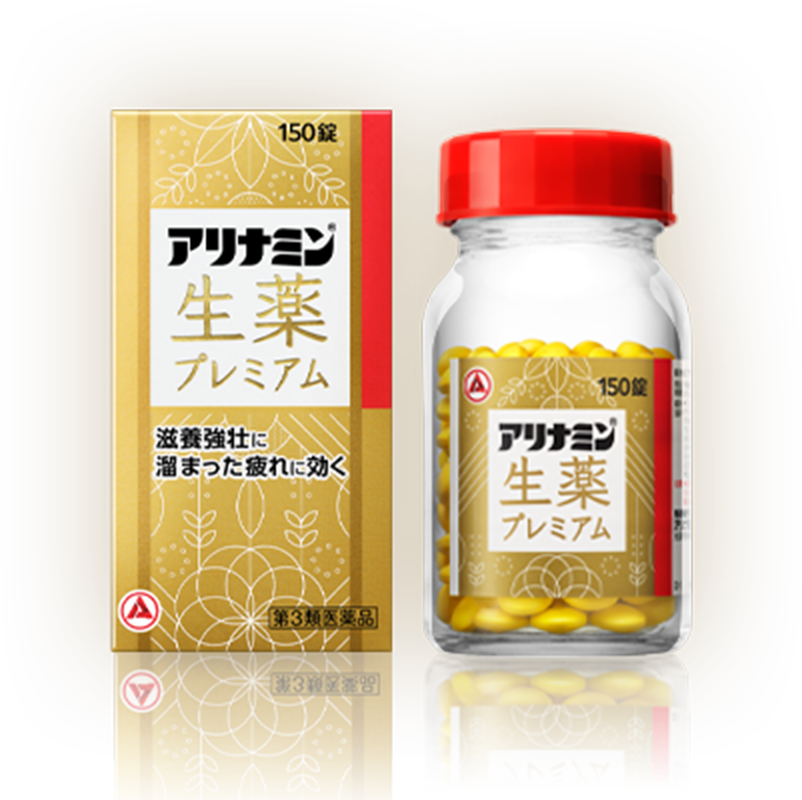
The official photograph shows the 150-tablet box and bottle. There are also 24-tablet trial and 70-tablet packs. Look for the complete name, アリナミン生薬プレミアム, rather than choosing by gold packaging. It is not アリナミンメディカルゴールド (Alinamin Medical Gold). An officially listed pack size does not establish stock at every store.
If you are still choosing within the range, start with our Alinamin series comparison. This article goes deeper into the new product’s formulation, label and buying decisions.
What is new? A formulation and tablet design—not the invention of B1
The new product combines two groups:
- Six herbal ingredients: Eucommia bark (tochu), peony root (shakuyaku), eleuthero (ezoukogi), astragalus (ogi), Chinese yam (sanyaku) and poria (bukuryo). The manufacturer describes a restorative formulation including astragalus and eleuthero.
- Six vitamin ingredients: fursultiamine (a vitamin B1 derivative), B2, B6, B12, nicotinamide and calcium pantothenate. That is not 12 vitamins, and herbal ingredients do not make it a universally suitable “natural supplement”.
Another feature is the manufacturer’s hybrid sugar-coating technology. Its explanation describes combined coatings that stabilise the ingredients, limit swelling caused by herbal ingredients and mask the uncoated tablet’s colour and taste, allowing a compact multi-ingredient tablet. The official dimensions are approximately 9.3mm in diameter and 5.1mm thick. This is a formulation feature—not proof of superior clinical effectiveness or a guarantee that everyone can swallow it comfortably. Ask a pharmacist if swallowing is difficult; do not chew it to solve that problem yourself.
How does it relate to energy? Support is not stimulation
Think of carbohydrate from food as raw material that must be processed into energy the body can use. Vitamin B1 participates in that process; fursultiamine is a B1 derivative, and the manufacturer describes its role as supporting energy production from carbohydrate. The medicine is not a meal’s worth of calories, and more tablets do not translate directly into more stamina.
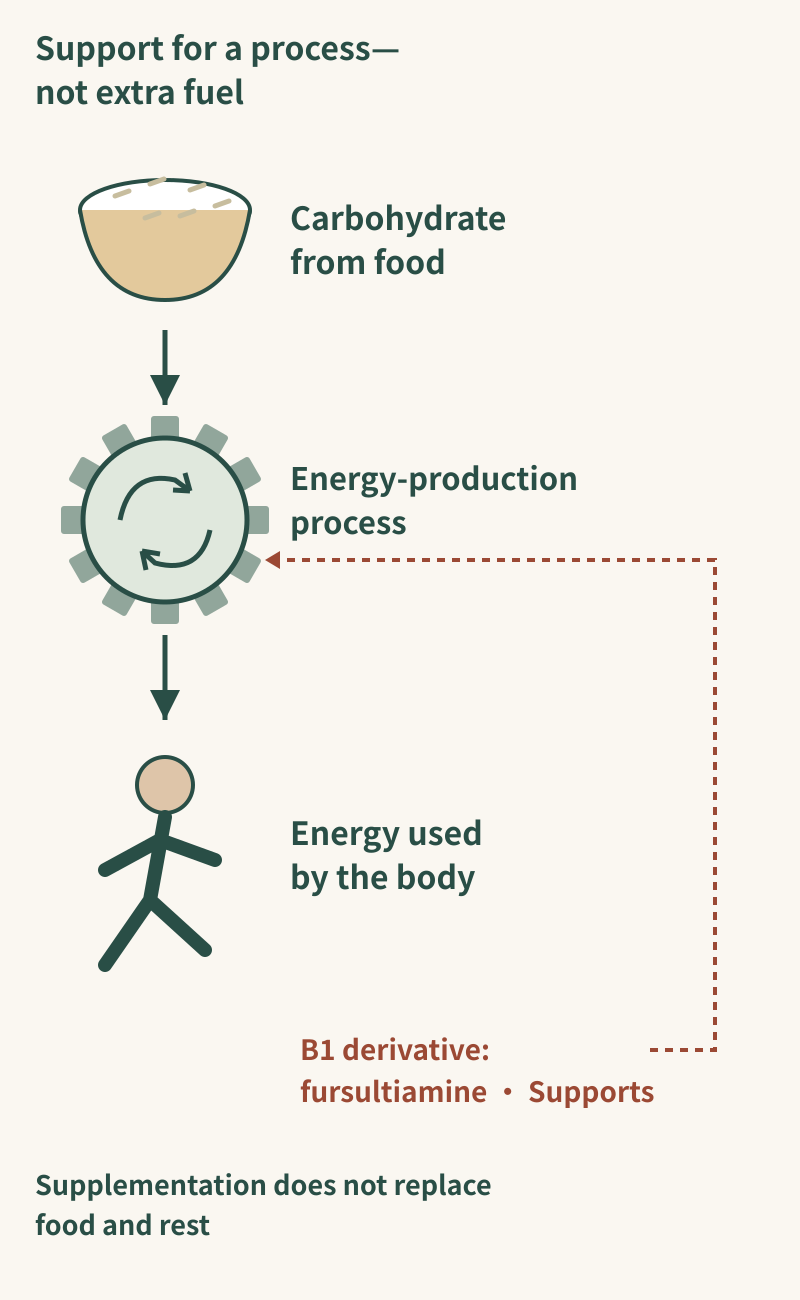
This helps explain why a vitamin formulation can be used for nutritional supplementation during physical fatigue. It does not establish that every episode of your tiredness is caused by B1 deficiency. Counting herbal and vitamin ingredients is not an effectiveness score. We do not assign an unverified organ-specific benefit to each herb.
The product contains no caffeine, so its rationale differs from a caffeine-based alertness product. Caffeine-free does not mean a sleeping medicine, a treatment for every sleep problem or a replacement for missed sleep. “Can be taken in the evening as directed” should not become “will help me sleep”.
Translate “fatigue” advertising back into the actual indications
The Japanese leaflet lists restorative support (滋養強壮), physical weakness (虚弱体質), and nutritional supplementation during physical fatigue, illness/recovery, poor appetite, nutritional disorders, wasting illnesses with fever, pregnancy/lactation and similar specified circumstances. These are the labelled indications, not an individual suitability test based on one matching word.
- Were you buying EX for eye strain, shoulder or lower-back symptoms? Do not switch simply because a newer gold box appears. Match your concern to each product’s actual indications first.
- Are you hoping to push through too little sleep or overwork? Nutritional supplementation does not replace rest and regular meals. Seek advice for persistent or unexplained fatigue rather than repeatedly upgrading supplements.
- Already taking medicines or vitamins? Bring them for a pharmacist to check. The manufacturer explicitly says that some prescribed medicines can be taken with this product and others cannot; ask the pharmacy that dispensed them. This article provides no blanket permission to combine them.
The easy-to-miss number: the ingredients are listed “per three tablets”
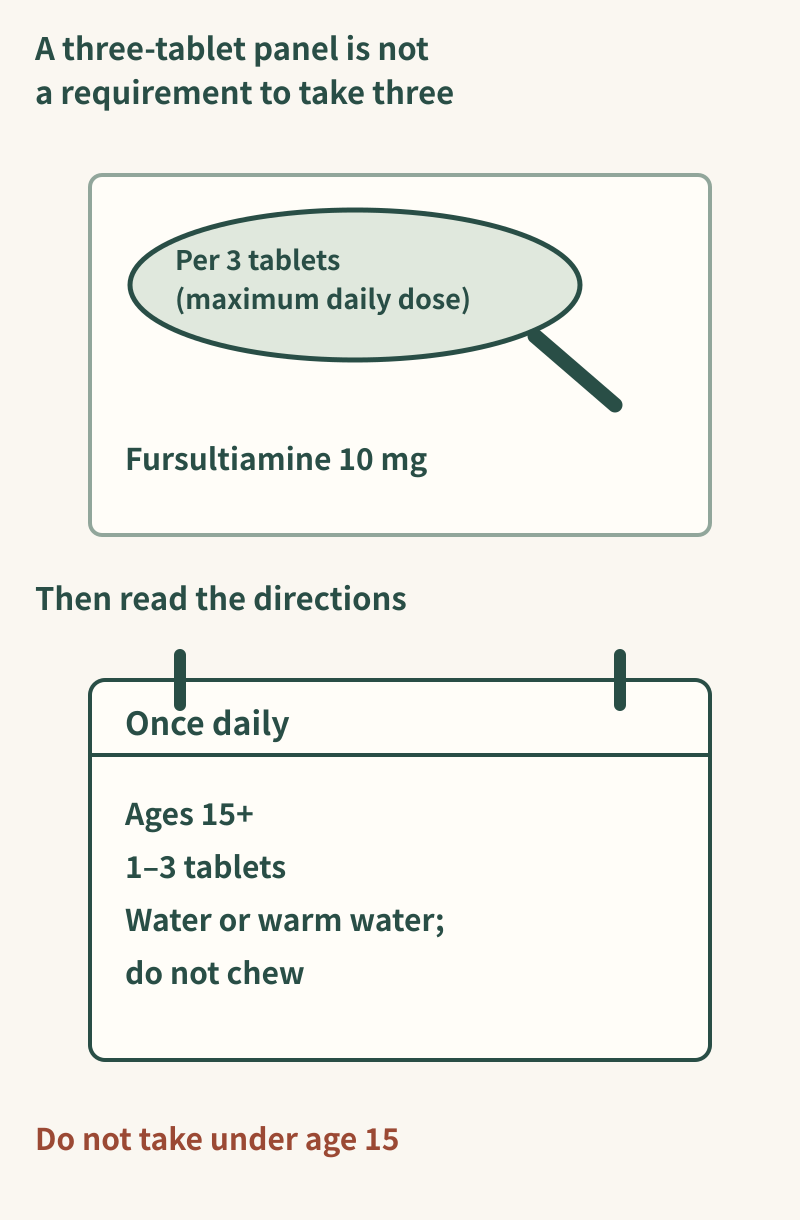
The directions are ages 15 and over: one to three tablets once daily with water or warm water, without chewing. Children under 15 must not take it. Once daily is not once at each meal, and the one-to-three range is not permission to add doses whenever you feel tired. Ask a pharmacist if unsure how the directions apply; do not exceed them.
The ingredient table gives amounts in three tablets—the maximum daily dose. For example, fursultiamine 10mg, B2 12mg and B6 20mg are not the amounts in a single tablet. A three-tablet table also does not mean everyone must take three.
The herbal entries have another layer. Astragalus dry extract is listed as 45mg, with 360mg shown as its crude-herb equivalent. These are two ways of describing the same extract contribution, not two separate ingredients to add into 405mg. Nor should crude-herb and vitamin amounts become a strength ranking. See the current Japanese leaflet for all 12 ingredient amounts.
Continued use does not mean continuing through adverse effects
The brand website discusses continued use when benefit is felt. That does not override the leaflet’s stopping conditions:
- For rash, redness, itching, nausea, vomiting or mouth inflammation, stop immediately and take the leaflet to a doctor, pharmacist or registered medicine seller.
- For persistent or worsening loose stools or diarrhoea, stop and seek advice.
- If symptoms do not improve after taking it for a while, stop and seek advice. This product’s leaflet does not define that as one month or another fixed number of days. Do not import a period from another Alinamin product or wait to finish the bottle.
The leaflet explains that B2 may make urine yellow; this specific explanation does not account for every abnormal symptom. Although nutritional supplementation during pregnancy/lactation is among the indications, individual circumstances and other products still need consideration. This article does not confirm individual suitability.
Pack size and opening date matter—not just price per tablet
24, 70 and 150 refer to tablet counts, not a fixed number of days for every user. Consider the intended use, directions and storage after opening rather than automatically stockpiling the largest bottle.
For bottles: keep the bottle tightly closed in a cool, dry place away from direct sunlight and children. Do not transfer the tablets to another container. Discard the bottle’s packing material when first opened and do not put it back: moisture retained by it can affect quality. Record the opening date and use the product promptly, with six months after opening as a guide, without exceeding the original expiry date. For other packaging, follow the enclosed instructions rather than transferring the bottle-handling steps or after-opening period.
The useful discovery is not “gold is stronger”. It is understanding what the formulation does, whether the labelled purpose matches your question, and how many tablets the ingredient numbers describe. That is what makes a new-product explanation useful at the shelf.