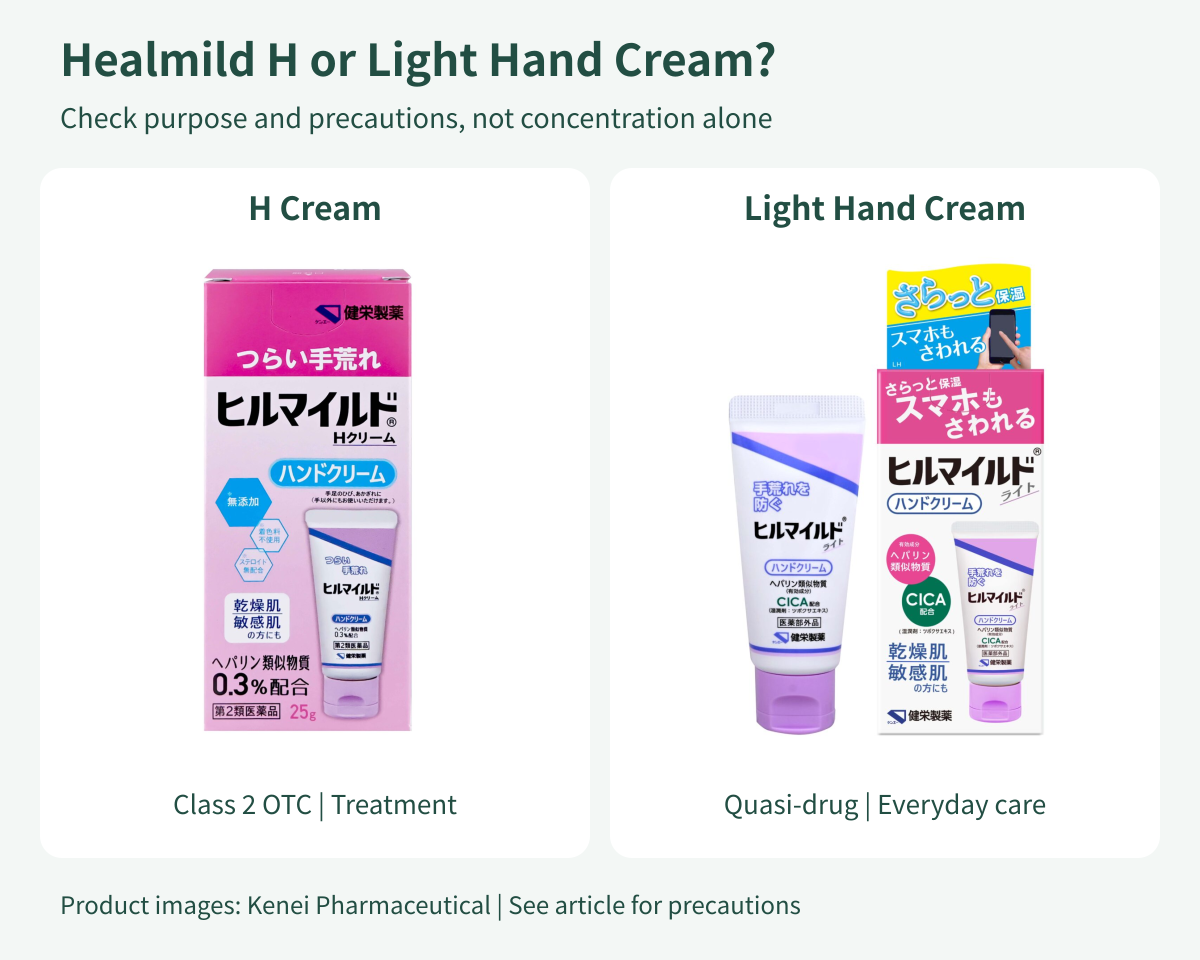
Both tubes say Healmild and contain heparinoid. Why is one an OTC medicine and the other a quasi-drug? Choosing comfortable hand care for phone use is not the same decision as treating rough, cracked hands.

I’m Irene, a Japan-licensed pharmacist from Taiwan working in a Japanese drugstore.
This guide compares only the Japanese ヒルマイルドHクリーム (Healmild H Cream) and ヒルマイルドライトハンドクリーム (Healmild Light Hand Cream). It is not a comparison of the original cream, lotion and spray, or a ranking based on ingredient concentration.
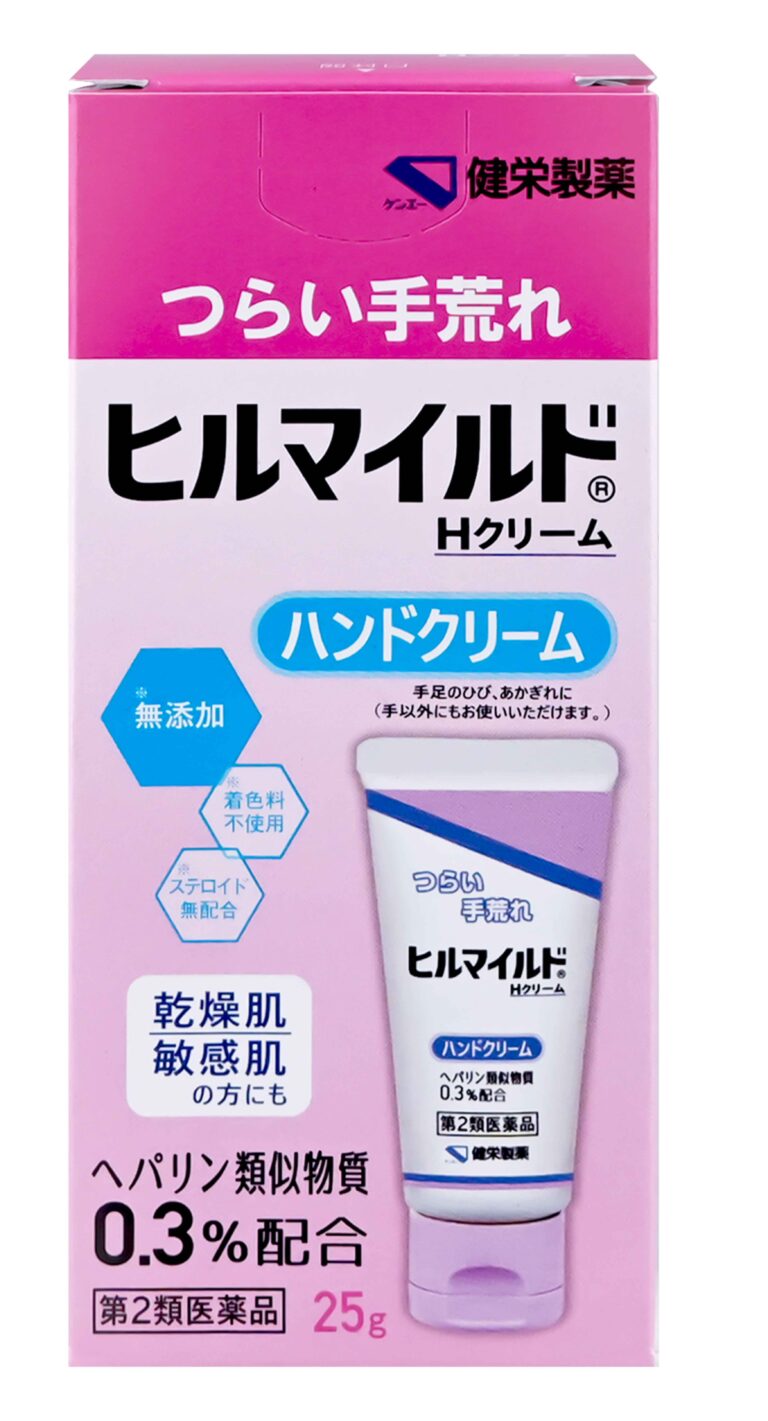
Check the full name, not just the pink box.
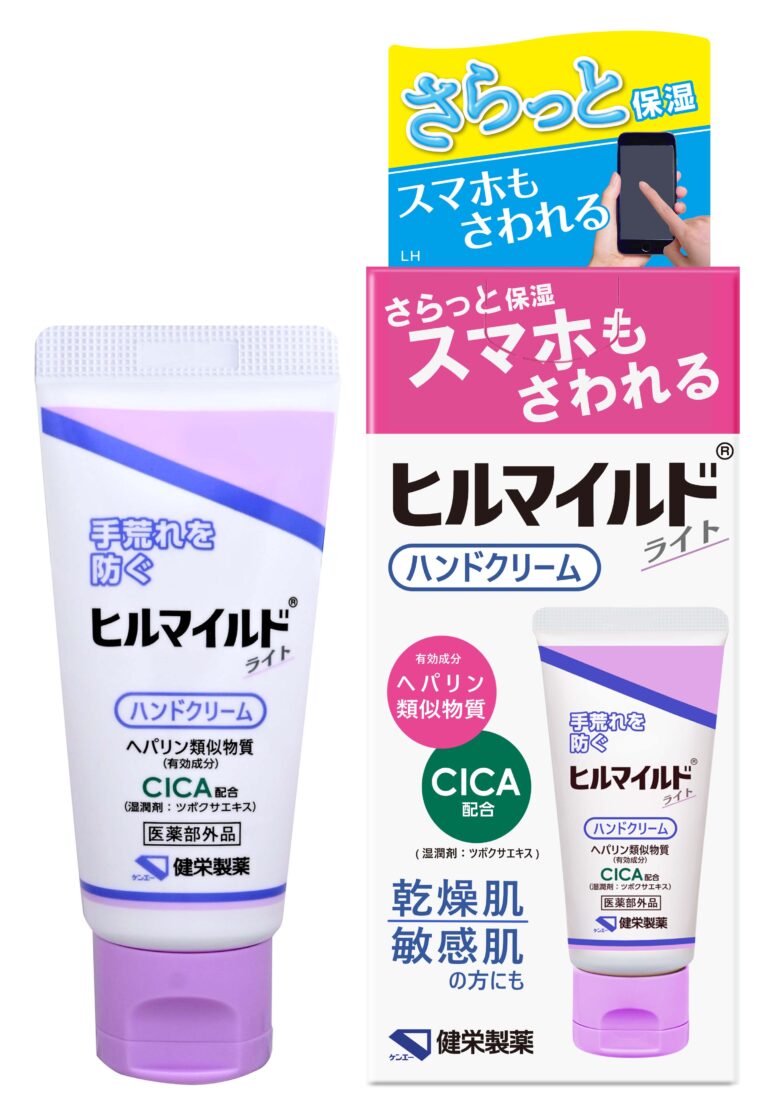
This is not H; compare purposes and restrictions below.
Product images: official Kenei Pharmaceutical materials. © Kenei Pharmaceutical Co., Ltd. Used to identify the two 25g products compared here, not to imply manufacturer endorsement or sponsorship. H / Light
Read the full Japanese name before choosing
- ヒルマイルドHクリーム — H Cream
- A Class 2 OTC medicine containing 0.3% heparinoid, available in 25g and 40g. Its labeled treatment indications include rough fingers and cracks or chapping of the hands and feet. That does not make it suitable for every hand skin problem.
- ヒルマイルドライトハンドクリーム — Light Hand Cream
- A quasi-drug in a 25g tube, with the registered product name 薬用マイルドハンドクリームKEb. Intended for everyday moisturizing, protection and prevention of dryness and chapping, among its labeled benefits. The active ingredients are heparinoid and dipotassium glycyrrhizinate. CICA (Centella asiatica extract) is a moisturizing additive, not a labeled active ingredient in this product.
The manufacturer’s series FAQ specifies 0.1% heparinoid for the Light range; the individual hand-cream page and package do not state that numerical concentration. A 0.3% versus 0.1% comparison does not establish “three times the effect.” The purpose, condition of the skin and restrictions are more useful shopping checks.
A practical shelf-side decision
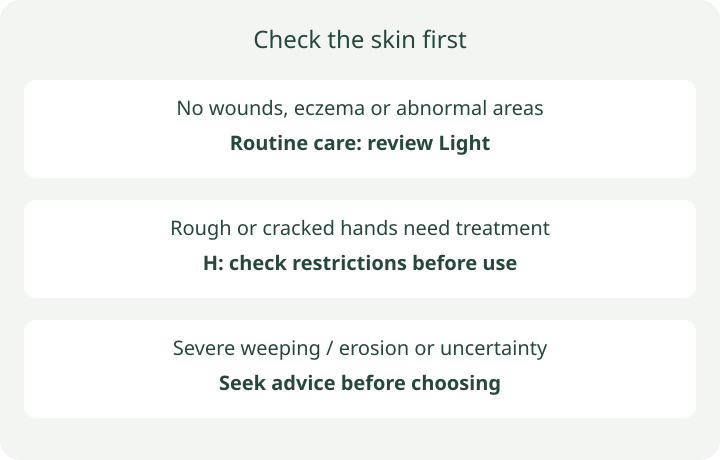
Check the skin first
- Routine moisturizing, without wounds, swelling, eczema or other abnormal skin at the application site: review Light’s intended use and precautions. The manufacturer describes a light, non-sticky finish suited to smartphone use. This is a manufacturer description, not our hands-on test.
- Treatment for rough or cracked hands: H has relevant labeled indications, but first check its contraindications and consultation requirements. Light is not an equivalent substitute. A lower concentration is not permission to apply it to any damaged area.
- Severe weeping or erosion, or uncertainty about eczema: ask a doctor or pharmacist rather than choosing from a skin photo or pack color. Light must not be applied to wounds, swelling, eczema or other abnormal areas.
The manufacturer gives Light during the day and H before bed as one example. It does not mean H is bedtime-only, that everyone needs both, or that they should be mixed. If treatment is needed, follow H’s directions and precautions, not just a day/night routine.
Keep the two sets of directions separate
H Cream: follow the medicine label
Apply an appropriate amount to the affected area one to several times a day, rubbing it in, or spread it on gauze or similar material and apply. For external use only. Children need parental guidance and supervision. Avoid eye contact; rinse with water or lukewarm water if it enters an eye, and see an ophthalmologist for severe eye symptoms. More is not automatically better.
Light: everyday hand care
Gently apply an appropriate amount to the hands. Do not apply to wounds, swelling, eczema or other abnormal areas. Do not transfer H’s dosing frequency or its five-to-six-day reassessment rule to Light as if those were Light’s package instructions.
Check H’s bleeding-related restrictions before use
Do not use H if you have a hemorrhagic blood disorder, such as hemophilia, thrombocytopenia or purpura, or if even slight bleeding could have serious consequences. Its action can inhibit coagulation and promote bleeding.
Before using H, consult a doctor, pharmacist or registered OTC seller if you are receiving medical treatment, have a history of allergic reactions to medicines or other substances, or have severe weeping or erosion of the skin. Not listing individual interacting medicines here does not mean compatibility with every medicine has been established.
When to stop and seek advice
- H: stop immediately and take the package to a doctor, pharmacist or registered OTC seller if rash, redness, itching, swelling or purpura occurs after use. If symptoms do not improve after five to six days, stop and consult rather than continuing or increasing the amount.
- Light: stop and consult a dermatologist or other appropriate clinician if it does not agree with your skin, or if redness, swelling, itching, irritation, loss of pigmentation such as white patches, or darkening occurs during use or after subsequent sun exposure. H’s five-to-six-day rule is not a reason to tolerate a reaction.
The individual packages reviewed do not give a numerical minimum age. That does not establish unconditional suitability for newborns or all ages. For a child, confirm the actual skin condition and product first; H use requires parental guidance and supervision.
Once you get home
Close both tubes securely, keep out of children’s reach and direct sunlight, and do not transfer to another container. Keep H in a cool, dry place and do not use after expiry; avoid extreme heat or cold for Light. Routine moisturizing and treatment of a skin problem are different needs. Bringing the full product name to a pharmacist is more helpful than asking about “Healmild” alone.
For the original formulations, see the separate Healmild cream, lotion and spray comparison. Its scope is not these two hand products.
Official sources
Sources checked: 8 November 2026. Labels may change; check the package in hand. This guide helps identify products and does not replace individual diagnosis.