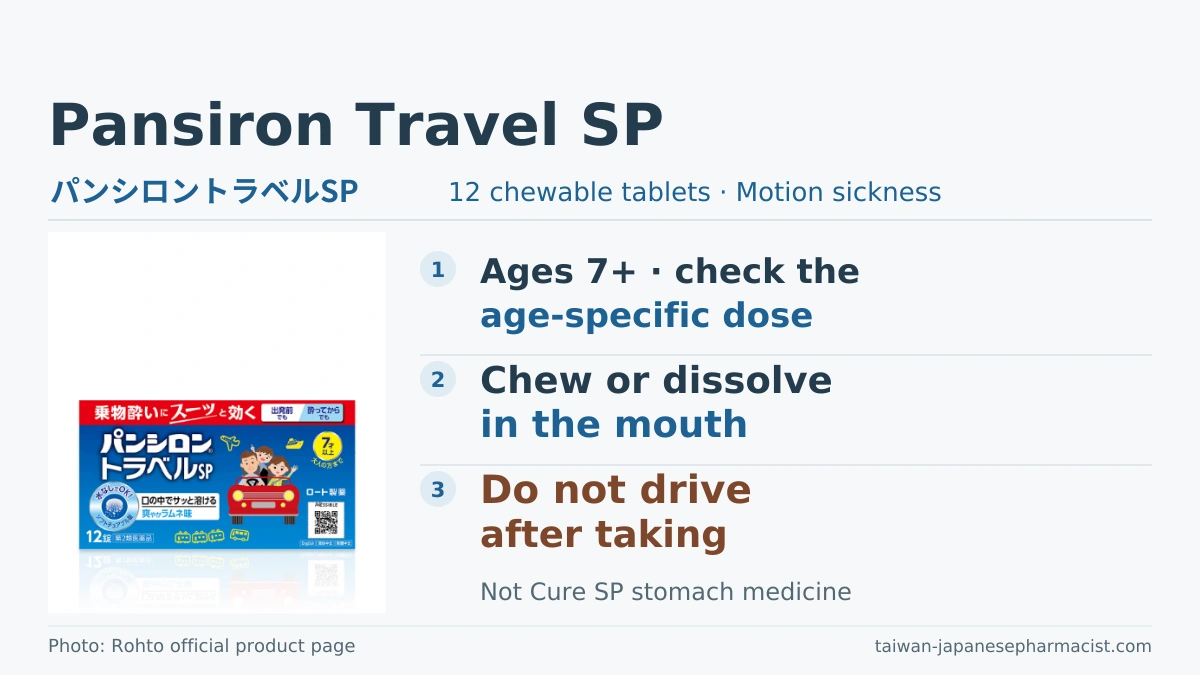
 I’m Irene, a Taiwanese pharmacist working in a Japanese drugstore. This guide uses the Japanese label to work through the choices travelers need to make: whether the product is suitable, which age-specific dose applies and when to stop.
- Will you be driving? Do not drive a vehicle or operate machinery after taking this medicine, even if you do not feel sleepy.
- Is the user at least 7? Do not use under age 7. Children and adults have different tablet counts per dose.
- What medicines have already been taken? Cold remedies, painkillers, allergy medicines and other motion-sickness medicines may rule out using it. Check the full list below.
Check suitability before looking up the dose
Drivers need a plan before taking it
The Japanese label says not to drive vehicles or operate machinery after taking this medicine. It may cause drowsiness, blurred vision or unusual sensitivity to light. If you will drive a rental car or take over for the return journey, do not take it and then decide whether you feel alert enough. Discuss your options with a pharmacist first. Do not assume it is safe to drive after a set number of hours.
Medicines you must not use together with it
While taking Travel SP, the label prohibits the following categories, not just medicines with an identical ingredient:
- Other motion-sickness medicines.
- Cold remedies.
- Fever reducers and painkillers.
- Sedatives.
- Cough suppressants and expectorants.
- Medicines for gastrointestinal pain and spasms.
- Oral medicines containing antihistamines, such as some rhinitis and allergy medicines.
If you have already taken one, or cannot identify its category, show a pharmacist the name or package, the amount taken and the time. Do not add or switch medicines on your own, or stop prescribed treatment just to use this product. The four-hour interval below applies to repeat doses of this product. It does not establish a safe interval for switching to another motion-sickness medicine.
Ask before use in these circumstances
The label requires consultation with a doctor, pharmacist or registered OTC medicine seller in Japan if you are under a doctor’s care, pregnant or possibly pregnant, an older adult, have a history of allergic symptoms from medicines or other substances, or have difficulty urinating. The same applies to a diagnosis of glaucoma, heart disease or phenylketonuria (PKU).
The tablets contain the sweetener aspartame, an L-phenylalanine compound, making the PKU check particularly relevant. A sweet, chewable tablet labeled for ages 7 and over is not suitable for everyone in that age range. Do not manage pregnancy or another consultation condition simply by reducing the dose yourself.
Look for トラベルSP, not just Pansiron or SP
- Full Japanese name
- パンシロントラベルSP
- Pack covered here
- 12 soft chewable tablets
- Japanese classification
- Class 2 OTC medicine for motion sickness
- JAN barcode
- 4987241103577
- Manufacturer
- Rohto Pharmaceutical Co., Ltd.
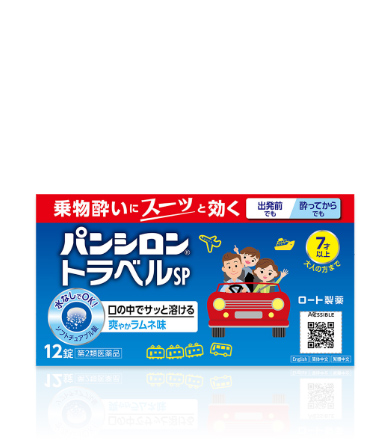
The approved use is prevention and relief of dizziness, nausea and headache caused by motion sickness. If symptoms are unrelated to travel or their cause is unclear, do not assume a motion-sickness medicine is the right treatment.
パンシロンキュアSP (Pansiron Cure SP) is a stomach remedy, a different product from Travel SP. If that was the medicine you meant, see the Pansiron stomach-remedy identification guide. The link helps distinguish the products; their doses are not interchangeable, and it is not a suggestion to combine them.
Keep dose, frequency and interval separate
Use this section only after checking the restrictions above. Tablets per dose, maximum doses per day and the interval between doses are three separate instructions.
Ages 15 and over
Per dose: 2 tablets
Per day: no more than 2 doses
If another dose is needed: wait at least 4 hours
Ages 7–14
Per dose: 1 tablet
Per day: no more than 2 doses
If another dose is needed: wait at least 4 hours
Do not divide an adult dose to give it to a younger child. Children aged 7–14 must take it under a parent or guardian’s guidance and supervision.
- For prevention: take it 30 minutes before boarding the vehicle or boat.
- After motion sickness starts: the label also permits use when symptoms occur. Age, medicine restrictions and the daily maximum still apply.
- How to take it: remove the tablet from its PTP blister sheet, then chew it or let it dissolve in the mouth. Water is not needed. Never swallow the blister packaging, which can cause injury. Do not cut the PTP sheet into individual one-tablet pieces.
- If a repeat dose is needed: use the dose for the user’s age, leave at least 4 hours after the previous dose and do not exceed 2 doses in a day.
An outward journey in the morning and a return trip in the afternoon do not automatically call for two doses. Two doses is a ceiling, not a daily target. Recheck whether another dose is needed, the time elapsed, any adverse symptoms and who will be driving. Four hours does not mean the medicine has worn off, driving is safe or another product can be taken.
-
1. Check the itinerary and medicines
Driving planned, under age 7, another potentially incompatible medicine, or a pre-use consultation condition? Address that restriction first rather than moving straight to a dose.
-
2. If suitable, match the dose to age
Confirm it is Travel SP: 2 tablets per dose from age 15, or 1 tablet at ages 7–14. Record the time. Any repeat dose must be at least 4 hours later, with no more than 2 doses a day.
-
3. Review symptoms before the return trip
Follow the stopping rules if adverse symptoms appear. Persistent vomiting, inability to keep fluids down or emergency warning signs call for medical help, not an extra tablet.
What does “per 2 tablets” in the ingredient list mean?
Two tablets contain meclizine hydrochloride 25 mg, scopolamine hydrobromide hydrate 0.25 mg and pyridoxine hydrochloride (vitamin B6) 6 mg. This is the amount in one dose for ages 15 and over, not a dose for every age and not a daily total. Ingredient counts are not a reliable way to rank different motion-sickness medicines by strength.
When to stop, and when to get medical help
Stopping rules on this product’s label
- Stop immediately and consult: rash, redness, itching, headache, difficulty urinating, facial flushing or unusual sensitivity to light after taking it. These may be adverse effects.
- Stop and consult if these persist or worsen: dry mouth, constipation, drowsiness or blurred vision.
Take the outer box to a doctor, pharmacist or registered OTC medicine seller in Japan. The no-driving instruction applies even before drowsiness or blurred vision has persisted or worsened.
The following are general vomiting warnings, not this medicine’s specific adverse-effect list. Seek prompt medical help if you keep vomiting and cannot keep fluids down. Vomiting blood or material that looks like coffee grounds, a sudden severe headache or abdominal pain, difficulty breathing or confusion requires emergency medical help. Being on a journey does not make every episode of nausea or vomiting motion sickness.
Practical questions for the trip
Can I repeat the dose if I vomit after taking it?
The official materials checked do not provide a replacement-dose rule after vomiting. The time you vomited does not tell you how much medicine was absorbed. Do not automatically repeat or increase the dose. Tell a pharmacist or doctor when you took it, when you vomited, how much was taken and any other symptoms. Inability to keep fluids down or the warning signs above takes priority.
Can I use the adult dose while breastfeeding?
The Japanese label checked does not give a breastfeeding-specific prohibition or instruction to interrupt feeding. That does not establish suitability for every breastfeeding person. Tell a doctor or pharmacist you are breastfeeding when choosing a medicine. Do not interrupt breastfeeding on your own or assume a safe interval before resuming.
How should I store the remaining tablets?
Keep them in a cool, dry place away from direct sunlight and out of children’s reach. Do not transfer them to another container, and do not use them after the expiry date. The packaging says to use the medicine as soon as possible after opening the inner bag, even within the expiry date. It does not specify a number of days or months after opening. Ask a pharmacist or the manufacturer if unsure. Sweet-tasting chewables still need to be stored as medicine.
What can I do without taking medicine?
General NHS motion-sickness advice includes looking at a fixed point such as the horizon, avoiding reading and screens while moving, getting fresh air, taking breaks and avoiding heavy meals and alcohol before or during travel. These are general travel measures, not Travel SP dosing instructions, and they do not mean every traveler needs preventive medicine.
What should I ask at a Japanese pharmacy?
Start with the user’s age, driving plans, medicines already taken and the times taken. Add ongoing treatment, allergies, pregnancy or breastfeeding as relevant. You can show the pharmacist this question together with the medicine packages or a list:
パンシロントラベルSPを検討しています。年齢、運転の予定、今日使った薬をお伝えするので、使用できるかと、飲む量・タイミングを確認していただけますか。
“I’m considering Pansiron Travel SP. I’ll tell you the user’s age, driving plans and medicines used today. Could you check whether it is suitable, and confirm the dose and timing?”
Sources and image note
Checked on November 11, 2026. This is a guide to the Japanese-market label, not a personal product trial or an individual medical assessment. Read the full labeling supplied with your pack; packaging and official information can change.
Official primary sources
- Rohto: Pansiron Travel SP product page and its linked official packaging PDF: product identity, JAN, current flavor, directions, ingredients, restrictions, stopping rules and storage. The complete product photograph comes from this official page and accompanies the identification discussion.
- PMDA product record and linked PDF: cross-check of the Japanese labeling. The PMDA update date is August 31, 2022; the packaging artwork carries December 22, 2021. The 2026 date in this guide is the checking date, not a claim of a 2026 product revision.
General medicine and medical-help references
- NHS: Motion sickness: non-medicine travel measures. UK medicine directions and age limits have not been transferred to this product.
- NHS: Diarrhoea and vomiting: general vomiting and emergency warning signs, not Travel SP adverse effects or repeat-dose instructions.
Media lead behind this topic
Japaholic’s five Japanese motion-sickness medicines article was originally published in October 2022 and is marked updated July 27, 2026. It highlighted product-identification and dosing questions travelers from Taiwan may face. Inclusion does not establish sales, search demand or effectiveness. No PR or sponsorship disclosure was found in the visible article checked; that does not prove an absence of commercial involvement. Its orange-flavor description differs from the current official ramune labeling, as explained above, without assuming a reformulation.