Japanese eye drops · A parent’s checklist
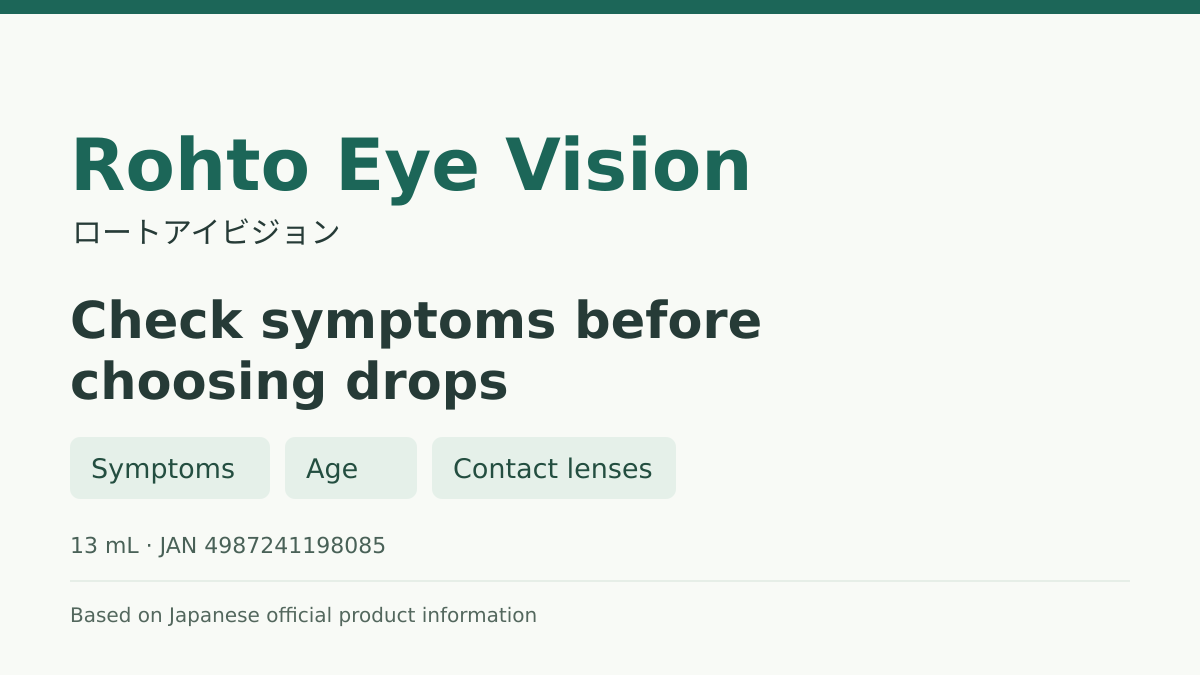
When a child says their eyes feel tired after using a tablet, a Japanese eye-drop box promising to “support recovery of the ability to see” can sound like a way to improve eyesight. ロートアイビジョン (Rohto Eye Vision) 13 mL is labeled for eye fatigue, but its indications do not include preventing or treating myopia, or correcting vision. First consider whether your child needs an eye assessment, then whether this particular medicine is suitable.
Start with the symptoms
If your child has difficulty seeing, an eye specialist should check for other eye disease even if you suspect increasing myopia. Do not keep trying drops until their vision seems clearer.
Severe pain or blurred vision needs attention
The leaflet says to seek advice before use for severe eye pain. If your child’s eyes or vision seem abnormal, arrange an assessment with an eye specialist rather than assuming it is “too much screen time.” If blurred vision does not improve during use, stop and seek advice. You do not need to wait two weeks.
Stop immediately and take the leaflet to a doctor, pharmacist or registered OTC medicine seller if use is followed by a skin rash, redness or itching, or eye redness, itching, swelling or stinging pain. These may be adverse reactions.
Also ask before use if your child is receiving medical treatment, has previously had an allergic reaction to medicines or similar substances, or has been diagnosed with glaucoma. Mention other eye drops and medicines being used; do not stop prescribed treatment on your own.
- Does this need an eye assessment first?
Severe pain or abnormal eyes or vision needs assessment. “Tired eyes” is not a diagnosis.
- Match the bottle and the child’s circumstances
Check the full product name, age, current treatment and contact-lens type. Ask a pharmacist if unsure.
- Once suitable, follow this product’s directions
1–2 drops per use, 3–4 times daily, under adult supervision. Keep the stop-and-consult instructions in mind.
Identify the 13 mL product
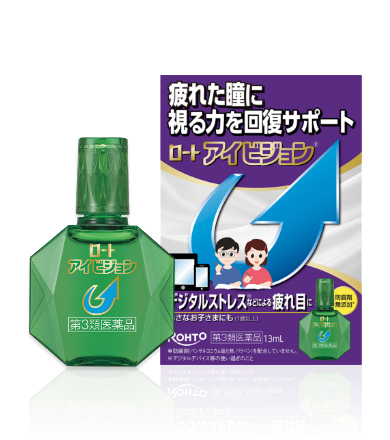
Japanese category: Class 3 OTC medicine
JAN barcode: 4987241198085
Identification photo: Rohto Pharmaceutical’s official product information. Match the full name and barcode rather than color alone; packaging may change.
Rohto launched this product in Japan on 26 March 2026. Chinese-language travel articles may call it “樂敦 i Vision”; the Japanese name and JAN identify the product covered here. It is different from Rohto Kodomo Soft (ロートこどもソフト), Digi Eye Contact and Alguard Epinastine. Do not borrow another product’s dose, frequency or lens instructions.
Age 1 and over does not mean suitable for every child
The product-specific official FAQ and brand page say it can be used from age 1. The two-page leaflet requires adult instruction and supervision for children. Age eligibility alone does not establish a need for the medicine or its suitability. Do not use this guide to self-treat a child under 1; ask a doctor or pharmacist.
The Japanese label lists eye fatigue; prevention of eye disease after swimming or when dust or sweat enters the eyes; blurred vision such as that associated with excess discharge; conjunctival redness; itchy eyes; inflammation caused by ultraviolet or other light, such as snow blindness; eyelid inflammation; and discomfort while wearing hard contact lenses. This list cannot diagnose a child’s eye condition and does not mean the drops prevent all eye infections.
The package wording “視る力を回復サポート” is the manufacturer’s product message. The listed indications do not include treatment of myopia or pseudomyopia, or vision correction. An ingredient described as helping focusing function does not establish that the drops can change a glasses prescription. The leaflet also encourages breaks from prolonged close work and an eye-specialist visit for abnormalities. Drops do not replace those steps.
Which contact lenses are excluded?
- Do not use while wearing soft contact lenses, including disposables.
- Do not use while wearing colored contact lenses, including circle lenses.
- The product FAQ allows use with hard lenses, including oxygen-permeable (O2) hard lenses. This does not establish that a child with eye symptoms should continue wearing lenses.
If you are unsure of the lens type, show its packaging to a pharmacist. The checked product information does not give a universal time for putting lenses back in after use. Do not copy a reinsertion interval from another eye drop.
1–2 drops, 3–4 times daily
1–2 drops per use · 3–4 times a day
- Wash hands first. An adult should guide and supervise the child. Gently pull down the lower eyelid and apply the labeled number of drops.
- Keep the tip away from the eye, eyelids and eyelashes to avoid contamination or foreign matter entering the bottle. Do not use cloudy liquid.
- Gently close the eyes for about one minute. After use, turn the cap until it clicks shut.
For eye use only. Do not increase the dose or frequency because the child’s eyes still feel tired. Do not use the liquid to clean contact lenses.
If other eye drops are being used, ask a doctor or pharmacist about the combination and how to use them. This guide does not provide one interval that applies to all eye medicines.
Two weeks and two to three months mean different things
Symptoms: stop and seek advice
The leaflet says to stop and consult if blurred vision does not improve, or if symptoms have not improved after about two weeks.
Two weeks is not a prescribed treatment course or a waiting period for every symptom. Stop immediately for possible adverse reactions; severe pain or abnormal vision needs assessment first.
After opening: a quality guide
The official FAQ gives about 2–3 months after opening as a handling- and storage-dependent guide. Use promptly and stop if the liquid becomes cloudy or develops floating matter.
This is not permission to treat symptoms continuously for 2–3 months. The box’s expiry date applies to an unopened product. Do not use an expired product.
Note the opening date. Cap tightly and store in a cool place protected from sunlight and fluorescent light. Avoid places reaching 40°C or above, such as a hot car or near a heater, and keep out of children’s reach. Do not share, transfer to another container or add anything to the bottle. The leaflet allows crystals on the tip or inside the cap to be gently wiped away with clean gauze; this is not the same as cloudiness or floating material in the liquid. Discard the empty container to avoid misuse.
Five active ingredients, not just BTA
- Berberine chloride hydrateベルベリン塩化物水和物
- 0.025%
- Sodium azulene sulfonate hydrateアズレンスルホン酸ナトリウム水和物
- 0.02%
- Taurineタウリン
- 0.1%
- Neostigmine methylsulfateネオスチグミンメチル硫酸塩
- 0.005%
- Sodium chondroitin sulfateコンドロイチン硫酸エステルナトリウム
- 0.25%
These percentages are formulation concentrations, not daily doses. BTA is Rohto’s name for the combination of berberine, taurine and sodium azulene sulfonate. The medicine has five active ingredients in total. Ingredient design or number alone does not establish that it is better for a particular child, or that it prevents permanent screen-related damage.
The full preservative statement is that benzalkonium chloride and parabens are not formulated in this product. This does not mean there are no additives. The listed additives are boric acid, borax, sodium edetate, BHT, eucalyptus oil, d-borneol, polysorbate 80, polyoxyethylene castor oil, polyoxyethylene hydrogenated castor oil, povidone, sesame oil and a pH adjuster. If ingredient allergy is a concern, have a pharmacist check the complete label.
Rohto’s cooling rating is 0. That is not an effectiveness score or a guarantee that it will never sting. Its pale green color comes from two active ingredients; color alone cannot establish potency or whether the liquid remains suitable for use. Avoid getting the drops on clothing and rinse promptly if this happens.
What to say at the pharmacy
「ロートアイビジョンを考えています。子どもの年齢と症状、使っている薬を伝えるので、使えるか確認してもらえますか?」
“I’m considering Rohto Eye Vision. Can you check whether it is suitable if I tell you my child’s age, symptoms and current medicines?”
Also explain when symptoms began, whether there is pain or difficulty seeing, and any contact-lens type. This is more useful than asking only for “children’s eye drops.”
Official sources
The following sources were checked on 12 November 2026, Japan time, including the two-page leaflet linked from the product page at that time. No revision date was visible on that leaflet; the check date is not a verified leaflet revision date. This is product identification and general information, not an individual diagnosis. Follow the instructions supplied with the actual product.
- Rohto: Eye Vision product information and official product photograph (identity, volume, Japanese category, JAN, ingredients, indications and precautions)
- Official leaflet currently linked from the product page (two-page PDF) (dose, stop-and-consult criteria, storage and application)
- Official FAQ: starting age
- Official FAQ: contact-lens compatibility
- Official FAQ: use after opening
- Rohto Eye Vision brand page (age, BTA and the specific preservative statement)
- Rohto: launch announcement, 26 March 2026
- Japan Ophthalmologists Association: childhood myopia (only the concluding eye-examination section is used to support assessment of reduced vision; this article does not draw on that page’s myopia-treatment advice)
The decision diagram is this site’s original text and layout based on the official information, not a manufacturer advertisement or copied leaflet illustration.