A Japanese guide may call a wound disinfectant simply “Makiron.” At the shelf, read the full Japanese name and classification: マキロンs and マキロン(販売名:マキロン プチA) have similar bottles but different formulas and restrictions. This guide helps identify them; it does not recommend disinfectant for every wound.
- First, separate the wound products from the rest of the brand
- The main comparison: s and Petit A
- A restriction that changes with the bottle
- Jet & Spray: the same active ingredients, different can precautions
- Use the directions and stopping points on your exact product
- Keep the bottle instructions with the bottle
- Related guides
- Sources and photograph credit
First, separate the wound products from the rest of the brand
ACNEIGE acne lotion/cream and Makiron itch patches are separate products. Brand recognition alone does not identify a wound liquid. For the two bottles here, check the small “s” and the regulatory wording, rather than bottle color alone.
Read the label in this order
- ACNEIGE or an itch patch? Outside this wound-liquid comparison.
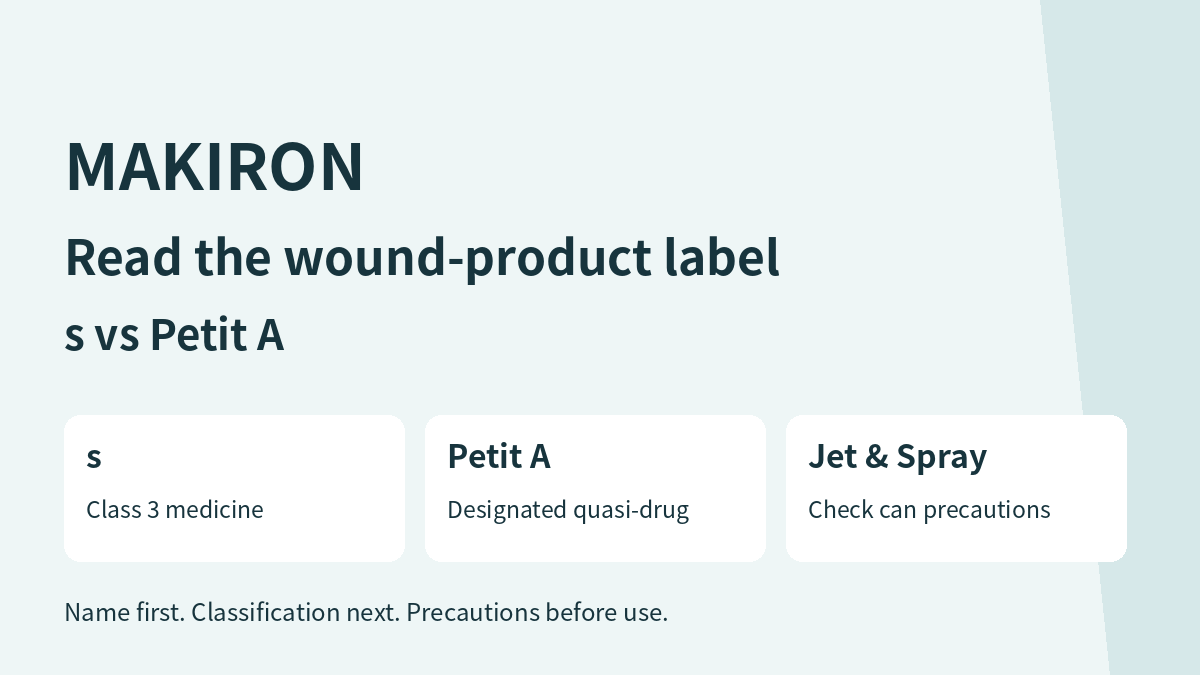
- マキロンs + 第3類医薬品? The s bottle: three active ingredients.
- マキロン + 指定医薬部外品? Check the sales name マキロン プチA: one active ingredient.
- ジェット&スプレー? The pressurized can: s actives, additional spray and heat precautions.
Identification comes before use. Serious or worsening wounds need medical assessment, not a different bottle.
The main comparison: s and Petit A
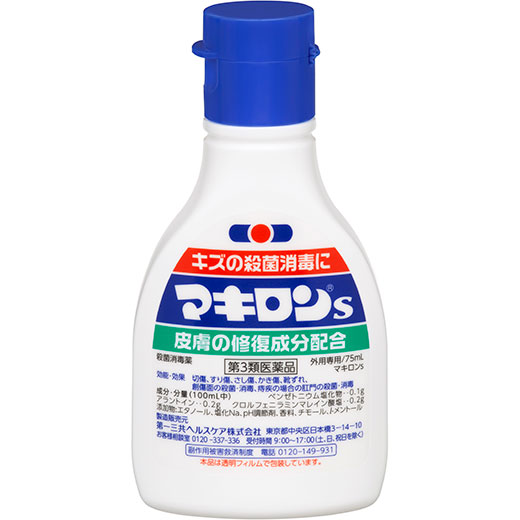
Japanese Class 3 OTC medicine (第3類医薬品). Bottle sizes: 30 mL and 75 mL. The pictured bottle is 75 mL. Look for the small s, green band and Class 3 wording.
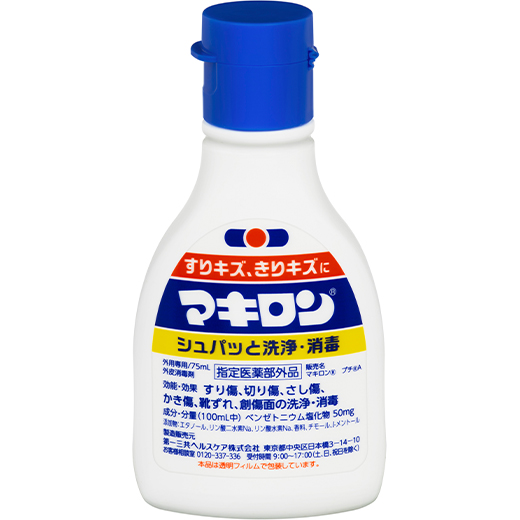
Sales name: マキロン プチA (Makiron Petit A). 75 mL. A Japanese designated quasi-drug (指定医薬部外品), not a designated Class 2 medicine. Look for the yellow band and quasi-drug wording.
The official photographs are used here for identification; the readable text below carries the comparison and precautions. Photo credit: Daiichi Sankyo Healthcare. Sources are collected at the end.
Composition per 100 mL, not an application dose: s contains benzethonium chloride 0.1 g (100 mg), allantoin 0.2 g and chlorpheniramine maleate 0.2 g. Petit A contains benzethonium chloride 50 mg as its only active ingredient. Benzethonium chloride is an antiseptic, not an antibiotic; it is not benzalkonium chloride.
The manufacturer describes allantoin as supporting skin-tissue repair and chlorpheniramine as relieving itching through antihistamine action. These roles do not establish that one bottle heals wounds faster. Petit A is neither a smaller s nor a product whose safety or effectiveness can be ranked simply from its lower antiseptic concentration.
Both labels cover cuts, abrasions, puncture wounds, scratches, shoe-rub injuries and wound surfaces: s uses antisepsis/disinfection wording, while Petit A uses cleaning/disinfection wording. Puncture-wound wording does not remove the need to assess depth or an embedded object. s also lists anal disinfection in hemorrhoidal disease; Petit A does not. That is a label distinction, not a recommendation or a mucosal-use guide. These labels do not establish acne, insect-bite, burn-treatment or scar-fading uses.
A restriction that changes with the bottle
Petit A: do not use on extensive affected areas, deep wounds or severe burns. s: consult before use for those same situations. This difference in label wording is not a reason to self-treat a serious wound with s.
For either bottle, consult before use if receiving medical treatment or if medicines have caused an allergic reaction. Petit A also asks people with a personal or family allergic tendency to consult. Its label names a doctor or pharmacist; s names a doctor, pharmacist or registered OTC medicine seller.
Jet & Spray: the same active ingredients, different can precautions
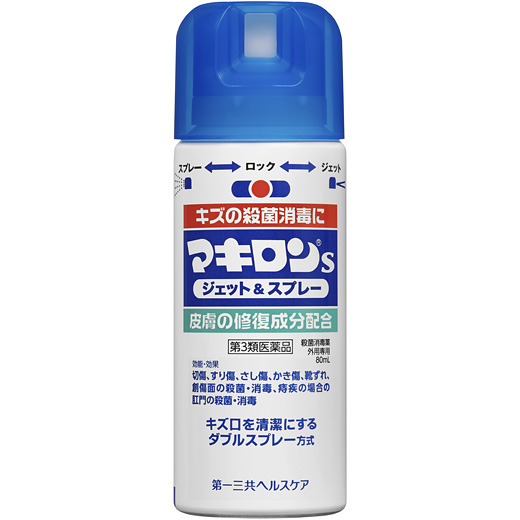
80 mL; Japanese Class 3 OTC medicine. The tall can and jet/spray/lock selector distinguish it from the bottles. Photo: Daiichi Sankyo Healthcare.
Jet & Spray has the same three actives and per-100-mL amounts as s. It is not a stronger formula. Its pre-use consultations and stop rules match s, but its handling differs. Follow the can’s jet/spray/lock markings. Do not spray directly onto the face or mucous membranes. The anal-disinfection indication does not override that restriction.
The can is nitrogen-pressurized. Do not store it at 40°C or above or throw it into a fire. Use it up before disposal; the manufacturer says to release remaining gas outdoors until the spraying sound stops. Keep it cool, out of direct sunlight and children’s reach, and respect the printed expiry. The bottle instruction to use within 12 months of opening is not stated on the Jet label; do not transfer it to the can.
Use the directions and stopping points on your exact product
- s: several times daily, spray onto the affected area or apply using gauze/absorbent cotton soaked with the liquid.
- Petit A: several times daily, apply (spray) to the affected area or apply using soaked absorbent cotton/gauze.
- Jet & Spray: several times daily, spray an appropriate amount onto the affected area or apply using soaked gauze/absorbent cotton, respecting its direct-spray restriction.
All are for external use only. Follow the label rather than inventing a spray count. Children require adult guidance and supervision. These labels give no numerical minimum age; that is not confirmation of suitability for infants. Keep out of the eyes. If exposure occurs, rinse immediately with water or lukewarm water; severe symptoms require an ophthalmologist.
Stop immediately and consult if rash, redness or itching appears after use; s and Jet also explicitly list swelling. Take the product or leaflet with you. If symptoms have not improved after 5–6 days, stop and consult. This is a checkpoint, not a required treatment course or permission to wait while a wound worsens.
Seek help sooner: uncontrolled bleeding, a very large/deep wound or an embedded object needs emergency assessment. Persistent dirt, pus, increasing redness, swelling or pain, fever or feeling generally unwell needs prompt medical care. Do not wait 5–6 days.
Keep the bottle instructions with the bottle
s and Petit A contain alcohol and may sting. Keep both tightly capped in their original containers, cool and away from direct sunlight and children. Do not decant. Use within 12 months after opening and before the printed expiry. During transport, put the bottle in a sealable bag because pressure on the cap can cause leakage.
Do not assume compatibility with hydrocolloid or other occlusive dressings. Follow the dressing’s own instructions and seek professional advice if unsure. The linked wound and dressing guides below cover broader care; this article stays focused on identifying these products.
Related guides
Sources and photograph credit
Sources checked: 12 November 2026 (Japan time). This is our source-check date, not a leaflet revision date or physician approval. Product facts come from the manufacturer’s current pages and linked labels. The NHS source supplies the short urgent-wound boundary.
- Makiron s: product information
- Makiron s: linked label
- Makiron / Petit A: product information
- Makiron / Petit A: linked label
- Makiron s Jet & Spray: product information
- Makiron s Jet & Spray: linked label
- Manufacturer: s versus Petit A FAQ
- NHS: Cuts and grazes
- Daiichi Sankyo Healthcare: website terms
The three unaltered product photographs are from the corresponding Daiichi Sankyo Healthcare product pages above. The cover and text-based identification diagram are original editorial artwork. Packaging and labels may change; read the product in hand.