
I'm Irene, a Taiwanese-born, Japanese-licensed pharmacist working in a Japanese drugstore. The gold Clinical i box and the green-accented i box both contain single-use eye drops, but their formulas, drop counts and storage wording are not identical.
- First check whether an eye drop is the right next step
- What these drops are, and what they are not
- Recognize the two packages
- Formula and dose: keep the two rows separate
- How to open and use a single-use container
- Contact lenses and children
- When to stop and ask for help
- Storage is slightly different, too
- My shelf-side takeaway
- Sources
First check whether an eye drop is the right next step
A painful red eye, changed vision, light sensitivity, an injury or a red eye in a contact-lens wearer needs prompt medical assessment. Do not postpone care to try a stronger-looking package. Severe headache with nausea alongside a red eye is another urgent warning sign.
For a suitable short-term OTC use after checking the cause, Rohto Antibacterial i offers a noncooling formula; Clinical i adds an antihistamine for itch, more of one anti-inflammatory ingredient and a slight cooling sensation. Both contain the same 4% antibacterial ingredient. Gold packaging does not establish that Clinical i treats every red eye better.
This guide compares these two single-use products only. It does not cover the EX bottle or other Rohto eye drops.
What these drops are, and what they are not
Their Japanese labels list styes, conjunctivitis, itchy eyes and blepharitis (inflamed eyelids). Both contain sodium sulfamethoxazole, a sulfonamide antibacterial ingredient. They are not ordinary lubricating drops for tired eyes.
Conjunctivitis has different causes. Antibacterial treatment does not work against viral or allergic conjunctivitis. Even though the Japanese labels use 結膜炎(はやり目), do not interpret that wording as a promise to treat every contagious red eye. A pharmacist or eye clinician can help decide whether the symptoms fit self-care.
Recognize the two packages
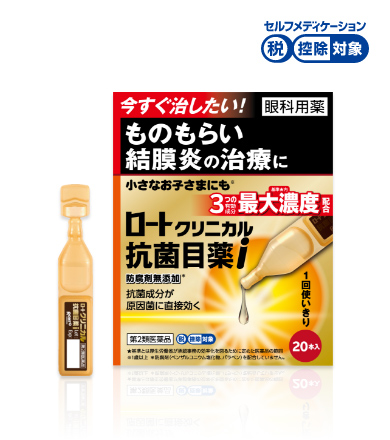
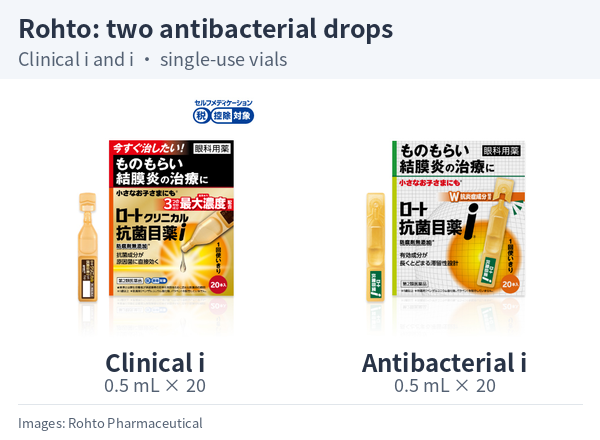
Clinical i: gold box, with an added itch-relief ingredient
The full name is ロートクリニカル抗菌目薬i. The box contains twenty 0.5 mL single-use containers. It is a Japanese Class 2 OTC medicine. Rohto rates its cooling sensation 1 on its 0–5 scale and includes menthol as an additive. This is the manufacturer's sensation scale, not an effectiveness score.
Antibacterial i: green-accented box, noncooling
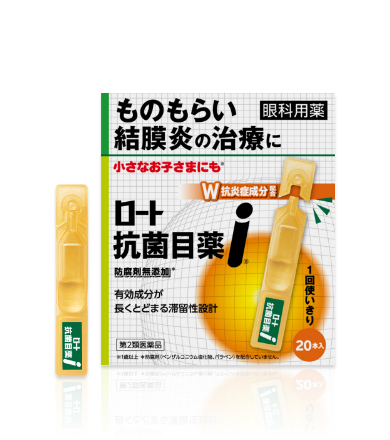
Look for ロート抗菌目薬i, without クリニカル. This also contains twenty 0.5 mL single-use containers and is Class 2. Rohto rates cooling at 0; its listed additives do not include menthol. If cooling is uncomfortable for you, that difference is more useful than choosing by the word “Clinical.”
Formula and dose: keep the two rows separate
| Label point | Clinical i | Antibacterial i |
|---|---|---|
| Sodium sulfamethoxazole | 4% | 4% |
| Dipotassium glycyrrhizate | 0.25% | 0.15% |
| Epsilon-aminocaproic acid | 1% | 1% |
| Chlorpheniramine maleate | 0.03% | Not an active ingredient |
| Drops per application | 1–3 drops | 2–3 drops |
| Frequency | 5–6 times daily | 5–6 times daily |
| Manufacturer age guidance | Age 1 and over; adult supervision for children | Age 1 and over; adult supervision for children |
The added chlorpheniramine in Clinical i is an antihistamine; the two glycyrrhizate concentrations also differ. Neither distinction means you should increase the dose or combine the two.
Both are described as free of benzalkonium chloride and parabens. That does not mean additive-free or allergy-proof. Both contain thickening ingredients, including hypromellose and alginic acid; avoid the medicine if you have previously reacted to it or one of its ingredients.
How to open and use a single-use container
- Wash your hands. Take one container without touching its tip. Slowly twist the cap off; do not pull it off partway or squeeze hard while opening.
- Use the exact product's drop count: Clinical i 1–3, or i 2–3, up to the labelled 5–6 applications daily. Keep the tip away from the eye, eyelids and lashes.
- Throw the opened container away after that use, even if liquid remains. The extra liquid helps dispensing; it is not an invitation to save a later dose.
- Do not share containers with anyone. Do not use cloudy liquid, transfer it to another bottle or use these products for anything other than eye instillation.
A single-use container is not a day's supply. A 20-container box should not be treated as twenty days of treatment, either: the frequency and stop-and-consult limit still apply.
Contact lenses and children
Both exact leaflets prohibit use while wearing soft contact lenses. More importantly, when an eye is red or inflamed, leave contact lenses out until the eye has recovered and seek advice about the cause. A “hard-lens compatible” icon is not permission to keep wearing lenses over a suspected infection.
Rohto states age one and over, with adult supervision for children. For a young child with a new red eye, arrange professional advice rather than choosing from age alone. Do not use these products in a baby under one; an infant's red or sticky eye needs medical assessment.
When to stop and ask for help
Do not use if you have had an allergic reaction to the product or an ingredient. Consult before use if you are receiving medical treatment, have a medicine-allergy history or have severe eye pain. If pregnant or breastfeeding, ask about your own situation and other medicines; the exact inserts do not provide a separate pregnancy/lactation instruction, which is not a blanket safety guarantee.
Stop and consult if there is no improvement after 3–4 days. Do not use continuously for a long period, and do not wait three days if pain, vision changes or other warning signs appear.
For skin rash, redness or itching, or eye redness, itching, swelling or painful stinging, stop immediately and consult a doctor, pharmacist or registered OTC medicine seller. Seek immediate medical care for possible severe allergy, such as hives with hoarseness, throat symptoms, breathing difficulty, palpitations or confusion. Bring the box and leaflet.
Storage is slightly different, too
For Clinical i, return unopened containers to the inner bag and box. After opening the inner bag, use the remaining unopened containers within about three months while following its storage instructions and the printed expiry date. This does not change the discard-immediately rule for an opened container.
For Antibacterial i, the exact leaflet says to keep it in its outer box and use promptly after opening; it does not give the same three-month inner-bag rule. Follow the leaflet in your box rather than borrowing Clinical i's storage allowance.
For both, avoid sunlight and fluorescent light, extreme heat such as a parked car, and extreme cold such as a refrigerator. Store somewhere cool, out of children's reach. Keep the original packaging; do not put loose containers in a back pocket where the cap could open.
My shelf-side takeaway
Check the eye problem first. If an OTC antibacterial drop is appropriate, compare cooling preference and the added itch-relief ingredient, then follow the correct drop count and single-use handling. Neither box should delay an eye examination when symptoms are concerning.
Sources
Product information checked October 15, 2026. NHS sources support general triage and the distinction between bacterial, viral and allergic conjunctivitis; Japanese product directions come from the exact Rohto leaflets.