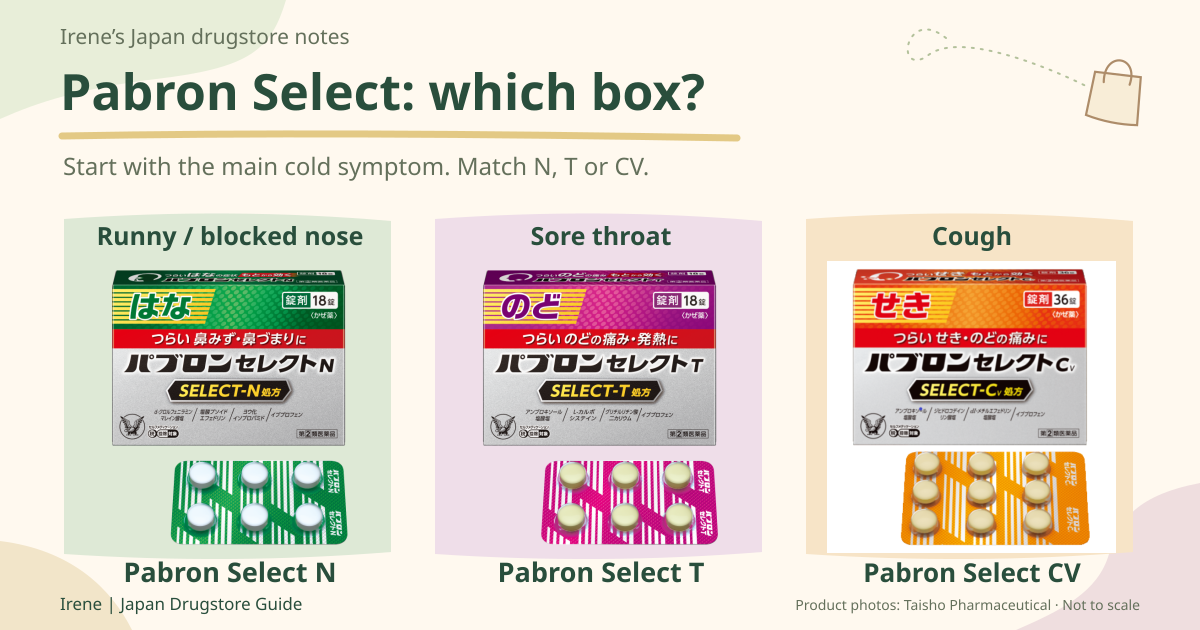
On a Japanese drugstore shelf, Pabron Select gives you three starting points: nose, cough and throat. Start with the cold symptom that bothers you most, then match the box and full Japanese name. If your shopping list has a photo of the older Select C, pay attention to one extra letter: the current cough-focused product is CV.
I’m Irene, a pharmacist from Taiwan working in Japan. Let’s make the three boxes easier to recognise, and keep one important difference in view: CV is three tablets per dose; N and T are two. This guide is for planning a shopping trip, finding a requested product for family, or checking a medicine you have at home in Japan.
Which cold symptom is bothering you most?
A runny or blocked nose is the main problem
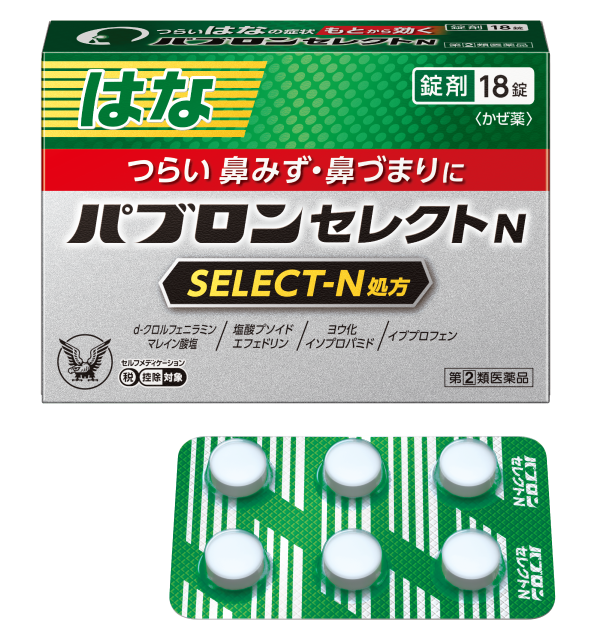
Product photograph: Taisho Pharmaceutical.
N | Green box · はな
パブロンセレクトN
はな means nose. N combines pseudoephedrine for congestion with ingredients that reduce a runny nose. It is the nose-focused option to compare.
Rule N out first if you have diagnosed high blood pressure, heart disease, thyroid dysfunction or diabetes, or difficulty urinating caused by an enlarged prostate.
Coughing and troublesome phlegm
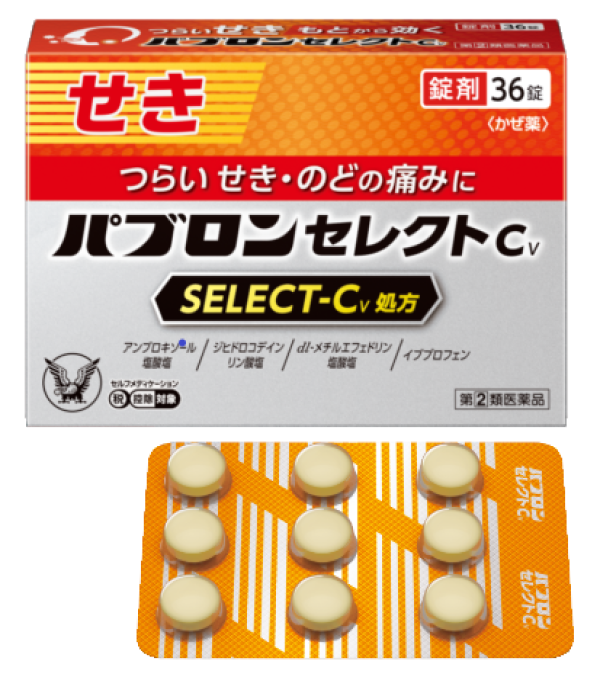
Product photograph: Taisho Pharmaceutical.
CV | Orange-red box · せき
パブロンセレクトCV
せき means cough. CV combines cough suppressants with ambroxol to help loosen and clear phlegm. Look for the full CV, rather than stopping at C.
A sore throat makes swallowing uncomfortable
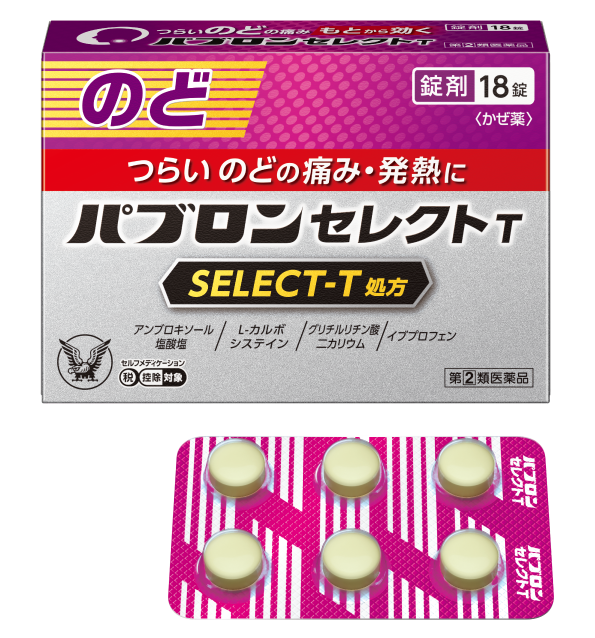
Product photograph: Taisho Pharmaceutical.
T | Purple box · のど
パブロンセレクトT
のど means throat. T combines ibuprofen and dipotassium glycyrrhizinate for inflammation and pain, plus ambroxol and carbocisteine to help clear phlegm. It is the throat-focused option.
All three are Japanese designated Class 2 OTC combination cold medicines. This starting point follows Taisho’s product positioning. Their labelled uses overlap: each also covers symptoms such as fever, headache, a runny nose and cough. The word on the box is a focus, rather than its only use.
None may be taken by anyone under 15. Do not drive, cycle or operate machinery after taking any of them. Plan around this if you are driving in Japan. Do not combine different Select products; check the other restrictions below before use.
Buying a requested product for someone? Save the full Japanese name with its box photo. Green, orange-red and purple help you find the range, but confirm N, CV or T, the pack size and the leaflet before buying. Colour alone is not enough.
Still looking for Select C? It is different from current CV
Taisho lists パブロンセレクトC as a product whose manufacture has ended. The cough-focused product in the current line is パブロンセレクトCV. The names are similar, but both the formula and tablet count per dose differ.
| Check | Older C | Current CV |
|---|---|---|
| Full Japanese name | パブロンセレクトC | パブロンセレクトCV |
| One dose, age 15+ | 2 tablets | 3 tablets |
| Active ingredients | 8 | 9 |
| Different ingredients | Platycodon root and cherry bark (オウヒ) extracts | Neither of those extracts; adds vitamin B1, vitamin C and anhydrous caffeine |
| Pack listed by Taisho | 18 tablets | 36 tablets |
オウヒ in old C means cherry bark, not citrus peel. The earlier Chinese version of this guide incorrectly called it citrus peel; that has been corrected. A discontinued-manufacture listing does not establish whether every shop has sold out. If you still have C, check its expiry date and its own leaflet. Do not use CV’s three-tablet dose for old C.
An extra tablet does not mean extra ibuprofen
Compare the labelled dose for age 15 and over: two N tablets, two T tablets and three CV tablets each contain 150 mg ibuprofen and 8 mg dihydrocodeine phosphate. Tablet count alone cannot tell you which is “stronger.”
- N has a distinct nasal-symptom combination: 45 mg pseudoephedrine hydrochloride, 2 mg isopropamide iodide and 1.17 mg d-chlorpheniramine maleate per dose (3.5 mg in the six-tablet daily dose), plus dipotassium glycyrrhizinate and carbocisteine. That explains its nasal focus, but N also has additional conditions that rule out use.
- T focuses on the throat and phlegm: alongside ibuprofen, one dose provides 13.3 mg dipotassium glycyrrhizinate (40 mg in six tablets daily), 15 mg ambroxol hydrochloride and 250 mg L-carbocisteine. These ingredients explain Taisho’s throat-focused positioning; they do not establish that T is best for every person with a sore throat.
- CV leads with cough control and phlegm clearance: 8 mg dihydrocodeine phosphate, 20 mg dl-methylephedrine hydrochloride and 15 mg ambroxol hydrochloride per dose. It also contains vitamins B1, B2 and C and anhydrous caffeine. The caffeine does not remove the no-driving restriction.
These are the differences useful for choosing, rather than complete ingredient lists. T and CV also contain an antihistamine. If you already take a cold medicine, pain reliever, oral rhinitis medicine or motion-sickness medicine, check the combination restrictions before adding anything.
How many tablets? Read the name before counting
For age 15 and over, all three are taken three times daily, preferably within 30 minutes after a meal, with water or warm water. The large number below is one dose.
Select N
2 tablets
6 tablets daily; an 18-tablet box is about 3 days
Select CV
3 tablets
9 tablets daily; a 36-tablet box is about 4 days
Select T
2 tablets
6 tablets daily; an 18-tablet box is about 3 days
Under 15: do not take any of these products. Do not halve an adult dose for a child. The pack calculations are for comparison, not instructions to finish a box. Older C is two tablets per dose, three times daily; keep it separate from CV.
If symptoms have not improved after five or six doses, stop and consult a doctor, pharmacist or registered OTC seller, especially if fever lasts three days or keeps returning. Do not take any of these medicines for more than five days. Five or six doses does not mean five or six days.
Push each tablet out of its blister before swallowing it with water; never swallow the blister packaging. Store in a cool, dry place away from direct sunlight and children, and keep the original container. Do not use after the expiry date; even within that date, use within six months of opening.
Before use: know what rules it out and what needs advice
Restrictions shared by N, T and CV
- Do not take them if you have had an allergy to the product or an ingredient, asthma triggered by this or another cold medicine or fever/pain medicine, are under 15, or are pregnant with a due date within 12 weeks.
- Breastfeeding: do not take the medicine, or avoid breastfeeding if you take it. If pregnant at another stage, or possibly pregnant, consult before use.
- Do not combine with other cold medicines, fever/pain medicines, sedatives, cough/expectorant medicines, or oral antihistamine-containing medicines such as some rhinitis, motion-sickness and allergy medicines. N must also not be combined with gastrointestinal pain-relieving antispasmodics.
- No driving or operating machinery after a dose, and no alcohol before or after taking it. Feeling alert does not cancel the driving restriction.
N has extra do-not-use conditions: diagnosed high blood pressure, heart disease, thyroid dysfunction or diabetes, and difficulty urinating due to an enlarged prostate. T and CV instead require advice before use for the four diagnoses. That is not permission to switch to T or CV on your own.
Consult before use if you are under a doctor’s or dentist’s care, are older, have a history of medication-related allergy, have a high fever or difficulty urinating. Also check the following conditions and medicines:
- All three require advice first: liver or kidney disease, glaucoma, systemic lupus erythematosus, mixed connective tissue disease, respiratory dysfunction, obstructive sleep apnoea or obesity; or a history of stomach/duodenal ulcer, ulcerative colitis or Crohn’s disease.
- T and CV: thyroid dysfunction, diabetes, heart disease and high blood pressure also require advice before use.
- Extra checks for N: previous insomnia, dizziness, weakness, tremor or palpitations after a cold medicine, cough/expectorant medicine or oral rhinitis medicine; or current treatment with a monoamine oxidase inhibitor, such as selegiline.
When should you stop after a dose?
Stop immediately and consult, taking the leaflet with you, if symptoms such as a rash, itching, nausea/vomiting, stomach pain, palpitations, dizziness, bloody stools or difficulty urinating appear. Stop and consult if constipation, dry mouth or drowsiness persists or worsens. This is a summary; the leaflets at the end contain the full adverse-effect lists.
Get medical attention immediately for symptoms such as difficulty breathing, tight chest pain with cold sweats, sudden one-sided weakness or difficulty speaking, or altered consciousness after taking the medicine. These are among the serious adverse-effect warnings in the leaflets. Do not wait for five or six doses.
The useful things to save are simple: your main cold symptom, the full product name and the number of tablets per dose. Match the requested box, read its restrictions before taking it, and spend less of your trip trying to decode the shelf.
Questions before you buy or take it
Can I take N and CV together for both a blocked nose and cough?
No. Both are combination cold medicines, and their leaflets prohibit use with other cold medicines. Use your main symptom as a starting point, then check the restrictions. Do not combine the products to cover more symptoms.
Is three-tablet CV stronger than old C or T?
Tablet count alone cannot show that. Three CV tablets and two old C or T tablets each contain 150 mg ibuprofen and 8 mg dihydrocodeine phosphate, but the other ingredients differ. Follow the exact product’s dose; do not change it to two or three tablets yourself.
Can I drive after CV because it contains caffeine?
No. The leaflets for N, T, CV and older C all prohibit driving vehicles or operating machinery after taking the medicine. The restriction applies even if you do not feel sleepy or dizzy.
Can I choose N for a blocked nose if I have high blood pressure?
No. Diagnosed high blood pressure rules out N. T and CV require advice before use for high blood pressure; do not switch to either one without that advice.
Can a 13-year-old take half the adult dose?
No. N, T, CV and older C must not be taken by anyone under 15. None has a labelled reduced child dose.
How long should I wait before stopping if it does not help?
Stop and consult if symptoms have not improved after five or six doses, especially if fever lasts three days or returns repeatedly. Do not use for more than five days. Side effects or serious warning symptoms may require stopping or medical attention sooner.
Official sources and product photographs
Based on Taisho’s Japanese-market information, checked on 7 October 2026. Match the full Japanese name and read the latest leaflet supplied with your product before use. Manufacturer photographs retain the original packaging and are used here to identify and compare the products.
- 大正製藥/Taisho: N product page: uses, ingredients, dose, 18-tablet pack and green-box photograph
- 大正製藥/Taisho: N Japanese leaflet: restrictions, combinations, stopping and storage
- 大正製藥/Taisho: T product page: uses, ingredients, dose, 18-tablet pack and purple-box photograph
- 大正製藥/Taisho: T Japanese leaflet: restrictions, combinations, stopping and storage
- 大正製藥/Taisho: CV product page: uses, nine ingredients, three-tablet dose, 36-tablet pack and orange-red-box photograph
- 大正製藥/Taisho: CV Japanese leaflet: restrictions, combinations, stopping and storage
- 大正製藥/Taisho: CV official English leaflet
- 大正製藥/Taisho: Older C official product PDF: discontinued manufacture, 18 tablets and eight ingredients
- 大正製藥/Taisho: Older C Japanese leaflet: two-tablet dose, platycodon and cherry bark