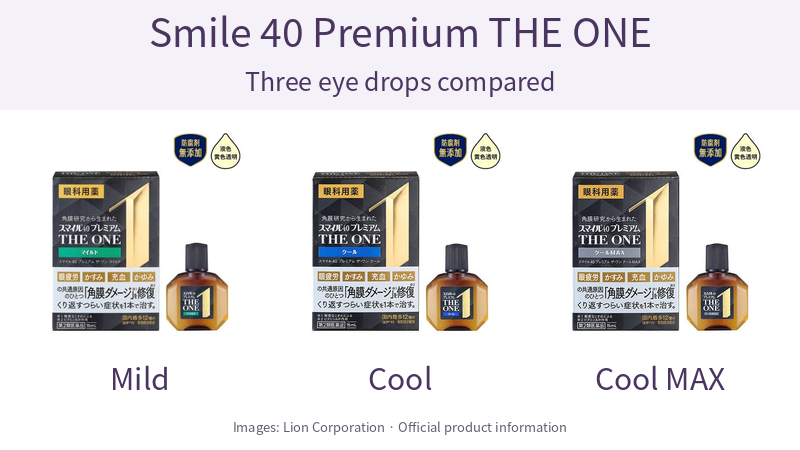
All three contain the same 12 active ingredients at the same concentrations. The main choice is how cooling you like your drops to feel. Consider Mild for a lower cooling sensation, Cool for a refreshing feel, or Cool MAX if you prefer stronger cooling. More cooling does not mean stronger treatment.

I’m Irene, a Taiwan-born, Japan-licensed pharmacist working in a Japanese drugstore. When three similar boxes sit together on the shelf, I suggest checking your symptoms and contact lenses first, then choosing a sensation you find comfortable.
Product information checked: 11 October 2026 · Japanese-market versions.
This guide compares the three products sold in Japan. None may be used while wearing soft contact lenses. Speak with a doctor or pharmacist before use if you are under medical treatment, have a history of allergic reactions to medicines or other substances, have severe eye pain, or have been diagnosed with glaucoma.
What changes between the three?
Feature
Mild
- Starting point
- Prefer less cooling
- Manufacturer’s cooling rating
- 2
- Active ingredients
- Same 12, same concentrations
- Dose
- 1–3 drops, 3–6 times daily
- Use while wearing soft lenses
- No
- Size / Japanese medicine category
- 15 mL / Class 2 OTC
Cool
- Starting point
- Like a refreshing feel
- Manufacturer’s cooling rating
- 4
- Active ingredients
- Same 12, same concentrations
- Dose
- 1–3 drops, 3–6 times daily
- Use while wearing soft lenses
- No
- Size / Japanese medicine category
- 15 mL / Class 2 OTC
Cool MAX
- Starting point
- Prefer stronger cooling
- Manufacturer’s cooling rating
- 7
- Active ingredients
- Same 12, same concentrations
- Dose
- 1–3 drops, 3–6 times daily
- Use while wearing soft lenses
- No
- Size / Japanese medicine category
- 15 mL / Class 2 OTC
Their inactive ingredients differ, so the complete formulas are not identical. Mild also contains menthol and other inactive ingredients: its cooling rating is not zero, and a milder sensation cannot guarantee freedom from irritation or allergy.
Identify the right box in Japan
Mild: green variant label
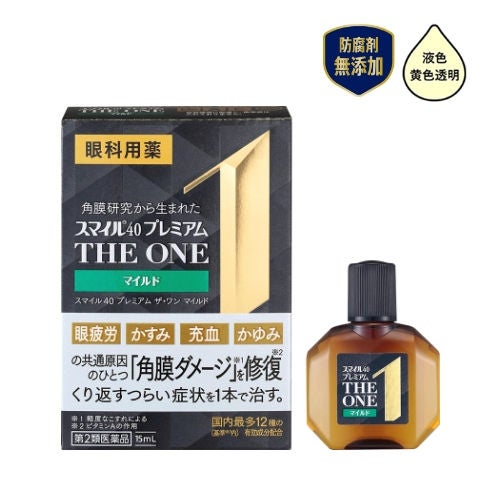
Official Japanese name: スマイル40 プレミアム ザ・ワン マイルド.
Look for Mild and THE ONE. This is the lower-cooling option within these three, rather than a version that is automatically suitable for everyone.
Cool: blue variant label
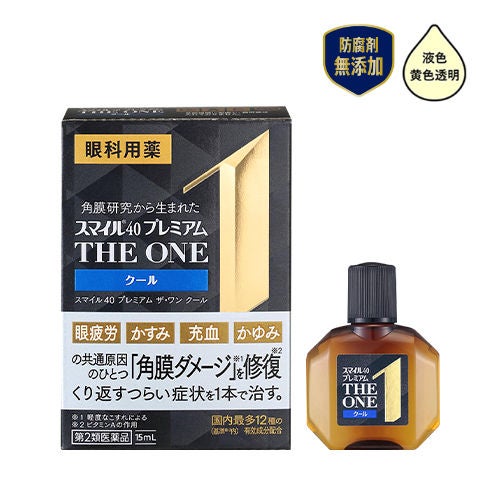
Official Japanese name: スマイル40 プレミアム ザ・ワン クール.
Look for Cool and THE ONE. Its cooling rating falls between Mild and Cool MAX, with the same active ingredients and concentrations.
Cool MAX: grey variant label
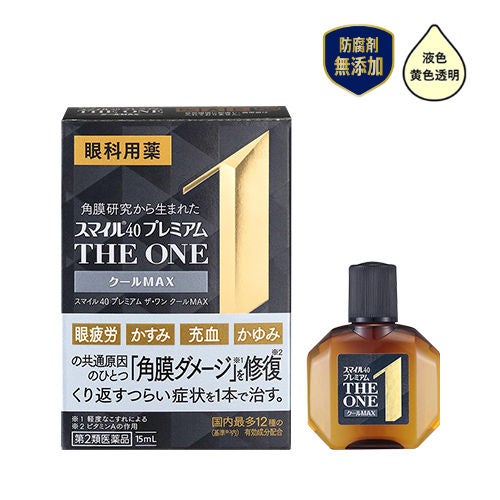
Official Japanese name: スマイル40 プレミアム ザ・ワン クールMAX.
Check the full Cool MAX name. It has a stronger cooling sensation, not higher doses of the active ingredients.
The brand also sells other ranges, including Premium DX. Check THE ONE and the full variant name rather than relying on the words Smile 40 or the box colour alone. The number 40 is not an instruction restricting use to people aged 40 or over; children’s precautions are explained below.
What symptoms are they labelled for?
The three share labelled uses including tired eyes, blurred vision such as when there is excess eye discharge, conjunctival redness, itchy eyes, eyelid inflammation and discomfort while wearing hard contact lenses.
Blurred vision has many possible causes. These drops are not a way to correct short-sightedness, treat presbyopia or self-treat other eye diseases.
Their shared active ingredients are listed below. Every amount is per 100 mL, not per 15 mL bottle or per dose.
| Main role | Ingredient and amount |
|---|---|
| Corneal and visual-function support | Vitamin A (retinol palmitate), 50,000 units |
| Circulation or metabolic support | Natural-form vitamin E (d-α-tocopheryl acetate), 0.045 g; vitamin B6 (pyridoxine hydrochloride), 0.01 g; taurine, 1 g; potassium L-aspartate, 0.8 g |
| Retaining moisture and protecting the cornea | Sodium chondroitin sulfate, 0.1 g |
| Focusing adjustment | Neostigmine methylsulfate, 0.005 g |
| Relieving itching | Chlorpheniramine maleate, 0.03 g |
| Reducing redness | Tetrahydrozoline hydrochloride, 0.02 g |
| Anti-inflammatory and related effects | ε-Aminocaproic acid, 1 g; berberine chloride hydrate, 0.015 g; dipotassium glycyrrhizinate, 0.25 g |
The manufacturer’s explanation of vitamin A supporting corneal repair specifically concerns damage from minor rubbing. It should not be read as permission to treat any corneal injury yourself. Having more ingredients also does not make these drops appropriate for every eye problem.
All three are made without preservatives such as benzalkonium chloride, with the formulation providing a preservative effect. This does not make them suitable for use over soft lenses or safe to keep indefinitely after opening.
How to use all three
Apply 1–3 drops, 3–6 times a day. Do not use extra doses for a stronger cooling sensation. Excessive use may cause abnormal sensitivity to light or make redness worse.
- Wash your hands and make sure you are not wearing soft contact lenses. These products are for eye drops only, not for rinsing or storing lenses.
- Point the bottle tip straight down when applying the drops. Do not touch your eye, eyelid or eyelashes with the tip. Holding the bottle sideways can leave liquid at the tip that drips when you close it.
- Close the cap firmly. Gently wipe away liquid or crystals on the tip or cap with clean gauze. Do not use cloudy liquid, and do not share the bottle.
The leaflets do not give a numerical minimum age. Children must use the drops under a parent’s or guardian’s supervision, and the manufacturer’s FAQ advises avoiding use in infants and young children. If you are unsure whether the product is appropriate for a child, check with a doctor or pharmacist before choosing it for them.
When to ask first or stop using them
Ask before use if you are under medical treatment, have a history of allergic reactions to medicines or other substances, have severe eye pain, or have been diagnosed with glaucoma.
Stop immediately and seek advice with the leaflet if you develop a skin rash, redness or itching, or eye redness, itching, swelling or painful stinging after use.
Also stop and seek advice if blurred vision does not improve, or if symptoms have not improved after 5–6 days. Changing from Mild to Cool MAX is not a substitute for getting persistent symptoms checked.
Because the formula contains viscous ingredients, your vision may briefly become blurred after application. Wait until you can see clearly before driving or doing anything that requires clear vision. Persistent blurred vision still calls for stopping and seeking advice as described above.
Storage and use after opening
Keep the cap tightly closed and store in a cool place away from direct sunlight. Avoid temperatures of 40°C or higher, such as inside a car or near a heater. Keep out of children’s reach, do not transfer the liquid to another container, and do not use it after the expiry date on the bottom of the box.
For vitamin A-containing eye drops, the manufacturer’s FAQ gives about 1–2 months after opening as a guide. Use them promptly and never beyond the printed expiry date. Writing the opening date on the box makes this easier to track.
The liquid is yellow because of plant-derived ingredients and may stain clothing. Discard the oxygen absorber after opening the transparent film packaging.
Which should you choose?
First check that the labelled uses and precautions fit your situation. Then choose your preferred cooling level: Mild 2, Cool 4 or Cool MAX 7. The active ingredients and concentrations are the same. None can be used while soft contact lenses are still in your eyes.
My advice is to choose a sensation you find comfortable rather than chasing the strongest cooling. Persistent blurred vision, eye pain or symptoms that are not improving deserve more attention than the colour of the next bottle.