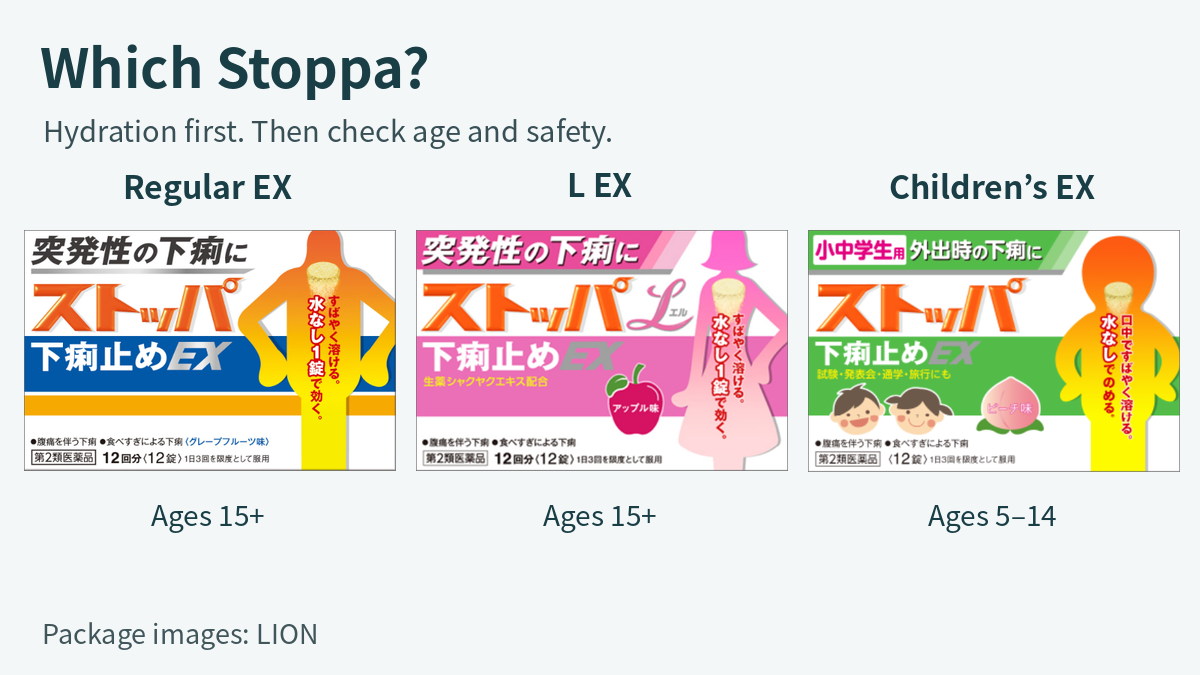
Diarrhea has interrupted your trip, and the Japanese drugstore has blue, pink and green Stoppa boxes. Which one should you buy? Start with fluids and a check for warning signs before choosing a medicine.
Ask a doctor or pharmacist before using Stoppa if diarrhea comes with fever, blood, persistent mucus, abdominal pain, bloating or nausea, or if it is sudden and severe. If you have bloody diarrhea, cannot keep fluids down, are passing much less urine or feel persistently dizzy, seek urgent medical care. Sudden severe abdominal pain, confusion, abnormal sleepiness or difficulty waking needs emergency care.
Once a pharmacist has confirmed that self-treatment is appropriate, narrow the choice by age:
- Age 15 and over: compare regular Stoppa EX with L EX, which adds peony root extract.
- Ages 5–14: the children’s version has two age-specific doses. Have a pharmacist check the child’s symptoms first.
- Under 5: none of these three products can be used.
- Need to drive after taking it, or using motion-sickness medicine? Do not choose any of these three for self-treatment.

I’m Irene, a Taiwan-born, Japan-licensed pharmacist working in a Japanese drugstore. Let’s make the package choice simpler while keeping hydration, age and travel plans in view.
Product information checked: 12 October 2026. This guide covers the products sold in Japan.
Fluids first, then decide whether an antidiarrheal is suitable
Stoppa relieves diarrhea symptoms; it does not replace lost water and salts. Take small, frequent sips if you can drink. Ask a pharmacist about a suitable oral rehydration product if dehydration is a concern. In Japan, look for the wording 経口補水液.
Oral rehydration solutions have a different formulation from ordinary sports drinks. If you have been told to restrict sodium, potassium, sugar or fluids, ask a healthcare professional before choosing one. They are not everyday drinks to consume in large amounts.
All three Japanese Stoppa leaflets require advice before use for diarrhea with fever, blood or persistent mucus, sudden severe diarrhea, or diarrhea with abdominal pain, bloating or nausea. Although their listed indications include diarrhea with abdominal pain, the warning still applies. Suspected food poisoning or an intestinal infection needs assessment: suppressing diarrhea can sometimes make an illness worse.
Match the box and the full Japanese name
Regular Stoppa EX: blue labeling, grapefruit flavor
Japanese name: ストッパ下痢止めEX.
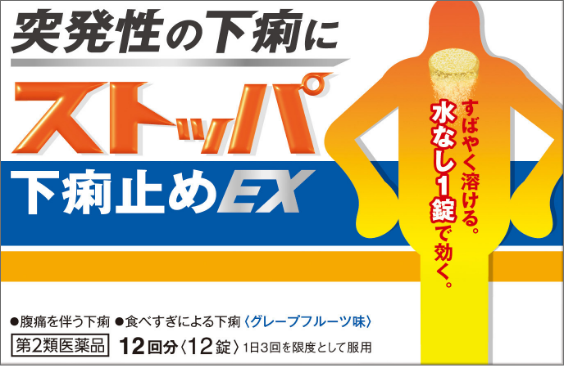
This version is labeled for people aged 15 and over. It contains scopolia extract and berberine tannate. Lion lists a grapefruit flavor and packs containing 12 or 24 doses; one dose is one tablet.
Stoppa L EX: pink labeling, added peony root extract
Japanese name: ストッパエル下痢止めEX. Lion’s English website calls it Stoppa EX-L Anti-Diarrhea Medicine; this guide uses L EX to match the familiar package shorthand.
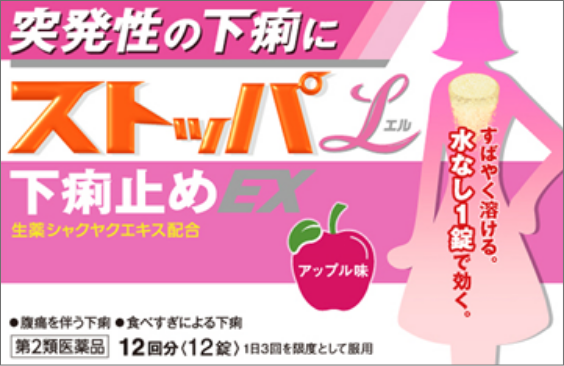
L EX is also for ages 15 and over. It has the same two shared active ingredients, in the same amounts per tablet as regular EX, plus dried peony root extract. The flavor is apple.
Lion markets it for diarrhea associated with menstruation and other situations involving abdominal pain. The Japanese leaflet gives an adult dose for ages 15 and over without separate male and female doses or a restriction excluding men. The letter L and pink box should not be read as an automatic “women only” restriction. Suitability still depends on symptoms, other medicines and health conditions. It is an antidiarrheal, not a stand-alone treatment for period pain, and the extra ingredient does not establish that it is stronger for everyone.
Children’s Stoppa EX: green labeling, “小中学生用” on the box
Japanese name: 小中学生用ストッパ下痢止めEX.
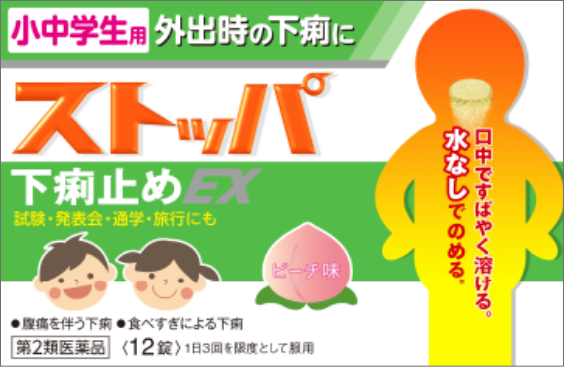
The Japanese label covers ages 5 to under 15, regardless of school year. Lion describes the flavor as peach. Each tablet contains smaller amounts of the shared active ingredients than the adult version, but use its own age-based directions. Do not cut an adult tablet to improvise a child’s dose.
The children’s product has no labeled dose for people aged 15 and over. Adults should not calculate a replacement dose by taking extra children’s tablets.
All three are Class 2 OTC medicines in Japan. These are the packages and sizes currently listed by Lion; this does not establish stock at an individual store.
What actually changes in the formula?
The shared ingredient scopolia extract, called ロートエキス on the Japanese label, helps reduce abnormal intestinal contractions. Berberine tannate has intestinal-mucosal protective actions. L EX adds dried peony root extract, which Lion describes as relieving pain accompanying diarrhea.
These quantities are per tablet, not daily totals:
| Active ingredient | Regular EX | L EX | Children’s EX |
|---|---|---|---|
| Scopolia extract trituration, labeled ロートエキス3倍散 | 60 mg, containing 20 mg scopolia extract | 60 mg, containing 20 mg scopolia extract | 20 mg, containing 6.7 mg scopolia extract |
| Berberine tannate | 100 mg | 100 mg | 33.3 mg |
| Dried peony root extract | None | 24 mg, equivalent to 168 mg crude herb | None |
The “3倍散” wording describes the ingredient preparation; it is not a claim of triple effectiveness. Use these amounts to identify the formulas, not to calculate substitutions between products or ages. All three contain aspartame among their inactive ingredients. Show the full pack to a pharmacist if you have ingredient allergies or special dietary restrictions.
How to take the product you have chosen
| Product and age | Tablets per dose | Maximum in one day |
|---|---|---|
| Regular EX or L EX, age 15 and over | 1 | 3 doses, totaling 3 tablets |
| Children’s EX, ages 11–14 | 2 | 3 doses, totaling 6 tablets |
| Children’s EX, ages 5–10 | 1 | 3 doses, totaling 3 tablets |
| Under 5 | Do not use any of these three | Not applicable |
Neither adult version can be given to someone under 15. The children’s version has no dose for ages 15 and over.
- Leave at least four hours between doses. Three doses a day is a limit, not a target.
- Take it for diarrhea symptoms only when appropriate. Stop taking it when the diarrhea stops; there is no course to finish.
- Chew the tablet or let it dissolve in the mouth, then swallow. Water may be taken after chewing or dissolving it. Dissolving in the mouth describes how to take the tablet; it does not establish absorption through the mouth.
- A parent or guardian must supervise children. Remove tablets from the blister first, and never swallow the packaging. Keep the medicine out of children’s reach.
Safety rules shared by all three
Do not combine them with gastrointestinal antispasmodic pain medicines, other gastrointestinal medicines containing scopolia extract, or motion-sickness medicines. Travelers often pack both an antidiarrheal and a travel-sickness medicine, so tell the pharmacist what you are using. Do not take two Stoppa products together.
Do not drive or operate machinery after taking Stoppa. The “no drowsiness-inducing ingredients” statement does not cancel the driving restriction: blurred vision and abnormal sensitivity to light can occur.
Pregnant or possibly pregnant? Ask before use. If breastfeeding, avoid taking the medicine, or avoid breastfeeding if you take it. Its ingredients can pass into breast milk and increase an infant’s heart rate; milk flow may also be reduced. Discuss an appropriate plan with a healthcare professional rather than guessing when to resume feeding.
People receiving medical treatment, older adults, people with previous allergic reactions to medicines, and anyone with difficulty urinating, heart disease or glaucoma must also seek advice before use.
Stop and consult a doctor, pharmacist or registered medicine seller if a rash, redness, itching, headache, difficulty urinating, facial flushing or abnormal sensitivity to light develops. Stop and seek advice if dry mouth or blurred vision persists or worsens.
All three leaflets say to stop and seek advice if symptoms have not improved after five to six days of use. This is not a recommended course or a reason to wait six days when diarrhea is worsening. Warning signs or repeated episodes warrant earlier assessment.
Quick questions before buying
Can I take it before a journey to prevent diarrhea?
No. Lion explicitly says Stoppa treats diarrhea symptoms and cannot be used as a preventive medicine. Carrying a pack for possible use is different from taking a dose without symptoms.
Does “no water needed” mean I do not need to drink?
You still need fluids. Water is optional for taking the tablet, but diarrhea-related fluid loss still needs attention. Seek help if you cannot drink, keep vomiting or develop signs of dehydration.
How many minutes until it works?
There is no guaranteed time to relief. A tablet that dissolves quickly does not guarantee that diarrhea will stop immediately. Do not shorten the interval or take extra tablets if you have not improved.
Is it interchangeable with Biofermin or BIO-THREE?
The shopping questions are different. These Stoppa products are antidiarrheal medicines. The guides to Biofermin S and S Plus and BIO-THREE Hi tablets and H powder explain intestinal-regulating products, their formulas and labeled uses. Switching brands is not a way to avoid assessment of acute diarrhea with warning signs.
At the counter, explain the person’s age, when symptoms started, any fever, blood or vomiting, and other medicines being taken. Then match the full Japanese product name. That gives the pharmacist much more to work with than asking for the fastest box.
Official sources and image credits
This guide explains Japanese products and their labeling; it does not replace an individual diagnosis. Follow the leaflet supplied with your pack and the advice of a healthcare professional.
- Lion’s current Stoppa range
- Regular Stoppa EX product information and Japanese leaflet
- Stoppa L EX product information and Japanese leaflet
- Children’s Stoppa EX product information and Japanese leaflet
- Lion’s directions and questions about Stoppa
- Lion: Stoppa cannot be used preventively
- Japan Consumer Affairs Agency: oral rehydration solutions
- NHS: dehydration and when to seek help
- NHS: diarrhea, vomiting and emergency warning signs
- Package images: Lion Corporation’s English product page. Shown for Japanese-package identification, not at life-size scale.