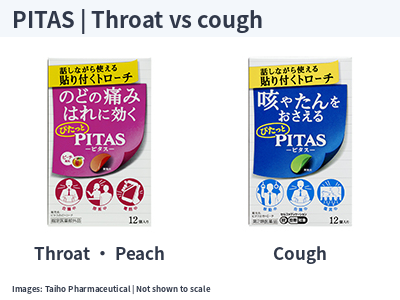
Choose the purpose before the flavour. PITAS Throat Troches in peach, orange and lychee share the same active ingredient and dose. The blue Cough Troches contain a cough suppressant and an expectorant, have different precautions, and must not be used before driving. All four are for ages 15 and over.

I'm Irene, a Taiwan-born pharmacist licensed in Japan and currently working in a Japanese drugstore. A small, sweet-tasting film can be easy to mistake for candy, so I want to help you spot the medicine distinction before you put PITAS in your travel bag.
Sources checked on 14 October 2026 (Japan time). This comparison covers PITAS Throat Troches, Throat Troches O, Throat Troches L and Cough Troches in Japan. Other PITAS products, such as Cool Troche S and Medical Troche, need their own labels.
Which type matches your reason for buying it?
- Throat pain, swelling, roughness, discomfort or hoarseness caused by throat inflammation: the three fruit-flavoured throat versions share these indications. They also list oral antisepsis and relief of bad breath.
- Cough or phlegm, with or without the listed throat symptoms: the cough version has those additional indications. Check other medicines and your plans to drive first.
- Under 15: none of these four is suitable under the Japanese directions.
- Difficulty breathing or severe symptoms worsening rapidly: seek immediate medical care.
Four variants at a glance
The table gives the labelled single dose and daily frequency for adults aged 15 and over. One troche is one dose, not six at once. Each pictured Japanese pack contains 12 troches. A designated quasi-drug is a Japanese regulatory category with specified uses and directions; it does not mean unlimited candy.
| Product / shelf name | Category and flavour | Labelled use at age 15+ |
|---|---|---|
| Throat Troches / ピタスのどトローチ | Designated quasi-drug; peach | 1 at a time, 4–6 times daily |
| Throat Troches O / ピタスのどトローチO | Designated quasi-drug; orange | 1 at a time, 4–6 times daily |
| Throat Troches L / ピタスのどトローチL | Designated quasi-drug; lychee | 1 at a time, 4–6 times daily |
| Cough Troches / ピタスせきトローチ | Class 2 OTC medicine | 1 at a time, 6 times daily; at least 2 hours apart |
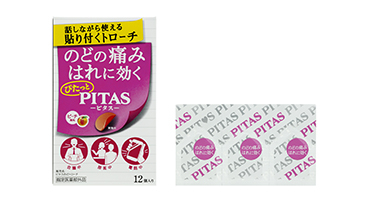
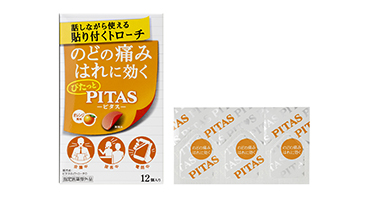
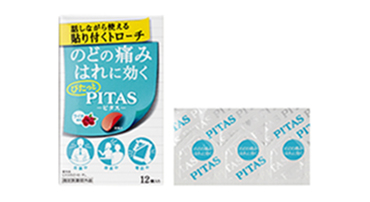
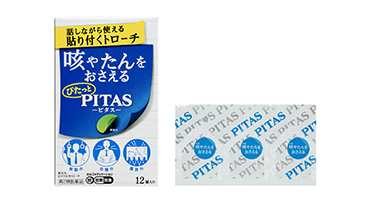
Same throat ingredient, different cough formula
Amounts below are the complete active ingredients per six troches. For ages 15+, six is the maximum labelled daily number for the throat versions and the labelled daily number for the cough version; it is not a single dose. Do not rank the products by the antiseptic amount alone.
| Formula | Active ingredients per 6 troches |
|---|---|
| Peach, orange and lychee throat versions | Cetylpyridinium chloride hydrate (CPC) 8.28 mg |
| Cough version | Dextromethorphan phenolphthalinate 60 mg; potassium guaiacolsulfonate 140 mg; cetylpyridinium chloride hydrate (CPC) 6 mg |
Among the three throat versions, flavour can guide the choice once the product is suitable for you. Their active formula and directions match, but flavourings and other additives differ. Someone with an allergy should check the exact pack rather than assume the three are identical in every ingredient. The throat products are described by Taiho as containing no drowsiness-causing ingredient; that statement must not be transferred to the cough version.
Let the film dissolve; do not chew or swallow it whole

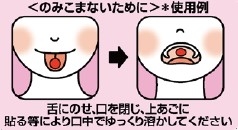
- Take out one troche when ready to use it; use promptly after opening the aluminium sachet.
- Place it in your mouth. The maker illustrates placing it on the tongue, closing the mouth and attaching it to the roof of the mouth to help avoid swallowing it.
- Let it dissolve slowly without chewing or swallowing it whole. Water is not needed. Do not apply it to a mouth ulcer as though it were an ulcer patch.
- Keep count of doses. For the cough version, leave at least two hours between them. Store unopened sachets in a cool, dry place away from sunlight and children; do not use after expiry.
The blue cough pack needs a medicine check
- Do not use if you have previously had an allergic reaction to this product or an ingredient.
- While using it, do not use other cough/expectorant medicines, cold medicines, sedatives, or oral medicines containing antihistamines, including some hay-fever, travel-sickness and allergy medicines. Ask a pharmacist to check your actual products.
- Do not drive or operate machinery after use: drowsiness can occur even though the medicine is a small film.
- Before use, consult if receiving medical treatment, pregnant or possibly pregnant, previously allergic to medicines, or experiencing high fever.
Different stop points matter
For the throat flavours, consult before use if under medical or dental treatment, pregnant or possibly pregnant, you or your family have an allergic tendency, or you have had a medicine allergy. Stop for rash, redness or itching, or if symptoms have not improved after one week. For the cough version, stop and consult if there is no improvement after 5–6 uses, not 5–6 days. Also stop for rash, itching, nausea, vomiting, appetite loss, dizziness, breathing difficulty or shortness of breath. Persistent or worsening drowsiness is another reason to stop and consult. Sudden hives, hoarseness, trouble breathing, palpitations or clouded consciousness after use can signal a serious allergic reaction: obtain urgent medical care.
For the fruit throat range, choose a suitable flavour after checking the label. Choose the cough medicine only when its purpose fits and its medicine restrictions fit your situation. Neither pack is a reason to keep suppressing symptoms that need a diagnosis.
Official sources and image credits
- Peach: Taiho product information and images; Japanese package label
- Orange: Taiho product information and images; Japanese package label
- Lychee: Taiho product information and images; Japanese package label
- Cough: Taiho product information and images; Japanese package label; Explanatory leaflet
- NHS: sore throat symptoms requiring immediate care