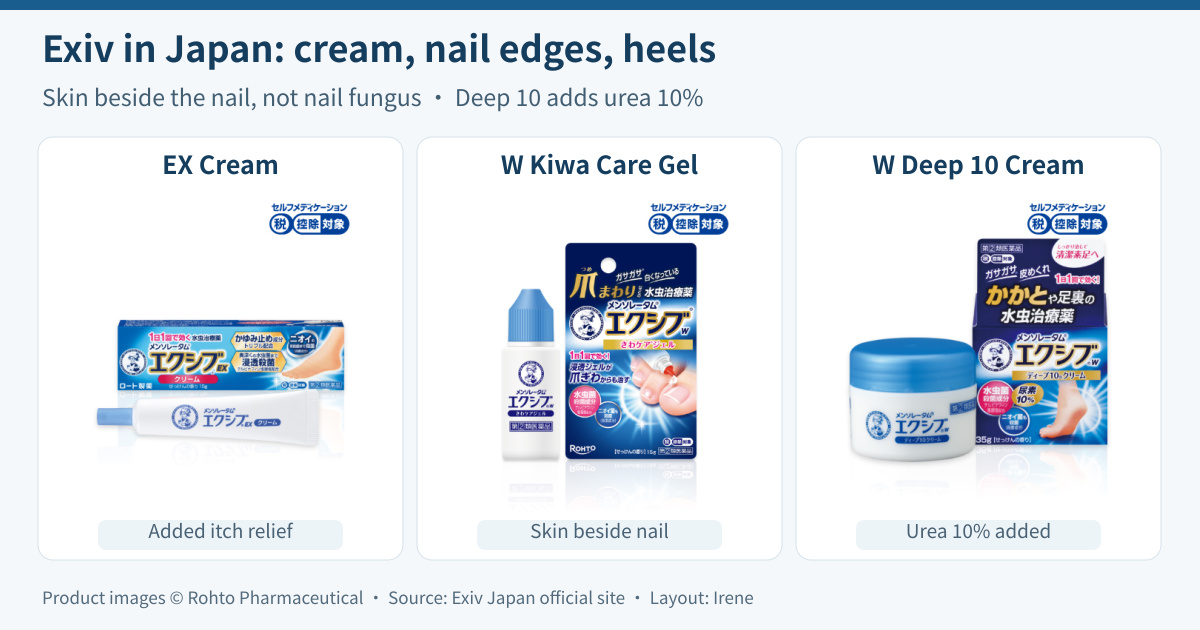
Start with the site and purpose: Exiv EX is a cream; W Kiwa Care Gel is designed for affected skin around a nail; W Deep 10 Cream adds urea 10% for thickened heel or sole skin affected by athlete’s foot. “Kiwa” does not make it a nail-fungus treatment, and “Deep 10” is not a reason to use an antifungal on every dry heel.

I’m Irene, a Taiwan-born, Japan-licensed pharmacist working in a Japanese drugstore. Let’s make the two easily misread labels, “around the nail” and “urea 10%”, useful when you compare the Japanese packs.
- For a skin fungal infection already identified as suitable for self-treatment, with a preference for cream: consider EX Cream, including for small areas such as between the toes. It contains antifungal and itch-relief ingredients, without urea.
- For affected skin beside a nail: W Kiwa Care Gel is the liquid-gel option designed around that site. A discoloured, thickened or crumbling nail itself needs medical assessment.
- For confirmed athlete’s foot involving thickened heel or sole skin: W Deep 10 adds urea to soften the outer skin layer. Roughness, peeling or dryness alone cannot confirm athlete’s foot.
Scope: Japan’s current メンソレータムエクシブEXクリーム, メンソレータムエクシブWきわケアジェル and メンソレータムエクシブWディープ10クリーム. All are designated Class 2 OTC medicines, a Japanese regulatory category, not an efficacy score. Checked 18 October 2026.
- Confirm the cause and condition of the skin first
- Match the full Japanese name and container
- Two label boundaries worth remembering
- The formulas differ, not just the texture
- Once daily: clean, dry, then apply to suitable skin
- Stop at two weeks without improvement; keep continuation advice separate
- Pregnancy, children and medical treatment: ask first
- Official sources and image credits
Confirm the cause and condition of the skin first
If you cannot distinguish eczema from a fungal infection, ask a doctor or pharmacist before choosing. Nail changes, pus, facial symptoms or a large affected area also need assessment. None of these three products may be used on eczema or severely weeping, eroded, cracked or injured skin. A cream’s marketing for moist athlete’s-foot skin does not override those exclusions.
Match the full Japanese name and container
This guide compares Japanese Mentholatum Exiv medicines. Keep the Japanese names when checking a shelf or an online listing: products sold under a familiar brand in another country can have different formulas and instructions.
EX Cream: メンソレータムエクシブEXクリーム, 15 g
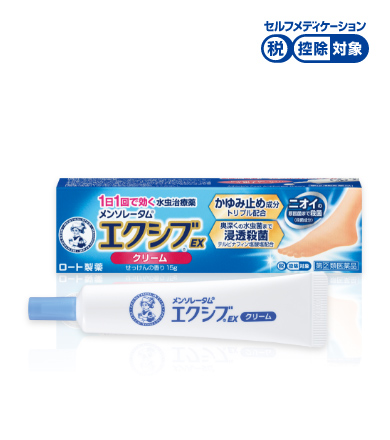
The narrow tube tip helps control application to small areas, such as between the toes. Rohto describes a non-sticky cream feel. There are three itch-relief actives alongside the antifungal, but no urea. This is a combination medicine rather than a single-antifungal-active formula.
W Kiwa Care Gel: メンソレータムエクシブWきわケアジェル, 15 g
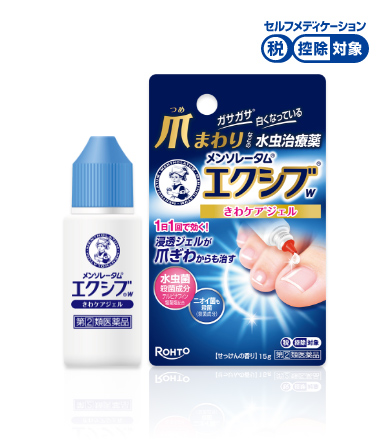
“Kiwa” means an edge or border. Here it refers to skin at the border of the nail, where the liquid gel is designed to reach an uneven surface. It is not a lacquer or solution for treating infection within the nail. The narrow nozzle is not an invitation to push medicine under the nail or into a wound or mucous membrane.
W Deep 10 Cream: メンソレータムエクシブWディープ10クリーム, 35 g
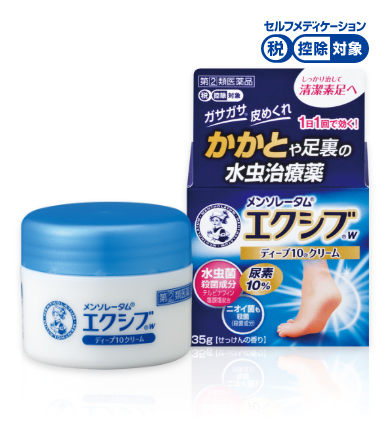
This formula combines antifungal treatment with urea 10%. Urea softens the thickened outer skin of heels or soles to help medicine reach the skin’s outer layer. The approved uses remain fungal skin infections. The 35 g on the jar is the pack size, not an application amount.
The current Japanese range also includes EX Liquid and EX Spray. They are outside this three-product comparison. If an older article shows “W Cream”, “W Liquid” or “W Spray”, do not assume it describes the current EX formula; match the full name and supplied leaflet.
Two label boundaries worth remembering
Skin beside a nail → confirm the skin condition
The Kiwa leaflet directs application to the skin at the nail border. A yellow, thickened or crumbling nail should be assessed by a doctor. The leaflet explicitly states that nail fungus needs appropriate treatment under a physician’s care. “Around the nail” does not extend this product’s role into the nail plate.
A rough heel → establish the purpose of treatment
Dryness and thickened skin can look similar to fungal skin changes. Deep 10 is a choice to discuss for confirmed athlete’s foot with thickened skin; an ordinary dry heel needs appropriate care for its actual cause. For a different use of urea, see the Ninocure a and Kurocure EX comparison. Those are 20% urea keratosis medicines without an antifungal active, so they are not substitutes for athlete’s-foot treatment.
The formulas differ, not just the texture
All amounts below are per 100 g of medicine, not per application. Each contains terbinafine hydrochloride 1 g, the antifungal; isopropylmethylphenol 1 g, an antibacterial ingredient; and lidocaine 2 g, a local anaesthetic used for itch relief. Their additional active ingredients are:
| Product | Other actives per 100 g | Urea per 100 g |
|---|---|---|
| EX Cream | Chlorpheniramine maleate 0.5 g Crotamiton 1 g Glycyrrhetinic acid 0.5 g | None |
| W Kiwa Care Gel | Diphenhydramine hydrochloride 1 g Glycyrrhetinic acid 0.1 g | None |
| W Deep 10 Cream | Diphenhydramine hydrochloride 1 g Glycyrrhetinic acid 0.1 g | 10 g (10%) |
EX uses chlorpheniramine, crotamiton and lidocaine for itch relief; the two W products use diphenhydramine and lidocaine. Glycyrrhetinic acid is an anti-inflammatory ingredient. None of the three active-ingredient lists contains a corticosteroid. The number of ingredients, “EX” and “10” do not establish a ranking of clinical benefit.
The bases differ too. EX Cream and W Kiwa Care Gel list ethanol; Deep 10’s additives do not. All three contain fragrance and are described as soap-scented. No ethanol does not mean no irritation, and no corticosteroid does not make a product suitable for any rash. Check the full active and inactive ingredient lists if you have allergies.
If your starting question is whether to choose one antifungal active or added symptom-relief actives, the Japanese Lamisil AT, Plus and DX comparison explains that separate choice. Comparing brands is not a reason to apply them together.
Once daily: clean, dry, then apply to suitable skin
- Check the site and exclusions. All three Japanese labels cover athlete’s foot, groin ringworm and body ringworm. Itch or dryness alone does not establish those diagnoses. Do not use on the eyes or surrounding skin, mucous membranes such as the mouth, nose or vagina, the scrotum or external genital area, including the vulva, eczema, or severely damaged skin described above.
- Keep it clean and dry thoroughly. The leaflets prohibit application while the affected skin or surroundings are dirty. After washing, gently dry between the toes too.
- Apply an appropriate amount once a day. The care guidance also includes surrounding affected-area skin, while avoiding every excluded site. Kiwa belongs on skin at the nail border. Do not scrape, dig or force the nozzle under a nail to make it “penetrate”.
- Wash your hands and close the container. Do not touch eyes or mucosa with medicine on your hands. If medicine gets into an eye, rinse immediately with water or lukewarm water and obtain eye care immediately.
The leaflets do not specify a universal number of grams, drops or centimetres per application. Do not add daily applications to chase faster itch relief. If different areas are affected or you already use another topical medicine, show the exact products to a pharmacist to plan their use rather than layering these three on the same spot.
Stop at two weeks without improvement; keep continuation advice separate
All three say to stop and consult if there is no improvement after about two weeks, or if symptoms worsen with use. Bring the leaflet to a doctor, pharmacist or registered medicine salesperson. Stop immediately for possible reactions such as contact dermatitis, irritation, burning, peeling, erosion, dryness or tightness, cracks, pain, pigmentation changes, rash/redness, itching, swelling or hives. Rash/redness, itching, swelling and hives can also be widespread. Do not wait for the two-week mark.
When treatment is appropriate and helping, disappearance of symptoms is not automatically the point to stop. The current leaflets are worded differently:
- EX Cream: continue treatment for about one month after symptoms appear to have cleared.
- W Kiwa Care Gel and W Deep 10 Cream: continue for a while after symptoms appear to have cleared; that paragraph does not give a fixed number of months.
- The brand FAQ: separately recommends about one to two months after symptoms disappear. This is broader manufacturer advice, not identical wording in all three leaflets.
Follow the leaflet in your pack and agree the appropriate continuing period with a pharmacist. Continuation advice does not override the stop-and-consult rule for no improvement or worsening. Do not substitute a shorter terbinafine course from another country’s label.
Pregnancy, children and medical treatment: ask first
Do not use a product that has previously caused you an allergic reaction, or one containing an ingredient to which you are allergic. All three leaflets require consultation before use if you are receiving medical treatment, pregnant or possibly pregnant; for infants and young children; with a history of allergic reactions to medicines or other substances; for facial or widespread symptoms, pus, or uncertainty between eczema and a fungal infection.
These leaflets do not provide one shared numerical minimum age. Children need an adult’s guidance and supervision, and infants or young children still require prior advice. There is no separate breastfeeding-specific instruction in these leaflets; ask about the exact product rather than interpreting the absence as unrestricted permission.
Store tightly closed in a cool place away from sunlight and children. Do not transfer to another container or use after expiry; use promptly after opening. Kiwa Gel additionally needs to be kept away from fire and off furniture or floors, as it can soften some synthetic resins or dissolve paint.
My shelf-side reminder: “爪まわり” points to skin around the nail, and “尿素10%” identifies Deep 10’s extra keratin-softening ingredient. Confirm the cause and permitted skin area, then choose the format and formula that fit.
Official sources and image credits
Japanese product information checked on 18 October 2026. Follow the leaflet supplied with the exact product you buy.
- Rohto: current Exiv product range
- EX Cream: Japanese product information and package image
- EX Cream: current Japanese leaflet (2 pages)
- W Kiwa Care Gel: Japanese product information and package image
- W Kiwa Care Gel: current Japanese leaflet (2 pages)
- W Deep 10 Cream: Japanese product information and package image
- W Deep 10 Cream: current Japanese leaflet (2 pages)
- Rohto Exiv FAQs: formats and continuing treatment
Complete package photographs: Rohto Pharmaceutical’s Japanese official website. The images identify products; they do not diagnose skin conditions.