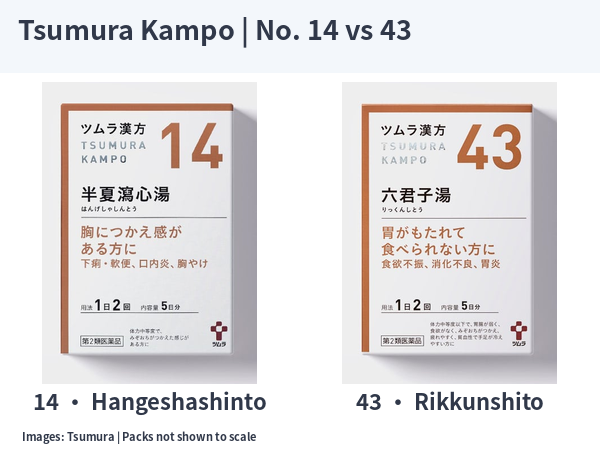
These two Tsumura OTC formulas are chosen by the whole labeled symptom pattern, not simply by “stomach medicine” or the box number. Hangeshashinto 14 includes a tendency to loose stools or diarrhea in its qualifying pattern; Rikkunshito 43 describes weak digestion, poor appetite and easy fatigue. Take that distinction to a pharmacist rather than diagnosing your own Kampo pattern.

I’m Irene, a Taiwan-born, Japan-licensed pharmacist working in a Japanese drugstore. Familiar Chinese formula names can feel reassuring, but the exact Japanese OTC product, dose and precautions still need checking. Let’s read these two boxes together.
Source check: 14 October 2026 (Japan time). This comparison concerns Tsumura’s Japanese OTC Hangeshashinto Extract Granules and Rikkunshito Extract Granules, both Class 2 OTC medicines. Always read the leaflet in your own pack.
Identify the OTC product first
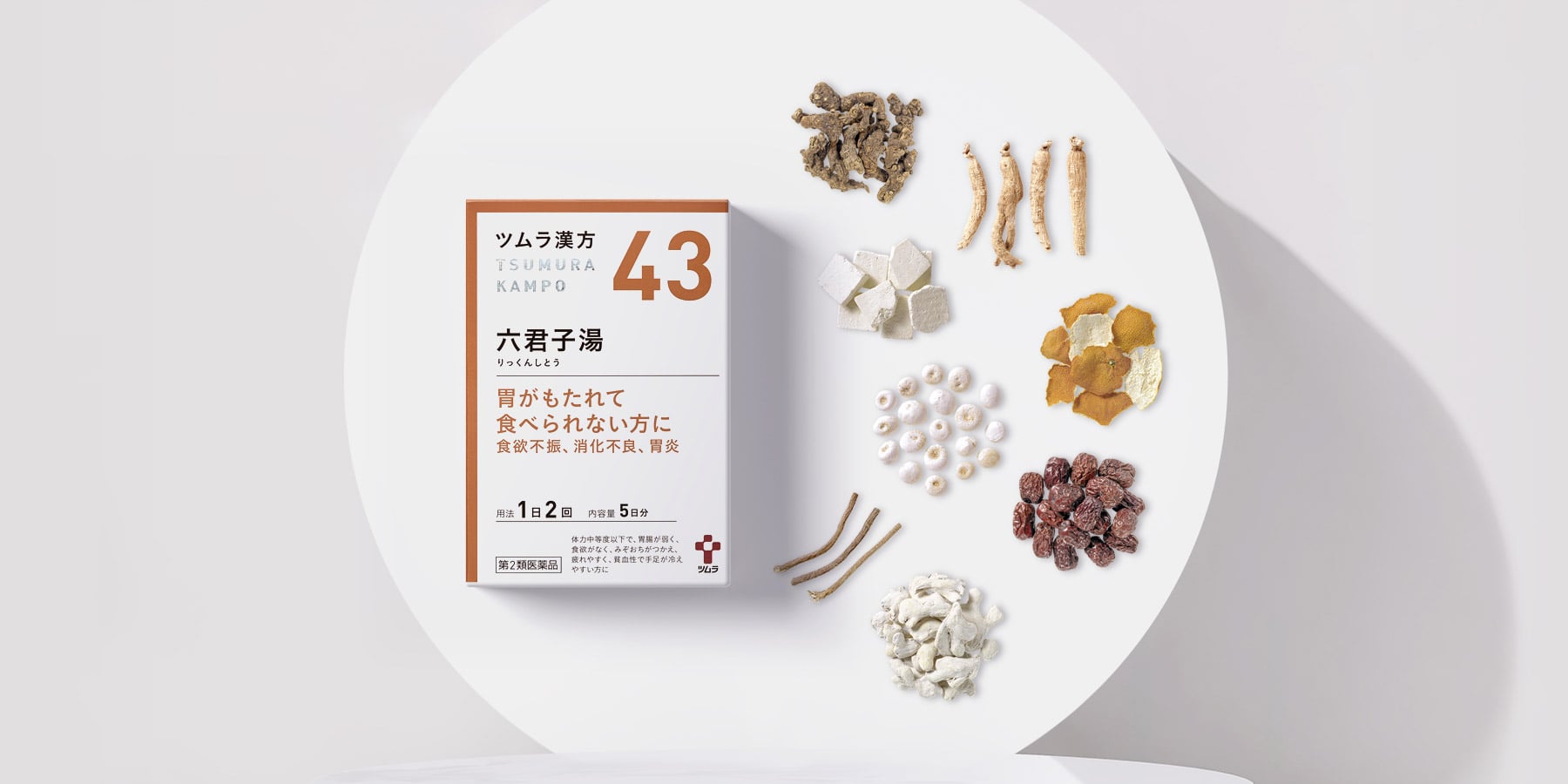
Look for ツムラ漢方半夏瀉心湯エキス顆粒 (Hangeshashinto, 14) or ツムラ漢方六君子湯エキス顆粒 (Rikkunshito, 43). Both current product pages show 10-sachet packs, equivalent to five adult days at the labeled dose. That is pack arithmetic, not a recommended treatment course.
Do not use prescription Tsumura instructions or another manufacturer’s sachet size for these OTC products. The label’s “half quantity” extract description is part of the formulation specification, not an instruction to double the dose.
Read the full qualifying pattern
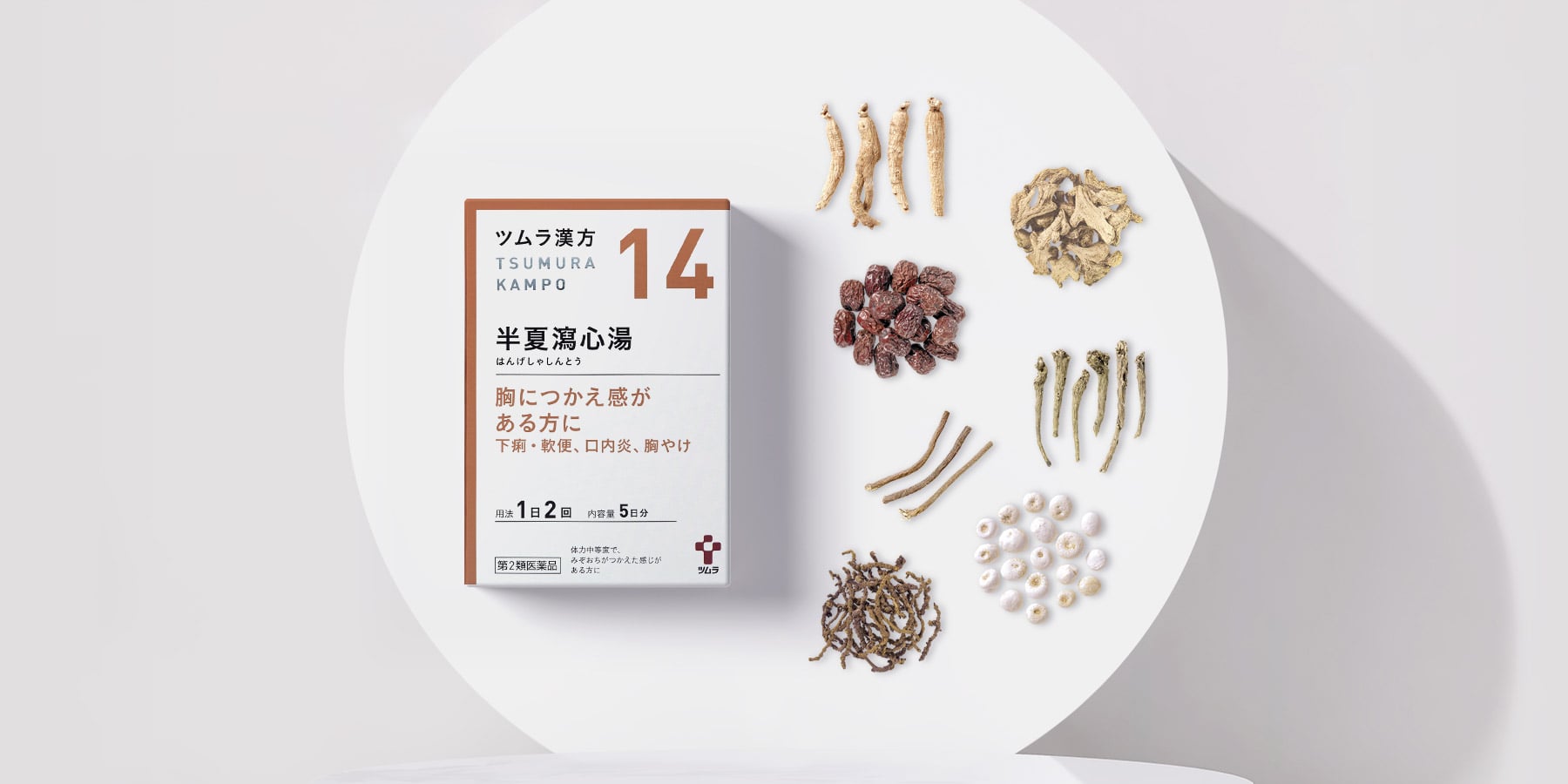
For Hangeshashinto 14, the label describes a person of moderate physical strength with a blocked/full feeling in the upper abdomen, sometimes nausea or vomiting, poor appetite, abdominal rumbling and a tendency to loose stools or diarrhea. Under that complete qualification, the indications are acute/chronic gastroenteritis, diarrhea/loose stools, indigestion, gastroptosis, nervous gastritis, weak stomach, hangover, belching, heartburn, stomatitis and neurosis.
For Rikkunshito 43, the label describes moderate or lower physical strength, weak digestion, poor appetite, a blocked/full feeling in the upper abdomen, easy fatigue, an anemic tendency and hands/feet that become cold easily. Under that complete qualification, the indications are gastritis, gastrointestinal weakness, gastroptosis, indigestion, poor appetite, stomach pain and vomiting.
These are translations of the approved product descriptions, not a checklist that confirms a diagnosis. “Anemic tendency” in the Kampo description does not make Rikkunshito an iron replacement or a treatment plan for diagnosed anemia. Likewise, a stomach symptom alone does not establish gastritis or gastroptosis. Ask a pharmacist whether self-care is appropriate.
The single-dose amounts below apply to both exact OTC products. Take twice daily before meals with water or warm water. The adult daily amount is two sachets, totaling 3.75 g of granules; one adult dose is 1.875 g. Children require adult supervision.
| Age | One dose, either product | Frequency |
|---|---|---|
| 15+ | 1 sachet (1.875 g) | Twice daily before meals |
| 7–14 | Two-thirds of a sachet | Twice daily before meals |
| 4–6 | Half a sachet | Twice daily before meals |
| 2–3 | One-third of a sachet | Twice daily before meals |
| Under 2 | Do not take | Not applicable |
Tsumura explains “before meals” as about 30 minutes before eating. Fold the opening of a divided sachet and use the remainder within two days. Keep it cool and dry, away from children. If measuring a child’s fraction reliably is difficult, ask a pharmacist rather than guessing.
The table lists the crude-herb quantities used for the labeled extract in the adult daily amount of two sachets (3.75 g of finished granules). Hangeshashinto contains 2.25 g of extract; Rikkunshito contains 2.0 g. The herb weights describe the extract’s source formula, so do not add them up and treat that sum as the weight of the finished dose.
| Crude herb in the labeled formula | Hangeshashinto 14 | Rikkunshito 43 |
|---|---|---|
| Pinellia tuber (hange) | 2.5 g | 2.0 g |
| Scutellaria root (ogon) | 1.25 g | Not included |
| Processed ginger (kankyo) | 1.25 g | Not included |
| Licorice (kanzo) | 1.25 g | 0.5 g |
| Jujube (taiso) | 1.25 g | 1.0 g |
| Ginseng (ninjin) | 1.25 g | 2.0 g |
| Coptis rhizome (oren) | 0.5 g | Not included |
| Atractylodes lancea rhizome (sojutsu) | Not included | 2.0 g |
| Poria sclerotium (bukuryo) | Not included | 2.0 g |
| Citrus unshiu peel (chinpi) | Not included | 1.0 g |
| Ginger (shokyo) | Not included | 0.25 g |
Both contain licorice, ginseng, pinellia and jujube. Do not combine the formulas yourself just because their symptom lists overlap. Show a pharmacist all Kampo, prescription and OTC medicines, including throat/cold products containing licorice or glycyrrhizin. The amount of licorice differs, but neither “herbal” nor a smaller amount proves a product is safe for everyone. Both also contain lactose hydrate among the inactive ingredients.
Who needs advice before taking them?
For both products, consult before use if receiving medical treatment, pregnant or possibly pregnant, or if medicines have previously caused rash, redness or itching. Hangeshashinto additionally lists older people, swelling, hypertension, heart disease and kidney disease. Its leaflet also requires consultation for prolonged use. Do not transfer a shorter warning list into a claim that Rikkunshito is safer for your condition.
These are the labels’ stop-and-consult thresholds when there is no improvement. They are not a reason to wait through severe or worsening symptoms.
| Product / use | No improvement: stop and consult |
|---|---|
| Hangeshashinto for acute gastroenteritis, hangover, belching or heartburn | After 5–6 doses |
| Hangeshashinto for its other labeled uses | After about one month |
| Rikkunshito | After about one month |
Stop either product for rash, redness or itching and seek advice. Both leaflets warn of rare liver dysfunction: yellowing of the skin/eyes, dark urine, fever, itching, marked tiredness or appetite loss need immediate medical care.
Hangeshashinto also warns of interstitial pneumonia and pseudoaldosteronism/myopathy. Sudden or persistent breathlessness, dry cough or fever, or worsening limb weakness, muscle pain, numbness or stiffness need immediate medical assessment. Keep the product and leaflet to show the clinician.
Sudden or severe abdominal pain, vomiting blood or coffee-ground material, or bloody/black sticky stool needs immediate medical care. Worsening, persistent or recurrent pain, difficulty swallowing or unexplained weight loss needs prompt assessment. These signs should not be managed by switching between the two formulas.
Irene’s practical takeaway
- Bring the exact OTC name or a clear photo, not only “number 14” or “43.”
- Describe your whole symptom picture, how long it has lasted and current medicines.
- Confirm suitability before choosing; then follow this product’s twice-daily, before-meal schedule.
- Keep the different stop rules in mind, particularly Hangeshashinto’s 5–6-dose rule for the specified acute symptoms.