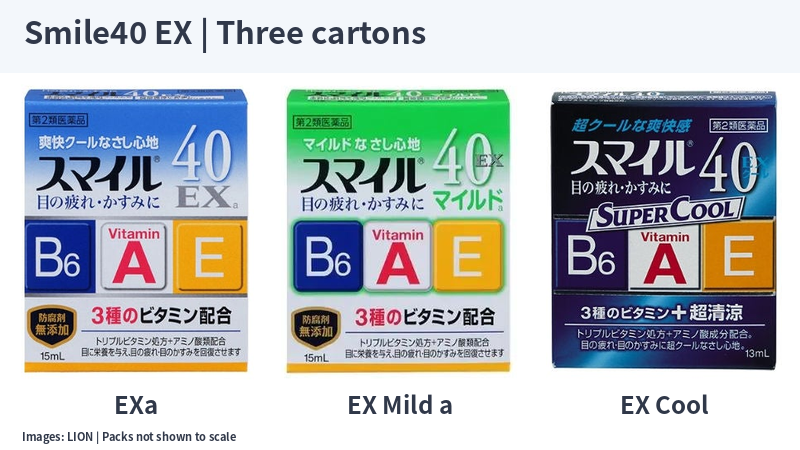
Smile40 EXa and EX Mild a share the same seven active ingredients and concentrations. EX Cool changes the vitamin A and B6 amounts as well as the cooling sensation, and it does not share the other two products’ preservative-free formulation. None of these three should be used while wearing soft contact lenses.

I'm Irene, a Taiwan-born pharmacist licensed in Japan, currently working in a Japanese drugstore. With these three bottles, I would check contact-lens use and the full formula before choosing a cooling level. A stronger cooling sensation is not a measure of better eye care.
Sources checked on 14 October 2026 (Japan time). This comparison covers the current Japanese Smile40 EXa, EX Mild a and EX Cool, all Class 2 OTC eye medicines. It does not cover Premium THE ONE or older products without the current suffixes.
A quick way to choose
- Want the mildest sensation among these three: EX Mild a has cooling level 2. “Mild” does not mean it is free of medicines or irritation risk.
- Prefer a cooler feel with the same active concentrations as Mild a: EXa has cooling level 5.
- Considering the strongest cooling sensation here: EX Cool is level 7, but check its different vitamins and preservatives rather than treating it as the same formula made colder.
- Need drops with soft lenses still in: none of these three fits that use.
Bottle size, cooling and preservatives
Cooling numbers are Lion’s sensation scale, not dose or clinical effectiveness. Bottle volumes below are package sizes. All three have the same labelled dose: 1–3 drops per use, 3–6 times daily. Children need adult supervision; no numerical minimum age is specified in these leaflets.
| Product / Japanese name | Bottle | Cooling level | Preservative distinction |
|---|---|---|---|
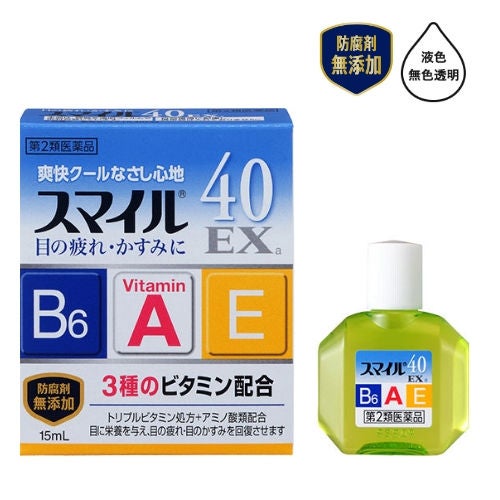
| EXa / スマイル40EXa | 15 mL | 5 | No added preservatives such as benzalkonium chloride |
| EX Mild a / スマイル40EXマイルドa | 15 mL | 2 | No added preservatives such as benzalkonium chloride |
| EX Cool / スマイル40EX クール | 13 mL | 7 | Contains benzalkonium chloride and chlorobutanol as additives |
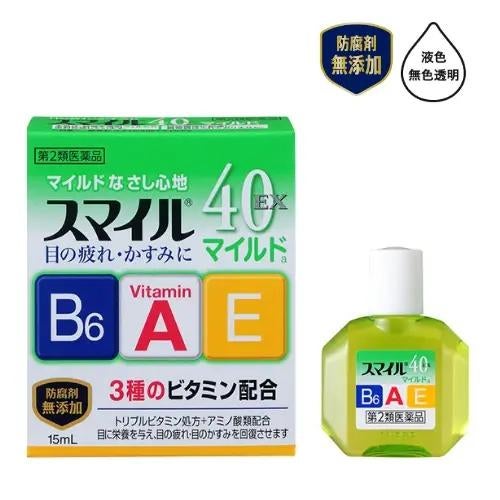
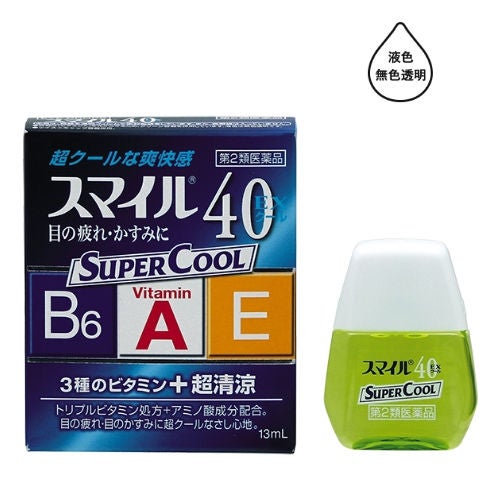
The vitamin A and B6 difference
Amounts below use the label basis of 100 mL of solution: vitamin A in units, all other actives in grams. They are concentrations, not contents per bottle, per drop or per day. Use the same 1–3 drops, 3–6 times daily directions above; higher concentration of one ingredient alone does not prove better overall results. Children require adult supervision; the leaflets specify no numerical minimum age.
| Active ingredient, per 100 mL | EXa and EX Mild a | EX Cool |
|---|---|---|
| Retinol palmitate (vitamin A) | 30,000 units | 10,000 units |
| d-alpha-Tocopheryl acetate (vitamin E) | 0.05 g | 0.05 g |
| Pyridoxine hydrochloride (vitamin B6) | 0.04 g | 0.08 g |
| Potassium L-aspartate | 1 g | 1 g |
| Tetrahydrozoline hydrochloride | 0.01 g | 0.01 g |
| Chlorpheniramine maleate | 0.03 g | 0.03 g |
| Neostigmine methylsulfate | 0.005 g | 0.005 g |
EXa and Mild a match in their active ingredients, but their additive lists are not identical: EXa also lists d-borneol. Mild a still contains menthol and camphor as additives. Cool has less vitamin A and more B6 on the same 100 mL basis. All three contain tetrahydrozoline for redness and chlorpheniramine for itching; they are medicated drops, not simply vitamin water.
Lion states that EXa and Mild a maintain preservation through its own formulation technology despite having no added preservatives such as benzalkonium chloride. They still require the normal hygiene, storage and expiry precautions. This claim does not extend to EX Cool: both its detailed product ingredient list and leaflet list benzalkonium chloride and chlorobutanol. Preservative-free also does not make EXa or Mild a suitable over soft lenses.
Contact lenses: hard and soft are different
All three list discomfort while wearing hard contact lenses among their uses. All three explicitly say not to use while wearing soft contact lenses, including soft coloured or circle lenses. Remove soft lenses before use. These leaflets do not give a reinsertion waiting time, so do not borrow a five- or fifteen-minute rule from another product; confirm the timing with a pharmacist and your lens instructions.
The labels cover tired eyes, blurred vision such as when there is excessive discharge, conjunctival redness, itching, eyelid inflammation, prevention of eye problems after swimming or exposure to dust or sweat, light-related eye inflammation such as snow blindness, and hard-lens discomfort. Persistent blur is specifically a reason to stop and consult; the product name does not turn unexplained vision changes into a self-care diagnosis.
Does “40” mean you must be over 40?
The reviewed labels do not set a 40-year age cutoff or any other numerical minimum. They instruct adult supervision when used by children. That is not a blanket recommendation for infants or every child: confirm suitability using the child’s age, symptoms and exact product rather than choosing Mild a just because it sounds gentle.
Use carefully, even when the bottle feels refreshing
- Check suitability and remove soft contact lenses. If under medical treatment, with a medicine-allergy history, severe eye pain or diagnosed glaucoma, consult before use.
- Use 1–3 drops at a time, 3–6 times daily. Do not exceed the directions: excessive use can cause unusual glare sensitivity or worsen redness.
- Point the tip downward without touching the eye, eyelid or eyelashes. Do not share the bottle or use cloudy solution.
- Stop promptly for skin rash, redness or itching, or eye redness, itching, swelling or painful stinging. Take the leaflet when seeking advice.
If blurred vision does not improve, stop and consult. For other symptoms, all three specify stopping and consulting if there is no improvement after 5–6 days. This is a reassessment point, not a reason to keep treating severe pain while waiting for day six.
Close tightly and keep cool, away from sunlight and children. Do not leave the drops in places at 40°C or above, such as a hot car or near a heater. Keep the original container, never use after expiry, and use promptly after opening; these leaflets do not promise a fixed number of safe months after opening. For EXa and Mild a, discard the oxygen absorber after opening the transparent outer film.
This is the basic EX family. For the separate Premium THE ONE Mild, Cool and Cool MAX products, see my Smile40 Premium THE ONE comparison. Do not carry doses, ingredients or cooling labels between the two families without checking the exact bottle.