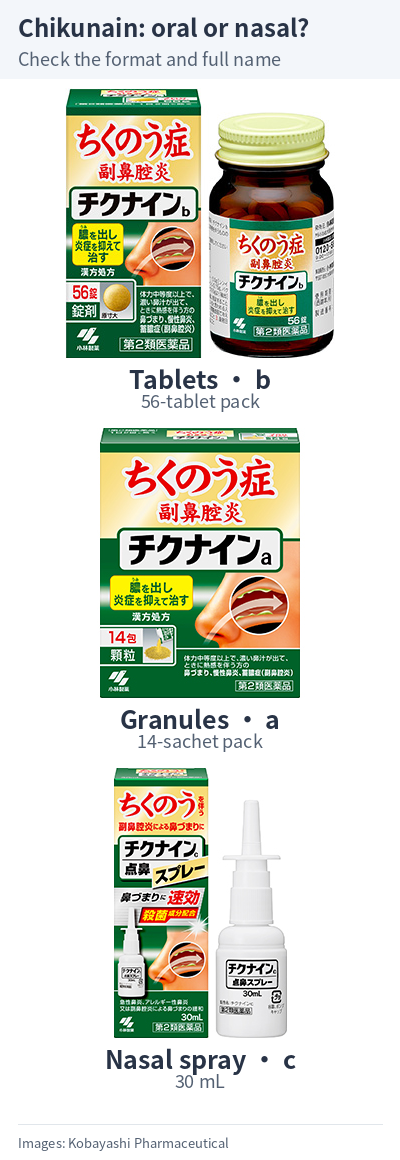
Chikunain tablets and granules contain the same Kampo formula. The nasal spray contains a different set of medicines, has a different minimum age and needs a much earlier review if it does not help. Start by checking whether the box says 錠剤, 顆粒 or 点鼻スプレー, rather than choosing by the green packaging alone.

Hi, I’m Irene, a Taiwan-born pharmacist licensed in Japan and working in a Japanese drugstore. I’ll help you read the Japanese labels and understand when a blocked nose needs medical advice. You can read more about me here.
Checked against the current Japanese manufacturer pages and linked labels on October 15, 2026. This is general medicine information, not a diagnosis or a personalized prescription.
First, decide whether self-care is appropriate
Seek medical advice promptly if you feel very unwell, symptoms are worsening or pain relief is not helping. A weakened immune system also warrants earlier assessment. Recurrent symptoms or symptoms affecting only one side deserve a medical review. Do not wait for a medicine’s normal review deadline in these situations.
Sinusitis is often associated with a viral infection. A green box, thick discharge or the word “sinusitis” does not establish that an antibiotic is needed. These OTC products do not replace assessment of persistent or severe symptoms.
Which Chikunain is which?
| Product on the box | Exact sales name | What it contains | Minimum labeled age |
|---|---|---|---|
| Tablets, 錠剤 | チクナインb | Shini-seihaito (辛夷清肺湯) Kampo extract | 5 years |
| Granules, 顆粒 | チクナインa | The same Kampo formula | 2 years |
| Nasal spray, 点鼻スプレー | チクナインc | Five ingredients including naphazoline | 7 years |
All three are Japanese Class 2 OTC medicines. Current listed pack sizes are 56, 112 and 224 tablets; 14 and 28 granule sachets; and a 30 mL spray. The brand also sells a nasal-washing product, which is outside this medicine comparison.
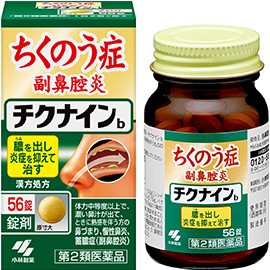
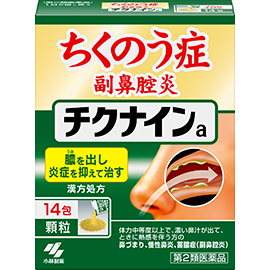
Tablets and granules: same formula, different age bands
Both oral products are labeled for blocked nose, chronic rhinitis and sinusitis in people with moderate or better physical strength, thick nasal discharge and sometimes a sensation of heat. That qualification matters: this is not a recommendation for every runny nose or every person with allergies.
The adult daily amount, eight tablets or two sachets, contains 2.0 g of Shini-seihaito extract. Two sachets contain 4.0 g of granules in total; that is the weight of the formulation, not 4.0 g of extract. The extract comes from the same nine crude drugs in both products. Do not add the tablet and granule doses together because they look different.
Oral dose per administration
Take the following amount twice daily, morning and evening, before meals or between meals, with water or warm water. “Between meals” means around two to three hours after eating, not while eating.
| Age | Tablets per dose | Granules per dose |
|---|---|---|
| 15 years and older | 4 tablets | 1 sachet |
| 7–14 years | 3 tablets | 2/3 sachet |
| 5–6 years | 2 tablets | 1/2 sachet |
| 4 years | Do not take | 1/2 sachet |
| 2–3 years | Do not take | 1/3 sachet |
| Under 2 years | Do not take | Do not take |
Children need adult guidance and supervision. A smaller child’s granule dose does not make the tablets suitable below their labeled age.
Check before taking an oral product
Ask a doctor, pharmacist or registered seller first if you are receiving medical treatment, pregnant or possibly pregnant, physically frail, or have weak digestion and tend to feel cold. Show them your other medicines and supplements so overlapping formulas can be checked. The exact labels do not give a separate breastfeeding instruction; that is not a guarantee of suitability while breastfeeding.
Stop and seek advice if loss of appetite or stomach discomfort develops. Rare but serious problems include:
- Interstitial pneumonia: new or persistent shortness of breath, dry cough or fever.
- Liver dysfunction: yellow skin or eyes, dark urine, unusual fatigue, loss of appetite, itching or rash.
- Mesenteric phlebosclerosis with long-term use: repeated abdominal pain, diarrhea, constipation or bloating.
Stop and obtain medical assessment promptly for these warning signs. If there is no improvement after about one month, stop and consult. Consult before continued long-term use even if symptoms improve; “herbal” does not mean suitable for indefinite use.
The spray: a different medicine for symptom relief
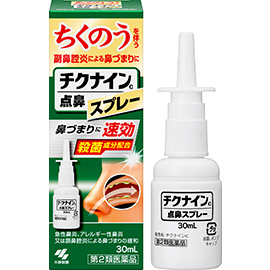
Chikunain c is labeled for relief of blocked nose, runny nose, sneezing and a heavy-headed feeling associated with acute rhinitis, allergic rhinitis or sinusitis. It is not the oral Kampo formula delivered through the nose.
| Active ingredient | Amount per 100 mL | Label-described role |
|---|---|---|
| Naphazoline hydrochloride | 0.05 g | Constricts nasal blood vessels to reduce swelling |
| Chlorpheniramine maleate | 0.5 g | Relieves runny and blocked nose |
| Lidocaine | 0.5 g | Relieves nasal pain and itching |
| Dipotassium glycyrrhizate | 0.3 g | Calms inflammation |
| Benzalkonium chloride | 0.02 g | Suppresses bacterial growth on nasal mucosa |
The last ingredient does not establish that this spray cures a bacterial sinus infection. It is also not a saline rinse.
How to use the spray
For adults and children aged seven and older: spray once or twice into each nostril per application, one to five applications a day. Leave at least three hours between applications. Children under seven must not use it; supervise older children.
- Gently blow your nose.
- Remove the cap. Before first use, press repeatedly until liquid sprays out.
- Keep the bottle upright, insert the nozzle lightly and spray once or twice. Repeat in the other nostril.
- Wipe the part that touches the nose with tissue and close the cap firmly.
Do not use it sideways, poke a blocked nozzle with a needle, share the bottle or use it anywhere other than the nose. Excessive use can make congestion worse. Do not use continuously for a long period. If symptoms have not improved after about three days, stop and consult.
Who needs advice before using the spray?
Do not use it if you have previously had an allergic reaction to this product or an ingredient. Consult first if you are receiving medical treatment, pregnant or possibly pregnant, have a history of medicine allergy, or have hypertension, heart disease, diabetes, thyroid dysfunction or glaucoma. Ask individually about breastfeeding and any other nasal medicines.
Stop and seek advice for rash, redness, itching, nasal swelling or irritation. Trouble breathing, hives, hoarseness, palpitations or impaired consciousness soon after use can indicate a severe allergic reaction: obtain immediate medical attention.
Storage and practical choices
Keep all products in their original containers, out of children’s reach, in a cool, dry place away from direct sunlight, and do not use them after expiry.
- Tablets: close the bottle promptly and tightly; avoid wet hands. Remove the transport packing when opening the bottle.
- Granules: after using part of a sachet, fold the opening at least twice. Use the remainder that day or discard it. The granules list lactose as an additive; ask about an ingredient restriction rather than assuming all formats are interchangeable.
- Spray: close the cap firmly after wiping the nozzle and never share it.
For an eligible adult choosing between tablets and granules, swallowing preference may be the practical difference. For a child, the exact age band comes first. For someone seeking a nasal spray, the three-day review point and health-condition cautions are more useful than a promise of stronger relief.
If you are comparing another nasal-spray brand, my NAZAL guide explains its separate products. Do not transfer its doses or combine sprays without a pharmacist checking the ingredients.