
I'm Irene, a Taiwanese-born, Japanese-licensed pharmacist working in a Japanese drugstore. Lamisil is a familiar name in many countries, but the Japanese shelf has its own formulas and instructions. Here is how I would make the choices easier to read.
Start with these three distinctions
For a skin fungal infection suitable for OTC treatment, AT is the single-active-ingredient option. Plus adds itch-relief ingredients, and its cream also contains urea. DX is a cream with the same listed active ingredients and concentrations as Plus cream, with packaging that emphasizes groin/body ringworm. It is not a stronger concentration of antifungal medicine.
Then choose the vehicle: creams spread into a thin layer; liquids have a quick-drying feel and a direct-contact applicator. The manufacturer positions liquids for dry, flaky affected skin. Severe weeping, erosion, cracking or injury is a reason not to use any of these products, even if a cream is described as suitable for a mildly moist type of athlete's foot.
Itch alone does not establish a fungal infection. If you are unsure whether this is eczema or ringworm, get advice before buying. Nail or scalp symptoms are outside this skin-product comparison and should be assessed separately.
Recognize Japan's current five products
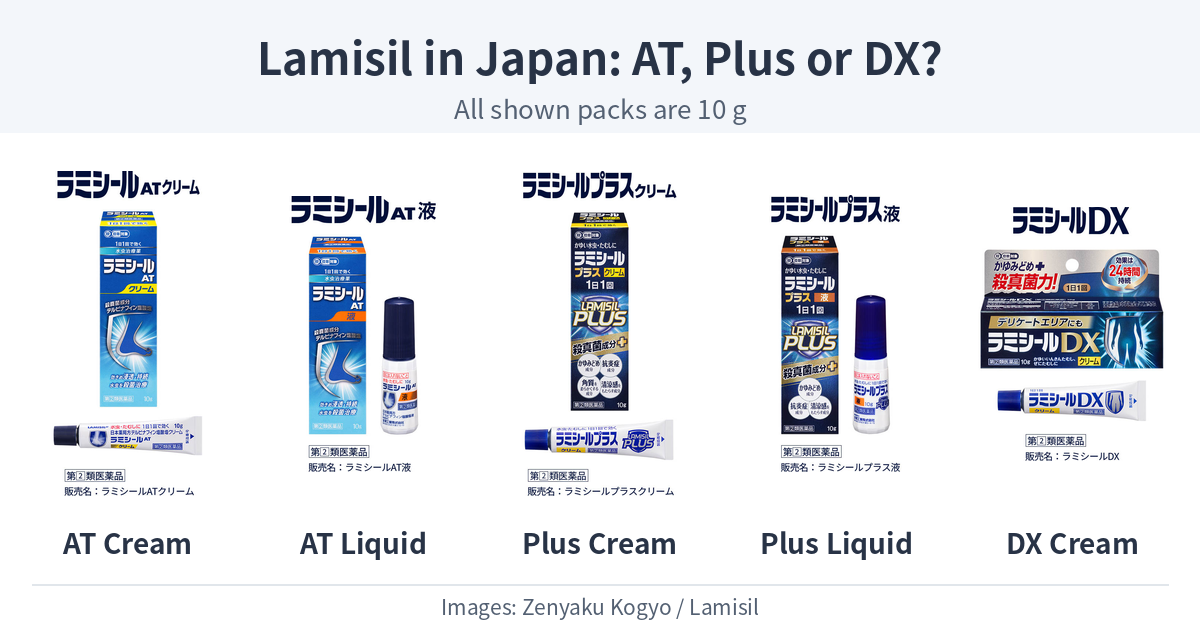
Zenyaku's Japanese catalog currently lists five Class 2 OTC products, all in 10 g packs, including the liquids. Older Haleon/GSK packaging may appear in older articles; use the exact name and the leaflet supplied with your purchase.
AT cream: one active ingredient
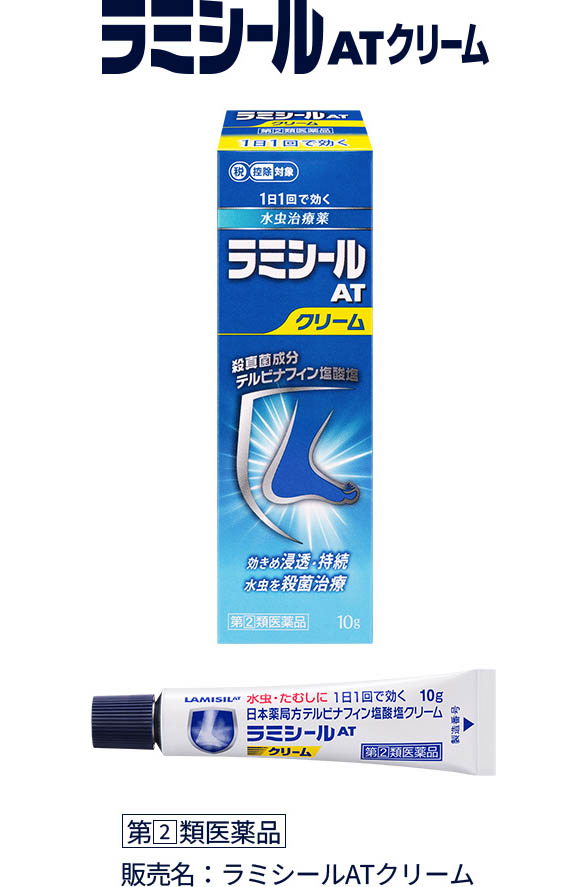
ラミシールATクリーム contains terbinafine hydrochloride, without the added crotamiton, glycyrrhetinic acid, menthol or urea found in the combination creams. Zenyaku describes a non-sticky cream feel. This is the clearest starting point when your choice is a cream with just the antifungal active ingredient. It still contains additives and can cause irritation or allergy.
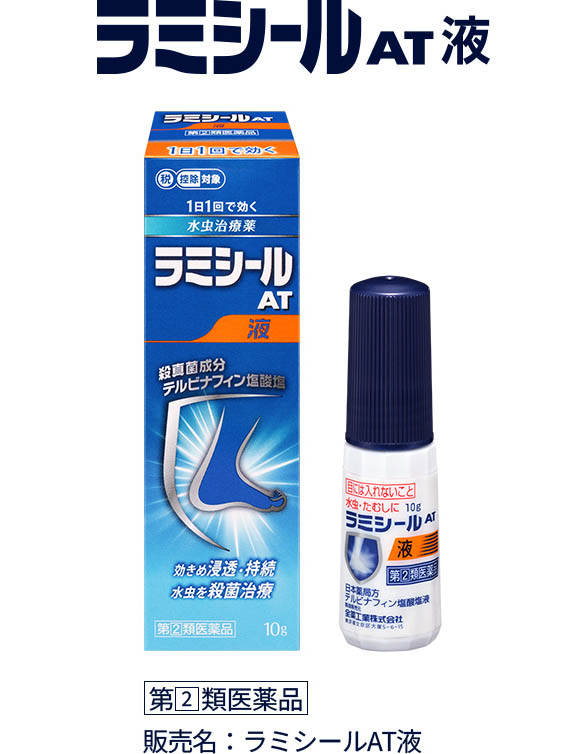
AT liquid: the single-active formula in a different vehicle
ラミシールAT液 also contains only terbinafine hydrochloride as its active ingredient. It is an alcohol-containing liquid, positioned for dry, flaky affected skin. The applicator is pressed gently against the skin; it is not a spray. The same concentration does not make its feel identical to the cream.
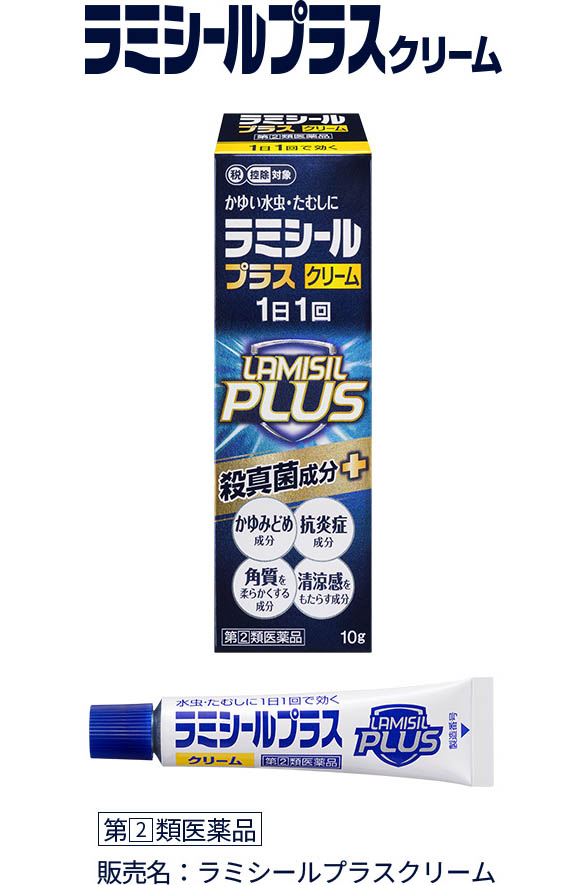
Plus cream: itch relief and urea
ラミシールプラスクリーム combines terbinafine with crotamiton, glycyrrhetinic acid and l-menthol for associated itching/inflammation, plus urea for dry, thickened skin. The menthol gives a cooling sensation. Urea is not a reason to treat deeply cracked or injured skin, which the leaflet excludes.
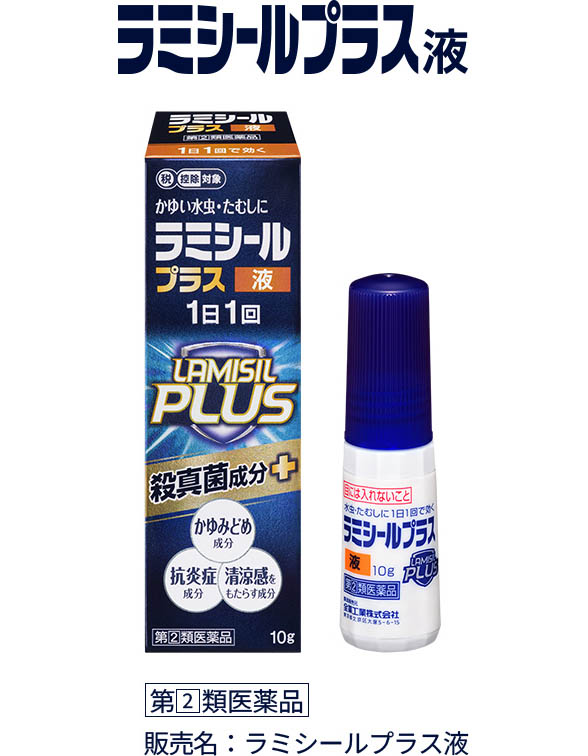
Plus liquid: cooling formula, without urea
ラミシールプラス液 has the same three added symptom-relief ingredients as Plus cream, but no urea. It contains ethanol and has a quick-drying feel. Choose it for an appropriate dry-skin condition and preferred application format, not because the cooling sensation proves stronger fungal treatment.
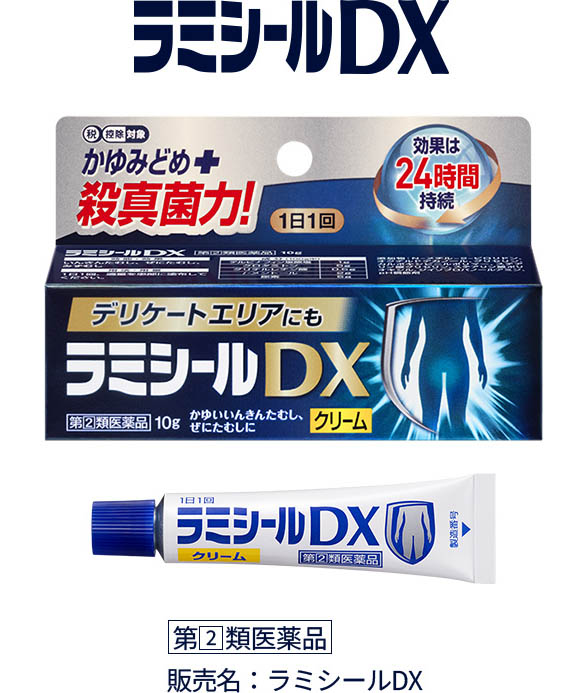
DX: check the permitted site carefully
ラミシールDX has the same active concentrations and listed additives as Plus cream. Its approved indications cover groin ringworm, body ringworm and athlete's foot; the other four list the same three conditions in a different order.
The marketing emphasis on a “delicate area” does not override the leaflet: do not apply DX or the other products to the scrotum, vulva, mucous membranes, eyes or around the eyes. Groin-ringworm treatment is not permission to put it anywhere on the genitals. An unexplained genital rash needs assessment.
Compare the ingredients on one basis
Below, all amounts are expressed per 100 g of medicine, not per application. AT's leaflet uses 10 mg per 1 g, which equals 1 g per 100 g. This is a comparison of concentration, not proof that all vehicles have identical effects.
| Product | Terbinafine hydrochloride per 100 g | Other active ingredients per 100 g |
|---|---|---|
| AT cream | 1 g | None |
| AT liquid | 1 g | None |
| Plus cream | 1 g | Crotamiton 5 g; glycyrrhetinic acid 0.5 g; l-menthol 2 g; urea 5 g |
| Plus liquid | 1 g | Crotamiton 5 g; glycyrrhetinic acid 0.5 g; l-menthol 2 g |
| DX cream | 1 g | Crotamiton 5 g; glycyrrhetinic acid 0.5 g; l-menthol 2 g; urea 5 g |
The antifungal ingredient is terbinafine hydrochloride. The extra ingredients address associated symptoms or skin texture; more ingredients are not automatically better for you. For allergies, read the complete additives list too.
Use once daily, with the correct applicator
- Wash the affected skin and surrounding area, then dry it well. Do not apply to dirty skin.
- Apply an appropriate amount once daily. For cream, spread a thin layer over the affected skin and its surrounding area, avoiding prohibited sites.
- For either liquid, first point the applicator upward and press its tip with a finger to release air. Then turn it downward or diagonally and press lightly against the affected skin to apply. This helps avoid excess liquid caused by pressure in the bottle.
- Wash your hands afterward. Do not touch eyes or mucosa with medicine on your hands. If it enters an eye, rinse with water or lukewarm water and obtain eye care immediately.

The cream tubes are opened using the point on the reversed cap, as shown in their leaflets. Close all containers tightly; keep liquids upright. Store cool, away from sunlight and children, without transferring containers or using expired medicine. Keep liquids away from fire, never burn their containers, and avoid spills on furniture or plastics, which they can damage.
Two weeks without improvement is a stop-and-consult point
For all five products, stop and consult if there is no improvement after about two weeks, or if symptoms worsen. Stop sooner for possible reactions such as irritation, burning, peeling, erosion, dryness/tightness, cracks, pain, pigmentation changes, rash, redness, itching, swelling or hives. Bring the leaflet.
Separately, the Japanese leaflets advise continuing for about one month after symptoms such as itching disappear. That advice applies when treatment is appropriate and improving; it is not permission to keep treating an unchanged or worsening rash for a month. Avoid importing a shorter treatment course from an overseas Lamisil label.
Who should ask before using it?
Do not use a product that previously caused an allergy, or if you are allergic to its ingredients. Do not use on eczema or severely wet, eroded, cracked or injured skin, or the prohibited body sites above.
The five leaflets require prior consultation if you are under a doctor's care, pregnant or possibly pregnant, using it for an infant/young child, have a history of medicine allergies, have facial or widespread symptoms, pus, or an uncertain diagnosis. They do not give a single numerical minimum age; children need adult supervision. No breastfeeding-specific rule is stated in these leaflets, so check the exact product with a professional rather than assuming unrestricted use.
If you have diabetes, speak with your treating clinician about foot symptoms. Medical assessment is also important with a weakened immune system, severe pain, or a hot, painful, red foot or leg. This general safety advice is supported by NHS guidance; it does not replace the Japanese product instructions.
My shelf-side recap
AT for one antifungal active; Plus for added symptom relief; cream versus liquid for a suitable vehicle. DX shares Plus cream's listed formula, so the name alone does not justify choosing it as stronger. Confirm the diagnosis and body site first, use the Japanese schedule, and reassess promptly if it is not helping.
Sources
Japanese product information checked October 15, 2026.