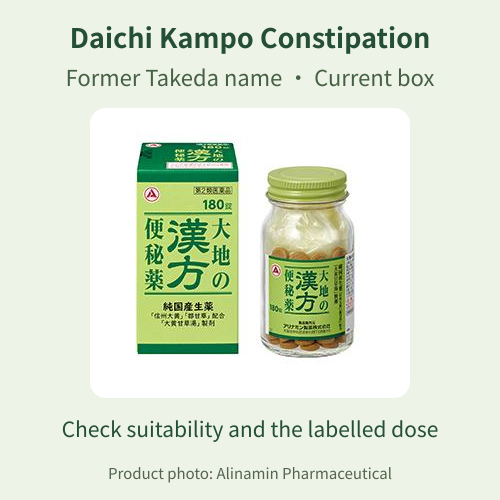
Looking for Takeda Kampo constipation tablets? The current Japanese product is Daichi no Kampo Benpiyaku (大地の漢方便秘薬). Match that full name on the green box. It contains Daiokanzoto, a rhubarb-and-licorice Kampo formula, and has scored tablets for dose adjustment. “Herbal” does not mean non-stimulant or suitable for a daily preventive routine.

I’m Irene, a Taiwan-born, Japan-licensed pharmacist working in a Japanese drugstore. An old shopping screenshot can make a familiar medicine hard to find. Let’s connect the old name to today’s box, then check the dose and the point at which self-treatment should stop.
Checked: 19 October 2026. Japanese-market Class 2 OTC medicine.
From Takeda to Daichi: what actually changed?
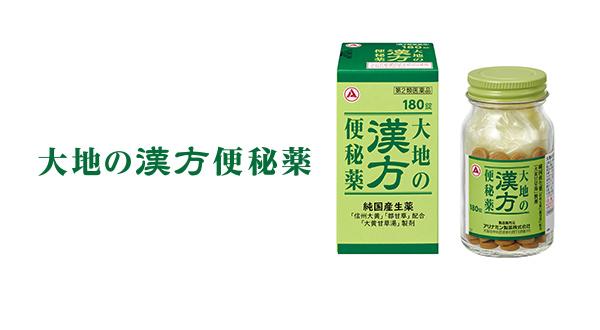
The manufacturer identifies タケダ漢方便秘薬 (Takeda Kampo constipation medicine) as the previous product and 大地の漢方便秘薬 as its renewal. The formula remains Daiokanzoto and the manufacturer says the directions are unchanged, but the renewed product uses its Japanese-grown Miyako licorice. It is more accurate to describe a product renewal than to say only the name changed.
The current range lists 65-, 120- and 180-tablet bottles; the photo shows 180 tablets. A larger bottle is not a stronger version or an instruction to keep taking it until it is empty. Check the leaflet supplied with your own pack.
Four tablets, the maximum daily amount for ages 15+, contain 800 mg of Daiokanzoto extract powder, extracted from 1,067 mg of rhubarb and 267 mg of licorice. These are amounts for four tablets, not for one tablet and not the starting dose. The formula promotes movement of the large bowel. It is not a bacteria-only intestinal regulator or a magnesium oxide laxative.
Its uses include constipation and relief of symptoms accompanying constipation, such as bloating. The associated skin-symptom wording is not an indication to take it for unrelated acne or as a “detox.”
The dose depends on both age and the labelled constipation category
Take one dose daily at bedtime, with water or warm water, without chewing. Start at the lowest amount in the applicable range. The leaflet separates two categories as follows; days without a bowel movement alone do not override the warning signs above.
Label: mild constipation
2–3 days without a bowel movement
- Ages 15+: 1–3 tablets per dose. First dose: 1 tablet.
- Ages 5–14: ½–1½ tablets per dose. First dose: ½ tablet.
Label: stubborn constipation
4 or more days without a bowel movement
- Ages 15+: 2–4 tablets per dose. First dose: 2 tablets.
- Ages 5–14: 1–2 tablets per dose. First dose: 1 tablet.
Under 5: do not use. Children require a parent or guardian’s supervision. The leaflet also says to keep the dose lower for people who are physically weakened and during menstruation; physically frail people should consult before use. Ask a pharmacist if you are unsure which range applies.
What the score line lets you do

Adjust by ½ or 1 tablet at a time, according to bowel movements, without exceeding the maximum for your age and category. This means adjusting a later scheduled dose, not taking extra doses during the same day. The official leaflet shows the tablet placed score-side up on the rounded back of a spoon, then pressing both sides to split it. Ask a pharmacist to demonstrate if splitting is difficult; do not estimate a half from crumbled pieces.
Package and tablet images: Alinamin Pharmaceutical. Original Japanese packaging retained; images are not to scale.
The manufacturer gives an approximate onset of 8–10 hours, with individual variation. That is not a promise of a bowel movement before your train or flight. Lack of an immediate effect is not a reason for an extra morning dose.
Before use: check other medicines, pregnancy and breastfeeding
- Do not take other laxatives while using this product. This includes another brand bought for the same problem. If prescribed treatment is not working, ask the prescriber before adding or replacing it.
- Breastfeeding: the leaflet says not to take this medicine, or to avoid breastfeeding while taking it. Arrange an individual plan with a clinician or pharmacist before use rather than guessing when to restart feeding.
- Consult first if receiving medical treatment, pregnant or possibly pregnant, physically frail, prone to diarrhoea with a weak stomach, or experiencing severe abdominal pain, nausea or vomiting.
Bring a list or photos of all medicines, Kampo formulas and supplements. Point out any rhubarb (大黄/ダイオウ) or licorice (甘草/カンゾウ) elsewhere in the list so the pharmacist can check overlap. Different brand names do not establish compatibility. This ingredient check is additional practical advice, not a substitute for the leaflet’s prohibition on other laxatives.
5–6 days without improvement is a stop point
- Stop immediately and seek advice if a rash, diarrhoea with severe abdominal pain, abdominal pain, nausea or vomiting appears after taking it. Bring the leaflet.
- Diarrhoea can occur; stop and consult if it persists or worsens.
- No improvement after 5–6 days: stop and consult a doctor, pharmacist or registered medicine seller.
- Continuous use for one month or longer requires consultation. This does not mean you should keep self-treating for a month when symptoms are not improving.
The manufacturer’s Q&A advises avoiding daily use. Once bowel movements improve, stop and observe for about 2–3 days. Repeatedly needing a laxative, or needing to increase the dose, is a reason to review the situation with a professional rather than make it a nightly travel habit.
Keep the bottle, and write down when you opened it
Store tightly closed in a cool, dry place away from direct sunlight and children. Do not transfer to another container. Discard the packing material inside the bottle after first opening, and tighten the cap after every use. Write the opening date on the box and bottle. The leaflet advises using it promptly, with six months after opening as a guide; never use it past the printed expiry date. This is a storage limit, not a six-month treatment course.
Rhubarb can make urine orange to reddish, and natural ingredients can cause slight variation in tablet colour. If you suspect bleeding or have other symptoms, seek advice rather than assuming a colour change is harmless.
What if you meant a different constipation medicine?
Use the travel constipation guide for everyday adjustments and when to seek help. If comparing shelves, the COLAC and COLAC II guide covers different bisacodyl formulas, the magnesium oxide comparison covers three separate products, and the WithOne guide explains its fiber-containing laxatives. Their tablet or sachet directions cannot be transferred to Daichi.
Sources and scope
Follow the complete leaflet supplied with your Japanese product. This guide does not replace individual medical advice.