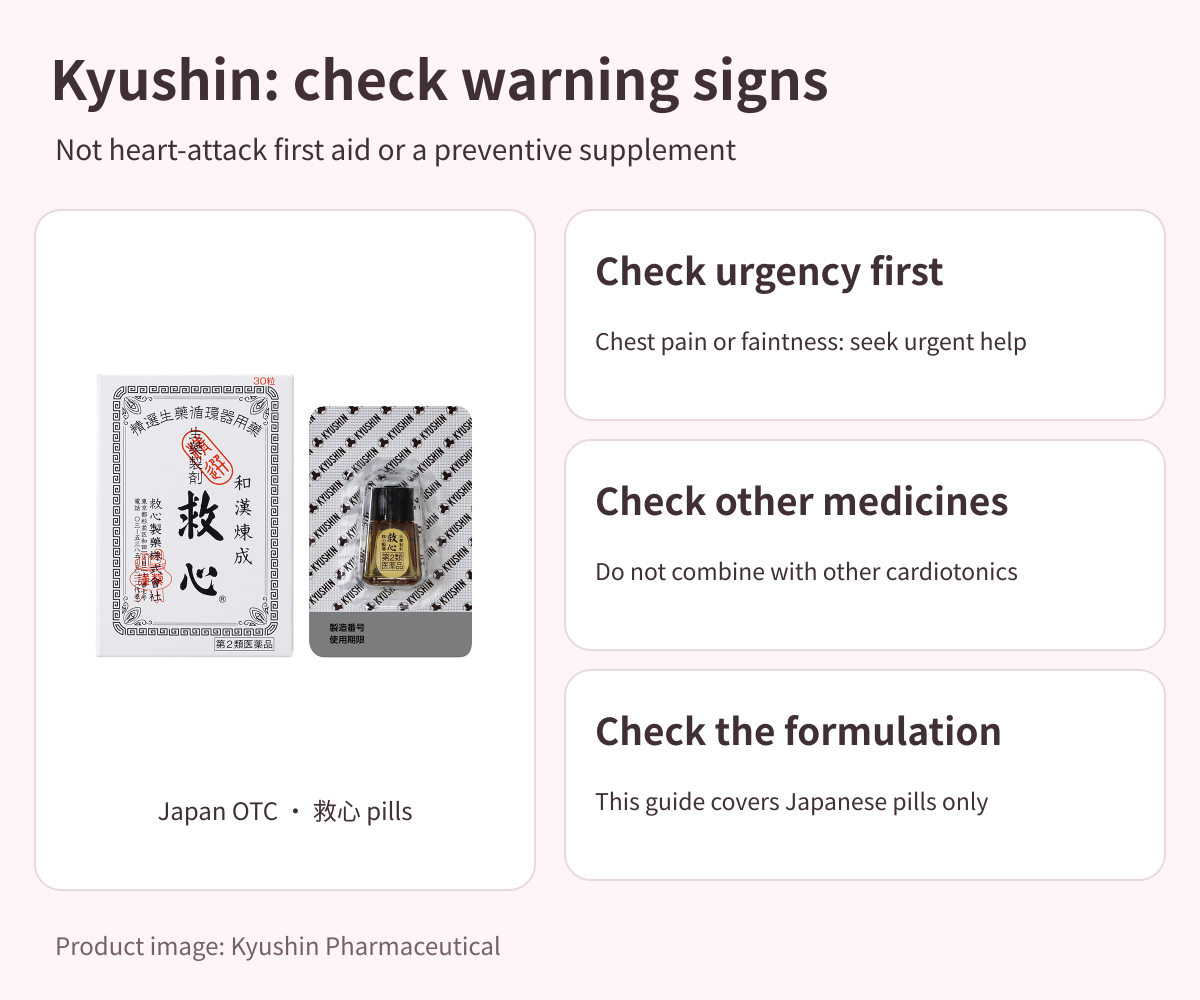
Japan’s Kyushin (救心) is not an emergency treatment for a heart attack or a supplement for preventing heart disease. Palpitations, breathlessness and dizziness need a safety check before a medicine-shopping decision.

I’m Irene, a Taiwanese pharmacist licensed in Japan and working in a Japanese drugstore. This is a label-based safety checklist, not a diagnosis, prescription or hands-on review.
Checked October 22, 2026 (Japan time). Scope: Japan’s OTC dark-brown Kyushin pills only—not Kyushin tablets, capsules or similarly named overseas products.
Warning signs come before dosing
Get emergency help for palpitations that do not go away, or palpitations with chest pain, shortness of breath, feeling faint or fainting. In Japan, call 119. Do not drive yourself. If these symptoms have stopped, still seek an urgent medical appointment.
Sudden breathing difficulty, chest pressure lasting several minutes, sudden dizziness so severe you cannot stand unaided, altered consciousness, or sudden one-sided weakness or speech difficulty also warrant an ambulance.
Arrange medical assessment if palpitations recur, become more frequent, last longer than a few minutes, or you have a heart condition or family history of heart problems—even if you currently feel well. Do not assume tiredness, stress or age explains the symptoms. This article cannot diagnose their cause.
Identify the exact product
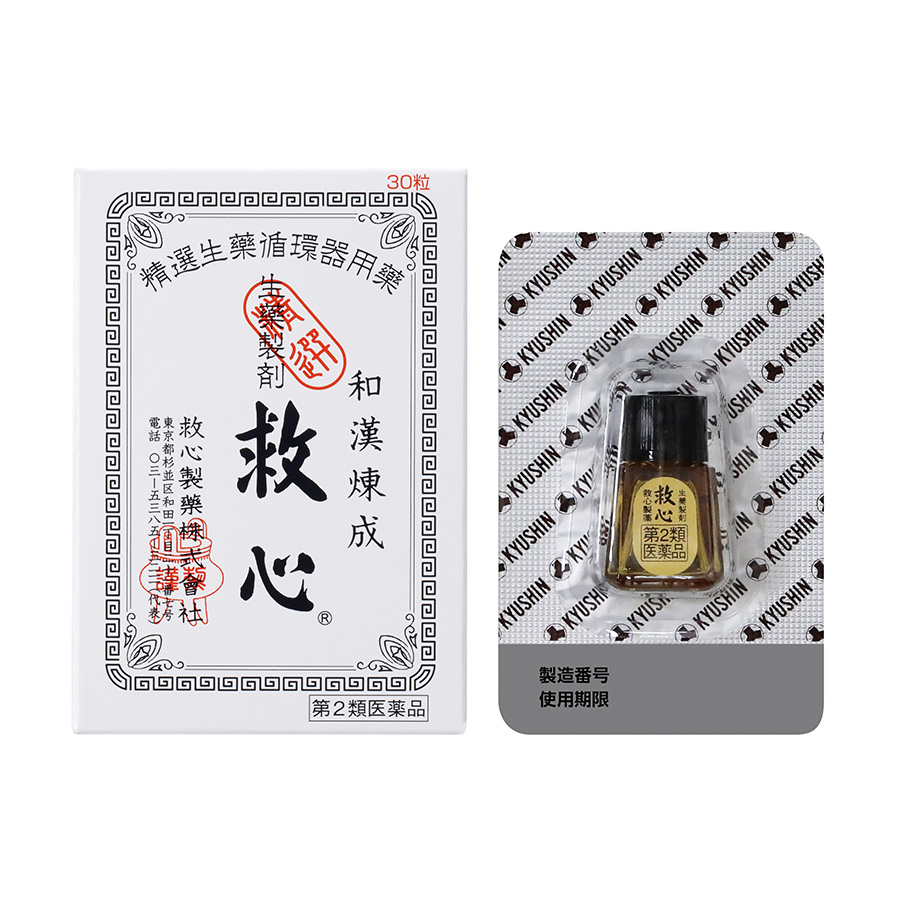
Kyushin is a Japanese Class 2 OTC medicine containing nine animal- and plant-derived crude drugs. Its labelled indications are palpitations, shortness of breath and “kitsuke” (気つけ), a Japanese label term covering situations such as dizziness or lightheadedness on standing. This wording does not identify the cause of dizziness or authorize treatment of an unconscious person.
The name is not an emergency-care promise. Heart-attack treatment and prevention of cardiovascular events are not indications in this insert. It must not replace prescribed heart medicines or emergency treatment.
Check medicines and consultation requirements first
- Do not use under age 15.
- Do not take other cardiotonic medicines while using Kyushin. The manufacturer’s FAQ specifically advises avoiding digitalis medicines (digoxin or methyldigoxin) and other senso (蟾酥)-containing products, such as Rokushingan (六神丸). Do not stop prescribed treatment to switch to Kyushin.
- The insert requires advice from a doctor, pharmacist or registered medicine seller before use if you are receiving medical treatment, pregnant or possibly pregnant.
Show the professional all prescription medicines, OTC products, traditional medicines and supplements. Also mention breastfeeding, allergies and other health concerns. This is additional consultation preparation, not a claim that the insert lists these as contraindications or that unlisted combinations are safe.
Only if suitable: two pills, three times daily
Age 15 and over: two pills per dose, three times daily—in the morning, evening and at bedtime—with water or warm water. Swallow the pills without chewing or holding them in your mouth or under your tongue. Chewing or holding them this way may temporarily numb your mouth or tongue. Do not substitute the one-tablet or one-capsule directions of another formulation, or increase the dose yourself.
When to stop: five to six days, not doses
- Stop immediately and take the leaflet to a doctor, pharmacist or registered medicine seller if rash, redness, itching, nausea or vomiting develops after use.
- Stop and consult with the leaflet if symptoms do not improve after five to six days. This does not mean waiting six days is safe: warning signs, worsening symptoms or recurring episodes take priority.
Keep tightly closed in the original container, somewhere cool and dry away from sunlight and children. Do not transfer to another container or use after expiry.
Bring a short consultation checklist
- When symptoms started, how long episodes last, and whether chest pain, breathlessness or fainting occurs.
- Existing illnesses, pregnancy possibility and allergies.
- All medicines and supplements, ideally their packs or photographs.
- The exact product name, formulation, leaflet and expiry date.
Urgent-care check → medicine and consultation check → pill directions. A matching symptom word on a label is not enough to decide that a medicine is appropriate for you.