“Stomach pain” on a box does not mean every abdominal pain is suitable for self-treatment. Japan’s OTC Buscopan A (ブスコパンA錠) is a gastrointestinal antispasmodic. Check for urgent symptoms first, medicines and precautions second, and dosing last.

I’m Irene, a Taiwanese pharmacist licensed in Japan and working in a Japanese drugstore. This guide turns the Japanese label into a discussion checklist—not a diagnosis, personal prescription or hands-on product review.
Official information checked: October 22, 2026. Scope: Japanese OTC ブスコパンA錠 only, not overseas Buscopan products or prescription versions.
- First: do you need medical help rather than a stomach medicine?
- Identify the Japanese OTC product—not just the brand
- Separate “do not use” from “ask before use”
- If suitable: one tablet, at least four hours apart, no more than three doses daily
- What changes after a dose mean you should stop?
- A pharmacy checklist is more useful than asking for the “strongest” box
- Official sources and image
First: do you need medical help rather than a stomach medicine?
Sudden severe abdominal pain, continuing severe pain, vomiting blood or blood in the stool: do not try a stomach medicine first. Japan’s Fire and Disaster Management Agency lists these as reasons to call an ambulance. In Japan, call 119.
Pain when your abdomen is touched, coffee-ground-like vomit, black sticky stools, inability to urinate or to pass stool or gas, breathing difficulty, chest pain or collapse also need emergency medical help. Do not drive yourself to emergency care.
Get prompt medical advice for pain that worsens, persists or keeps returning, or abdominal pain during pregnancy. A “cramping” description cannot establish the cause. Do not wait to reach a leaflet’s dose count when you need medical assessment.
Identify the Japanese OTC product—not just the brand
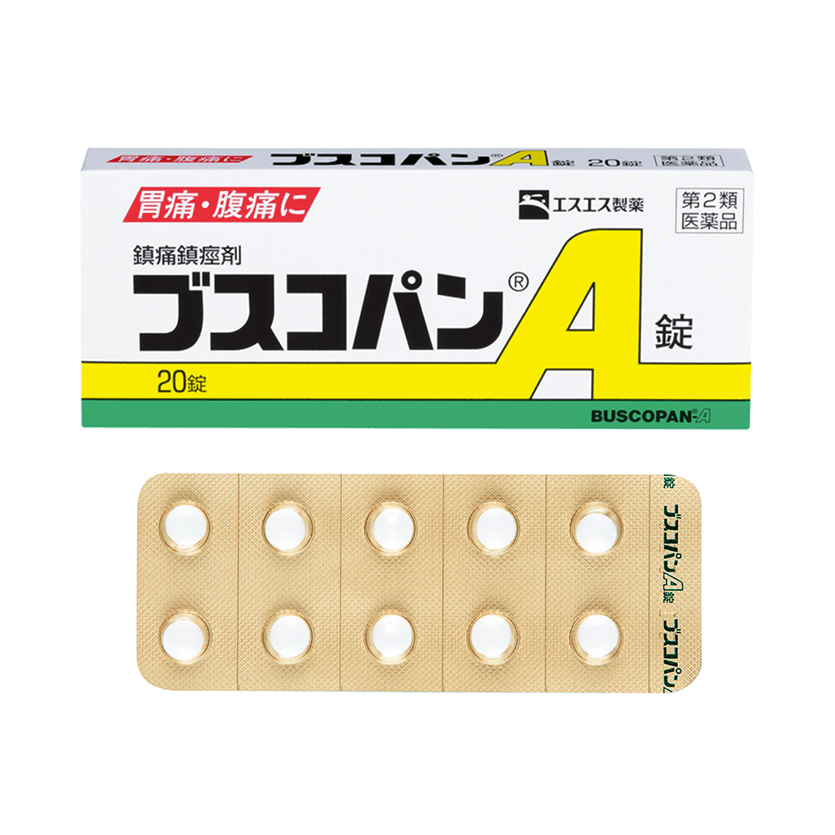
This is a Japanese Class 2 OTC medicine, containing 10 mg scopolamine butylbromide (ブチルスコポラミン臭化物) per tablet. Its Japanese labelled indications are stomach pain, abdominal pain, colicky pain (さしこみ/疝痛・癪), excess stomach acid and heartburn. That list does not diagnose the cause of pain.
“Stomach medicine” is an everyday umbrella term, not proof that products share ingredients, suit the same problem or can be combined. This guide does not treat Buscopan A as an antidiarrhoeal, digestive supplement or universal abdominal-pain remedy. Do not borrow doses from prescription or overseas versions: check the full name, ingredients and leaflet together.
Separate “do not use” from “ask before use”
- Do not take it if you have had an allergic reaction to this product or its ingredients. Children under 15 must not take it.
- Do not combine it with other gastrointestinal pain-relieving antispasmodics, other stomach medicines containing scopolia extract (ロートエキス), or motion-sickness medicines while taking it. Different brand names do not establish compatibility.
- Consult a doctor, pharmacist or registered OTC medicine seller before use if you are receiving medical treatment, pregnant or possibly pregnant, an older adult, have a history of allergic reactions to medicines or other substances, have difficulty urinating, or have diagnosed heart disease or glaucoma.
These are deliberately different categories. Also disclose breastfeeding, other conditions and all medicines you take; absence from this short checklist is not confirmation of safety.
A travel-planning issue: after taking it, do not drive vehicles or operate machinery. Blurred vision or abnormal sensitivity to light may occur. The four-hour interval below separates doses; it is not clearance to drive after four hours.
If suitable: one tablet, at least four hours apart, no more than three doses daily
- Ages 15 and over: one tablet per dose, with water or lukewarm water.
- Maximum three doses per day, at least four hours apart. Persistent pain is not a reason to double a dose or take the next dose early.
- The manufacturer’s FAQ says to take it when symptoms such as stomach pain occur—not as a routine daily wellness supplement.
- Remove the tablet from its blister first. Never swallow the blister packaging.
If symptoms have not improved after five or six doses, stop and consult a doctor, pharmacist or registered OTC medicine seller with the leaflet. This means doses, not five or six days, and does not mean you must finish that many doses. Worsening pain or warning signs require earlier help.
What changes after a dose mean you should stop?
Stop immediately and seek professional advice for a rash, redness, itching, headache, difficulty urinating, facial flushing or abnormal light sensitivity. Stop and consult if dry mouth, constipation or blurred vision persists or worsens.
Rarely, a severe allergic reaction can occur. Rapidly developing hives, hoarseness, an itchy throat, breathing difficulty, palpitations or clouded consciousness after a dose require immediate medical attention. Call 119 for an emergency in Japan. Do not mistake these changes for the original stomach problem and keep dosing.
A pharmacy checklist is more useful than asking for the “strongest” box
- Explain when and where the pain started, whether it is worsening, and any fever, vomiting, diarrhoea or bleeding.
- Give your age, pregnancy or breastfeeding status, medical conditions and allergy history. Show all medicines or photos of their labels—including motion-sickness and other stomach medicines.
- Say if you need to drive. Ask whether this exact Japanese OTC product fits the situation, rather than asking only for a brand.
Keep the original pack and leaflet. Store away from sunlight in a cool, dry place out of children’s reach; do not transfer to another container or use after expiry. This is general label-reading and care-seeking guidance, not a substitute for individual medical assessment. Read the full leaflet supplied with your pack.
Official sources and image
- SSP Japan: Buscopan A product page — current Japanese product, ingredient, dosing and image.
- Official package insert, version 72 (PDF) — prohibitions, consultation and stop-use rules, storage.
- SSP Buscopan A FAQ — timing, pregnancy and driving.
- Japan FDMA: Guide for Ambulance Services (Japanese/English PDF) — emergency abdominal symptoms and 119.
- NHS: Stomach ache — care-seeking warning signs; emergency phone numbers depend on your location.
The full official product image is uncut and unredrawn, not evidence of a hands-on test. Packaging may change.