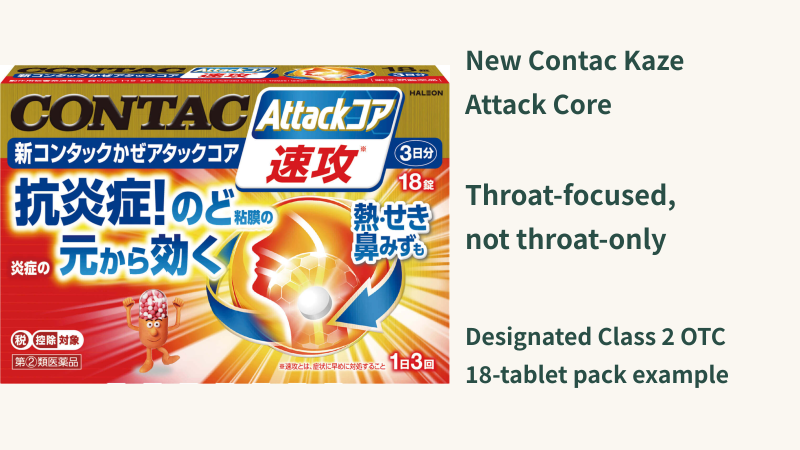
A throat-focused box does not mean a throat-only medicine. New Contac Kaze Attack Core, launched in Japan on 3 August 2026, is a combination cold medicine indicated for 11 cold symptoms. Reading its inflammation-focused message means distinguishing reducing inflammation and relieving symptoms from eliminating the cause of an infection. “New” alone does not establish greater effectiveness.
This is a Japanese Designated Class 2 OTC medicine. Using the current Japanese 18-tablet packaging and leaflet, this guide separates seven ingredient roles, a single dose from a daily total, and the situations in which you must not wait until the box is finished.
- Identify Core: its dosing is not shared across the brand
- Acting on inflammation is not the same as eliminating a virus
- Seven ingredients mean different jobs, not seven times the effect
- Cough-specific and combination cold medicines are not two boxes to add together
- Two tablets per dose, three times a day—not six tablets at once
- Who must not take it, and who needs advice first?
- Five or six doses and five days are different limits
- Keep the identifying information after taking it home
- Official sources
Identify Core: its dosing is not shared across the brand
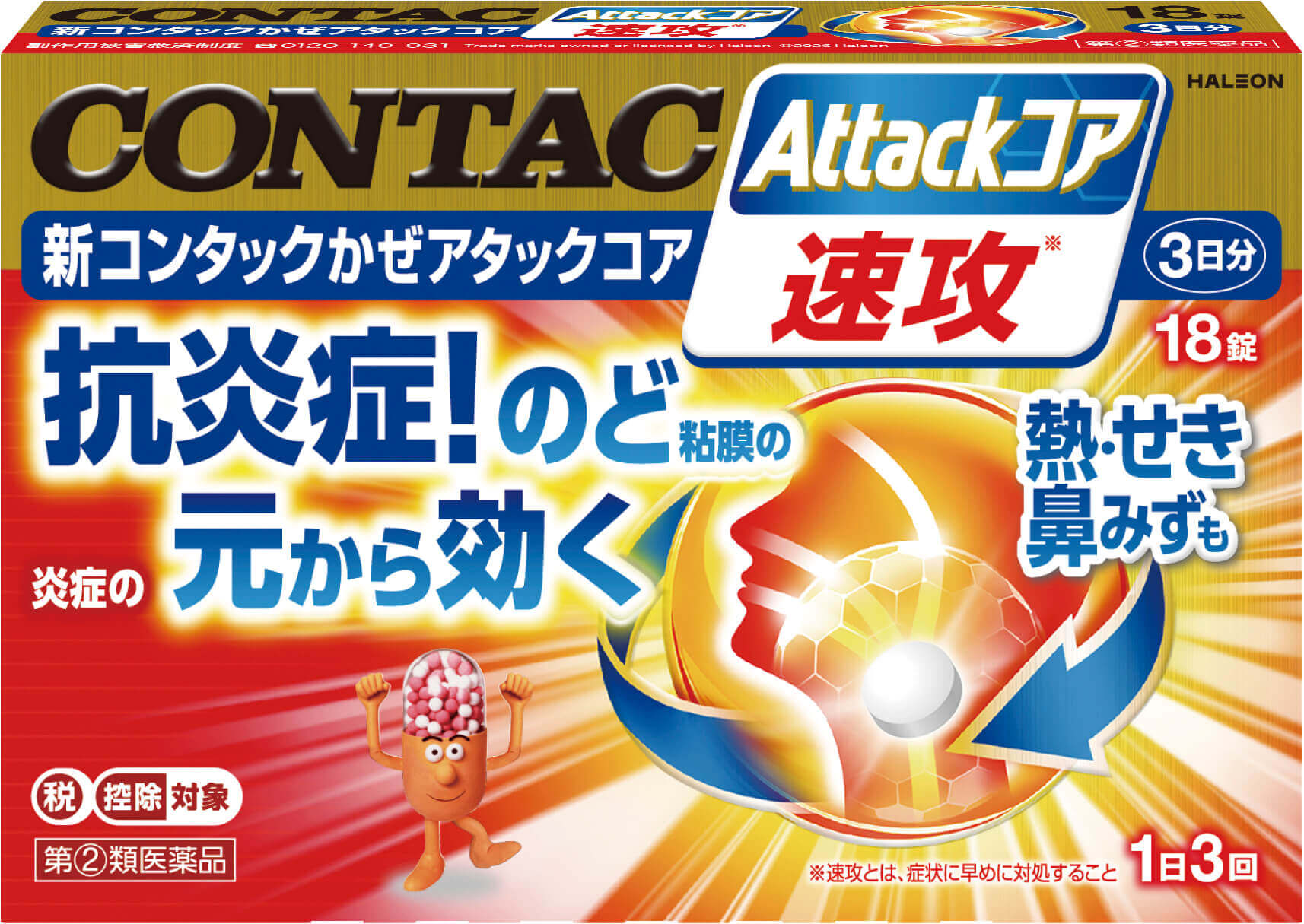
The official photograph shows an 18-tablet box labelled three doses a day and a three-day supply. That is a pack-size calculation using the labelled adult daily dose—not an instruction to take it for three full days, finish the box, or expect recovery in three days. The box’s “速攻” footnote refers to addressing symptoms early, not a promise of relief within a particular number of minutes.
Other CONTAC products have different dosage forms and schedules. Do not transfer another product’s twice-daily or sustained-release capsule instructions to Core tablets. Check the complete name, not just the brand or box colour.
Acting on inflammation is not the same as eliminating a virus
The manufacturer highlights dipotassium glycyrrhizinate, which suppresses inflammation of the throat and nasal mucosa. This describes an anti-inflammatory role; it does not mean this medicine kills viruses or bacteria or cures every condition responsible for symptoms. The authorised indication is relief of cold symptoms, not eradication or prevention of infection.
The indications cover sore throat, fever, runny nose, blocked nose, sneezing, cough, phlegm, chills associated with fever, headache, joint pain and muscle pain. Emphasising the throat is not the same as treating only the throat. It also does not establish superiority over other cold medicines.
Seven ingredients mean different jobs, not seven times the effect
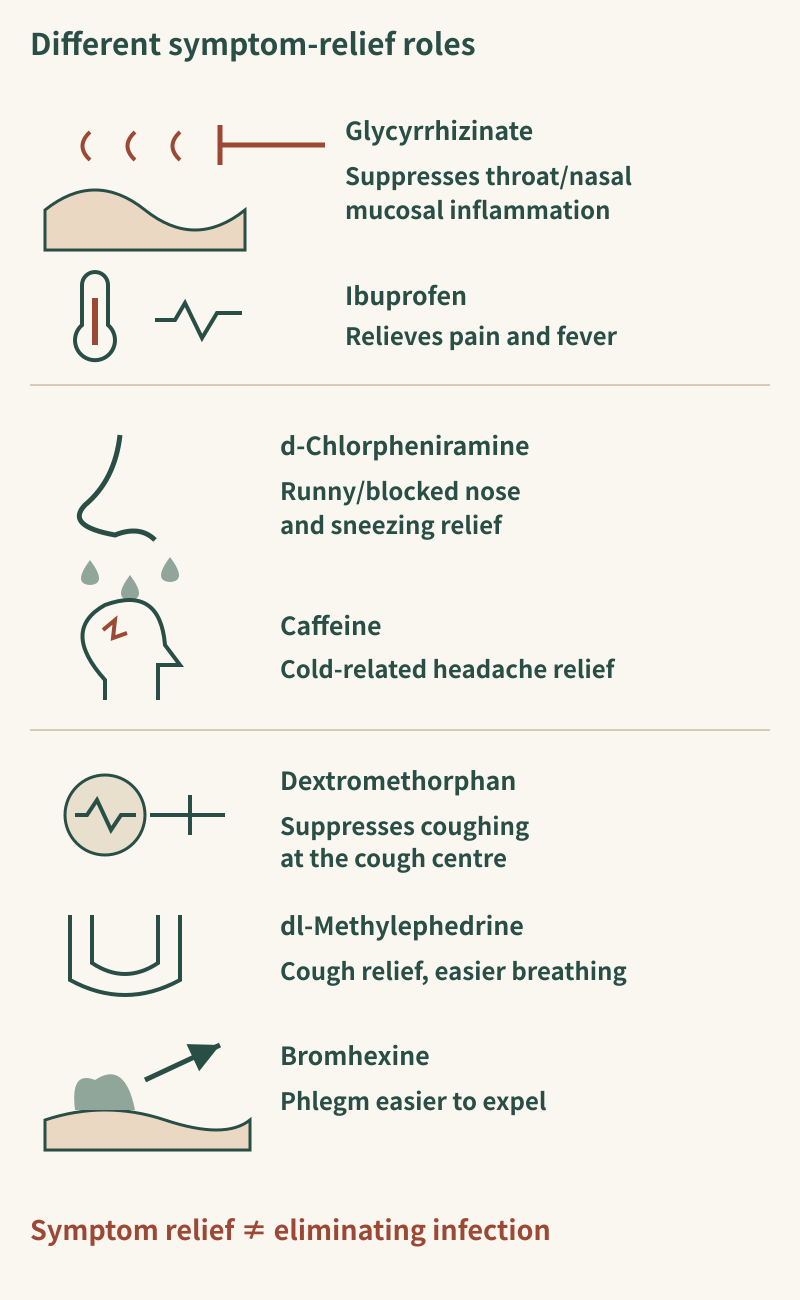
The following amounts are per six tablets: the total daily dose for people aged 15 and over, not one dose. The roles follow the current manufacturer’s ingredient descriptions. They do not mean everyone needs all seven ingredients.
- Ibuprofen 450 mg: relieves sore throat, fever, headache, joint pain and muscle pain.
- Anhydrous caffeine 75 mg: relieves headache associated with a cold. Caffeine does not cancel this medicine’s driving prohibition.
- Dipotassium glycyrrhizinate 42.6 mg: suppresses inflammation of the throat and nasal mucosa.
- d-Chlorpheniramine maleate 3.5 mg: relieves runny nose, blocked nose and sneezing.
- dl-Methylephedrine hydrochloride 60 mg: suppresses coughing and eases breathing.
- Dextromethorphan hydrobromide hydrate 48 mg: acts directly on the cough centre to suppress coughing.
- Bromhexine hydrochloride 12 mg: makes phlegm, one cause of coughing, easier to expel.
This is a map for understanding the formulation, not a tool for diagnosing a throat or airway condition. Symptom relief does not demonstrate that an infection has disappeared. A larger amount of one ingredient does not by itself establish that the whole product is stronger, safer or produces faster recovery.
Cough-specific and combination cold medicines are not two boxes to add together
Our CONTAC cough-and-phlegm product comparison addresses a different choice; Core is a combination cold medicine. Different indication ranges do not make the products suitable for stacking. Show a pharmacist or registered seller your symptoms, medicines already taken, the timing of the last dose and the candidate packaging.
While taking Core, do not use other cold medicines, antipyretic/analgesic medicines, sedatives, cough/expectorant medicines or oral medicines containing antihistamines, including nasal-allergy, motion-sickness and allergy medicines. Do not invent a gap of a few hours as permission to combine or switch products.
Two tablets per dose, three times a day—not six tablets at once
For ages 15 and over: take two tablets three times daily, preferably within 30 minutes after a meal, with water or warm water, without chewing. Under 15s must not take this medicine. Follow the dose strictly; do not take excessive amounts. Remove tablets from the blister packaging before swallowing; never swallow the packaging.
Do not drive or operate machinery after taking it: drowsiness can occur. Do not drink alcohol before or after taking it. Do not take it for more than five days. This limit does not mean you should wait until day five if symptoms fail to improve or an adverse reaction occurs.
Who must not take it, and who needs advice first?
Do not take it if you have had an allergic reaction to this medicine or its ingredients; have experienced asthma after this medicine, another cold medicine or an antipyretic/analgesic; are under 15; or are pregnant within 12 weeks of your expected delivery date.
Consult a doctor, pharmacist or registered seller before taking it if you are receiving medical or dental treatment; are pregnant or may be pregnant; are breastfeeding; are older; have a history of medicine allergy; have high fever or difficulty urinating; have been diagnosed with thyroid dysfunction, diabetes, heart disease, hypertension, liver disease, kidney disease, glaucoma, systemic lupus erythematosus or mixed connective tissue disease; or have had a stomach/duodenal ulcer, ulcerative colitis or Crohn’s disease.
Being 15 or older, or recognising a symptom on the box, does not establish suitability. Answer the seller’s questions about age, intended use and other medicines accurately. This page is not a guarantee of personal suitability or purchase.
Five or six doses and five days are different limits
If symptoms do not improve after five or six doses, stop taking it and consult a doctor, pharmacist or registered seller with the leaflet, particularly if fever lasts three days or more or recurs. This does not mean waiting five or six days. Do not take it for more than five days in any case; possible adverse reactions or worsening do not have to wait for either threshold.
Stop immediately and seek advice with the leaflet if you develop a rash, redness, itching or bruising; nausea, vomiting, loss of appetite, stomach discomfort or pain, mouth inflammation, heartburn, a heavy stomach, gastrointestinal bleeding, abdominal pain, diarrhoea or bloody stools; dizziness, palpitations, shortness of breath or difficulty breathing, or difficulty urinating; blurred vision, ringing in the ears, swelling, nosebleeds, bleeding gums, difficulty stopping bleeding, bleeding, back pain, an excessive fall in body temperature or unusual tiredness. Stop and seek advice also if constipation, dry mouth or drowsiness persists or worsens.
The leaflet lists rare serious reactions including shock/anaphylaxis, severe skin and mucosal reactions, liver dysfunction, kidney injury, aseptic meningitis, myocardial infarction, cerebrovascular disorders, interstitial pneumonia, asthma, aplastic anaemia and agranulocytosis. Warning signs such as sudden breathing difficulty, hoarseness or confused consciousness; persistent high fever with eye or widespread skin/mucosal abnormalities; jaundice or reduced urine; severe headache with neck stiffness; crushing chest pain or cold sweats; sudden one-sided limb difficulty or speech difficulty; wheezing; or marked bleeding, pallor, sudden high fever and sore throat require immediate medical attention. Do not take another dose to see what happens.
Keep the identifying information after taking it home
Store away from direct sunlight in a cool, dry place out of children’s reach. Do not transfer it to another container. Do not use it beyond the expiry date on the outer packaging; the date is also on the inner aluminium bag. The stated expiry is the usable period while unopened, not a guarantee of usability until that date after opening. Keep the leaflet and packaging for checking the product and showing a clinician if necessary.
Official sources
Based on current Japanese information checked on 2 November 2026. The leaflet bears an August 2026 revision date. Read the current instructions supplied with your own product before buying or taking it.
- Haleon: New Contac Kaze Attack Core and ingredient roles
- Haleon official leaflets: select New Contac Kaze Attack Core
- Haleon Japan: 16 July 2026 announcement of the 3 August launch
Product photograph: Haleon’s current official product page. The independently composed role diagram explains the manufacturer’s descriptions; it is not a comparative efficacy study.