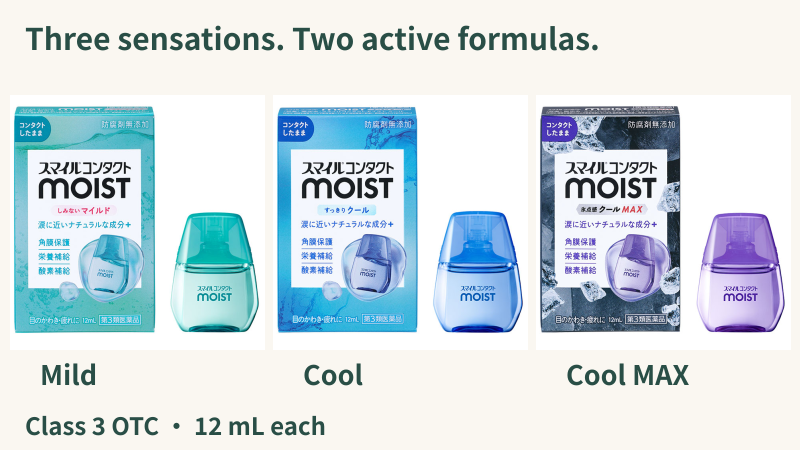
Three cooling sensations do not mean cooling is the only difference. Lion launched Japan’s Smile Contact Moist series on 24 September 2026. Green Mild, blue Cool and purple Cool MAX are all 12 mL Class 3 OTC medicines, but their active ingredients form two patterns: four in Mild, five each in Cool and Cool MAX.
Check the complete name and ingredient panel before choosing your preferred sensation. Stronger cooling does not establish greater effectiveness. A new launch also does not establish a newly invented active formulation or superiority over the former range.
- Green Mild: four active ingredients
- Blue Cool: five active ingredients
- Purple Cool MAX: the same active amounts as Cool, not an identical complete formula
- “Mild” does not mean every ingredient amount is lower
- What does the moisture layer between lens and cornea do?
- Check the indication and eye condition before the sensation
- The dose is shared—not unlimited whenever discomfort returns
- When should you consult first or stop?
- Preservative-free still requires careful nozzle hygiene and storage
- Official sources
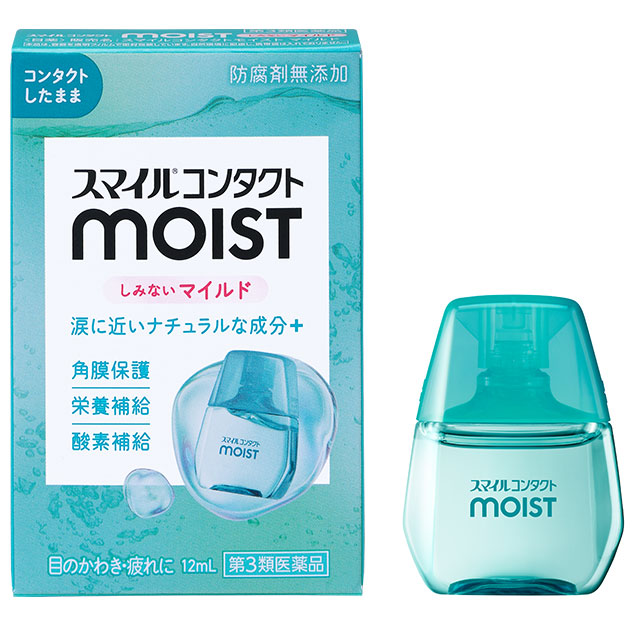
Green Mild: four active ingredients
The full Japanese name is スマイルコンタクトモイスト マイルド. The manufacturer positions it as having no cooling sensation. That is not a guarantee that nobody will experience stinging, allergy or another adverse reaction. Look for MOIST and マイルド on the box, not green alone.
Blue Cool: five active ingredients
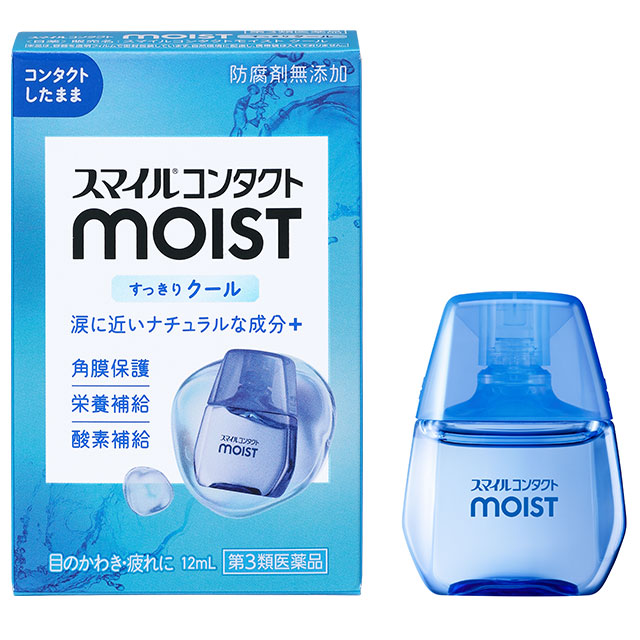
The full name is スマイルコンタクトモイスト クール. Unlike Mild, it includes povidone as an active ingredient, and several shared active ingredients have different concentrations. It is not simply Mild with some cooling added.
Purple Cool MAX: the same active amounts as Cool, not an identical complete formula
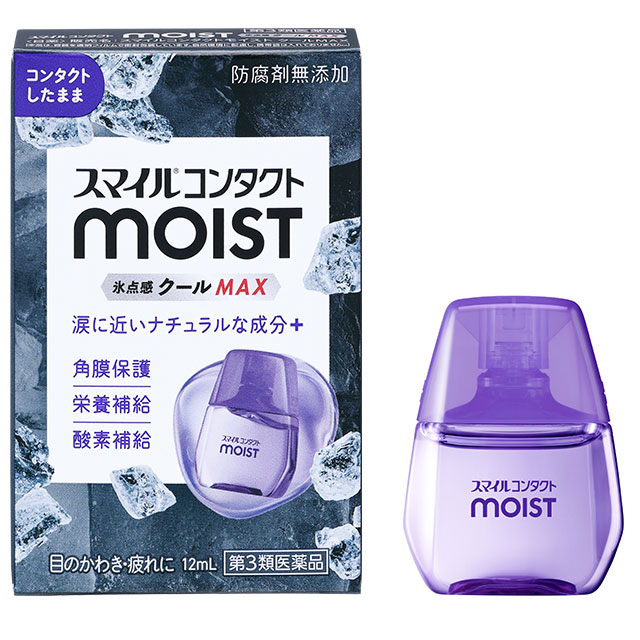
The full name is スマイルコンタクトモイスト クールMAX. Its current leaflet lists the same five active ingredients and amounts as Cool, but the additives are not entirely identical: for example, Cool lists dl-camphor while MAX lists d-camphor. MAX’s stronger cooling sensation is not a ranking of efficacy, safety or how long moisturisation lasts.
“Mild” does not mean every ingredient amount is lower
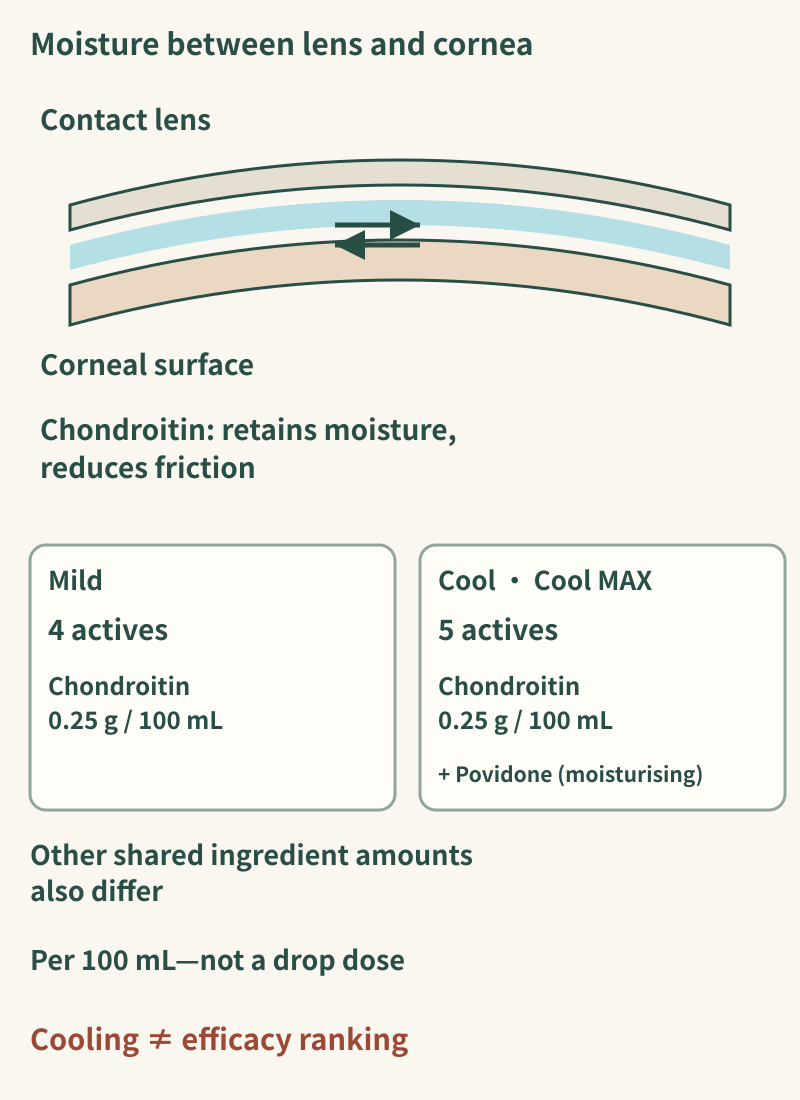
All figures below are grams per 100 mL, not the amount in a 12 mL bottle or in one application. The shared corneal-protecting ingredient has the same concentration in all three. Mild contains more of some shared ingredients, including taurine, but those numbers do not identify the best product for an individual.
| Active ingredient | Mild / 100 mL | Cool and Cool MAX / 100 mL |
|---|---|---|
| Chondroitin sulfate sodium | 0.25 g | 0.25 g |
| Taurine | 1.0 g | 0.2 g |
| Potassium L-aspartate | 0.5 g | 0.1 g |
| Sodium chloride | 0.3 g | 0.2 g |
| Povidone | Not listed as an active ingredient | 0.25 g |
These numbers help identify formulations; they are not a method for increasing the number of drops, alternating or stacking products, or choosing the “strongest” one. Identical active ingredients in Cool and MAX do not establish identical complete formulations or an identical experience for every user.
What does the moisture layer between lens and cornea do?
The manufacturer describes chondroitin sulfate sodium as a corneal-protecting ingredient that retains moisture: it enters the space between lens and cornea and acts like a cushion, reducing friction and improving a gritty sensation. This explains a role, not a guarantee that all grittiness comes from dryness or evidence that the drops repair any corneal wound.
The other roles differ too. Sodium chloride supplies a mineral also present in tears and supports their function. Taurine is described as providing nutritional support, and potassium L-aspartate as supporting oxygen supply. Povidone in Cool and MAX is listed as a moisturising ingredient. “Oxygen supply” should not be pictured as injecting oxygen gas into the eye or treated as permission to wear lenses longer.
The series contains no added preservatives such as benzalkonium chloride; Lion says its technology provides a preservative effect. No added preservatives does not mean permanently sterile, safe to keep until the expiry date after opening, or permission to touch the eye with the nozzle.
Check the indication and eye condition before the sensation
Current official information for all three permits use without lenses and while wearing all contact-lens types. Their indications are discomfort while wearing soft or hard lenses, tear supplementation for dry eyes, eye fatigue, and blurred vision such as when there is excess eye discharge. This is not a claim to treat every eye disease or permission to keep wearing lenses despite pain.
If receiving eye treatment, follow your clinician’s instructions and consult before use. Do not mask an obvious problem simply by switching to a cooler or milder product. The similarly named Smile 40 Premium THE ONE range is a different group of products: do not transfer its ingredients, lens compatibility or dosing to this series.
The dose is shared—not unlimited whenever discomfort returns
Use one to three drops per application, three to six times daily, for eye use only. Children must use them under a guardian’s guidance and supervision. Hold the nozzle downwards when applying drops. Do not touch the eye, eyelid or eyelashes with it, to avoid contamination with discharge, dust or other material. Do not use cloudy solution.
Follow the leaflet’s twist-cap instructions: keep the cap pointing upwards, hold the sides of the container and twist it open; press the cap straight down until it clicks to close. Squeezing the broad faces while opening or closing can eject liquid. These are eye drops, not a lens-cleaning or storage solution; do not repurpose them for rinsing or soaking lenses.
When should you consult first or stop?
Consult a doctor, pharmacist or registered seller before use if you are receiving medical treatment, have had allergy symptoms from medicines or other substances, have severe eye pain, or have been diagnosed with glaucoma. Mild and “usable with contact lenses” do not override these conditions.
If you develop a skin rash, redness or itching, or eye redness, itching, swelling or stinging pain, stop immediately and consult a doctor, pharmacist or registered seller with the leaflet. Do not tolerate stinging as proof the medicine is working.
Stop and seek advice if blurred vision does not improve, or if symptoms do not improve after about two weeks. Two weeks is not a waiting period for adverse reactions, severe pain or other abnormalities. Extra drops or stronger cooling are not a substitute for assessment.
Preservative-free still requires careful nozzle hygiene and storage
Keep tightly capped in a cool place away from direct sunlight. Do not leave it at 40°C or above, in a car or near a heater. Keep out of children’s reach, do not decant it and do not share it. Do not use beyond the expiry date on the bottom of the box; use as soon as possible after opening even if still within that date. This guide does not invent a fixed number of months after opening.
Using the bottle sideways or storage conditions can leave ingredient crystals on the nozzle or cap. The leaflet says to wipe these gently with clean gauze before use. That does not make cloudy liquid usable after wiping. Keep the original leaflet for reference.
Official sources
Based on current Japanese product information and all three leaflets checked on 2 November 2026. Photographs show Lion’s current official 12 mL packaging examples. The independently composed role diagram is not a comparative efficacy study.