Current Japanese package insert, purchase checks and user information reviewed: 2 November 2026. This guide is for Allegra FX Premium, not universal directions for regular Allegra FX, Junior or overseas products.
Premium does not mean taking an extra regular Allegra FX tablet. Japan’s Allegra FX Premium adds an ingredient with a different role, especially for troublesome nasal congestion from allergy. Although each dose contains two tablets, its labelled daily fexofenadine amount is the same as regular FX’s. Tablet count and the word “Premium” do not tell the whole story.
Another useful detail is the sustained-release design: the tablets must be swallowed intact, and a residual shell may sometimes appear in stools. For this particular product, the manufacturer explains that this is material left after absorption—not a reason to take an extra dose. Here we separate action, formulation and safety instead of treating an added ingredient as an upgrade for everyone.
- Identify Premium and its pharmacist-guidance classification
- Two actions—not twice the same action
- Why swallow it whole—and what is the residual shell?
- Morning and evening on an empty stomach—not all season indefinitely
- Who must not take it, and who must consult first?
- Show all medicines—do not solve interactions with a guessed interval
- When to stop and seek medical help
- Buying and storing Premium
- Main official sources
Identify Premium and its pharmacist-guidance classification
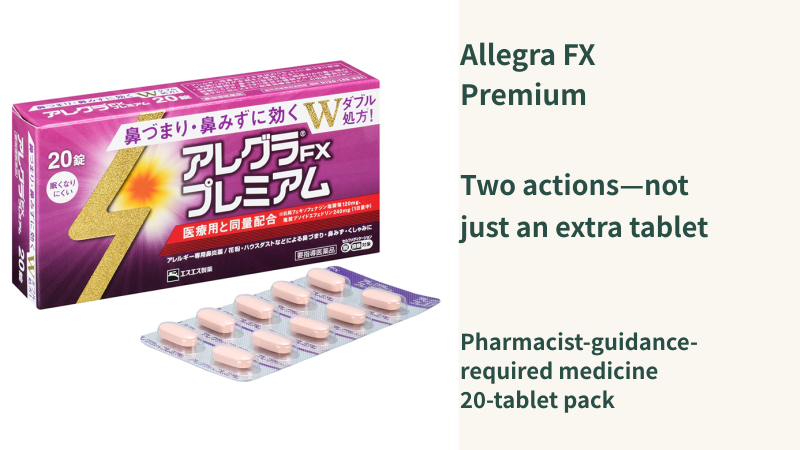
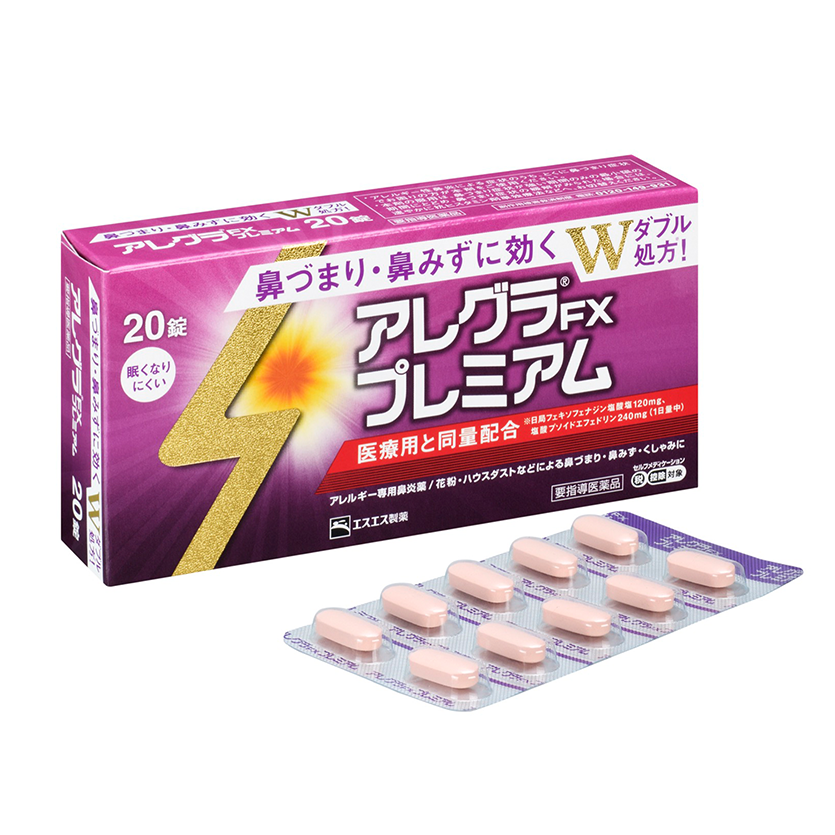
The full name is アレグラFXプレミアム (Allegra FX Premium), a Japanese pharmacist-guidance-required medicine (要指導医薬品) for allergic rhinitis. The official photograph shows a 20-tablet carton with one 10-tablet blister sheet—not a ten-tablet pack or a single dose. It launched in January 2024; this is not a new 2026 formulation.
Its indication is relief of sneezing, runny nose and nasal congestion caused by nasal allergy to pollen, house dust and similar triggers, particularly troublesome blockage. It is not a cold or flu treatment, nor a solution for every type of breathing difficulty. Do not transfer overseas Allegra or Allegra-D instructions simply because the brand sounds familiar.
Two actions—not twice the same action
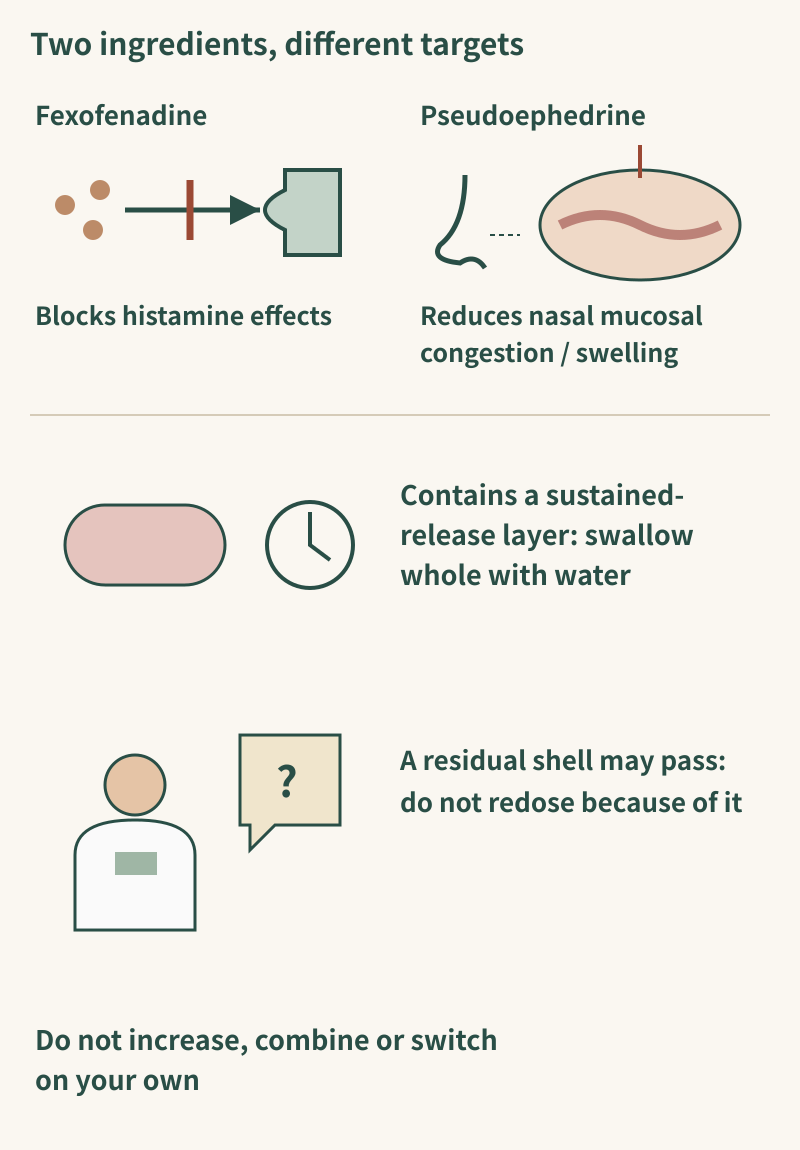
- Fexofenadine hydrochloride is a second-generation antihistamine that suppresses allergy-related histamine effects and helps relieve nasal allergy symptoms.
- Pseudoephedrine hydrochloride reduces congestion and swelling of the nasal mucosa, helping air pass through the nose. This added ingredient is an important reason for the additional suitability checks.
A blocked nose is not only “too much mucus”; congested, swollen nasal tissue is another target described by the manufacturer. This is not a diagram-based diagnosis, and adding an ingredient does not establish better effects or safety for everyone.
The labelled four-tablet daily dose contains fexofenadine hydrochloride 120 mg and pseudoephedrine hydrochloride 240 mg. One two-tablet dose is half those amounts. Regular FX’s current label has fexofenadine hydrochloride 120 mg in its two-tablet daily dose. More tablets therefore does not mean double the daily antihistamine amount; the same amount does not mean the complete products have identical effects, eligibility or safety. Do not combine or substitute them by arithmetic.
Why swallow it whole—and what is the residual shell?
This tablet contains a sustained-release layer. Swallow it intact with water; do not chew or crush it. The release design is not a reason to split, dissolve or powder a tablet yourself. The official materials checked for this guide do not specify the ingredient arrangement in each layer, so we do not invent that arrangement.
The manufacturer says a shell from this product may pass in stools after the ingredients have been absorbed, without affecting its action. Do not take an additional dose because of that shell. This is the explanation for this particular medicine, not reassurance about every tablet or unidentified object in stools. If unsure what you have seen, or if you also feel unwell, show the product information to a doctor or pharmacist.
“Less likely to cause drowsiness” is not “cannot cause drowsiness”: the insert still lists it as a possible adverse effect. The brand website defines its Japanese “速攻” wording as addressing symptoms early. Do not convert advertising wording into a guaranteed number of minutes until your nose clears, or a promise of safe driving.
Morning and evening on an empty stomach—not all season indefinitely
For ages 15 and over: two tablets per dose, twice daily, morning and evening on an empty stomach, swallowed intact with water. Do not use under age 15. Official examples include on waking and in the evening before eating, or before breakfast and dinner on an empty stomach. Do not copy regular FX’s one-tablet dose or omit the empty-stomach condition. Skip a missed dose; do not double up. Consult a doctor or pharmacist if you take too much.
Use it for the shortest necessary period while congestion is severe. When the blockage improves, the official directions call for a prompt change to an antihistamine-only treatment or another appropriate option. Confirm the choice and switching schedule with a doctor or pharmacist rather than overlapping two rhinitis medicines yourself.
- No improvement after one week: consult a doctor or pharmacist; the cause may need reassessment.
- Even if improved, consult before continuing beyond two weeks.
- For adverse reactions below, follow the stopping and medical-care directions without waiting a week or two.
Who must not take it, and who must consult first?
In addition to children under 15, do not take it if you:
- Have had an allergic reaction to this medicine or its ingredients.
- Have urinary retention or difficulty urinating due to an enlarged prostate.
- Have been diagnosed with hypertension, heart disease, thyroid dysfunction, diabetes or glaucoma.
- Have experienced insomnia, dizziness, weakness, tremor or palpitations from cold remedies, cough/expectorant medicines, oral rhinitis medicines or similar products.
Do not drink alcohol before or after taking it. The breastfeeding instruction is not to take the medicine, or to avoid breastfeeding while taking it. Do not stop feeding simply to follow this article; discuss a plan with a doctor.
Consult a doctor or pharmacist before use if receiving medical treatment; unsure whether symptoms are allergic rhinitis or another cause such as a cold; previously diagnosed with another allergic disease such as asthma or atopic dermatitis; pregnant or possibly pregnant; elderly; previously allergic to medicines or similar substances; or diagnosed with kidney disease. These consultation categories do not weaken the prohibited-use conditions above.
Show all medicines—do not solve interactions with a guessed interval
While taking this product, do not use other allergy medicines, including skin-disease medicines and oral rhinitis treatments; oral antihistamine-containing medicines and related products such as some cold, cough/expectorant, motion-sickness or sleep/sedative medicines; erythromycin; aluminium hydroxide/magnesium hydroxide preparations; methyldopa or reserpine; oral pseudoephedrine hydrochloride or sulfate products; monoamine oxidase inhibitors such as selegiline hydrochloride; or apalutamide.
Bring prescription and OTC medicine names or package photographs for a pharmacist to check. Do not stop a prescription yourself to take this product, or replace an interaction check with a waiting time found online.
When to stop and seek medical help
Stop immediately and take the leaflet to a doctor or pharmacist if any of these occur after use: rash, throat/eyelid/lip swelling, itching, hives or redness; nausea, vomiting, abdominal pain, indigestion or bloody stools; headache, fatigue, numbness, malaise, dizziness, insomnia, nervousness, nightmares, sleep disturbance, excitement, restlessness, weakness, fear, anxiety, tension, tremor or hallucinations; frequent urination, difficulty urinating or urinary retention; rapid heartbeat, palpitations, raised blood pressure, hypertension, irregular heartbeat or circulatory collapse; altered taste, swelling, chest pain, breathing difficulty, appetite loss, pallor or menstrual changes.
Breathing difficulty, confusion, convulsions or a rapidly developing severe allergic reaction requires immediate medical attention. The insert also warns about liver problems, including jaundice, dark urine, fever or marked malaise; blood-cell disorders signalled by sudden high fever, chills or sore throat; and acute generalised exanthematous pustulosis, with high fever, widespread redness/rash and small pustules, persistent or rapidly worsening illness. These require immediate medical assessment too.
Stop and consult if dry mouth, constipation, diarrhoea or drowsiness persists or worsens. This is not a checklist that guarantees safety when a symptom is not listed.
Buying and storing Premium
Pharmacist explanation and checks are required for this guidance-required medicine. Current manufacturer information limits each purchase to one box. Its pseudoephedrine also places it within Japan’s designated abuse-prevention framework: accurately disclose your age, other medicines and medicine purchases. Individual or traveller purchase is not guaranteed. The current system includes an online pharmacist-guidance route for eligible guidance-required medicines; this guide neither declares all such medicines store-only nor promises that any particular website offers an eligible service for this product.
Store somewhere cool, dry and away from direct sunlight, out of children’s reach. Do not transfer to another container or use after expiry. Remove tablets from the blister before swallowing; never swallow the packaging.
For regular FX or Alesion20, see the Allegra FX and Alesion20 comparison. Those instructions must not be transferred to Premium. Further reading is not permission to combine or switch medicines yourself.
Main official sources
- SSP: current Premium product and package insert
- Premium official action explanation and claim footnotes
- Premium directions, precautions and official FAQ
- Official check sheet and user booklet
- Regular Allegra FX: current daily composition and directions
- January 2024 launch announcement
- MHLW: medicine-sales system changes
- MHLW: designated abuse-prevention ingredients
This guide explains the current Japanese product. It does not replace individual diagnosis, pharmacist purchase checks or the complete package instructions.