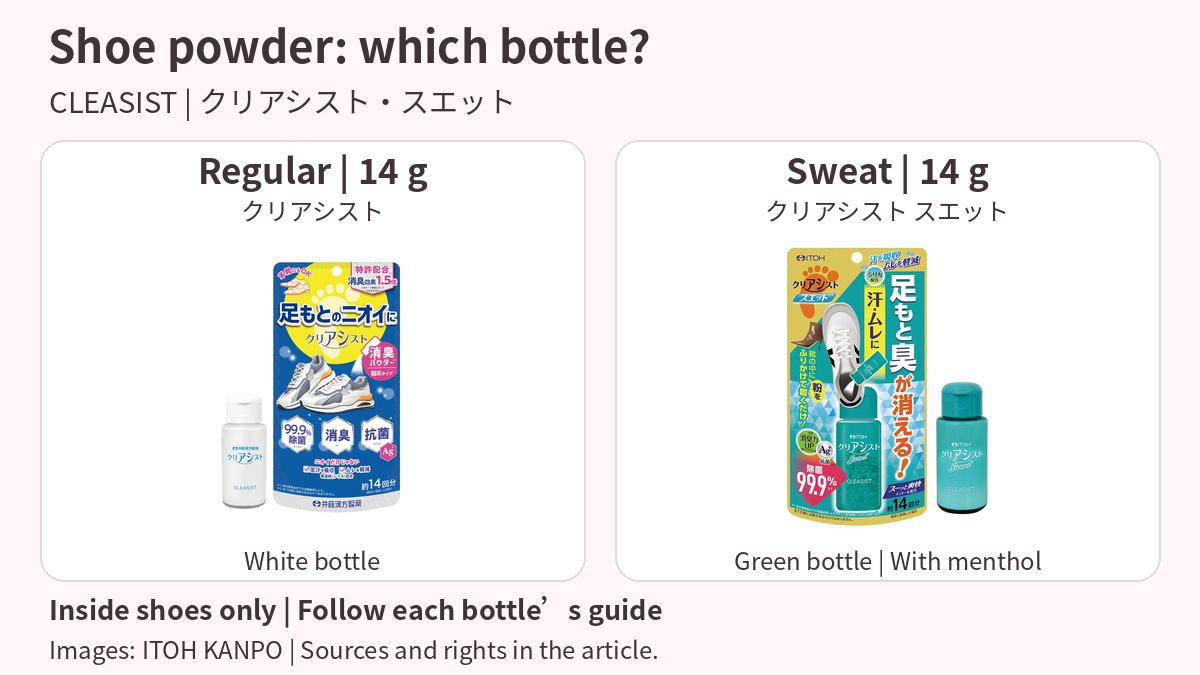
Two small CLEASIST bottles sit on a Japanese drugstore shelf: white and green, both 14 g. Does the extra “Sweat” on the green one mean you should choose it as the stronger option? A more useful starting point is where the powder goes: inside your shoes. Then match the bottle to its own quantity guide. That makes the choice much clearer than treating it like a product you rub onto your feet.

I’m Irene, a Taiwan-born pharmacist qualified in Japan.
Japanese official information checked: 25 October 2026. This guide is for adult readers choosing shoe-odour products in Japan and covers ITOH KANPO’s クリアシスト and クリアシスト スエット.
- First, are you trying to manage odour inside your shoes?
- Same 14 g size, different shake counts
- White bottle: match クリアシスト and CLEASIST
- Green bottle: find the extra スエット / Sweat name
- Sprinkle inside, then tilt towards the toes
- Precautions for using and putting it away
- Match the purpose, the bottle and the amount
- Official information and image sources
First, are you trying to manage odour inside your shoes?
Both products are deodorizing powders for use inside shoes. Apply the powder to the shoe interior, not directly to skin, clothing, the outside of a boot or socks. They are not medicines for athlete’s foot, wounds or excessive sweating. If your concern involves skin symptoms, do not rely on shoe deodorizer to address them.
Check your feet first: consult a doctor before use if you have a skin abnormality or a condition such as an allergic tendency. If you have a wound on your foot, the manufacturer recommends waiting until it has healed.
Same 14 g size, different shake counts
| What to compare | クリアシスト CLEASIST regular | クリアシスト スエット CLEASIST Sweat |
|---|---|---|
| Visual clues | White bottle with blue-and-yellow packaging | Green bottle; Sweat / スエット appears in the name |
| Contents | 14 g | 14 g |
| Manufacturer’s guide per shoe | About 7–9 shakes, approximately 0.5 g | About 10–12 shakes, approximately 0.5 g |
| Formulation clues | Lists silica as a moisture absorbent | Also lists silica, with menthol and polyaluminium chloride additionally listed |
On a phone, scroll sideways within the table.
The different shake counts are each product’s guide to approximately 0.5 g per shoe. More shakes do not rank the green bottle as stronger. Sweat contains menthol and is presented by the manufacturer as offering a cooling sensation; that is not a ranking of medical benefit or safety. Follow the bottle you have and adjust for shoe size.
White bottle: match クリアシスト and CLEASIST
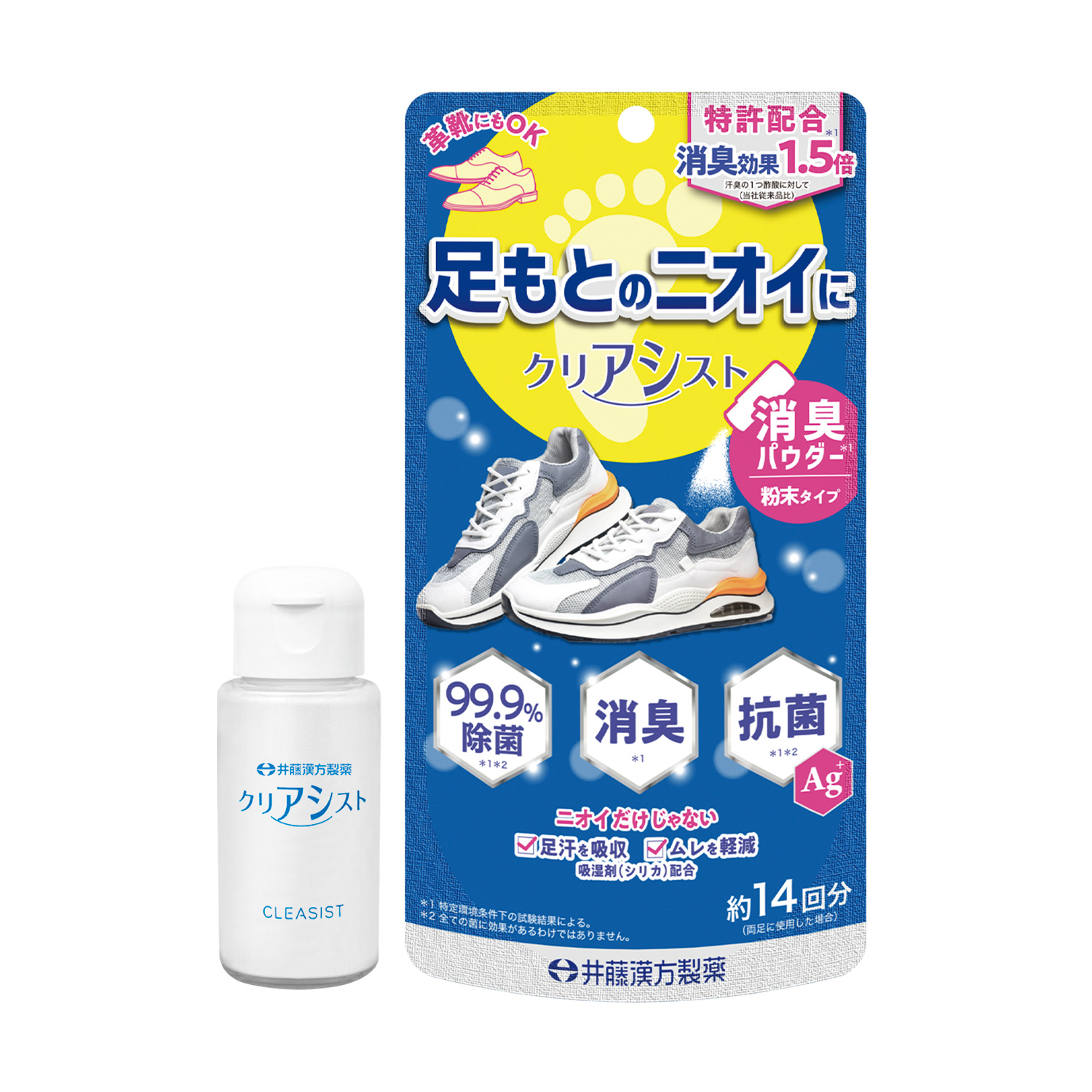
The regular product’s full Japanese name is クリアシスト. Match that name rather than choosing only by a general foot-odour claim on the pack. It leads you to this bottle’s guide of 7–9 shakes per shoe.
Green bottle: find the extra スエット / Sweat name
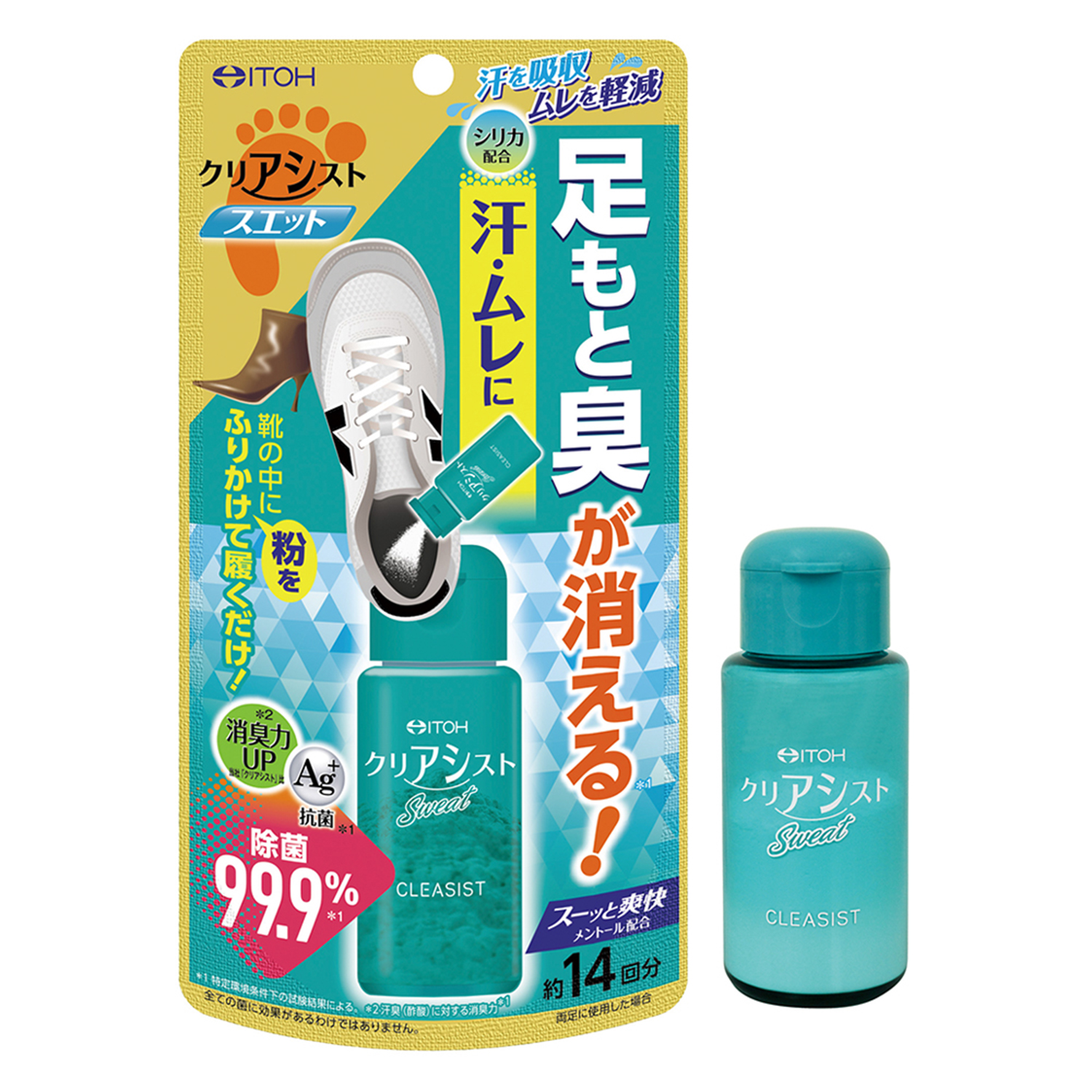
The full name is クリアシスト スエット. Consider whether you want the menthol cooling sensation described by the manufacturer, then check this bottle’s quantity guide. “Sweat” is not an antiperspirant medicine label or a reason to assume a stronger version of regular CLEASIST.
Want to double-check the barcodes?
Both contain 14 g. The regular product’s JAN is 4987645401835; Sweat’s is 4987645400586. These identify two different products, not a bottle and its refill.
Sprinkle inside, then tilt towards the toes
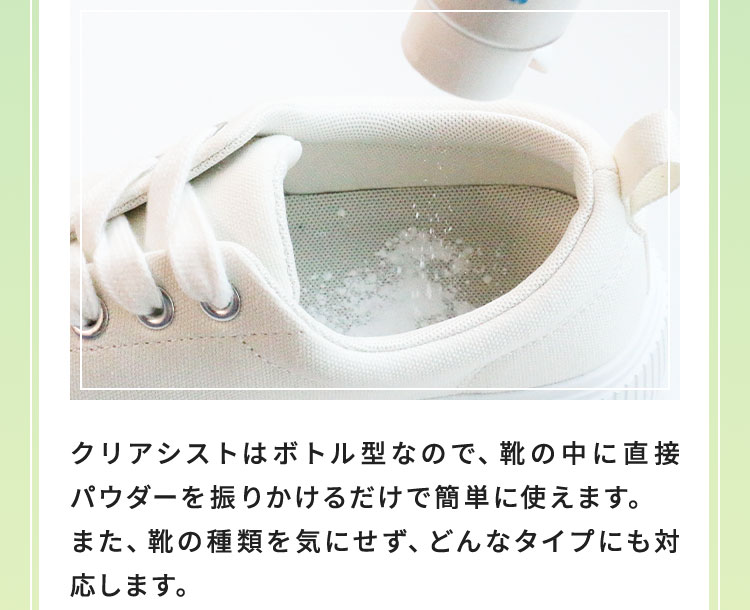
- Apply the guide amount to each shoe. Use about 7–9 shakes of regular CLEASIST or 10–12 of Sweat per shoe; each guide corresponds to approximately 0.5 g. Adjust for shoe size. This is not a combined amount for the pair.
- Tilt the shoe to spread powder evenly, right to the toes. The manufacturer’s visual guide is a light white dusting across the inside, rather than a pile left at the heel.
- Put the shoes on. The directions say you can wear them as they are; the powder gradually settles with time. Do not measure 0.5 g by the pile in the photograph, or expect it to disappear completely after a fixed number of hours.
Both product FAQs say it can be used in shoes with removable insoles. Keep following your own bottle’s quantity guide: the regular-product photograph is not a measured-dose example for Sweat.
Planning to take your shoes off indoors? Keep one small step in mind: powder may transfer to socks or other items and leave them white. Brush powder off your socks before stepping indoors. A low-residue advertising claim does not remove this instruction.
Precautions for using and putting it away
- Ask first if something is wrong: consult a doctor if you have a skin abnormality or a condition such as an allergic tendency. Wait for foot wounds to heal before using it.
- Stop if a reaction appears: discontinue use and consult a doctor if abnormalities occur on your skin or elsewhere during use.
- Keep it for shoes: do not repurpose it as a powder to apply directly to your body, clothes or socks.
- Watch for white powder transfer: powder inside shoes may whiten socks or other items. Brush it off your socks before going indoors.
- Avoid heat and humidity: close the cap tightly after use. Before and after opening, keep it out of reach of children, people with dementia and others at risk of accidental ingestion. It is not food.
Read the patch-test statements separately, too. The regular product’s FAQ reports testing on a similar product; Sweat’s FAQ says it has been patch tested. Both warn that irritation may still occur. Neither statement gives permission to apply the powder directly to skin.
If swallowed, keep the packaging and seek advice
The manufacturer’s instructions: both product warnings list measures including rinsing the mouth and drinking water. The FAQs say to consult a doctor immediately if a child swallows it. Do not treat “a small amount” as a safe threshold or a reason to wait and see.
General poisoning first aid: the Japan Poison Information Center explains that treatment depends on the substance and the person’s condition. Keep the packaging and tell a doctor or poison service the amount swallowed and any symptoms. Do not induce vomiting or force large drinks. Serious symptoms such as unconsciousness or seizures need emergency medical help immediately; do not try to make the person drink. This is general first-aid context, not a product-specific safe amount to swallow.
Match the purpose, the bottle and the amount
Are you addressing odour inside shoes, are your feet free of a reason to postpone use or seek advice, and are you willing to sprinkle and spread the powder as directed? Then choose regular CLEASIST or consider Sweat for its stated menthol cooling sensation. If you need something for skin, a wound or athlete’s foot, do not use either bottle as a substitute. Where it goes, which bottle it is and how much goes into each shoe are more useful buying clues than the largest number on the pack.
Official information and image sources
The two product photographs in the cover and article come from their respective ITOH KANPO product pages. The regular-product application photograph comes from the brand page. Image rights remain with ITOH KANPO Pharmaceutical or their respective rights holders. Quantities and precautions are organised from each product’s own page.
The 99.9% on the original packaging is a manufacturer test claim under specified conditions, not a claim covering every microorganism. The 1.5× claim is a limited comparison concerning acetic acid against the manufacturer’s previous product. These are not this site’s tests or guarantees for every use condition, and are not used here to rank the two products’ strength.
- ITOH KANPO: regular CLEASIST photograph, directions, ingredients, precautions and FAQ (Japanese)
- ITOH KANPO: CLEASIST Sweat photograph, directions, ingredients, precautions and FAQ (Japanese)
- CLEASIST brand page: regular-product inside-shoe photograph and information (Japanese)
- Japan Poison Information Center: general first-aid advice after a poisoning accident (Japanese)