Current Japanese official information checked: November 2, 2026. This guide covers Japanese のどぬ~る鎮痛カプセルEX, not the brand’s sprays or the former capsule a.
At a Japanese drugstore, look beyond the Nodonuru brand name. 鎮痛カプセルEX is an oral pain-relief and fever-reducing medicine, with a different formula from the former 鎮痛カプセルa. Launched on August 26, 2026, EX adds acetaminophen and changes the tranexamic acid amount. An older ingredient guide cannot simply be applied to the new box.
Already taking a cold medicine, but your throat still hurts? The Japanese instructions prohibit taking other pain/fever medicines, cold medicines or sedatives while taking this product. A throat-focused label does not make it an unrestricted add-on. Show a pharmacist your current medicine, ingredients and last dose time; this guide does not supply a do-it-yourself switching interval.
- Read the full name, not just “Nodonuru” or “EX”
- Two active-ingredient changes—not an increase in every ingredient
- The labelled uses are symptom relief
- Separate “do not take” from “ask before taking”
- Three capsules per dose; four hours refers to this product
- Stop if there is no improvement after five or six doses—not days
- Bring both medicine boxes to the counter
- Official sources and scope
Read the full name, not just “Nodonuru” or “EX”
Look for のどぬ~る鎮痛カプセルEX; its Japanese registered product name is 鎮痛カプセルEX. It is a designated Class 2 OTC medicine in Japan (第②類). The current official listing shows an 18-capsule pack. That is the box quantity, not one dose. The brand also includes sprays and other products, so neither the brand name nor the letters EX alone identify the formulation.
Read these three box labels
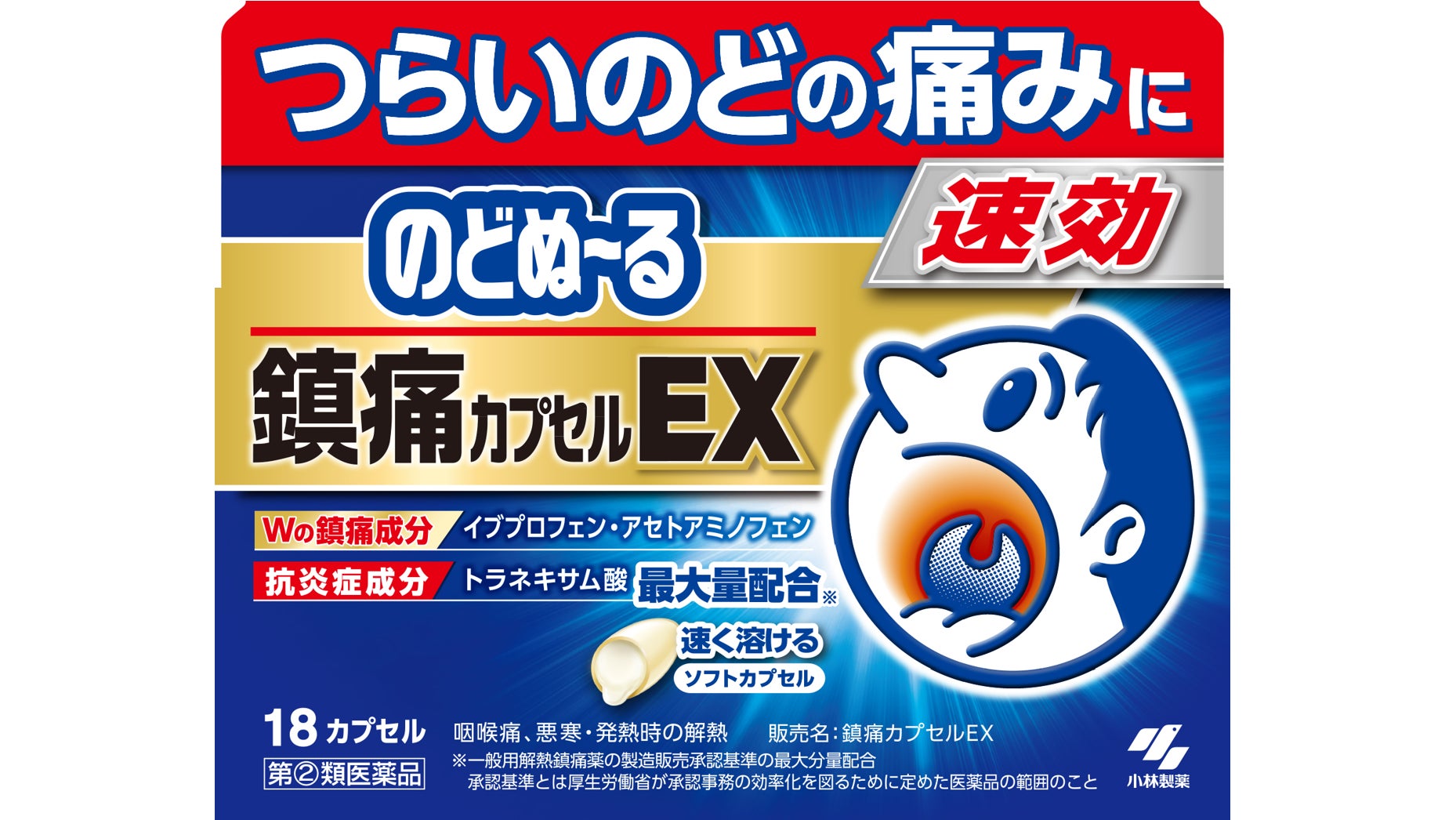
- 鎮痛カプセルEX
- Full name for current EX swallowed capsules—not just the brand or spray.
- 18
- Pack quantity, not a dose.
- Wの鎮痛成分
- Two pain/fever ingredients, not twice the effect.
The former product’s registered name is 鎮痛カプセルa. Its official page says manufacturing and shipments have ended, with sales continuing until remaining stock runs out, and directs readers to EX. This does not establish that every shop has changed its stock, or determine whether an old box at home is usable. Check its full name, expiry date and enclosed instructions.
Two active-ingredient changes—not an increase in every ingredient
All amounts below are per nine capsules, the labelled daily quantity. They are not per capsule or per dose, and do not mean you must take nine capsules every day.
| Ingredient | Former a | Current EX |
|---|---|---|
| Acetaminophen (paracetamol) | Not listed as an active ingredient | 195 mg, added |
| Ibuprofen | 450 mg | 450 mg, unchanged |
| Tranexamic acid | 420 mg | 750 mg, changed |
| Dried aluminium hydroxide gel | 208.5 mg | 208.5 mg, unchanged |
The pack’s “Wの鎮痛成分” wording refers to two pain-relief/fever-reducing ingredients: acetaminophen and ibuprofen. Tranexamic acid is labelled as the anti-inflammatory ingredient, and dried aluminium hydroxide gel as the gastric-mucosal protective ingredient. Two pain-relief ingredients do not mean twice the effect, and a stomach-protective ingredient does not eliminate gastrointestinal side effects. This ingredient comparison does not establish that EX works faster, works better or is safer than a.
EX also lists medium-chain triglycerides, gelatin, succinylated gelatin, glycerin and parabens as additives. If you have an allergy history, have the complete formulation checked, not just the active ingredients.
The labelled uses are symptom relief
The Japanese instructions list pain relief for conditions including throat pain, headache, toothache and menstrual pain, as well as fever reduction when chills or fever occur. These are examples, not the full indication list; see the official leaflet linked at the end for all indications. These indications do not identify the cause of pain or establish that an infection has been cured.
Separate “do not take” from “ask before taking”
Do not take this product if:
- You have had an allergic reaction to it or one of its ingredients.
- This product, another pain/fever medicine or a cold medicine has previously triggered asthma.
- You are under 15.
- You are pregnant and within 12 weeks of your expected delivery date. This means the 12 weeks before the due date, not the first 12 weeks of pregnancy.
Do not take other pain/fever medicines, cold medicines or sedatives while taking this product. Do not drink alcohol before or after taking it, and do not use it continuously over a long period. The medicine restriction covers these categories, not merely duplicate ingredients. Failing to find a shared ingredient on another box does not override it.
Consult a doctor, dentist, pharmacist or Japanese registered OTC medicine seller before taking it if:
- You are receiving treatment from a doctor or dentist.
- You are pregnant or may be pregnant, breastfeeding, or an older adult. The prohibition within 12 weeks of the due date still takes priority.
- You have previously had an allergic reaction to a medicine or another substance.
- You have been diagnosed with heart, kidney or liver disease; a stomach or duodenal ulcer; systemic lupus erythematosus; or mixed connective tissue disease.
- You have a blood clot, including cerebral thrombosis, myocardial infarction or thrombophlebitis, or are at risk of thrombosis.
- You have a history of stomach or duodenal ulcer, ulcerative colitis or Crohn’s disease.
Three capsules per dose; four hours refers to this product
The Japanese directions are three capsules per dose for ages 15 and over, up to three doses a day, at least four hours apart. Take with water or warm water, avoiding an empty stomach where possible. Follow the stated directions and amounts. Do not give it to anyone under 15.
The four-hour minimum is the interval between doses of this product. It is not a guarantee that you can take EX four hours after any other cold medicine or painkiller. Have a professional review the actual medicines and dosing record if a change is needed.
Push each capsule out of its foil blister packaging (PTP) before swallowing. Never swallow the packaging; it can injure the oesophagus and cause other serious harm. Keep the leaflet for reference and to take with you if you need medical advice.
Stop if there is no improvement after five or six doses—not days
If symptoms have not improved after five or six doses, stop and take the leaflet to a doctor, dentist, pharmacist or registered OTC medicine seller. This is a stopping rule for lack of improvement, not a course you must finish or a waiting period for side effects. If constipation persists or worsens, stop and take the leaflet to a doctor, pharmacist or registered OTC medicine seller.
If the following possible adverse effects occur after taking it, stop immediately and seek advice from a doctor, dentist, pharmacist or registered OTC medicine seller with the leaflet. Signs of the serious reactions below require immediate medical attention.
Examples in the leaflet’s stop-and-consult warnings include rash, itching, bruising, stomach pain, nausea, bloody stools, dizziness, drowsiness, palpitations, breathlessness, swelling and unusual bleeding. These are examples, not a complete side-effect checklist. Read the full symptom tables on both pages of the official leaflet linked at the end; absence from this article does not establish that you can keep taking the medicine.
After taking the medicine, signs such as breathing difficulty, altered consciousness, squeezing chest pain, or sudden difficulty moving an arm/leg on one side or speaking require immediate medical attention. Do not wait for five or six doses. High fever with a widespread rash, red eyes or eroded lips after taking it also calls for stopping the medicine and getting immediate medical attention—not treating it as the original throat complaint.
Expand: which rare serious reactions does the leaflet list?
The leaflet lists shock/anaphylaxis; Stevens–Johnson syndrome, toxic epidermal necrolysis and acute generalised exanthematous pustulosis; drug-induced hypersensitivity syndrome; liver dysfunction and kidney damage; aseptic meningitis; myocardial infarction and cerebrovascular disorders; interstitial pneumonia and asthma; aplastic anaemia and agranulocytosis.
Beyond the urgent signs above, examples of other listed warning signs include jaundice or brown urine, reduced urine with widespread swelling, severe headache with a stiff neck, and sudden high fever with chills and throat pain. These examples cannot diagnose or rule out a reaction. Signs of serious reactions require immediate medical attention. See pages 1–2 of the official leaflet linked at the end for the complete symptoms and precautions.
Bring both medicine boxes to the counter
If you already have a cold medicine, a useful question is not whether EX is “stronger.” Show the pharmacist the full product name, ingredients, amount taken and time of the last dose. Explain your age, how long symptoms have lasted, allergies and medical history, and any pregnancy or breastfeeding. Identifying EX correctly is only the product check, not a personal assessment that it is suitable for you.
Store away from direct sunlight in a cool, low-humidity place, out of children’s reach. Do not transfer it to a different container or use it after its expiry date.
Official sources and scope
Safety directions here follow both pages of the current EX leaflet. The former a is included only for product identity and active-ingredient comparison, not as a complete guide to using the old product. The launch date does not establish stock at individual shops.
- Kobayashi: current EX product information
- Complete official EX instructions (two pages, Japanese)
- Former capsule a: ingredients and renewal/discontinuation notice
Product image: Kobayashi Pharmaceutical Co., Ltd. Source: Kobayashi’s official EX release, distributed on PR TIMES (7 August 2026). The unchanged package image is reproduced for product identification; it is not an endorsement or a claim that the manufacturer’s promotional wording is independently established.