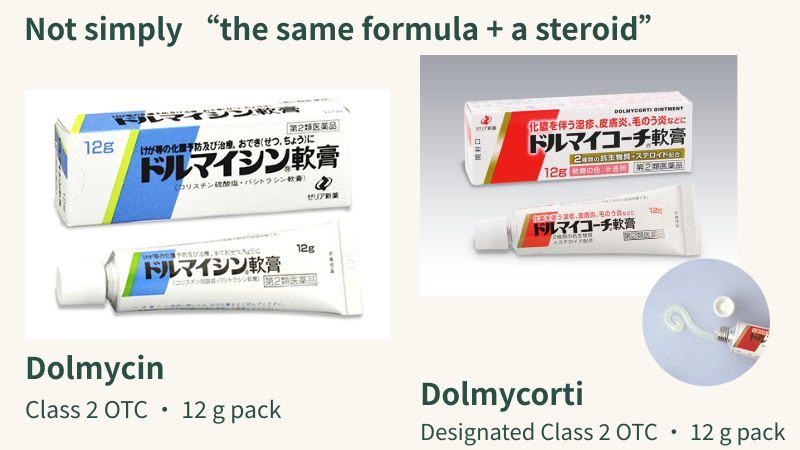
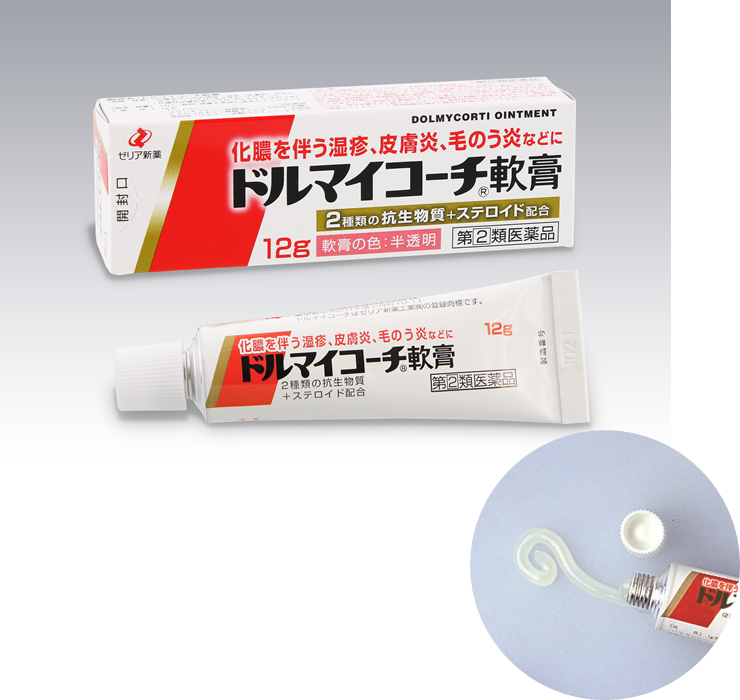
The blue-and-white Dolmycin Ointment (ドルマイシン軟膏) and red-and-gold Dolmycorti Ointment (ドルマイコーチ軟膏) have similar names. The useful question is not simply which is “stronger”: their antibiotic combinations differ too. Dolmycorti is not the unchanged Dolmycin formula with a steroid added.
This guide explains the labels of two current Japanese products, not how to diagnose an infection from its appearance or select an antibiotic yourself. Neither product may be used on deep wounds, severe burns, or severely weeping or eroded areas. If you do not know what the skin problem is, describe its location, symptoms and your medicines to a doctor or pharmacist before choosing a box.
- Read the complete name, not just the shared brand
- Shared bacitracin, but a different second antibiotic
- The qualifying words in the indications matter
- Check shared restrictions and product-specific ones separately
- Per-gram composition is not the amount for one application
- Five to six days is not a waiting period for adverse reactions
- Better questions to take to the pharmacy
- Official sources and the scope of this check
Read the complete name, not just the shared brand
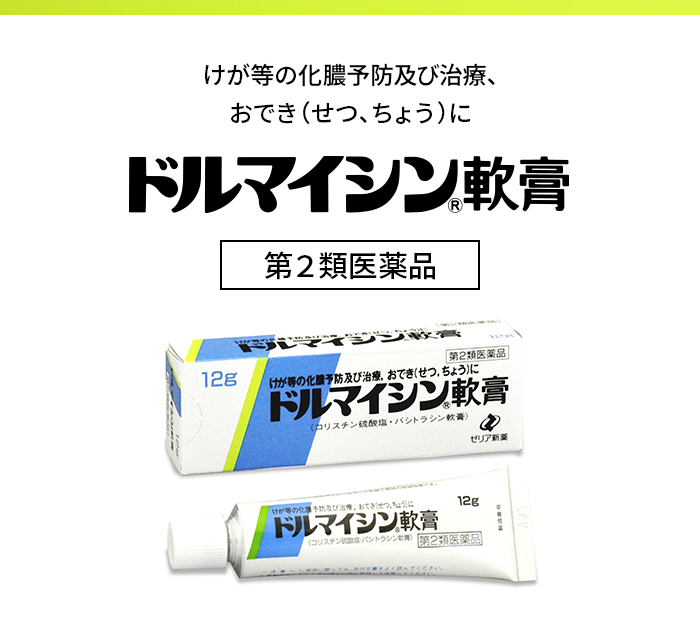
Dolmycin is a Class 2 OTC medicine; Dolmycorti is a Designated Class 2 OTC medicine. Each photograph shows a 12 g packaging example, not an amount to apply or a complete list of available packs. Both are for external use, not eye ointments.
Shared bacitracin, but a different second antibiotic
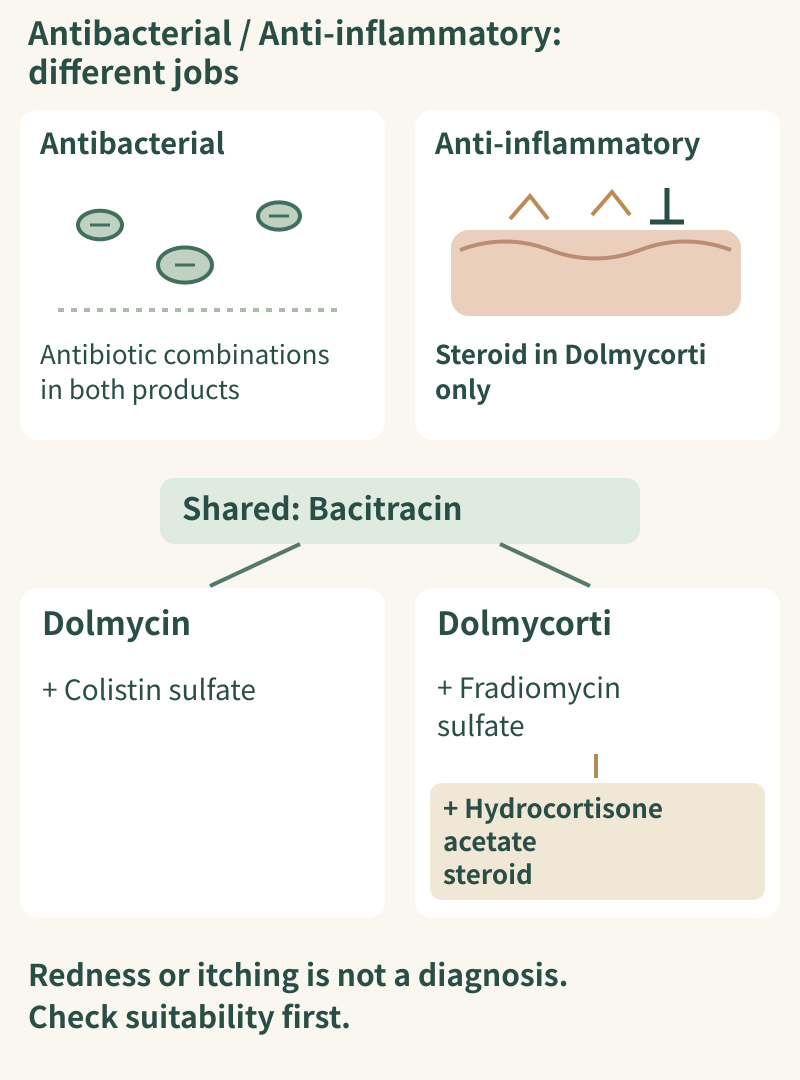
The quantities below are per 1 g of ointment, not instructions to apply 1 g each time. Units and milligrams cannot be added together or used to rank effectiveness.
| Product | Antibiotics | Steroid |
|---|---|---|
| Dolmycin | Colistin sulfate 50,000 units; bacitracin 250 units | No steroid among the listed active ingredients |
| Dolmycorti | Bacitracin 250 units; fradiomycin sulfate 3.5 mg (potency) | Hydrocortisone acetate 2.5 mg |
The antibiotics provide antibacterial action. Dolmycorti also contains a steroid that suppresses inflammation and relieves symptoms such as itching, eczema and contact dermatitis. Antibacterial and anti-inflammatory actions are different jobs. Redness or itching does not establish a bacterial infection or tell you which antibiotic to choose. This guide does not turn bacterial names into a self-treatment chart, or equate an added steroid with being universally stronger or more suitable.
The inactive ingredients also differ: both list white petrolatum and liquid paraffin; Dolmycorti additionally lists purified lanolin. Steroid-free does not mean allergy-free or unrestricted.
The qualifying words in the indications matter
Dolmycin: the leaflet lists prevention and treatment of suppuration associated with injuries and burns; impetigo, boils and related lesions, folliculitis, eczema, skin diseases caused by single or mixed Gram-positive and Gram-negative bacterial infections, suppurative conditions, infectious dermatitis and skin ulcers. These are label indications, not instructions to identify bacteria or manage an ulcer yourself. Deep wounds and severe burns remain prohibited. Its approved prevention of suppuration should not be expanded into routine daily use on uninjured skin.
Dolmycorti: its indications include eczema, dermatitis, heat rash, contact dermatitis, chilblains, insect bites and hives accompanied by suppuration, plus suppurative skin diseases such as impetigo, facial boils and folliculitis. Do not drop that qualifier or treat it as an all-purpose medicine for every itch or rash. An unclear skin problem calls for advice, not trying the two products in succession.
Check shared restrictions and product-specific ones separately
Do not use either product if you have previously had an allergic reaction to it or an ingredient, or on severely weeping or eroded areas, deep wounds or severe burns.
Before using either, consult a doctor, pharmacist or registered sales clerk if you are receiving medical treatment, have had allergic symptoms from medicines or other substances, have an extensive affected area, or have lesions on mucous membranes such as inside the nose. A consultation warning is not permission to apply it inside the nose yourself.
Dolmycorti has additional restrictions: do not use on chickenpox, athlete’s foot, ringworm or similar fungal conditions; do not apply over extensive areas of the face or use continuously for a prolonged period. Consult first if pregnant or possibly pregnant. These are this product’s specific leaflet conditions. The absence of the same sentence from the other leaflet does not establish that the other product is an appropriate substitute.
Per-gram composition is not the amount for one application
Dolmycin is normally applied in an appropriate amount one to three times daily, directly to the affected area or on gauze. Dolmycorti is applied in an appropriate amount once to several times daily. Do not transfer one product’s frequency to the other or increase the amount because the tube contains 12 g or the composition table uses a 1 g basis. If an appropriate amount for your location or area is unclear, show the actual product to a professional. This guide does not provide methods for occlusive covering, mixing or layering other ointments.
Follow the directions. Children must use either product under a parent’s or guardian’s guidance and supervision. The current leaflets do not state a numerical minimum age; that is not a guarantee of suitability for every baby or child. Use externally only and avoid the eyes. If it enters an eye, rinse immediately with water or lukewarm water; seek ophthalmic care if symptoms are severe.
Dolmycorti additionally warns that its oily base can weaken or damage latex contraceptive products, including condoms: avoid contact with them. This material-compatibility warning is not permission to use it on genital areas.
Five to six days is not a waiting period for adverse reactions
For either product, stop immediately and consult a doctor, pharmacist or registered sales clerk with the leaflet if a rash, redness, itching or contact dermatitis develops. Dolmycorti also lists athlete’s foot/ringworm, acne, suppurative symptoms or persistent irritation at the application site as reasons to stop and consult immediately.
Rare but serious anaphylaxis requires immediate medical attention. Signs soon after use can include itchy skin, hives, hoarseness, sneezing, an itchy throat, breathing difficulty, palpitations or clouded consciousness. Do not wait five to six days.
If symptoms do not improve after five to six days of use, stop either product and consult with the leaflet. This is a non-improvement stopping point, not a course you must complete and not permission for prolonged Dolmycorti use.
Better questions to take to the pharmacy
Prepare the location and extent of the problem, how long it has been present, any weeping or pus, current medicines, allergy history and pregnancy status. Ask whether self-care is appropriate before matching the complete product name. Do not mix the products or assume they are freely interchangeable.
Keep either product tightly closed in a cool place away from direct sunlight and out of children’s reach. Do not transfer it to another container or use it after expiry. For the different role of a general antiseptic ointment, see the Oronine guide; its directions are not substitutes for these antibiotic products’ instructions.
Official sources and the scope of this check
Current official links checked on November 2, 2026. Both leaflets are marked revised September 2012, not newly revised in 2026. This guide does not guarantee shop stock or identical packaging across every batch.