Japanese manufacturer information checked 5 November 2026. This guide covers Kobayashi’s ギュラック 10-tablet pack. It explains purchase and label conditions, not a diagnosis or an individual recommendation.
The word “diarrhoea” on a Japanese medicine box does not tell you whether it suits a sudden stomach upset on holiday. Gyurakku (ギュラック) is restricted to people previously diagnosed and treated by a doctor for irritable bowel syndrome (IBS), for eligible recurrent symptoms. A first episode, food-related illness or diarrhoea that seems linked to stress does not establish eligibility.
Before buying, two questions matter particularly: are these the same symptoms as at the previous diagnosis, and can the tablet be swallowed whole with about 180mL of water? Here is how those conditions fit with the exclusions and treatment limits.

I’m Irene, a Japan-licensed pharmacist from Taiwan working in a Japanese drugstore. Let’s check Gyurakku’s recurrence requirements, whole-tablet water rule and stopping points, rather than treating it as a general diarrhoea medicine to pack for a trip.
Match the full Japanese nameギュラック
Pack size 10 tablets
Japanese classification Pharmacist guidance required
Manufacturer Kobayashi
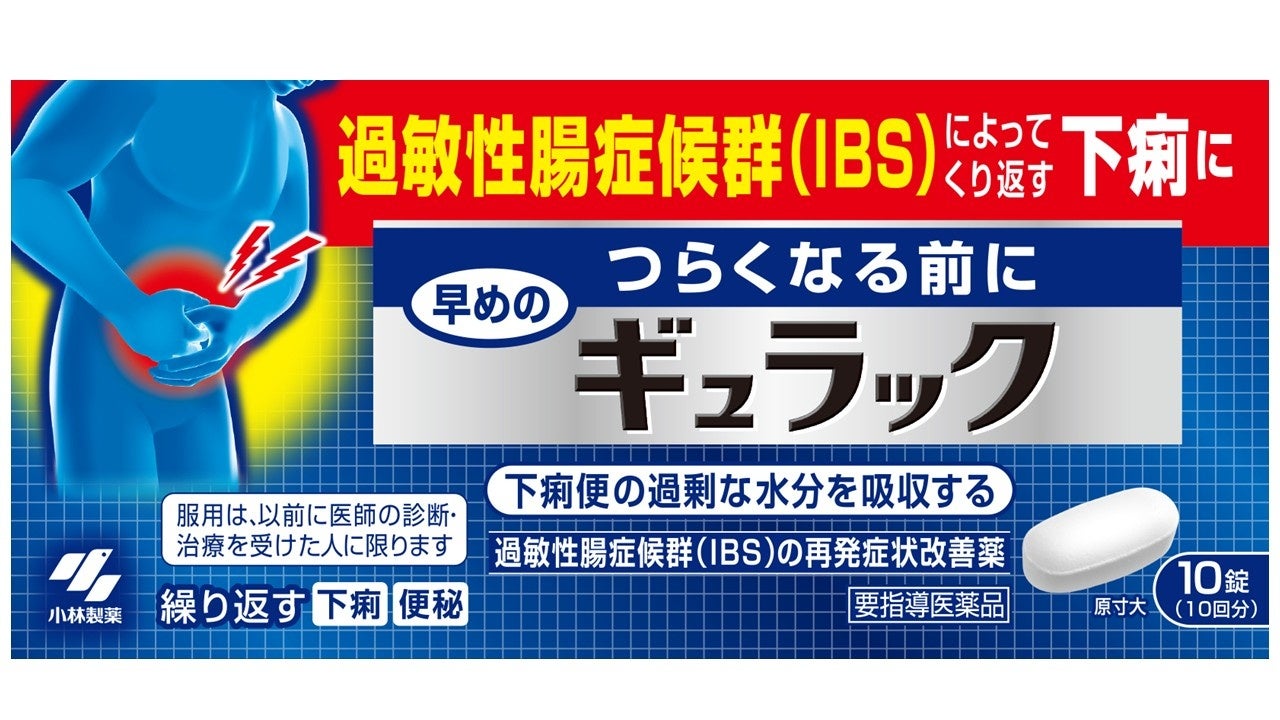
The official package image above helps identify the ギュラック 10-tablet pack. The word “diarrhoea” on the box does not mean it suits every episode or may be taken preventively. Previous diagnosis and treatment, current symptoms and all use conditions still need to be checked with the pharmacist before purchase.
- Why a previous diagnosis is only the first check
- Why both diarrhoea and constipation appear on the label
- One whole tablet after meals with about 180mL of water
- When the label says not to take it
- Who must consult before taking it
- Medicine combinations need more than a timing adjustment
- Stop if unimproved at two weeks; four weeks is the maximum
- Bring your treatment history and medicine list
- Official sources and diagram notes
Why a previous diagnosis is only the first check
The labelled indication is relief of recurring or alternating diarrhoea and constipation accompanied by abdominal pain or discomfort in IBS, limited to people previously diagnosed and treated by a doctor. Suspecting IBS is not enough.
The manufacturer’s purchase checklist asks for the date and hospital or clinic of the previous consultation, then whether the current symptoms match those at the previous diagnosis. If symptoms differ, you are unsure this is a recurrence, or too much time has passed to tell, do not take it; seek medical assessment again. Conditions including colorectal cancer and inflammatory bowel disease can cause similar symptoms.
The checklist also directs people who have repeatedly used Gyurakku or other IBS medicines over a prolonged period not to take this product and to see a doctor for diagnosis and treatment. Buying another pack or changing brands does not reset that condition.
Why both diarrhoea and constipation appear on the label
The active ingredient is calcium polycarbophil (ポリカルボフィルカルシウム): 500mg per tablet, or 1500mg in the labelled daily three tablets, expressed as dry substance. This is not 1500mg of elemental calcium.
The manufacturer explains that calcium separates in the stomach; polycarbophil then absorbs and retains water, forms a gel and expands in the intestine. It takes up excess water in diarrhoea and helps soften and increase stool volume in constipation. This explains the two bowel patterns in the indication; it does not make the product suitable for every episode of diarrhoea or ordinary constipation. The user guide describes a gradual effect with continued use, not immediate rescue relief, a tablet after each loose stool or preventive use before travel.
One whole tablet after meals with about 180mL of water
For people meeting the other conditions, ages 15–74: one tablet three times daily after meals, with water. The manufacturer explains “after meals” as within about 30 minutes of finishing a meal. Under-15s and people aged 75 or over must not take it; people aged 50 or over must also consult a doctor or pharmacist beforehand.
Only for eligible people aged 15–74
Swallow whole Do not split or crush
3 times daily, after meals Within about 30 minutes of finishing
Water only No medication jelly or thickener
- Use one glass, about 180mL, of water with each dose. Swallow the tablet whole; do not split or crush it. Do not use swallowing aids such as medication jelly or thickeners.
- Do not swallow it at the same time as tablet or capsule supplements. The manufacturer also says not to take it with anything other than water, including milk or yoghurt.
- The whole-tablet and water requirements help reduce the risk of expansion and lodging in the throat or oesophagus. The manufacturer also explains that calcium-rich dairy products may reduce the effect by allowing the ingredient to bind to calcium again. People with difficulty swallowing must not take it. Cutting it up, crushing it or adding jelly is not a workaround.
- Remove the tablet from its blister before swallowing; never swallow the packaging. Skip a missed dose and take the normal single dose next time, not two doses together.
The official user guide describes a white film-coated tablet measuring 17.8 × 7.6 × 5.9mm. These dimensions help with identification and discussing swallowing concerns; they are not instructions for dividing it. Tell the pharmacist if you cannot follow the whole-tablet and water requirements.
Discuss swallowing concerns using the official dimensions
Length 17.8 mm
Width 7.6 mm
Thickness 5.9 mm
This is a dimensions summary, not a depiction of the tablet or a life-size guide. Source: official user guide, PDF page 8 (printed page 6). Take the tablet whole with about 180mL of water; do not split or crush it. People with difficulty swallowing must not take it.
When the label says not to take it
In addition to the diagnosis, recurrence, swallowing and age exclusions above, the current leaflet lists:
- Symptoms: a need to pass stool or abdominal pain at night, including during sleep; fever; joint pain; bloody, mucus-containing stools or rectal bleeding; recurring severe diarrhoea; acute severe diarrhoea; abdominal pain not relieved by passing stool; vomiting; or unexpected weight loss of 3kg or more within six months.
- Medical history: colorectal cancer or inflammatory bowel disease, including Crohn’s disease and ulcerative colitis.
- Possible obstruction after open abdominal surgery: a history of that surgery together with severe abdominal pain, inability to pass gas, or marked constipation with abdominal distension.
- Current treatment for: an acute abdominal condition such as appendicitis, intestinal bleeding or ulcerative colitis; high blood calcium; kidney stones; or kidney failure, excluding people on dialysis from this particular item. Dialysis requires prior consultation, not automatic permission to use it.
- A previous allergic reaction to this product or its ingredients.
These exclusions call for medical assessment, not an assumption that every new symptom is part of previously diagnosed IBS.
Who must consult before taking it
The leaflet’s prior-consultation group includes people receiving medical treatment; those pregnant or possibly pregnant; anyone aged 50 or over; people with anaemia; a history of allergy to medicines or other substances; diagnosed diabetes, thyroid dysfunction or hyperparathyroidism; a tendency to high blood calcium, such as from excess vitamin D; absent or reduced stomach acid, or suspected low acid; a family history of colorectal cancer or inflammatory bowel disease; severe abdominal pain or constipation; and people on dialysis.
The current leaflet places pregnancy under prior consultation. That is not a statement of pregnancy safety. If breastfeeding, ask a doctor or pharmacist before considering this medicine; this guide does not establish its suitability. Consultation language does not override the explicit “do not take” conditions.
Medicine combinations need more than a timing adjustment
While taking Gyurakku, the label prohibits taking: other medicines for IBS symptoms, activated vitamin D preparations, calcium medicines, cardiac glycosides, antibiotics, proton pump inhibitors (PPIs), H2 blockers, and medicines containing antacids.
Label examples include trimebutine maleate, alfacalcidol, calcium lactate, digoxin, tetracycline or norfloxacin, omeprazole, famotidine or ranitidine, and aluminium hydroxide gel or magnesium hydroxide. These are examples, not an exhaustive list of medicine names. Show the pharmacist all prescriptions, non-prescription medicines and supplements. Do not stop prescribed treatment to make room for Gyurakku, or assume that spacing doses by a few hours makes a prohibited combination acceptable.
Stop if unimproved at two weeks; four weeks is the maximum
- No improvement after two weeks: stop taking it and bring the leaflet to a doctor or pharmacist.
- Even with improvement: take it for no more than four weeks. Do not use it continuously long term or treat successive courses as an exception to the prolonged, repeated-use referral above.
- Possible adverse effects after taking it: stop immediately and bring the leaflet to a doctor or pharmacist. Do not wait for the two-week point.
The listed symptoms are rash or itching; nausea, vomiting, dry mouth, abdominal bloating, diarrhoea, constipation, abdominal pain or rumbling; general tiredness, yellow skin or yellow whites of the eyes; swelling, blood or protein in the urine, headache, sudden high fever, chills or sore throat. Although the user guide mentions possible early bloating, it instructs users to stop immediately and seek medical care if bloating worsens with continued use or other abnormalities occur. Do not dismiss every change as an adjustment to treatment.
Bring your treatment history and medicine list
Gyurakku is classified in Japan as 要指導医薬品, a pharmacist-guidance-required medicine. This category is not the same as prescription-only medicine. The purchase discussion needs to cover previous diagnosis and treatment, current symptoms, exclusions and other medicines, rather than just matching the box.
If your earlier care was outside Japan, give the pharmacist your treatment information and ask what is needed. This guide does not establish whether an overseas diagnosis satisfies the purchase requirements or whether a medical certificate is required. Ask the supplying pharmacist about purchase arrangements and availability.
Keep the medicine in a cool, dry place away from direct sunlight and children. Do not transfer it to another container or use it after expiry. Read the full leaflet before use; the summaries and diagrams in this guide cannot replace it.